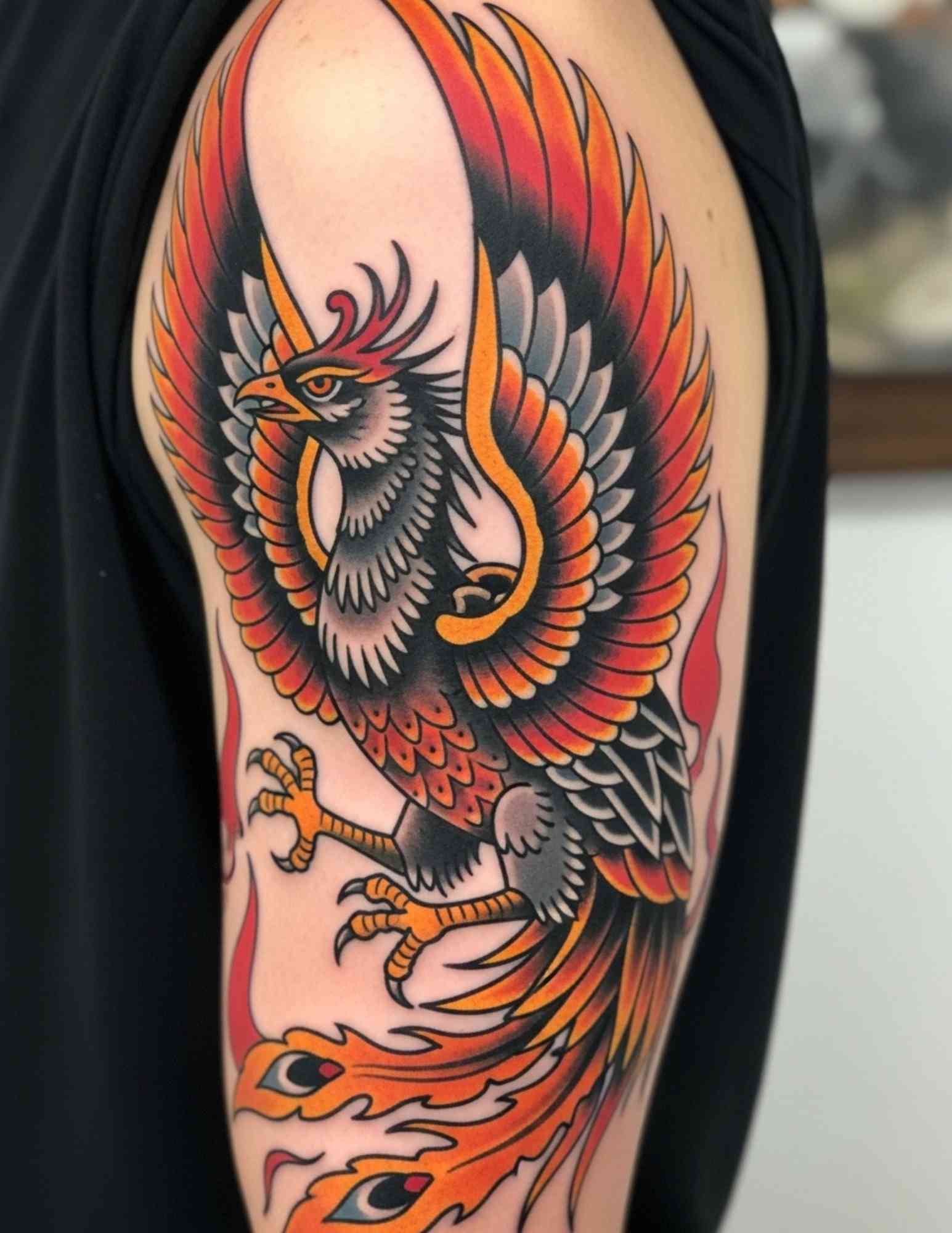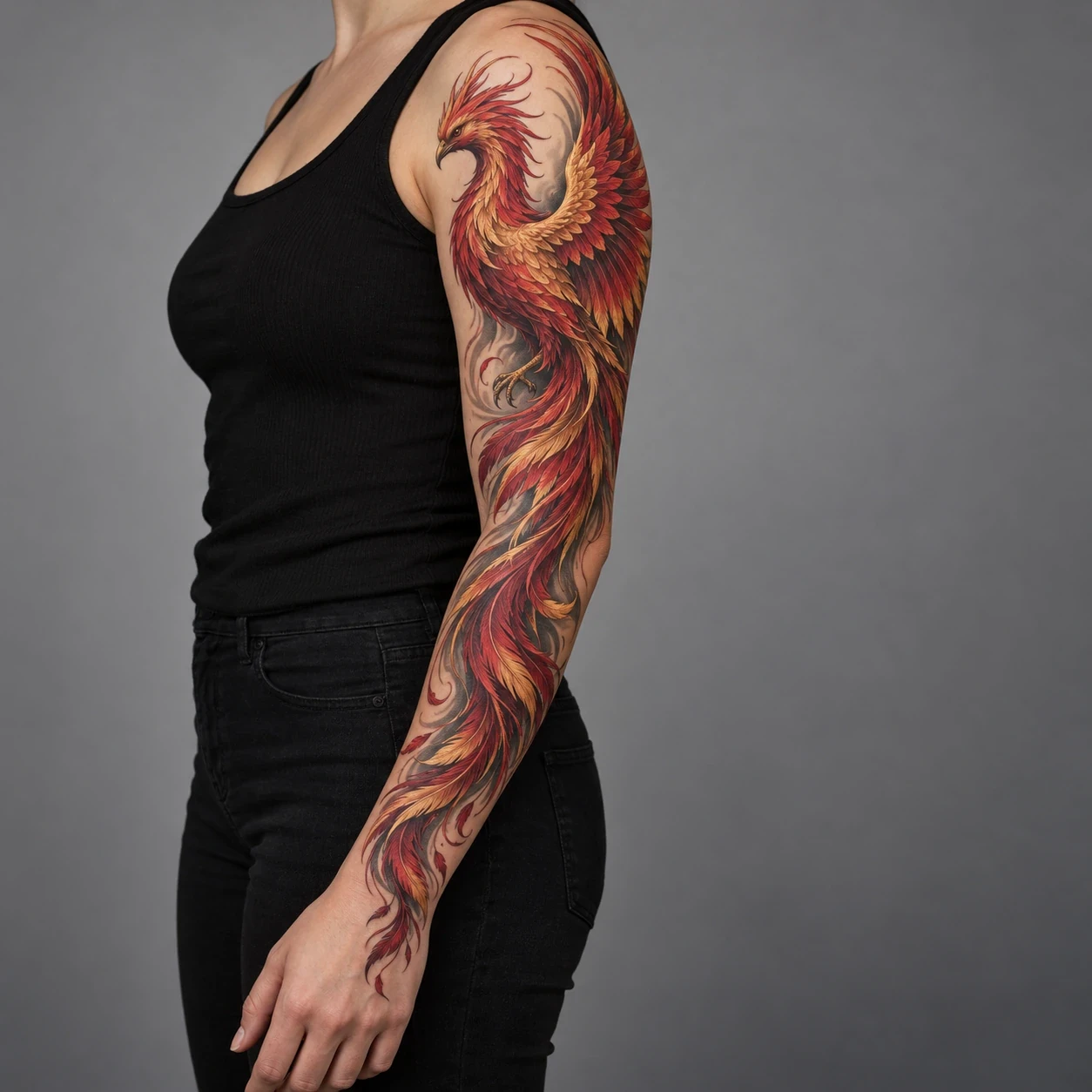
Full sleeve phoenix tattoo designs need a plan for the whole arm: where the bird’s head sits, how the wings cross the shoulder and upper arm, and how the tail continues toward the wrist. Choosing the bird alone leaves the most important layout questions unanswered.
These 16 original concepts compare feather styles, colour, open space and supporting elements. Most are flat design illustrations so you can see the entire composition. Their broad wings and tapered tails are starting points for an artist to reshape around your arm, not measured wrap templates.
Image disclosure: All images are AI-generated concepts. The hero is a generated placement mockup; the 16 design illustrations are not real or healed tattoos, historical designs or ready-to-use stencils. An artist needs to redraw, size and fit the final piece to your body.
Plan the bird and the sleeve together
Begin with the silhouette. A broad pair of wings creates a different upper-arm layout from a narrow bird with a long tail. Decide which feature should be visible from the outside of the arm, then ask the artist how the rest of the drawing will continue around the inner arm and elbow.
For other placements, browse our broader phoenix tattoo ideas. This collection concentrates on a continuous sleeve brief. The concepts are original fantasy-bird arrangements; they are not presented as accurate representations of a particular culture’s sacred or traditional bird.
| Part of the sleeve | What to decide | What to check in the drawing |
|---|---|---|
| Shoulder and upper arm | Head position and wing spread | One readable head and clearly attached wings |
| Elbow area | How the composition changes direction | Feathers, background and open gaps remain distinct |
| Forearm | Tail direction and supporting subjects | The tail belongs to the same bird |
| Wrist boundary | Soft taper, clear stop or planned hand extension | The ending is intentional from every view |
1. Red and gold feather groups
Red and warm gold divide the wings and tail into visible groups. The bird occupies the broad upper section, while the tail narrows through the lower composition. The colour contrast supplies much of the visual movement without a separate background scene.
Ask the artist how those large wing shapes would wrap the upper arm. Keep a clear boundary between one feather group and the next before adding smaller marks. Gold here describes an ochre colour choice, not reflective metallic ink or a guaranteed appearance on skin.
2. Black and grey layered feathers
Shaded feather layers give this version a softer tonal structure. Dark wing edges and lighter inner feathers keep the upper body distinct, while the long tail continues the same drawing language below. Small cloud-like accents sit behind the bird rather than replacing its outline.
Compare the lightest and darkest areas at the size you intend. Ask the artist which feather divisions should remain prominent and which could be simplified. A detailed paper illustration needs editing for your arm; it should not be treated as a command to reproduce every tiny mark.
3. A bold blackwork phoenix
Solid black feather shapes alternate with broad open gaps. The face and wings read through the silhouette, with much less reliance on soft grey shading. The narrow lower section uses the same black-and-open rhythm as the broader upper part.
Discuss the amount of black coverage before choosing this direction. Ask for a clear view of the untouched spaces as well as the inked areas. If the head disappears when you look at the drawing from farther away, simplify the surrounding shapes before adding more detail.
4. An open-outline sleeve
This phoenix uses contours and open feather shapes instead of dense fill. The wings remain broad, and the tail supplies a loose downward sweep. It is a comparatively airy drawing, even though the subject still extends through a full-sleeve layout.
Ask the artist to choose a workable line weight and spacing for the actual size. Open drawing does not mean every feather needs its own delicate outline. Decide where the gaps should remain before adding shading simply because an area looks empty on paper.
5. Dotwork shading through the feathers
Stippled dots build the darker wing sections and the long tail. The texture is visibly different from a smooth grey wash, while the main feather groups remain connected to one bird. Open areas around the neck help the head stay separate from the raised wings.
Review healed dotwork in the artist’s portfolio at a comparable scale. Ask how much texture the sleeve needs and which areas could remain simpler. The dots should describe the bird’s form rather than turn every part of the arm into an equally busy surface.
6. Angular feather panels
Straight edges and dark facets turn the feathers into graphic panels. The head, wings and tail still belong to a recognizable bird, but their construction is deliberately angular. It is a useful contrast to the flowing curves in the other concepts.
An arm is curved, so the flat geometry needs to be tested on the body. Ask which lines should remain visually continuous from one view and which can turn out of sight. Keep the major feather groups readable before subdividing them into more triangles.
7. Blue and coral colour washes
Black contours hold the phoenix together while blue and coral washes move through the feathers and nearby space. The softer colour edges give the design a painterly appearance. The outline remains useful because it distinguishes the bird from the surrounding washes.
Decide how much of that loose background you want on skin. Ask the artist to compare the bird without the washes first, then add only the areas that support the composition. A generated wash is a visual suggestion, not a prediction of how tattoo pigment will behave.
8. Gold and teal neo-traditional colour
Dark outlines separate broad gold, teal and red feather groups. The colours change the character of the phoenix while preserving a clear head and extended wings. The tail repeats the same palette so the lower section feels connected to the upper subject.
Choose the dominant colour before adjusting small accents. Ask the artist how they would adapt the palette to their style and your skin tone, using their healed work as a reference. You can keep the broad shapes and reduce the number of colours if that better suits your brief.
9. A curving ornamental frame
Long botanical curves frame the wings and follow the tail. The bird stays central, with the ornament giving the overall drawing a more deliberate boundary. The curves are decorative rather than a claim to a particular sacred pattern.
Keep the distinction between feather tips and ornamental stems clear. Ask the artist to identify which curls are necessary to the layout and which can be removed. On the inner arm, a few well-placed curves may be more useful than copying every flourish from the flat illustration.
10. A red phoenix with broad flames
Orange and ochre flames run beside the red tail and continue toward the lower end. The fire is a separate supporting shape, rather than an extra set of feathers. Strong colour areas give this version a more graphic appearance than the grey-shaded concepts.
Ask the artist where the flame shapes should stop and how they will remain distinct from the bird. If the entire lower arm becomes a similar field of pointed shapes, remove some flames or increase the open gaps. The phoenix should remain identifiable without a caption.
11. A phoenix with open smoke ribbons
Grey smoke curves around the long tail, leaving visible gaps between the background and feathers. The smoke provides a second kind of movement without adding another animal or object. Its broad curves contrast with the more detailed feather edges.
Ask the artist to plan the smoke around the whole arm, including the parts that turn away from the main view. Keep enough separation around the head and body. Extra smoke should solve a composition problem rather than fill every undecided space.
12. A phoenix with pink peonies
Two large pink blooms interrupt the long red-and-gold tail. The flowers create rounded areas within a design otherwise dominated by pointed feathers. Green leaves introduce a limited third shape without turning the sleeve into a dense garden.
Choose whether the bird or the flowers should dominate. Ask where the larger bloom would sit once the design is wrapped, especially relative to the elbow. Our full-sleeve flower ideas offer more ways to compare floral density before adding further blossoms.
13. A phoenix above one open lotus
One broad lotus flower gives the black-and-grey composition a clear lower focal point. The bird sits above it, while the tail continues around and below the petals. The flower and feathers share shading, but their outlines remain different.
Discuss the flower’s size and position before refining individual petals. It should not conceal an unresolved connection between the body and tail. Choose the lotus for your own brief and context; the illustration does not assign a single religious or personal meaning to everyone who uses it.
14. An indigo phoenix with a crescent
A dark blue phoenix sits beneath a crescent moon with a few star accents. The restrained palette provides an alternative to warm fire colours. The moon adds a separate upper shape, while the long tail keeps the lower part of the sleeve connected.
Ask whether the crescent belongs near the shoulder cap or elsewhere once the drawing is fitted. Keep small stars away from areas where they compete with the bird’s eye or crest. This is a decorative night-themed arrangement, not a constellation map or an astronomical claim.
15. Rust feathers with autumn leaves
Rust and gold feather groups carry the main design, with red maple leaves scattered along the lower section. The leaves add smaller separate shapes around the tail. Their placement makes the lower sleeve different from a continuous mass of feathers.
Ask the artist how many leaf accents the composition actually needs. Keep their edges distinct from the tail and avoid distributing them evenly just to fill space. This is an original decorative fantasy design, not a claim to a historically prescribed combination of motifs.
16. Light feathers against broken black panels
The phoenix is described by light feather shapes against dark background sections. Open breaks divide those panels and prevent the whole composition from becoming one uninterrupted block. This reverses the emphasis of the other blackwork concept, where the bird itself supplies most of the black.
Treat the light areas as a plan for open skin, not a promise that white ink will reproduce ivory paper. Ask the artist to show the negative-space drawing clearly and explain how the panels would wrap. Agree on the amount of dark coverage before committing to the background.
Fit the shoulder, elbow and wrist as one design
A complete sleeve needs more than one attractive side view. Ask the artist to show how the composition continues around the arm, including the inner upper arm, back of the elbow and inner forearm. The two wings may need different shapes or positions once the design is wrapped.
Set the main viewing angle
Decide where you want the head to be most visible. That decision affects which wing faces outward and where the tail begins to turn. Bring a few photographs of your arm in a relaxed position instead of relying only on a flat drawing.
Resolve the elbow transition
Ask which part of the drawing should cross the elbow area. A long tail, broad background curve or open gap each creates a different transition. Review the proposed stencil with the arm relaxed and bent, and let the artist adjust the drawing to your body.
Choose an ending before adding filler
The wrist can finish with a taper, a clearer boundary or a separately planned hand extension. The hero mockup shows one possible visual flow toward the hand; that extension is optional, not part of the definition of a full sleeve. Tell the artist where you want the tattoo to stop.
For a wider planning comparison, see our full-sleeve tattoo ideas. If the drawing style is still undecided, the tattoo styles guide can help you separate a shaded, outlined or graphic brief.
Turn the references into a useful artist brief
Choose a few concepts and label the part you like: the open wings, colour balance, tail route or amount of background. Combining every attractive detail can obscure the original subject. Give the artist a clear priority and room to redraw the composition in their own hand.
A useful brief might be: “One black-and-grey phoenix, head on the outer upper arm, long tail through the forearm, open skin between the feathers and no extra subjects.” A colour brief could specify two main colours, a limited background and a firm wrist boundary. Both are more actionable than asking for something dramatic.
If the tattoo marks a personal change or milestone, explain that in your own words. This article compares design choices rather than assigning one universal meaning. If you want a specific cultural or religious bird, bring a reliable reference and work with an artist familiar with that tradition; these fantasy concepts do not establish that identity.
Discuss the studio’s drawing process, estimate, session plan, deposits and touch-up terms directly. Ask for healed examples of comparable work. These illustrations cannot establish a standard price, appointment count, pain score or guaranteed healed result.
Prepare for the appointments and aftercare
Ask for written instructions for the actual tattoo and discuss clothing, work and other practical arrangements with the artist. If you have an individual skin or health concern, ask a doctor or dermatologist. An inspiration article cannot assess whether tattooing is suitable for you.
For healed tattooed skin, the American Academy of Dermatology recommends broad-spectrum, water-resistant SPF 30 or higher before going outside, reapplied at least every two hours when exposed to the sun. It notes that UV light can fade some tattoo inks. Follow the artist’s fresh-tattoo instructions rather than substituting healed-skin guidance.
The AAD recommends seeing a dermatologist for a reaction or a change in tattooed skin. Source checked 20 October 2026. The generated images do not show healing stages or predict your result.
Full-sleeve phoenix tattoo questions
Can one phoenix fill a whole sleeve?
One bird can be the main subject, with wings, tail and background arranged around the arm. It does not need several additional animals to become a complete composition. Ask the artist to plan the parts that turn out of the main view.
Does a phoenix sleeve have to be red?
No. This collection includes black-and-grey, blackwork, blue, teal and warm-colour concepts. Compare the drawing structure first, then review the artist’s healed work before choosing the palette.
Can I use one of these drawings as a stencil?
Use it as a reference for an original fitted drawing. The illustrations are not measured templates and may need substantial changes to wrap your arm. Ask the artist to check the head, wing attachments, feather divisions and tail before fitting the stencil.
Should the sleeve cover the hand?
A hand extension is a separate choice. Agree on the boundary before the lower-arm drawing is finalized, whether you want the design to stop above the wrist or continue farther.
Can the sleeve be built in stages?
Discuss that with the artist while planning the whole composition. Ask which areas can make a clear temporary stopping point and how later work would connect. Get the appointment and budget expectations from the studio rather than a generated example.