An airplane tattoo works best when you decide what it is actually about before you decide what it looks like. Every good one I have seen answers a question first: a place, a person, a move, a career, a version of yourself that only existed in transit.
I have spent a long time looking at aviation ink — in studio portfolios, on forearms in airport queues, in the reference folders artists send clients before a session. The designs that hold up are rarely the most detailed ones.
They are the ones sized correctly for the body part, drawn with lines the skin can keep, and built around a symbol the wearer can still explain in ten years. That is a much lower bar than most people think, and a much harder one than it sounds.
Below are the airplane tattoo styles I keep coming back to, what each one costs you in healing and upkeep, and how to pick between them. If you want something even quieter than what you see here, the same logic applies to minimalist tattoo ideas across the board.
Which Airplane Tattoo Style Is Right for You?
This is the comparison I wish someone had handed me the first time I booked an aviation piece. Sizes are the ranges artists most often quote me, not rules.
| Style | Typical size | Ages best at | Choose it if |
|---|---|---|---|
| Minimalist / fine line | 1–2 in | Medium — thin lines soften over years | You want it small, quiet and quick |
| Silhouette | 1–3 in | Very well — solid black holds shape | You want small but permanent-looking |
| Geometric | 2–5 in | Well, if lines are not hair-thin | You like structure and symmetry |
| Vintage / traditional | 3–6 in | Excellent — built for it | You want it readable across the room |
| Clouds / scenery | 4–8 in | Good, though soft grey can fade | You want atmosphere, not just an object |
| Realism | 5 in and up | Needs the most upkeep | The specific aircraft matters to you |
What Actually Makes an Airplane Tattoo Work
Scale is the first thing. An aircraft is a wide, horizontal object, and the body offers very few wide, horizontal surfaces — which is why so many small plane tattoos end up looking cramped on a wrist and relaxed on a forearm.
Line weight is the second. Detail that is smaller than the gaps between your own pores will not stay separate forever. Ink spreads slightly under the skin as it settles, and adjacent thin lines gradually read as one.
Every experienced artist I have asked says the same thing in different words: shrink the design until it stops being readable, then go one size back up. That is your minimum.
Placement is third, and it is mostly about sun. Forearms, calves and shoulders take daily UV; inner arms, ribs and thighs do not. Two identical tattoos on those two groups will not look identical in a decade.
Meaning is last on this list but first in practice. Aviation symbols are unusually flexible — the same silhouette can mean a career, a migration, a person you fly to visit, or simply the pull of somewhere else.
Airplane Tattoo Ideas by Style
1. Minimalist Airplane Tattoos
This is where most people start, and honestly it is a reasonable place to start. A minimalist plane is a handful of strokes: fuselage, two wings, a tail.
When I tested small fine line work on my own inner forearm, the thing that surprised me was how much the placement carried the design. On the wrist it read as jewellery; two inches higher it read as a symbol.
The trade-off is upkeep. Very thin black lines soften with time — not dramatically, but enough that a hairline design at year one looks noticeably rounder at year eight. Most people find a single touch-up sorts it out.
Ask your artist for the thickest line that still looks delicate, rather than the thinnest line the machine can lay down. It is a small conversation that buys you years.
2. Vintage and Propeller Aircraft
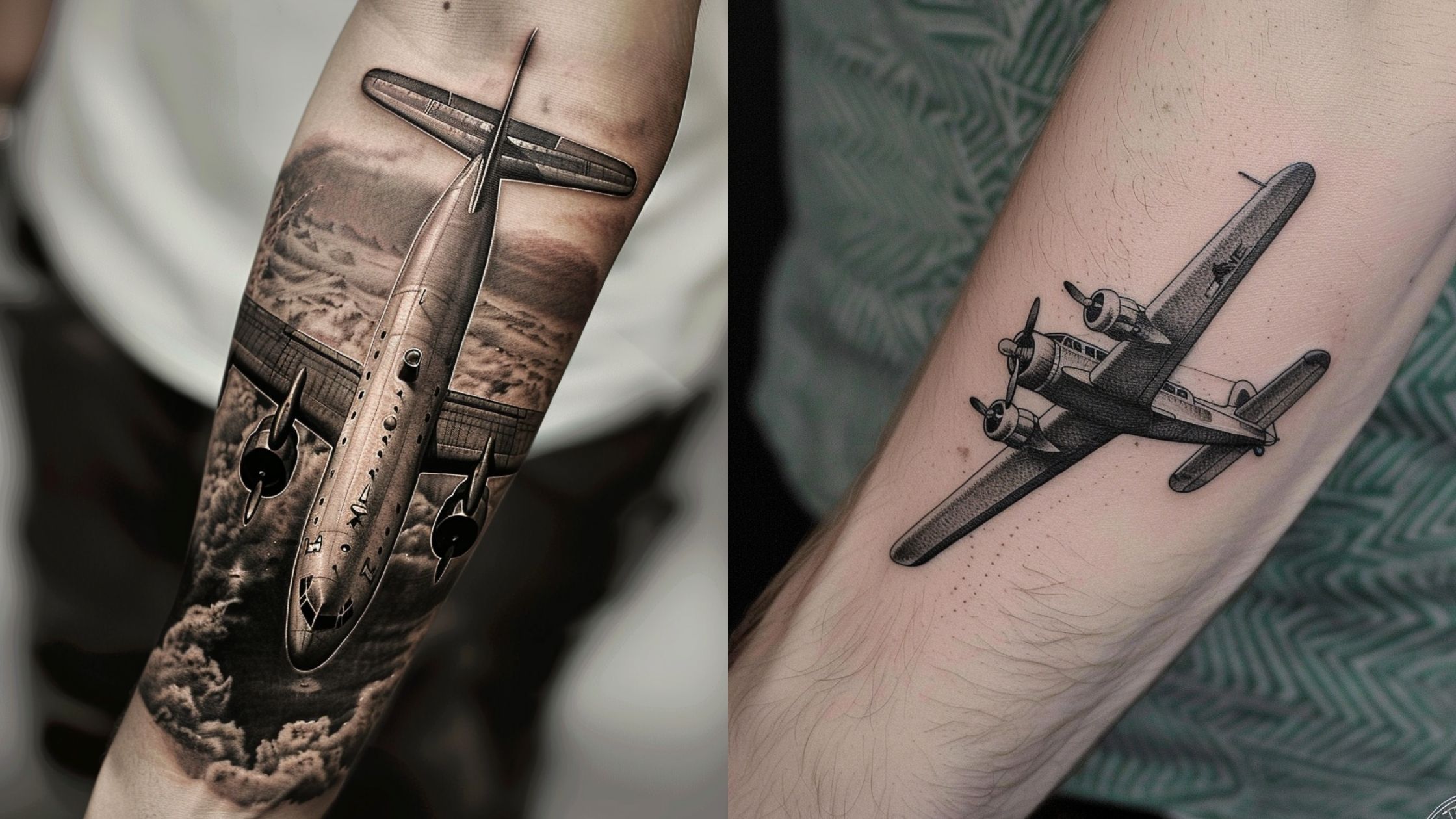
Vintage aviation designs — biplanes, warbirds, early commercial props — are the most forgiving airplane tattoos in the long run, because traditional tattooing was built around exactly this problem.
Bold outlines, limited internal detail, high contrast. Those three habits are why century-old traditional work is still legible today, and they apply just as well to a Spitfire as to a swallow.
In my experience these also age best on limbs, where the shape can follow the muscle. A biplane running along the outside of a calf sits naturally in a way it never does on a flat panel of back.
If you want the aircraft to be a specific one, bring photographs of it from more than one angle. Reference libraries like the Smithsonian National Air and Space Museum are far better sources than a single web image, and artists notice the difference.
3. Geometric Airplane Tattoos
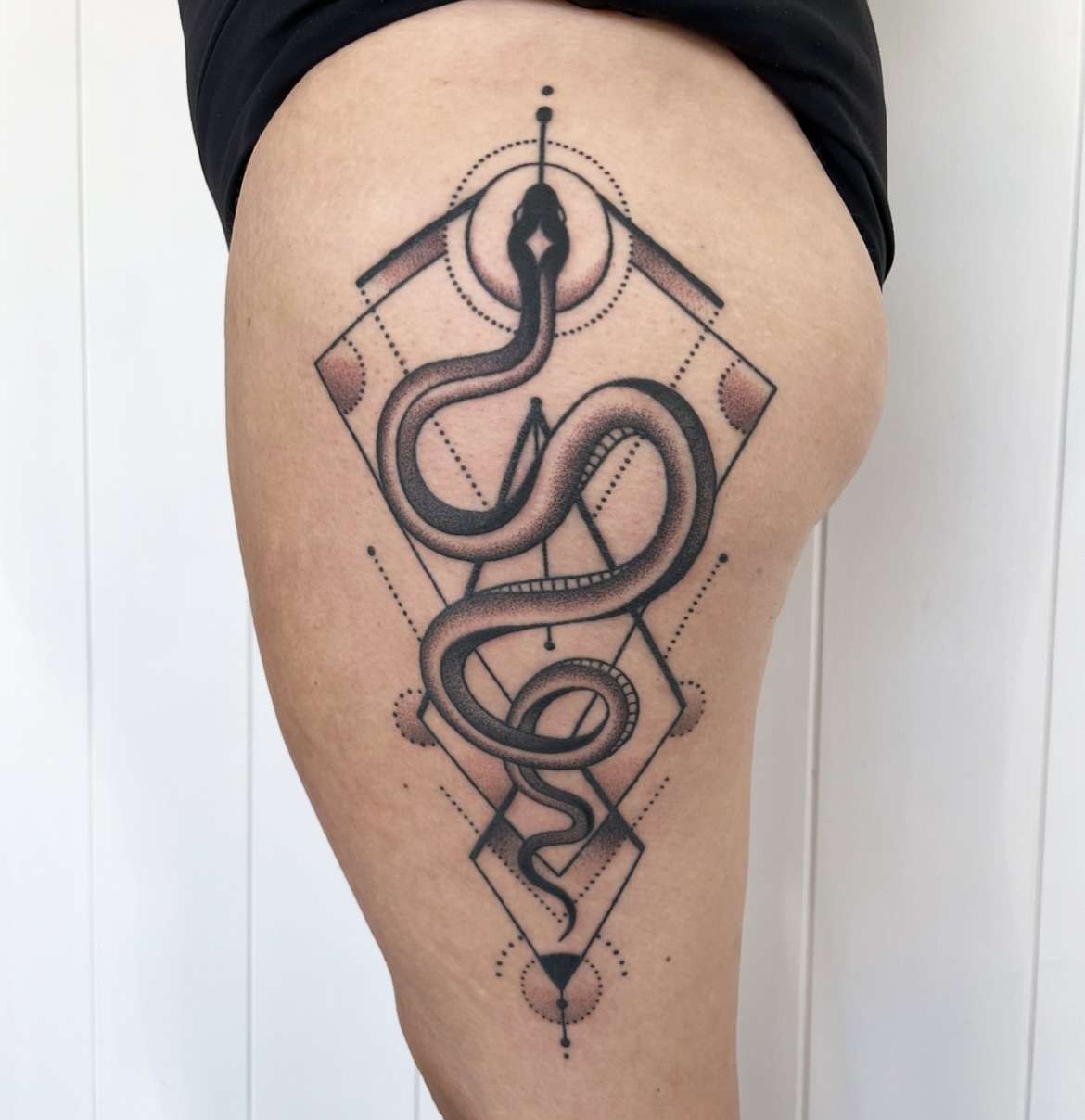
Geometric work turns the aircraft into shapes: triangles for wings, circles for the horizon, straight lines for the flight path. It suits people who like their symbolism tidy.
The honest warning here is that geometry is unforgiving. A wobble in an organic flower is character; a wobble in a straight 4-inch line is a mistake you will see every day.
So this is the one style where I would genuinely choose the artist before the design. Look through a portfolio specifically for long straight lines and clean circles, not just for planes.
Framing devices help enormously — a circle, a hexagon, a horizon band. The same structural thinking runs through most geometric tattoo designs, and it is worth borrowing.
4. Paper Airplane Tattoos
The paper plane is the softest version of this idea, and for a lot of people it is the more accurate one. It says movement and possibility rather than aviation.
I have seen it used most often for a first tattoo, for childhood memory pieces, and for people who wanted travel symbolism without a machine in it.
Practically, it is one of the easiest designs to place well. It is small, it is asymmetric, and it reads correctly at almost any angle — ankle, wrist, behind the ear, ribs.
A dashed trail behind it is the single most common addition, and the one that most often gets extended later. Ask your artist to leave the trail open-ended if you think you might add to it.
5. Airplane and Compass Combinations
Pairing a plane with a compass rose is a well-worn combination for a reason: one symbol supplies the movement, the other supplies the direction.
When I have asked people why they picked it, the answer is usually about a decision rather than a destination — a move, a career change, a point where they chose a heading.
Compositionally it also solves a real problem. A compass fills the circular space a single plane leaves empty, which is why this pairing works so well on shoulders and forearms.
If the navigational side is the part that speaks to you, it is worth reading up on compass tattoo meaning before you commit to a layout.
6. Silhouette Airplane Tattoos
A solid black silhouette is, in pure longevity terms, the most reliable small airplane tattoo you can get. There is no internal detail to blur, because there is no internal detail.
Every artist I have asked about small work eventually says some version of this: solid shapes survive, thin details negotiate. The silhouette takes the first deal.
The style suits underside placements especially well — inner forearm, inner bicep, ribs — where sun exposure is lowest and solid black stays densest.
Its limitation is expressiveness. A silhouette cannot show you a particular aircraft, only the idea of one. If the exact model matters, this is not your style.
7. Airplanes and Clouds
Adding cloud work changes the piece from an object into a scene, and it is usually what people actually wanted when they said they wanted a plane.
Soft grey wash is doing the work here. It gives depth, it hides the join between the aircraft and bare skin, and it makes a small plane feel like it is somewhere.
The caveat is that light grey shading is the first thing to fade, particularly on sun-exposed placements. In most cases you should expect the clouds to need refreshing before the linework does.
Cloud work also scales in a way silhouettes cannot — it can grow into a half sleeve later. If that appeals, look at how standalone cloud tattoo ideas are built before you plan the layout.
8. Realistic Aircraft Portraits
Realism is the right answer when the specific aircraft is the point — the one you flew, the one your grandfather serviced, the one on the wall of the hangar you grew up in.
It is also the most demanding choice on this page. Panel lines, canopy reflections and rivet detail all need physical space, which in practice means five inches minimum and often much more.
Budget for time as well as money. Larger realistic pieces are commonly split across multiple sessions, and rushing that is how you end up with an uneven heal.
Realism carries the highest touch-up expectation of any style here. That is not a reason to avoid it; it is a reason to stay with an artist you can go back to.
Variations Worth Considering
If none of the eight styles above is quite right, these adjacent directions come up constantly in consultations.
Flight paths and route lines
A dashed arc between two points, with or without an aircraft on it, is the most personal version of this tattoo. It names places without spelling them out.
People often build these from a real route they have flown. Pair it with map tattoo ideas if you want the geography to be legible to other people too.
Wings without the aircraft
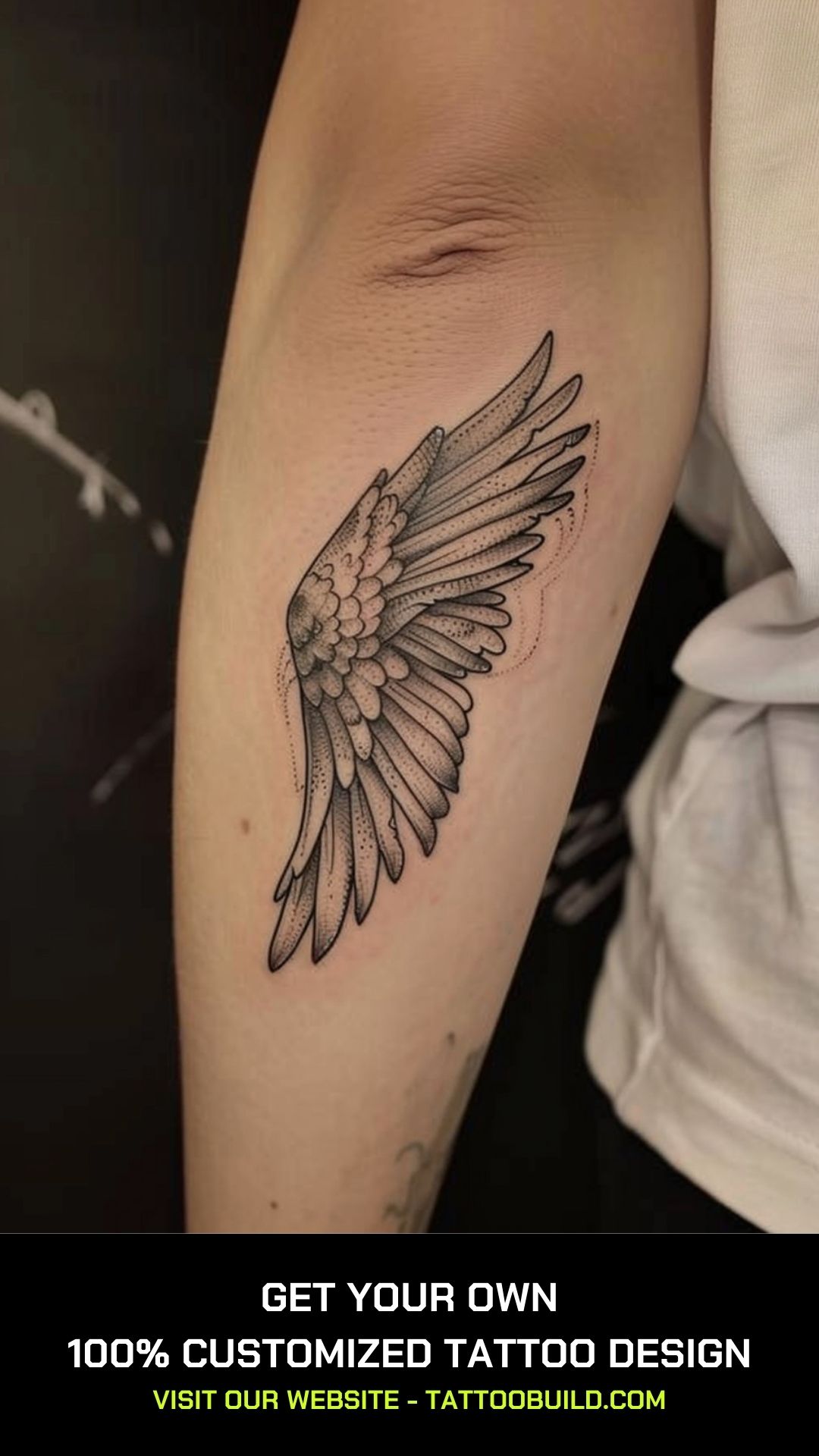
Pilot wings, insignia and feathered wings all carry aviation meaning without drawing a plane at all, and they sit more comfortably on the chest and back.
There is a large design vocabulary here already — browsing wing tattoo ideas is the fastest way to find the shape you want.
Going up instead of out
Some people discover partway through the process that what they want is not travel but distance. Rockets, satellites and orbital lines say something different.
If that lands, space tattoo ideas cover the same emotional ground with a different visual language.
Landscape context
A plane over a mountain range or a coastline anchors the design to a place. It also gives an artist somewhere to put contrast, which small aviation pieces often lack.
Both mountain tattoo ideas and ocean tattoo ideas work well as the ground layer under an aircraft.
Florals and softer framing
Wrapping a plane in botanical linework is the most common way people warm up an otherwise mechanical subject, and it fills awkward space around the wings.
It also gives a small design a reason to occupy a larger area without adding technical detail that will blur later.
Aftercare and Practical Advice
Nothing on this page is medical advice, and I am not a clinician. What follows is the general guidance artists give, and it is worth confirming with your own artist for your own skin.
Follow the aftercare instructions your studio hands you rather than a routine you found online, including this one. Products and timelines vary by artist, ink and placement, and they are the ones who saw the wound.
Sun is the long game. The American Academy of Dermatology recommends protecting healed tattoos with sunscreen, and on forearms and calves that is the single biggest factor in how a fine line plane looks a decade later.
Signs of infection or an ink reaction are a doctor’s call, not a forum’s. Spreading redness, worsening pain after the first few days, fever, or a rash that appears later all warrant real medical attention — the US Food and Drug Administration notes that reactions can appear even years after tattooing.
And never attempt DIY tattooing or at-home removal. Both carry genuine infection and scarring risk, and removal in particular belongs with a licensed professional.
Common Mistakes and How to Avoid Them
The mistake I see most often is choosing a design at a size the design cannot survive at. A gorgeous six-inch reference squeezed onto a two-inch wrist is not the same tattoo.
The second is booking on style rather than portfolio. An artist who is superb at botanical work is not automatically the right hand for a 4-inch straight line.
The third is over-explaining the symbolism inside the tattoo itself — coordinates, plus a date, plus a compass, plus a route, plus the plane. Pick two.
Still not sure which direction fits? Compare against minimalist tattoo ideas for the pared-back end of the spectrum before you commit to anything larger.
Frequently Asked Questions
How small can an airplane tattoo be?
Most artists I have spoken to put the practical floor for a recognisable plane at around one inch wide, and that is for a simple silhouette or fine line design. Below that, the wings and tail start merging as the ink settles. Detailed styles need considerably more room — usually three inches and up. The honest test is to print the design at your intended size and look at it from arm’s length.
Do airplane tattoos hurt more in certain places?
Pain varies a lot between people, but the general pattern holds: areas over bone or with thin skin tend to be sharper, and fleshier areas tend to be more tolerable. Ribs, ankles, feet and the inner bicep are commonly reported as more uncomfortable than outer arms and thighs. Session length matters as much as location — a small paper plane is over quickly wherever it goes. Tell your artist if you need a break; they would rather pause than have you go pale.
How long does an airplane tattoo take?
A small minimalist or silhouette plane is often a single short sitting, sometimes under an hour including setup and stencil. Geometric and vintage pieces at three to five inches usually run a few hours. Realistic aircraft with full shading are commonly booked across multiple sessions. Ask for a time estimate when you book, because it affects both cost and how much aftercare you are signing up for.
What does an airplane tattoo mean?
There is no fixed meaning, which is part of the appeal. The interpretations that come up most often are travel and adventure, freedom and independence, a personal journey or turning point, and a connection to aviation as a career or family history. Paper planes lean toward memory, imagination and letting go. The meaning that matters is the one you can still articulate years later.
Will a fine line airplane tattoo fade?
All tattoos change over time, and very thin lines change most visibly — they soften and thicken slightly as ink settles under the skin. Sun exposure accelerates it, which is why placement and sunscreen matter more than most people expect. Many people with fine line work get a touch-up somewhere in the first several years and are happy with it afterwards. If the idea of maintenance bothers you, a solid silhouette is the lower-effort choice.
Quick Summary
- Decide what the tattoo is about before choosing how it looks — the meaning drives the style.
- Match style to size: silhouettes and fine line for small, vintage and geometric for mid-size, realism for five inches and up.
- Solid black silhouettes age most reliably; hair-thin fine line ages the least reliably.
- Choose the artist by portfolio evidence of the specific skill you need, especially for geometric straight lines.
- Low-sun placements — inner arm, ribs, thigh — keep contrast longer than forearms and calves.
- Cloud and scenery work adds atmosphere and leaves room to expand later.
- Follow your studio’s aftercare instructions, protect healed work from the sun, and see a doctor for anything that looks like infection or a reaction.
- Never attempt DIY tattooing or at-home removal.