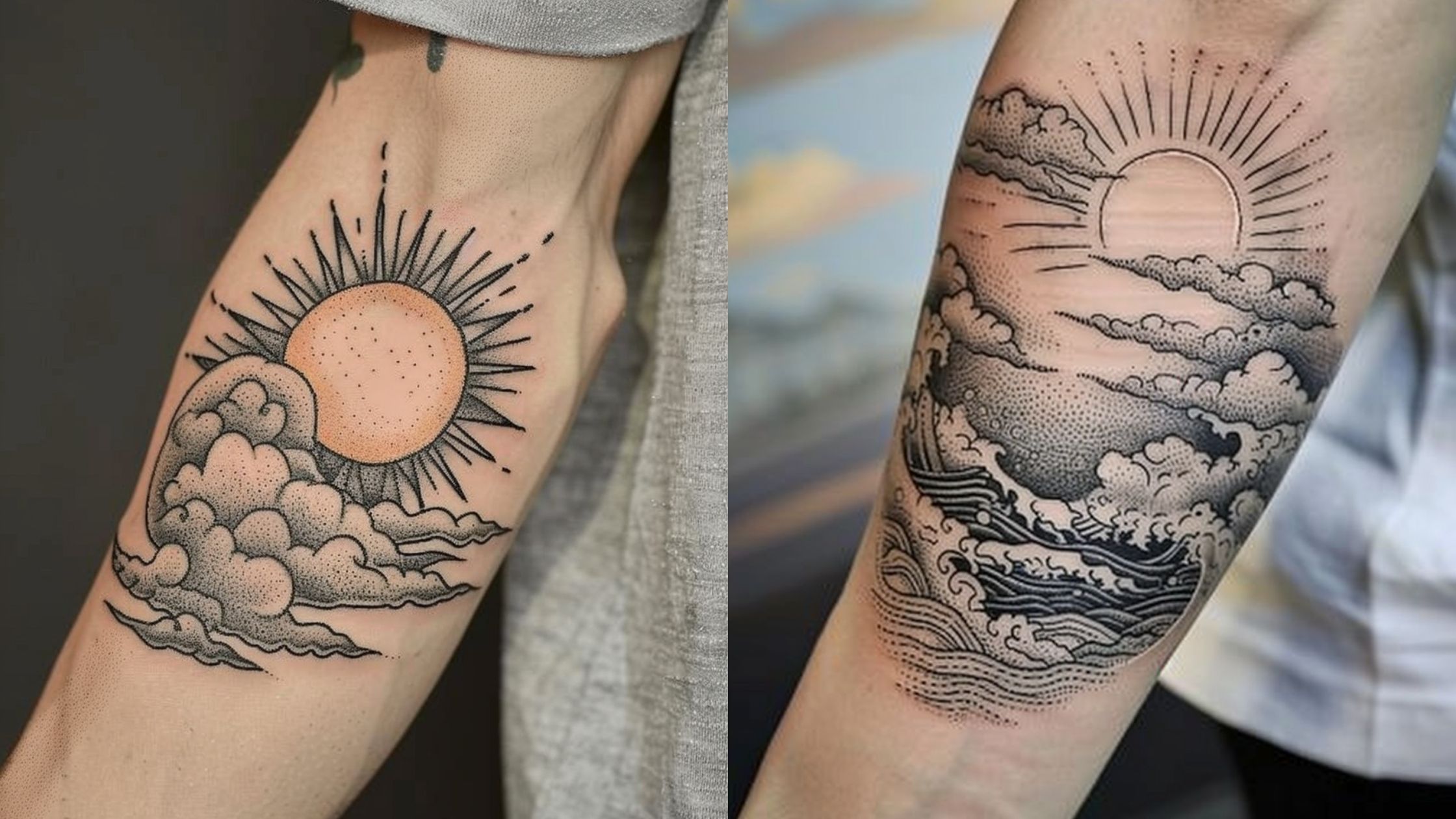
I have been sketching and researching cloud tattoo ideas for years, and the thing that surprised me most is how differently the same subject reads depending on the hand that draws it. A cloud is the rare tattoo subject that can be a five-minute wrist piece or the backbone of a full sleeve, and it looks deliberate at either extreme.
Clouds have no fixed outline, which is exactly why they work so well on skin. There is no "wrong" shape to get wrong, and the body’s curves can be used as part of the drawing instead of fought against.
In this guide I walk through the styles I see most often in portfolios, what each one actually costs you in time and healing, and where I would put it on the body. If you like understated work, the same logic applies to minimalist tattoo ideas more broadly.
Everything below comes from looking at real healed work and asking artists what they would do differently. Where I am uncertain, I say so.
Which Cloud Tattoo Style Is Right for You?
This is the comparison I sketch out for anyone who is torn between approaches. Sitting time is a rough guide only — your artist’s pace and the size you choose matter more than the style.
| Style | Best Placement | Typical Sitting | How It Ages |
|---|---|---|---|
| Realistic / soft grey | Upper arm, chest, back | 3–6 hours for a palm-sized piece | Softens noticeably; needs a touch-up eventually |
| Minimalist line | Wrist, ankle, behind the ear | Often under an hour | Thin lines can blur, especially on hands and feet |
| Japanese wind bar | Sleeve, back, thigh | Multiple sessions as part of a larger piece | Built to last — bold outlines hold for decades |
| Storm cloud | Forearm, calf, shoulder | 2–5 hours depending on detail | Dark packed areas hold well; fine rain lines fade first |
| Watercolor | Inner arm, shoulder blade | 2–4 hours | Fades fastest of the group; sun exposure is the enemy |
| Cloud as filler | Gaps in an existing sleeve | Added session by session | Depends entirely on the surrounding work |
What Cloud Tattoos Actually Mean
The honest answer is that clouds mean whatever the wearer decides, and I have heard the same design explained six different ways in one afternoon.
Still, a few themes come up again and again. Transformation is the most common — clouds change shape constantly, which makes them a natural stand-in for a period of your life that reshaped you.
Impermanence is the close second. A cloud that is there and then is not maps neatly onto grief, onto recovery, onto anything that passed.
Then there is the weather reading: storm clouds for a hard stretch you came through, breaking clouds with light behind them for the part where it got better. The most memorable cloud tattoos I have seen were the ones where the weather told a specific story rather than a general mood.
In Japanese tattooing clouds carry a more formal role, functioning as the connective tissue between the main subjects of a composition rather than as a symbol in their own right. If that tradition interests you, the wider world of ukiyo-e woodblock imagery is where those cloud conventions come from.
Popular Cloud Tattoo Designs
1. Realistic Cloud Tattoos
A realistic cloud is built out of shading, not line. The artist works almost entirely in grey wash and negative space, letting your skin tone become the bright edge of the cloud.
This is harder than it looks and not every artist can do it well. When I ask for realistic clouds I want to see healed photos, not fresh ones — soft grey work looks incredible on day one and tells the truth about the artist’s skill a year later.
It suits larger placements. A single realistic cloud smaller than your palm tends to read as a grey smudge from a few feet away, which defeats the point.
The best realistic cloud pieces I have seen were paired with a hard-edged element — a sharp horizon, a bird, a line of text — so the eye has something crisp to compare the softness against.
2. Minimalist and Fine-Line Cloud Tattoos
The minimalist version strips the cloud down to two or three curved lines. It is the cheapest and fastest cloud tattoo you can get, and it is the one I most often see people regret — not because it looks bad, but because they wanted more.
Fine-line clouds live or die on placement. On the inner forearm they hold well. On the side of a finger or the top of a foot, thin lines tend to spread and soften faster than people expect.
Rain drops underneath the cloud are the most common addition, and they give the piece a bit of movement that a bare outline lacks.
If you are drawn to this direction, it pairs naturally with other small, low-commitment work that sits comfortably on the same limb.
3. Storm Cloud Tattoos
Storm clouds are where cloud tattoos get personality. Dark packed shading, jagged edges, usually rain or lightning coming out of the bottom.
They also age better than soft clouds, because there is real black in there holding the shape together. Every artist I have asked prefers doing storm clouds over pale ones for exactly this reason.
Lightning is a design decision worth thinking about. A single bolt reads as drama; three or four bolts start to read as a weather map.
My rule of thumb: if you want the tattoo to still look sharp in fifteen years, put weight in it now.
4. Cloud and Sun Tattoos
The sun-behind-clouds combination is the most requested cloud variant I come across, and it is easy to see why: it carries an optimistic reading without needing any explanation.
Design-wise it solves a problem too. The sun gives the artist a hard geometric shape to anchor the soft cloud against, which is the same trick I mentioned in the realistic section.
Rays are where these go wrong. Long straight rays can turn a nice piece into something that looks like a corporate logo — I would ask for broken or partial rays instead.
If a celestial theme appeals to you, sun and moon tattoo ideas and moon tattoo ideas cover the same territory from a different angle.
5. Cloud and Mountain Tattoos
Mountains and clouds are a natural pairing because they solve each other’s weakness. Mountains are all hard angles; clouds are all soft edges.
The composition I see work best is clouds sitting low, cutting across the mountain rather than floating above it. It creates depth without any extra shading.
These scale well. The same design works as a two-inch forearm piece or as a full back panel, which is not true of most tattoo subjects.
For more in this direction, mountain tattoo ideas and nature tattoo ideas are worth a look.
6. Cloud and Bird Tattoos
Birds give a cloud tattoo scale. A cluster of small silhouettes tells your eye the clouds are far away and enormous, which is difficult to communicate any other way.
Keep the birds small and keep them uneven. Evenly spaced birds look printed; a loose scatter looks observed.
Swallows, swifts and gulls each carry their own baggage in tattoo tradition, so it is worth reading up on bird tattoo meanings before committing to a species.
7. Japanese Wind Bar Clouds
In traditional Japanese work, clouds are not the subject — they are the structure. They fill the space between a dragon, a koi and a set of waves and tie the whole sleeve into one image.
They are drawn with a distinct vocabulary: bold outlines, spiral curls at the edges, and consistent directional flow around the limb.
This is not something to ask a non-specialist for. The conventions are specific enough that a well-meaning artist working outside the tradition usually produces something that reads as almost-Japanese, which is worse than either option.
If you are planning a large piece, look at sleeve tattoo ideas to see how cloud work functions inside a full composition.
8. Clouds as Filler and Background
This is the most practical use of clouds and the least discussed. If you have a collection of unconnected tattoos on one arm, cloud work is the standard way to join them into something that reads as a single piece.
Grey wash clouds are especially forgiving here because they can sit over and around existing work without competing with it.
I would say this is the single most useful thing a cloud tattoo can do — it turns a scattered arm into a sleeve without covering anything you already love.
Variations Worth Considering
Color Versus Black and Grey
Most cloud tattoos are black and grey, and I think that is the right default. Grey wash is what the subject is built for.
Color works when the cloud is a sunset rather than a cloud — oranges and pinks bleeding through the shape. If you want that, watercolor tattoo ideas will show you what the style can and cannot do, including how it holds up over time.
Negative Space Clouds
Instead of tattooing the cloud, the artist tattoos the sky around it and leaves your skin as the cloud. It is striking, and it is unforgiving — the shape has to be right the first time because there is nothing to adjust afterwards.
It also requires large solid black areas, which means longer healing and more discomfort than the design’s simplicity suggests.
Clouds With Script
A short line of text running through or under a cloud is common, usually a date or a name. The failure mode is predictable: fine script inside a shaded area loses its readability faster than the cloud loses its shape.
If you want text, ask for it outside the shaded region with clear skin around it.
Placement, Sizing and Aftercare
Clouds reward placement on curved surfaces. The outer shoulder, the calf and the ribs all let the shape wrap in a way that flat areas do not.
On sizing, my honest advice is to go one step larger than your instinct. Soft shading needs room; a cloud crammed into a small space loses the gradient that makes it a cloud. The forearm is a reliable middle ground if you are unsure.
Healing for heavily shaded clouds tends to be a little more demanding than line work — more plasma, more peeling, and a longer stretch where the piece looks cloudy and dull before it settles. That is normal and usually resolves over a few weeks.
Keep it out of direct sun once healed, and use sunscreen on it long term. UV exposure is the main reason grey wash goes flat. For general guidance on tattoo risks and healing, Mayo Clinic’s overview is a solid starting point.
If you develop spreading redness, swelling that worsens after the first few days, pus, fever, or a rash that appears weeks or months later, see a doctor rather than asking online. Allergic reactions to specific pigments do happen, and the FDA’s consumer guidance on tattoo inks explains what to watch for. Nothing in this article is medical advice, and your artist and your doctor both know your situation better than a blog does.
Common Mistakes — and What to Do If You’re Still Not Sure
The most common mistake is going too small. The second is asking for a cloud with a hard black outline all the way around it, which is the one thing clouds do not have in nature.
The third is treating the cloud as an afterthought in a larger design. If the cloud is background, say so up front so the artist can plan the values — a background element that ends up as dark as the foreground flattens the whole piece.
Do not book a large shaded piece with an artist whose portfolio is all line work. Grey wash is a genuinely different skill, and most artists will tell you honestly if it is not theirs.
Still undecided? It often helps to look at neighbouring subjects before you commit — moon phase designs if you want something with more structure than a cloud offers.
Frequently Asked Questions
What does a cloud tattoo symbolize?
Most often transformation, impermanence, or a period of difficulty that passed. Storm clouds usually point to a hard stretch, while clouds with light breaking through tend to mark coming out the other side. In Japanese tattooing the meaning is different again — clouds there are largely compositional, tying the elements of a larger piece together. There is no fixed meaning, so the reading you give it is the one that counts.
Do cloud tattoos fade faster than other designs?
Soft grey wash clouds generally fade more visibly than bold line work, because there is less pigment holding the shape. Storm clouds and Japanese-style clouds with strong outlines hold up considerably better. Sun exposure is the biggest factor either way, so sunscreen on a healed piece makes a real difference. A touch-up after several years is common and not a sign anything went wrong.
Where is the best place to get a cloud tattoo?
Curved areas suit them best — the outer shoulder, upper arm, calf and ribs all let the shape wrap naturally. Forearms are a good default if you want it visible and have room for shading. I would avoid hands, fingers and feet for fine-line clouds, since thin lines blur fastest in those spots. The right answer also depends on how large you want to go, so discuss it with your artist before booking.
How much does a cloud tattoo cost?
It varies enormously by size, artist and region, so anyone quoting you a single figure is guessing. A small minimalist cloud is often a shop-minimum job; a realistic shaded piece covering the upper arm is a multi-hour session at your artist’s hourly rate. Japanese cloud work is usually priced as part of a larger project rather than on its own. Ask for a quote based on a finished design rather than a rough idea.
Can clouds be added to tattoos I already have?
Yes, and it is one of the most useful things cloud work does. Grey wash clouds can flow around existing pieces to connect them into a coherent sleeve without covering anything up. It works best when one artist plans the whole layout, even if the work happens over several sessions. Bring photos of everything you already have to the consultation.
Quick Summary
- Clouds are one of the most flexible tattoo subjects — they scale from a wrist outline to a full back piece.
- Realistic grey wash clouds look best at palm size or larger; smaller than that they read as a smudge.
- Minimalist line clouds are fast and cheap, but thin lines blur soonest on hands, fingers and feet.
- Storm clouds age the best of the softer styles because the packed black holds the shape.
- Pair clouds with a hard-edged element — a sun, a mountain ridge, a bird — to give the eye contrast.
- Japanese wind bar clouds are a specialist tradition; book an artist who works in it rather than one who will approximate it.
- Cloud work is the standard way to connect scattered tattoos into a single sleeve without covering anything.
- Keep healed grey work out of direct sun, and see a doctor rather than a forum if healing goes wrong.