A whale tattoo is not a small statement, and it should not be treated like one. These are the largest animals on the planet, creatures that navigate by sound through total darkness and communicate across entire ocean basins.
I have spent a lot of time looking at whale work, and the pieces that land all share one thing: the artist respected the animal’s scale instead of shrinking it into a cute shape.
That does not mean every whale tattoo has to be a back piece. It means the design has to decide early whether it is about size, about depth, or about family, because those three readings pull in different directions. If you are still exploring the wider category, our ocean tattoo ideas collection is a useful place to see how whales sit alongside the rest of the sea.
Below are 20 approaches, from a fine line fluke on an ankle to a full colour humpback across a thigh, with honest notes on what each one actually costs you in sessions, upkeep, and artist selection.
Which Whale Tattoo Style Is Right for You?
Style choice drives almost everything else: how long it takes, what it costs, and how it looks in ten years. Here is how the four main routes compare.
| Style | Best Size | Typical Sessions | How It Ages | Choose It If |
|---|---|---|---|---|
| Colour realism | Large (thigh, back, full arm) | Two to four | Softens; usually wants a touch-up within a decade | You want the animal, not a symbol of it |
| Blackwork and traditional | Medium to large | One to two | Best of the four; bold lines hold | You want something that still reads at 20 years |
| Fine line and minimalist | Small to medium | One, often under two hours | Thin lines spread; artist skill decides everything | You want something quiet and low commitment |
| Watercolour | Medium to large | One to three | Fades fastest; needs a structural anchor line | You want atmosphere and accept upkeep |
Why People Choose Whale Tattoos
The whale attracts a fairly specific kind of person, and the reasons people give are remarkably consistent across the artists I have spoken to.
The most common one is depth. A whale lives in the dark and must still surface to breathe, which is a ready-made metaphor for anyone who feels most themselves in their interior life but has to show up in the world anyway.
The second is family. Orcas live in matrilineal groups and humpbacks form long cooperative associations, which makes the pod composition a genuine family symbol rather than a borrowed one.
The third is simply scale. A whale tattoo says something about perspective: that the thing you are worried about is smaller than you think, or that something very large is moving underneath the surface of your life.
Very few people regret the meaning of a whale tattoo. The regrets I hear about are almost always about execution, and specifically about going too small for the style chosen.
20 Whale Tattoo Ideas
These run roughly from the most detailed to the most conceptual. Each note includes the practical catch, because every one of them has one.
1. Humpback Colour Realism
A humpback whale in full colour realism: the dark dorsal surface, the white ventral grooves, the long pectoral fins, and the barnacle crust that grows on the animal’s skin.
The barnacles are the part most people skip, and they are the part that sells it. In my experience a humpback rendered without that texture reads as a generic grey shape from three feet away.
This is a large-format idea. Thigh, back, or a full outer arm gives the animal room to keep its proportions, and the artist room to build the skin in layers rather than flattening it into one wash.
Budget multiple sessions for this one. Colour realism at this scale is usually a two to four sitting project, and rushing it in a single marathon day tends to cost you in healed detail.
2. Geometric Blue Whale
A blue whale rendered in low-polygon geometric style: the vast smooth form of the largest animal known to have lived, rebuilt in angular planes.
The blue whale suits geometric treatment precisely because its shape is uncomplicated. There is no mane, no fur, no tangle of limbs to abstract, so the faceting reads as a deliberate design choice rather than confusion.
Fine black linework with selective plane shading is the usual approach. Some artists add a single accent colour inside two or three facets, which keeps the piece graphic without tipping into full colour.
One honest caveat from watching these heal: very fine geometric lines placed close together can blur as they settle. Ask your artist to space the internal lines slightly wider than the design looks on paper. See our broader geometric tattoo designs guide for how that spacing logic applies across subjects.
3. Minimalist Whale Silhouette
A small whale silhouette in fine line or solid fill: the essential outline of the animal, nothing else.
This is the most requested whale tattoo I come across, and for good reason. The whale profile is one of those shapes that stays legible at almost any size, which is rare among animal subjects.
Wrist, ankle, inner bicep, behind the ear, and the back of the calf all work. At coin size, choose solid black fill over an outline, because a thin outline at that scale can close up over the years.
Keep the fluke slightly oversized. The tail is what makes the silhouette read as a whale rather than a fish, and shrinking it to true proportion is the single most common way these lose their identity.
4. Watercolour Orca
An orca in watercolour technique: the hard black and white of the killer whale with soft blue and teal washes suggesting the water behind it.
The contrast is the whole idea. The orca’s markings are among the most graphic in nature, so the loose washes around them read as intentional rather than accidental.
Every artist I have asked about watercolour makes the same point: the piece needs a structural element to survive ageing. With an orca you already have one, because the black saddle patch and eye patch hold the design together even as the washes soften.
If you like the technique generally, our watercolour tattoo ideas guide covers which subjects hold up best over a decade.
5. Narwhal
A narwhal: the tusked whale of the high Arctic, rendered in fine line illustrative style or a softer whimsical approach.
The tusk is an elongated tooth that spirals as it grows, and it gives you a compositional line most animal tattoos do not have. Artists often run it along a forearm or up a calf so the tusk follows the limb.
The narwhal is far less commonly tattooed than the humpback or the orca, which makes it a genuinely distinctive choice rather than a merely unusual one.
Reference a real narwhal, not a cartoon. The stylised version drifts toward unicorn imagery quickly, which may be what you want, but it is worth deciding on purpose.
6. Whale and Diver
A whale with a small human diver suspended beside it: the oldest trick in whale illustration and still the most effective.
Scale only exists in relation to something. A whale alone on skin is a shape; a whale with a figure the size of a fingernail next to it is a fact about size.
When I tested different versions of this composition on paper, the diver worked best placed low and slightly behind the whale rather than directly in front, where it competes for attention.
Works at ribcage, thigh, or upper back scale. Below about six inches the diver becomes a smudge, so this is not a small-tattoo idea.
7. Sperm Whale Diving
A sperm whale diving vertically, the flukes visible above the surface as the body descends into darkness.
Sperm whales are the deepest divers of the large whales, and the image of the tail lifting before the animal disappears is one of the most recognisable in whale photography.
The composition is inherently vertical, which makes it one of the best whale ideas for the forearm, the outer calf, or the spine.
The gradient is the technical challenge. Ask to see healed work where your artist has taken black from solid to nothing, because a poorly graded fade into the deep is what separates a good version of this from a muddy one.
8. Whale and Stars
A whale swimming through stars: the ocean replaced by a starfield, the animal moving through space rather than water.
It sounds like a gimmick and it is not. Both environments are dark, vast, and largely unvisited, and the substitution reads as a comment on scale rather than a novelty.
Fine line blackwork with dotwork stars is the cleanest execution. Subtle blue and violet washes behind the whale push it toward the nebula look, which dates faster but photographs beautifully when fresh.
Popular at upper arm and shoulder blade scale, where the star field can spread beyond the animal without needing a border.
9. Traditional American Whale
A whale in traditional American style: heavy black outlines, a limited flat palette, and the graphic shorthand of old-school flash.
This is the one style with a genuine historical claim on the subject. Sailors were tattooed with nautical imagery long before whales became a symbol of conservation, and the traditional whale sits inside that lineage rather than borrowing from it.
Traditional work also ages better than almost anything else, because bold lines and solid colour are designed around how ink behaves in skin over decades.
Pairs naturally with rope, anchors, banners, and swallows if you are building toward a larger nautical arrangement later.
10. Beluga Whale
A beluga whale: the white, rounded form of the Arctic whale with its distinctive bulbous melon-shaped head.
Belugas are almost never tattooed, which is most of the appeal. The pale ivory skin also gives an artist an unusual problem, because a white animal has to be built out of greys and shadows rather than pigment.
That makes it a poor choice for a first tattoo with a new artist. In my experience this is a piece to commission from someone whose healed realism you have actually seen in person.
Skin tone matters more here than with most subjects. On deeper skin tones the pale beluga usually reads better as a linework or negative-space treatment than as light colour realism, and a good artist will tell you that up front.
11. Whale Breaching
A humpback mid-breach: the body airborne, water sheeting off the flanks, the moment the deep animal enters the air.
Breaching is the whale at maximum energy, and it is the composition to choose if you want movement rather than stillness in the piece.
Two credible routes here. Bold blackwork silhouette gives you a graphic, permanent-feeling image. Colour realism with spray detail gives you the photograph, at the cost of more sessions and more upkeep.
The diagonal of a breaching whale suits the thigh and the outer shoulder, where the body has room to tilt without running out of skin.
12. Whale Fluke Detail
Just the tail flukes of a diving whale: the butterfly shape above a suggestion of ocean surface, with the body implied below.
This is the smartest small whale idea on the list. It is far more minimal than a full-body rendering yet nobody mistakes it for another animal.
Ankle placement works especially well, since the flukes echo the natural width of the joint. Behind the shoulder and the inner forearm both work too.
Fluke patterns are individually distinctive between humpbacks, which is genuinely how researchers identify them, so some people bring a photograph of a specific known whale rather than a generic tail.
13. Whale Song Waveform
A waveform rendering of whale song: the acoustic pattern of a humpback vocalisation drawn as a line of peaks and troughs.
Male humpbacks produce long, structured, repeating songs, which is documented by NOAA Fisheries among others. That gives the waveform idea a real basis rather than a decorative one.
Most people pair it with a small whale silhouette so the reference is explicit. Without that, a waveform reads as a soundwave tattoo of anything at all.
Check the source of your waveform. If you want it to be truthful, take the image from an actual published recording rather than a stock graphic, and tell your artist which one it is.
14. Orca Family Pod
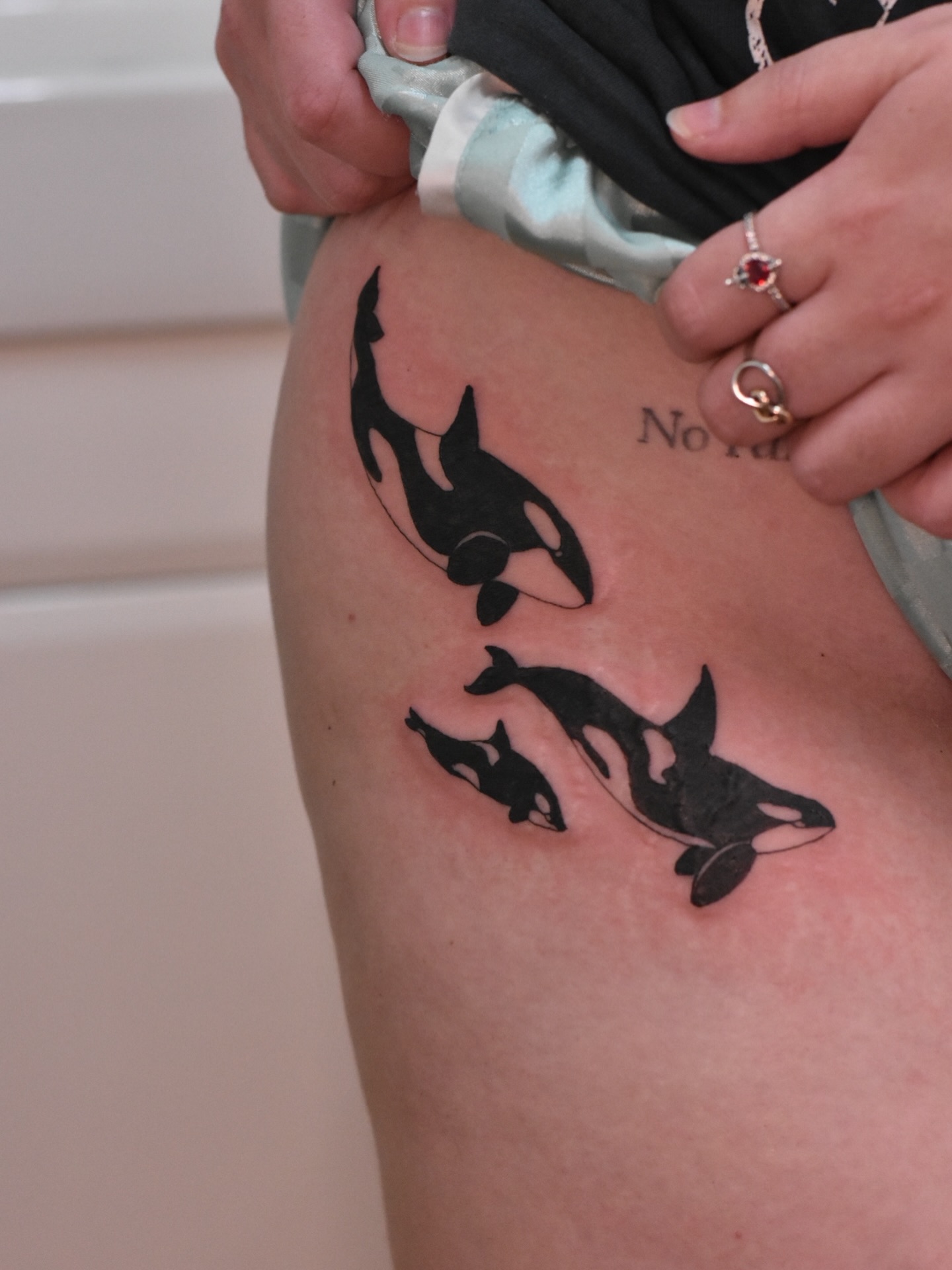
A pod of orcas in one composition: adults and calves at visibly different sizes, moving in the same direction.
Orcas live in stable matrilineal groups, and offspring of both sexes often stay with their mothers for life. That biology is why the pod tattoo works as a family piece in a way that a generic animal group does not.
People commonly match the number of animals to the number of people in their family. It is a nice idea with one practical catch: adding a whale later is easy, and removing one is not.
Size ordering matters compositionally. Staggering the animals on slightly different depth planes reads better than lining them up evenly like a row of icons.
15. Whale and Moon
A whale below the surface with the moon above it, the body of water between them acting as the link.
The pairing is not arbitrary. The moon governs the tides, and the tides govern where the water goes, so the two share an actual physical relationship as well as a symbolic one.
Fine line versions read as quiet and illustrative. Watercolour versions with deep ocean blues read as atmospheric. Both are common; the choice mostly tracks how much upkeep you want.
If you like celestial pairings generally, this is one of the few that does not feel forced onto the animal.
16. Minimalist Whale Line
A whale described in a single unbroken line: the pen never lifts, and the shape emerges from one continuous mark.
Single line work is harder than it looks, and it is an area where artist selection matters more than design. The line has to be one consistent weight the entire way, with no wobble at the turns.
Ask to see healed single line work specifically, not fresh photographs. Fresh fine line always looks perfect; the test is what it looks like at eighteen months.
Common placements are the inner forearm, the sternum, and the outer ankle. Our minimalist tattoo ideas guide goes deeper into how these age.
17. Whale and Boat
A whale beneath a small boat: the animal visible below the waterline while the vessel floats, unaware, above it.
The whole piece rests on the size difference. If the boat is too large the composition becomes a nautical scene; if it is small enough, it becomes a statement about perspective.
This one is often chosen by people who want a tattoo about what sits under the surface of their own life, and the image carries that reading without needing any text.
Vertical placements suit it best, because you need the depth between the two elements to do the work.
18. Blue Whale in Watercolour
A blue whale in watercolour: the largest animal known to have lived, rendered in washes of deep blue, grey and teal.
The blue whale’s long smooth form suits the technique because colour can flow along its length rather than pooling in detail. According to NOAA Fisheries, no larger animal is known to have existed, which is part of why the subject carries weight at any size.
At thigh or back scale this becomes one of the most atmospheric wildlife watercolour compositions available.
Ask for a black or dark grey anchor line somewhere in the piece. Pure watercolour with no structural element is the version that most often disappoints people at the five-year mark.
19. Whale Skeleton
A whale skeleton in scientific illustration style: the articulated bones rendered in precise fine line.
This has a natural history museum quality to it, the animal reduced to structure. It appeals to a different person than the realism version, usually someone who likes the anatomical and the archival.
Clean fine line blackwork is the standard treatment. Some artists add light stipple shading inside the ribcage to give the form depth without breaking the illustrative feel.
The vestigial hip bones are a nice detail to ask for, since whales retain small remnants of the hind limbs their ancestors walked on.
20. Whale as Landscape
A whale whose body becomes a landscape: trees along the dorsal surface, mountains rising from the back, a small settlement on its flank.
The whale-as-world composition treats the animal as an ecosystem in its own right, which has a long precedent in illustration and translates well into large-scale tattooing.
This is the most ambitious idea here and the one most dependent on the artist. It is a design commission as much as a tattoo, so expect to pay for drawing time separately.
Back, full thigh, or a large outer arm panel are realistically the only placements that give the internal detail room to survive healing.
If a Whale Is Not Quite Right
Sometimes the feeling is right but the animal is not. These are the subjects people most often land on instead, and why.
Octopus
An octopus gives you intelligence, adaptability and problem solving rather than patience and scale, and it fills awkward placements better because the arms can wrap a shoulder or knee. Our octopus tattoo guide covers the placement logic in detail.
Shark
A shark carries the same ocean association with a much harder edge: survival, threat, and forward motion instead of depth and stillness. See the shark tattoo ideas collection if that reading fits better.
Sea Turtle
A sea turtle is the gentler option, generally read as longevity, navigation and homecoming. It also works far better than a whale at small sizes, because the shell gives an artist detail to work with in a two-inch space. There is more on the symbolism in our sea turtle tattoo meaning guide.
A Whale Element Instead of a Whale
If you love the subject but not the commitment, take a part of it. The fluke, the song waveform, a single breath spout, or a fine line outline of the animal all carry the reference without occupying a full panel of skin.
Getting a Whale Tattoo Right
Choose the placement before you choose the size. A whale is a long horizontal animal, and it wants a long placement: the outer thigh, the ribcage, the forearm, the line of the spine.
Then match the artist to the style, not to convenience. A brilliant traditional artist is not automatically the right person for single line work, and vice versa. Our fine line tattoo ideas guide explains what to look for in a portfolio when the style depends entirely on line control.
Ask for healed photographs every time. Fresh work flatters every artist equally; healed work is the only honest evidence, and any artist worth booking will have it ready.
For aftercare, follow the studio’s written instructions rather than internet consensus, and see the American Academy of Dermatology guidance on caring for tattooed skin. If you develop spreading redness, swelling that worsens after the first few days, pus, or a fever, contact a doctor rather than your artist. Nothing on this page is medical advice, and allergic reactions to certain pigments are uncommon but real.
Common Mistakes and What to Do Instead
Going too small for the style. This is the mistake, by a distance. A detailed humpback at three inches becomes a grey blob within five years. Either go larger or switch to a silhouette or fluke design that is built for the size.
Booking on price rather than portfolio. A whale is a subject where technical skill is visible from across the room, and the gap between a competent artist and the right one shows up in the healed result, not the fresh one.
Skipping the structural element in watercolour. Washes without an anchoring dark line are the pieces people come back to cover up. If you want the technique, see how other jellyfish tattoo compositions handle the same problem, since they face it too.
Treating the whale as generic nautical filler. If you want a maritime piece with traditional weight, an anchor may serve you better, and our guide to what an anchor tattoo symbolises covers that vocabulary properly.
Frequently Asked Questions
How much does a whale tattoo cost?
It depends almost entirely on size and style rather than on the subject. A small fine line fluke or silhouette is usually a single short session at a studio’s minimum or a little above it, while a colour realism humpback across a thigh is a multi-session project priced by the day. Ask for a written estimate in sessions rather than hours, since experienced artists quote large work that way. Prices vary widely by city and by artist demand, so treat any figure you see online as a starting point only.
What does a whale tattoo mean?
Most people choose it for one of three readings: depth and interior life, family and lifelong bonds, or sheer scale and perspective. Specific species shift the meaning further, so an orca pod usually signals family, a narwhal signals rarity or whimsy, and a sperm whale signals the deep. There is no fixed traditional meaning the way there is with some nautical symbols. What it means is largely what you decide it means, which is worth being clear about before you sit down.
Do whale tattoos work in small sizes?
Some do and some really do not. A silhouette, a single line whale, or a fluke-only design reads perfectly at wrist or ankle scale. Colour realism, geometric faceting, and anything with internal texture needs room, and shrinking those is the most common regret I hear about. If you want small, choose a design built for small rather than a miniature version of a large one.
Which whale species tattoos best?
The humpback is the most popular because its long pectoral fins and textured skin give an artist so much to work with. The blue whale suits geometric and watercolour treatments because its form is smooth and simple. The orca is the strongest graphic choice thanks to its natural black and white markings, and the beluga and narwhal are the distinctive options if you want something rarely seen. Each has different technical demands, so discuss the species with your artist early.
How long does a large whale tattoo take to heal?
The surface usually settles within two to three weeks, but the deeper layers continue to remodel for several months, which is why final detail and colour are best judged at around the three month mark rather than at three weeks. Large pieces on high-friction areas such as the ribs and thighs often feel tender longer than smaller work. Follow your studio’s written aftercare and keep the area out of direct sun while it settles. If anything looks or feels wrong, ask a doctor rather than waiting it out.
Quick Summary
- Decide first whether your whale tattoo is about depth, family, or scale, because that choice drives the composition.
- Match size to style: realism and geometric work need large placements, silhouettes and flukes do not.
- Long horizontal placements suit whales best, particularly the outer thigh, ribcage, forearm and spine.
- Blackwork and traditional styles age the most reliably; watercolour ages the fastest and needs a dark anchor line.
- The humpback gives the most detail to work with, the orca the strongest graphic contrast, the narwhal and beluga the most distinctiveness.
- Add a diver, boat, or moon only if you want the piece to be explicitly about scale or perspective.
- Judge artists on healed photographs in the specific style you want, never on fresh work alone.
- Follow your studio’s written aftercare, keep new work out of the sun, and see a doctor for anything that looks infected.