Space humbles you if you let it. The distances are incomprehensible, and the timescales make all of human history look like a single held breath.
A galaxy tattoo is not really a picture of space — it is a statement about scale, and about choosing to carry something vast on a body that is small and temporary. That is why the good ones feel different from other colour work.
I have watched galaxy pieces heal well and I have watched them turn to purple mud, and the difference almost never comes down to the idea. It comes down to the artist and the placement. If you are still deciding on a direction, it is worth browsing wider space tattoo ideas before you settle on a galaxy specifically.
These 19 ideas cover the full range, from a single fine line planet to a full sleeve you can fall into. I have flagged which ones are forgiving and which ones need a specialist.
Which Galaxy Tattoo Style Is Right for You?
Most people arrive with a picture and no sense of what it will cost them in sittings or in touch-ups. This is the honest version of that trade-off.
| Style | Best placement | Difficulty | How it ages |
|---|---|---|---|
| Full-colour nebula | Shoulder, thigh, half sleeve | High — specialist only | Softens; needs a touch-up eventually |
| Black and grey space | Forearm, calf, back | Moderate | Very well with solid contrast |
| Fine line planets | Inner arm, ribs, ankle | Moderate | Lines can soften and blur over years |
| Geometric frame + galaxy fill | Forearm, upper back | High — two skill sets | Frame holds; fill softens first |
| Dotwork star field | Spine, back, ribs | Moderate | Dots can merge if placed too tightly |
| Watercolour galaxy | Shoulder, thigh | High | Fades fastest of the group |
What Actually Makes a Galaxy Tattoo Work
Galaxy tattooing succeeds or fails on two things: depth and darkness. Everything else is decoration.
Depth is the illusion that you are looking through the skin rather than at it. It comes from smooth gradients, from colours layered in a deliberate order, and from an artist who knows when to stop blending.
Darkness is the harder half. A galaxy needs genuinely dark background to make the bright parts read as light, and packing solid dark saturation over a large area is slow, uncomfortable work that a lot of artists rush.
The stars are almost always negative space, not white ink. White ink sits on top and greys out over time; skin left untouched stays bright for the life of the tattoo. Any artist doing serious colour work will already know this, and it is a fast way to check whether yours does.
In my experience the single most useful question you can ask an artist is not to see their portfolio, but to see healed photos of a colour piece at least a year old. Fresh galaxy work is easy. Healed galaxy work is the actual skill.
19 Galaxy Tattoo Ideas Worth Taking to an Artist
These are grouped roughly from the most common to the most ambitious. Every one of them is a real, workable design brief rather than a mood board.
1. Spiral Galaxy Sleeve
The arm as a window into space. A spiral galaxy modelled on the Milky Way or Andromeda, wrapping the forearm or the full arm, with the bright core sitting on the elbow or the inner wrist.
The arms of the spiral trail outward and fade into the darker background, which is what stops the design looking like a sticker.
The trick is orientation. A spiral galaxy is a flat disc seen at an angle, so the design has to commit to a viewing angle and hold it all the way around the limb. Every artist I have asked about this says the same thing: the tilt is decided in the stencil stage, not on the fly.
Expect multiple sittings. Solid dark saturation over an arm’s worth of skin is not a single-session job in most cases.
2. Nebula Shoulder Piece
A nebula is the cloud of gas and dust where stars are born, and it is the most forgiving galaxy subject because it has no correct shape.
The Orion Nebula, the Eagle Nebula, or something entirely invented in pinks, violets and blues. The soft edges suit airbrush-style blending and watercolour technique equally.
The shoulder and upper arm are the natural home for this because the surface is rounded and continuous, with no hard creases to interrupt a gradient.
If you want the piece to grow later, ask the artist to leave the lower edge deliberately unresolved. It is far easier to extend a nebula into a half sleeve than to graft one onto a finished circle.
3. Planet in Fine Line
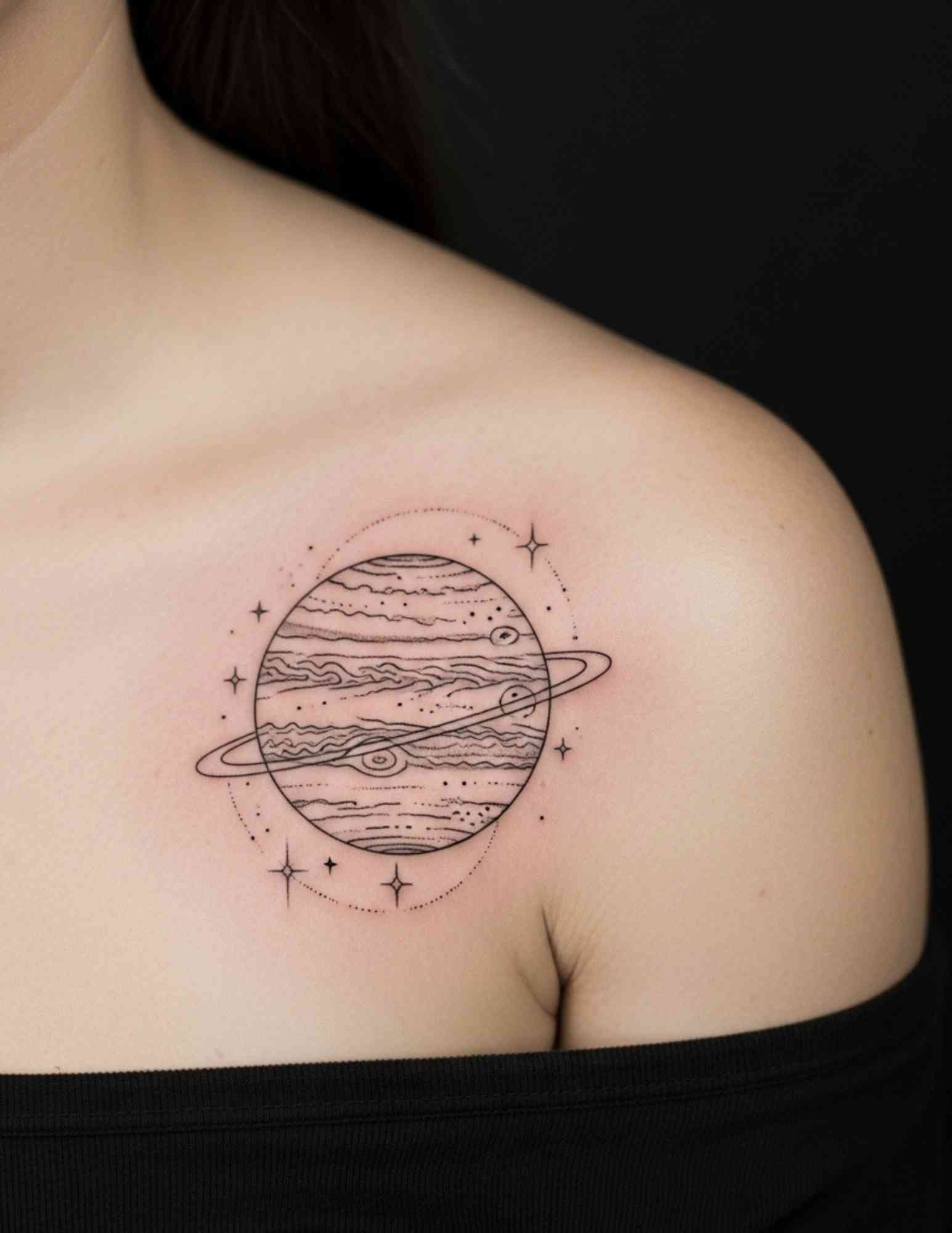
A single ringed planet in thin black line, sometimes with a handful of stars scattered around it. No colour at all.
This is the smallest possible entry point into the subject, and in my experience it is the one people regret least. It reads clearly from across a room and it costs a fraction of a colour piece.
The honest caveat: fine lines soften over the years. A design that depends on hairline detail at three millimetres will not look the same at fifteen years, so give the artist room to use a slightly heavier line than the reference photo.
4. Galaxy Inside a Geometric Frame
A hard-edged shape — a triangle, a circle, a hexagon, a diamond — with a nebula and star field contained inside it.
The contrast is the whole point: a mathematically clean border holding something formless.
This one asks two different skills of the same artist. Crisp geometry needs a steady straight line and a confident circle, while the fill needs soft colour blending, and plenty of good artists are strong at one and only adequate at the other.
Check a portfolio for both before you book.
5. Milky Way Across the Spine
The band of the galactic plane running vertically down the spine, dense with stars near the centre and thinning toward the shoulders and lower back.
The spine is genuinely well suited to this: it is the one line on the body that already looks like a galactic plane. It pairs naturally with other fine line spine tattoo work if you want to build outward later.
Be warned that the spine is among the more painful placements for most people, and this design covers a long stretch of it.
6. Black Hole
A dark centre with a bright, warped accretion ring bending around and above it — the shape the 2019 Event Horizon Telescope image made famous.
Tattooed well, it is one of the few space designs that works almost entirely in black and grey, because the subject genuinely is mostly darkness.
The difficulty is the light bending. A black hole’s ring appears in front of, behind and above the shadow at once, and an artist who does not understand why will draw a flat donut instead.
Bring a reference image and talk it through. This is a design where five minutes of explanation saves a permanent mistake.
7. Astronaut in Deep Space
A figure in a suit, untethered, small against an enormous background. The subject is not the astronaut. It is the emptiness around them.
Scale is the entire design decision here. The smaller the figure sits within the composition, the more the piece says.
A common mistake is making the astronaut large and detailed enough to become the focal point, which turns a piece about insignificance into a portrait.
Visor reflections are worth the extra sitting. A galaxy or a planet mirrored in the helmet glass is a small detail that people notice years later.
8. Constellation Map on the Back
Fine dots connected by hairline rules, laid out as a real star chart — often the sky above a specific place on a specific date.
This is the most personal design in the list that does not require any colour. The night sky on a birth date, a wedding date, or the day someone died is a legitimate, checkable piece of data.
Vary the dot sizes to reflect actual stellar magnitude rather than making every star identical, and keep the connecting lines lighter than the dots. If you like the vocabulary but not the map, plain star drawings for tattoos give you the same feel with more freedom.
Leave real space between dots. Dotwork placed too tightly will merge into a grey smudge as the tattoo settles.
Bolder Variations and Where They Fit
The rest of the list moves away from straightforward depictions of space into designs that use the galaxy as a texture, a fill or a metaphor.
9. Galaxy Eye
A realistic eye with the iris replaced by a nebula. The lashes, lids and reflection stay conventional; only the iris goes cosmic.
It is a compact design that carries a lot of colour, which makes it a good way to get galaxy work without committing a whole limb.
The iris is small, though, and the colour has nowhere to hide. In my experience this is the design most often attempted by artists who are not quite ready for it.
10. Aurora and Stars
Curtains of green and violet light above a star field, sometimes with a horizon line of trees or mountains at the base.
The aurora brings greens into a palette that is otherwise all blues and purples, which stops a large piece feeling monotone. It sits well alongside shooting star tattoo elements if you want movement in the composition.
Vertical placements suit it best — the outer thigh, the calf, the ribs — because real aurora hangs in vertical bands.
11. Tiny Solar System
The planets in order, drawn small and lined up along the inner forearm, the collarbone or the ribs.
Decide early whether you want accuracy or balance, because you cannot have both. Real relative planet sizes would make Jupiter enormous and Mercury nearly invisible, so most artists compress the scale.
Some people include Pluto anyway. That is a personal call, not an astronomical one.
A linear layout is one of the few designs that genuinely works on the collarbone, where the natural line of the bone does half the composition for you.
12. Galaxy Half Sleeve
Shoulder to elbow, filled edge to edge with nebula colour, planets and stars, with no visible border.
Half a sleeve gives an artist enough surface to build real depth rather than a flat colour patch, which is why galaxy work often looks better at this size than small. If you already have unrelated pieces on the arm, sleeve filler ideas can bridge them into a cosmic background.
Plan for several sessions and budget for a touch-up in the first year or two. Large saturated colour rarely heals perfectly evenly the first time, and a good artist will expect to revisit it.
13. Supernova
A star at the moment it explodes: a blinding centre with light and material thrown outward in every direction.
This is the most dynamic design in the list, and it depends almost entirely on saved skin. The brightest point should be untouched skin, ringed by progressively heavier colour.
It reads well on the shoulder blade, the chest and the outer thigh, anywhere the radiating lines have room to run out before they hit a joint.
14. Moon Phases with Galaxy Fill
The lunar cycle laid out in a row, but with each moon filled with nebula colour instead of grey crater detail.
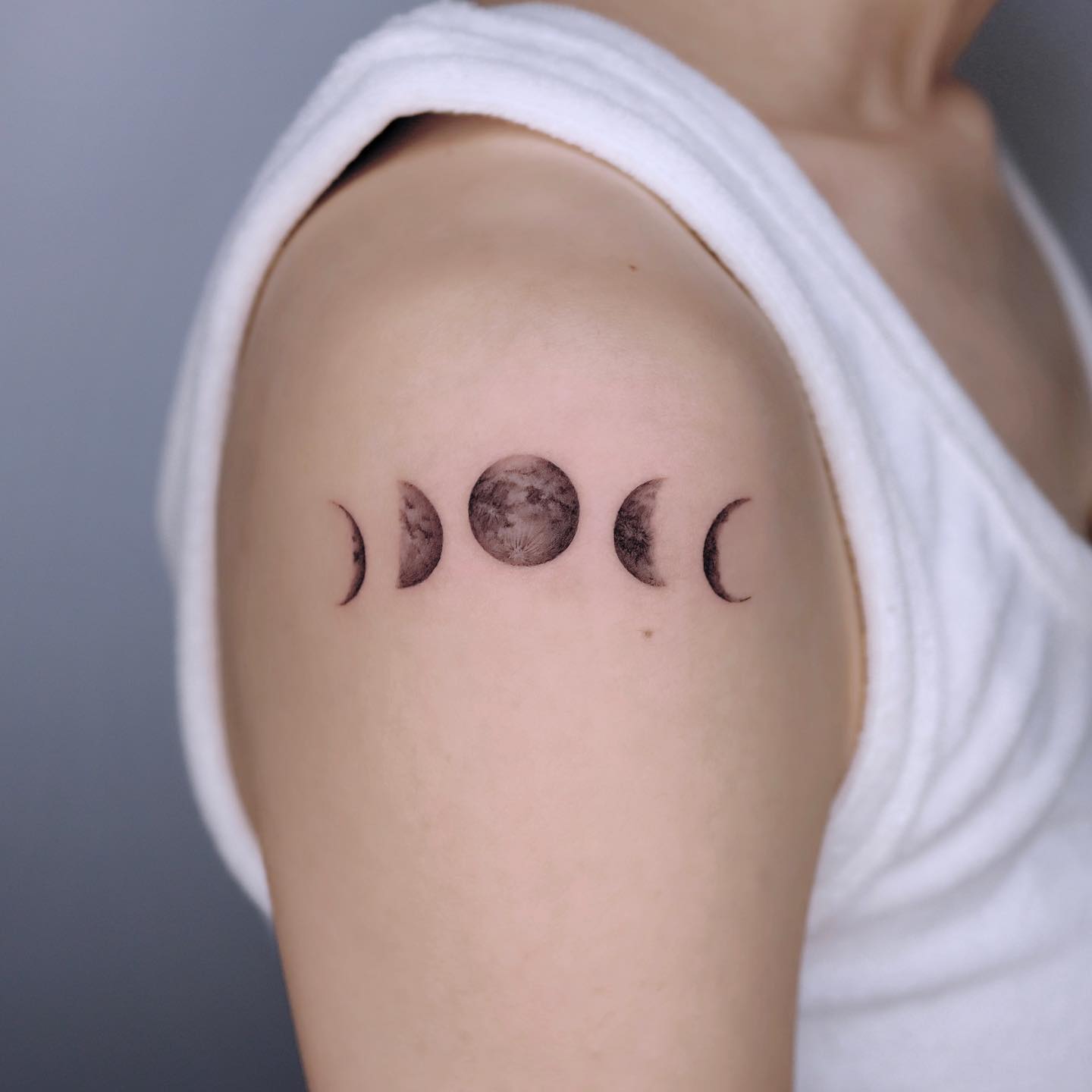
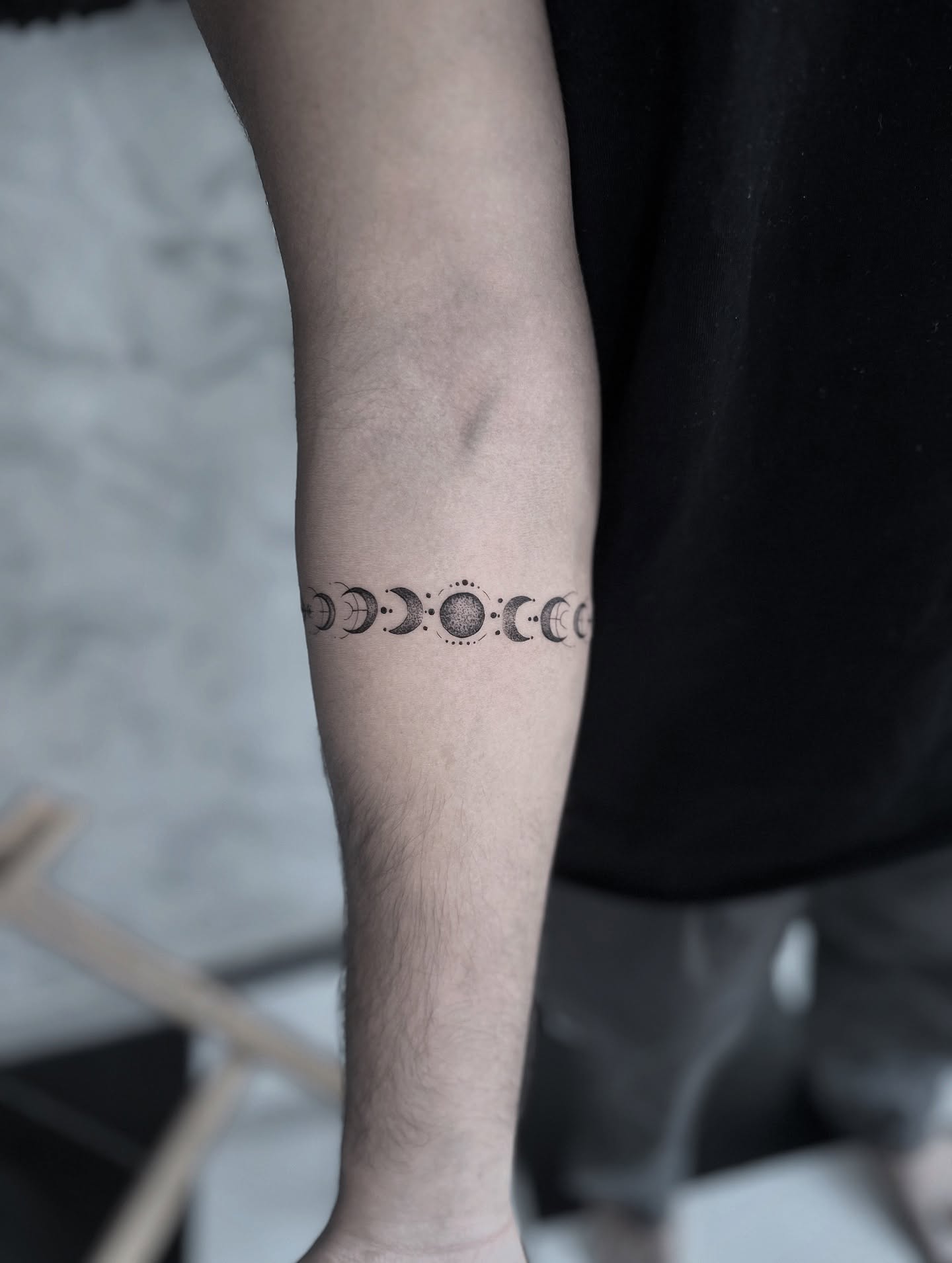
It is a familiar format made unfamiliar, and it suits the forearm, the collarbone and the spine. Standard moon phase tattoo ideas will show you the layouts before you decide on the fill.
Keep the crescent phases simpler than the full moon. A sliver filled with detailed nebula work turns into an unreadable smudge at a distance.
15. Astronomical Clock
Ornate dial work, orreries, astrolabes and zodiac rings, rendered in fine line or heavy black and grey, sometimes with colour bleeding through the gaps.
The appeal is the contrast between human instruments and the thing they are trying to measure. It gives a galaxy piece structure and a sense of scale that pure space imagery lacks.
This is dense, detailed work. Size it generously — a design with this much internal line detail crammed into a small area will close up over time.
16. Galaxy Animal
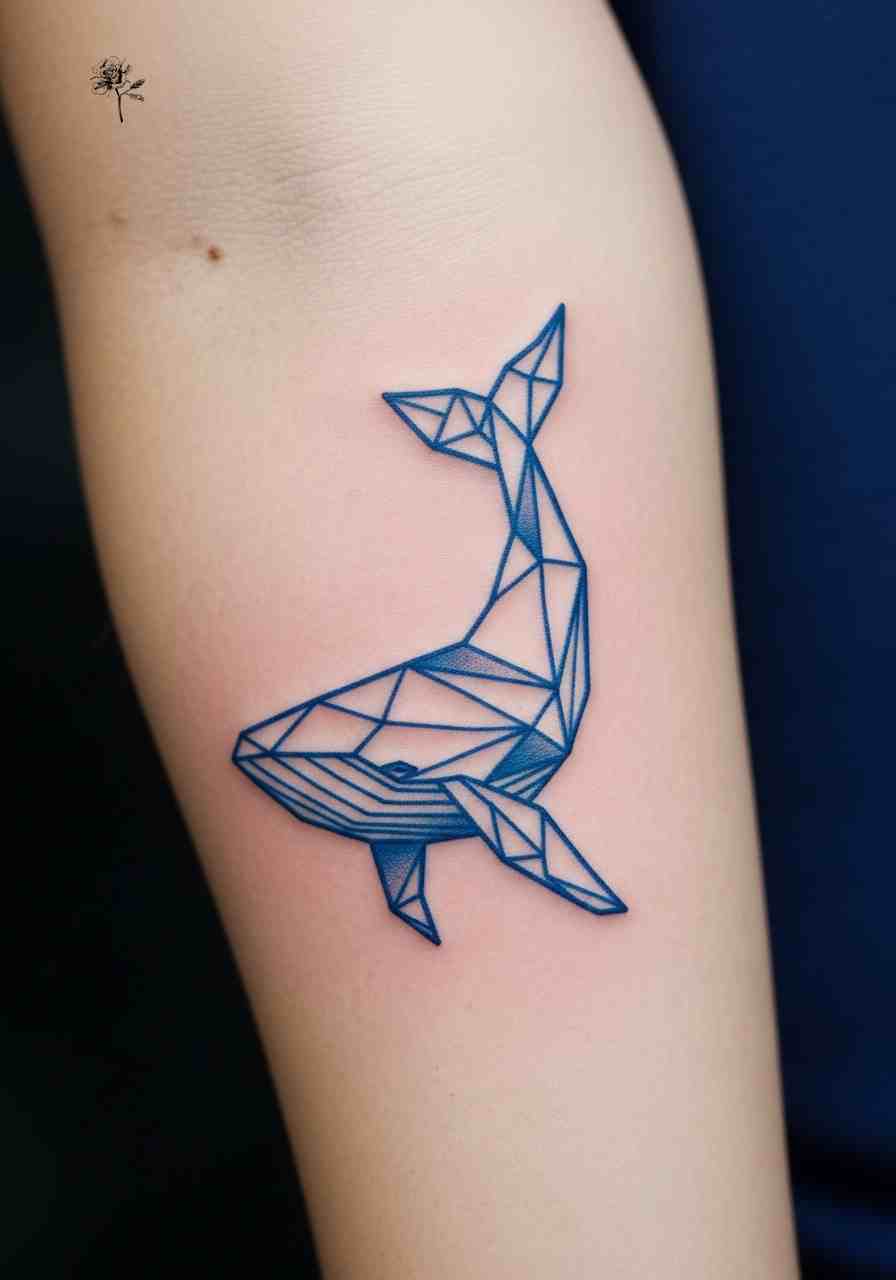
A wolf, a whale, a bear, a deer or a bird rendered as a silhouette and filled with stars and nebula colour.
It is one of the most requested versions of this idea, and the reason it works is that a strong silhouette gives the loose colour something to be contained by.
The outline has to be excellent. Because the fill pulls the eye inward, any weakness in the animal’s shape becomes very obvious, and no amount of good colour rescues a badly drawn wolf.
17. Voyager or Deep Space Probe
A real spacecraft — Voyager, Cassini, New Horizons — drawn accurately, small, and surrounded by nothing.
This is the quiet option in the list, and it appeals to people who want the meaning without the colour. Voyager 1 and 2 are still travelling outward decades after launch, which is a fairly direct metaphor for persistence.
Technical accuracy matters here in a way it does not for a nebula. Find a good reference photograph and expect the artist to follow it closely.
18. Hubble Deep Field
Based on the Hubble deep field images: a tiny patch of apparently empty sky that turns out to contain thousands of galaxies, each one a system of billions of stars.
Almost every speck of light in the source image is an entire galaxy. As a tattoo it renders the scale of the universe more directly than any single dramatic object can.
Visually it is mostly dark skin scattered with tiny points, which ages better than you would expect. There is very little fine line to soften.
19. Personal Cosmos
A galaxy assembled from things that mean something to you: stars arranged in the initials of people you love, nebula colours pulled from a specific memory, a planet placed where your home city would sit on a cosmic map.
The universe as autobiography. It is the most ambitious idea in the list and the only one nobody else can copy.
It also requires the most from an artist, because there is no reference image to work from. Expect a real design consultation, and expect to pay for the drawing time.
Healing and Aftercare for Heavy Colour Work
Large saturated colour is harder on the skin than line work, and it usually takes longer to settle. Plan for that rather than being surprised by it.
Follow the aftercare your artist gives you, since they know what ink and technique they used. In general that means keeping it clean, keeping it lightly moisturised, and not picking at it — guidance on healing ointments is worth reading before your appointment rather than after.
Sun is the main long-term enemy of a galaxy piece. Purples and blues are among the first colours to shift, so once the tattoo is fully healed, high-SPF sunscreen on the area is the single most effective thing you can do. The American Academy of Dermatology publishes practical guidance on caring for tattooed skin that is worth reading.
If you develop a rash, persistent swelling, or a reaction that appears weeks or months later, see a doctor rather than working it out yourself. Reactions to specific pigments are uncommon but real, and the FDA has published consumer information on tattoo safety. Nothing in this article is medical advice.
Assume you will need a touch-up. Most large colour pieces I have seen benefit from one after the first year, and most reputable artists price that in or do it cheaply.
Still Not Sure? The Mistakes Worth Avoiding
Booking on price is the first one. Galaxy work is a specialism, and a cheaper artist who does not do colour regularly will cost more in the end than the specialist you skipped.
Going too small is the second. A galaxy needs room to have a dark background and a bright foreground, and a coin-sized version of a full-colour nebula becomes an indistinct blob within a few years.
Underestimating the sittings is the third. If you have not sat for long colour work before, it is worth reading up on managing tattoo pain first, because the endurance is a real part of this.
And the fourth: not asking to see healed work. Fresh photos flatter everyone. If you want a sense of how other cosmic pieces settle in, browsing sun and moon spine tattoo designs alongside galaxy work will show you which motifs stay legible over time.
Frequently Asked Questions
How much does a galaxy tattoo cost?
It depends far more on size and artist than on the design itself, so the only reliable answer is to get quotes from two or three artists whose colour work you actually like. A fine line planet is an hour or so; a full colour half sleeve is usually several full sessions. Ask whether the quote is hourly or a flat piece price, and whether a touch-up is included. In my experience specialists quote higher and are still the better value, because you are not paying twice.
Do galaxy tattoos fade faster than black and grey?
Colour generally fades sooner than black and grey, and purples and blues are among the more vulnerable pigments. That said, a well-packed galaxy piece protected from the sun can hold up for many years. The biggest single variable is sun exposure, followed by how densely the artist saturated the colour in the first place. Sunscreen once healed is the cheapest insurance you will ever buy.
What is the best placement for a galaxy tattoo?
Large, rounded, relatively flat areas work best: the shoulder, the outer thigh, the upper back and the calf. These give an artist room to build depth and they flex less than joints do. The spine works beautifully for a Milky Way band specifically, though it is a more painful sitting for most people. Avoid the hands, fingers and feet for heavy colour, since those areas turn over skin quickly and tend to lose saturation.
Can a galaxy tattoo be done in black and grey?
Yes, and some subjects are arguably better for it. A black hole, a deep field, a constellation map and a Voyager probe are all essentially monochrome subjects already. Black and grey also ages more predictably and costs less to maintain. If you love the imagery but are nervous about colour longevity, this is the sensible route.
How do I find an artist who is actually good at this?
Search for galaxy, nebula or cosmic work specifically rather than browsing general portfolios, and then ask each artist for healed photos at least a year old. Look for whether the stars are saved skin rather than white ink, and whether the dark areas are genuinely dark rather than washed grey. A specialist will be happy to be asked. Anyone who is evasive about healed results is telling you something useful.
Quick Summary
- Galaxy tattoos live or die on two things: real depth and genuinely dark backgrounds.
- Stars should be saved skin, not white ink — white ink greys out over time.
- Go bigger than feels necessary; small colour galaxies lose their contrast as they settle.
- Rounded, flat placements — shoulder, thigh, upper back, calf — suit the subject best.
- Black and grey options (black hole, deep field, constellation map) age more predictably than full colour.
- Always ask to see healed photos at least a year old, not just fresh portfolio shots.
- Budget for multiple sittings and a likely touch-up in the first year or two.
- Sunscreen once healed is the single most effective thing you can do for colour longevity.