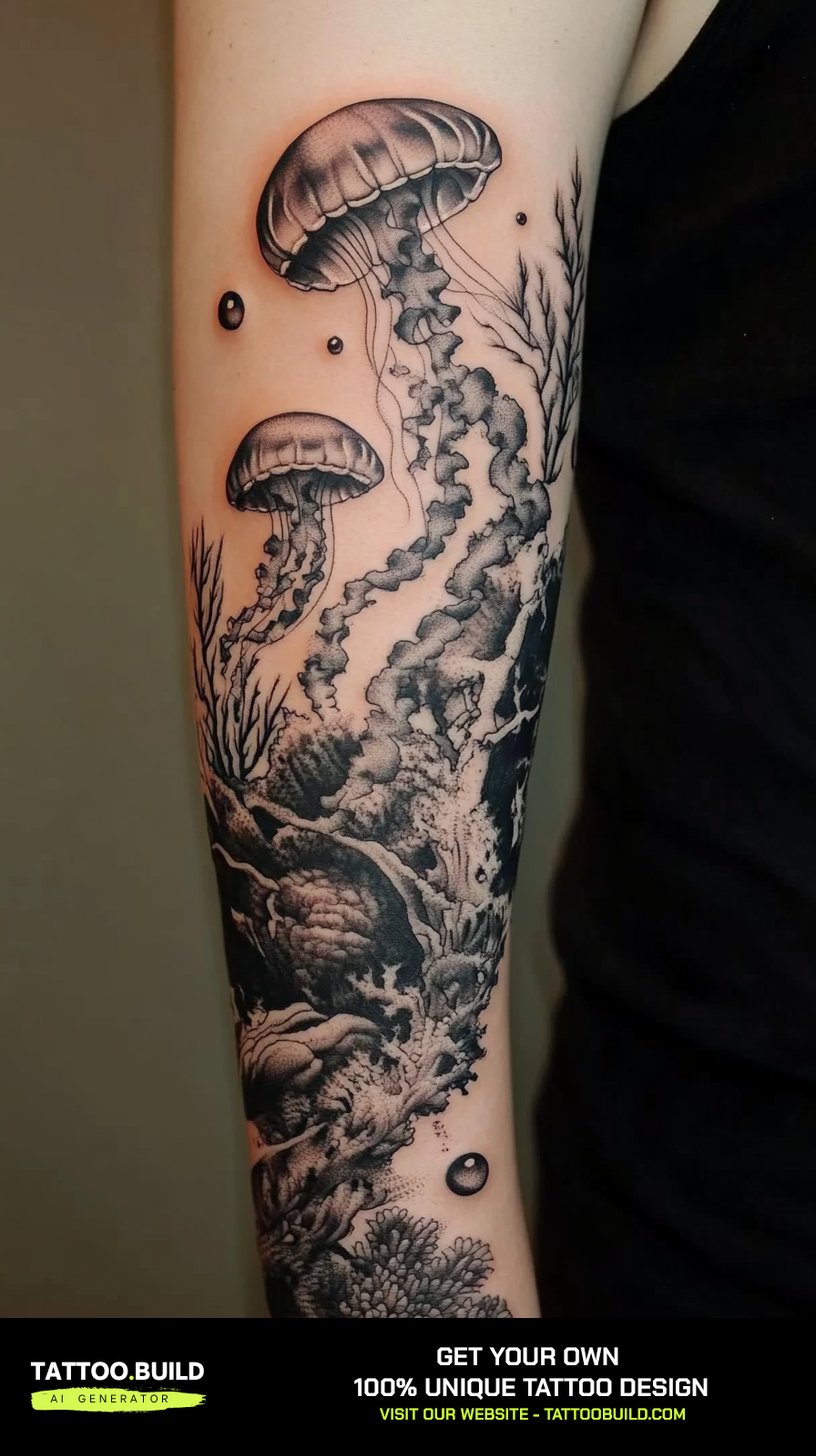
A jellyfish tattoo is one of the few ocean designs that works just as well at two inches as it does at two feet. That is rarer than it sounds.
I have been collecting and writing about ocean tattoo ideas for years, and most sea creatures fight the body. A whale wants width. An anchor wants a straight vertical line. A jellyfish wants neither.
It has a compact bell and a long, loose, unpredictable tail. That shape drapes down a forearm, wraps a rib cage, or fills a spine without ever looking forced.
Below are 35 directions I keep coming back to, sorted by style and by placement, with the honest trade-offs of each. Every photo here is a design concept rather than a healed client photo, so treat them as reference to bring to your artist, not as a guarantee of how ink will settle on your skin.
Which Jellyfish Tattoo Style Is Right for You?
Style decides how the piece ages more than the subject does. Here is how the six main approaches compare on the things that actually matter a decade in.
| Style | Best size | Typical sitting | How it ages | Pick it if |
|---|---|---|---|---|
| Fine line | 3–6 in | 2–4 hours | Softens noticeably; often wants a touch-up | You want delicate and can accept upkeep |
| Black and grey realism | 6–12 in | 4–8 hours | Very well when contrast is built in | You want the tentacles to look wet |
| Illustrative / botanical | 5–10 in | 3–6 hours | Well; line weight carries it | You want flowers woven into the tentacles |
| Colour / neo-traditional | 5–10 in | 4–8 hours | Bold colour holds; pastels fade first | You want it visible across a room |
| Blackwork / high contrast | 4–10 in | 3–6 hours | The most forgiving of the six | You want a graphic silhouette |
| Full underwater scene | 10 in and up | Multiple sessions | Depends entirely on planned negative space | You are building toward a sleeve |
Sitting times are the ranges I have seen quoted by artists for a single, uninterrupted session, not a promise. Your artist’s speed and your own pain tolerance move those numbers.
What a Jellyfish Tattoo Actually Means
Most meaning lists for this design are recycled. I would rather tell you where the symbolism genuinely comes from, because that is what makes it yours instead of generic.
The animal is old. The Smithsonian Ocean Portal places jellies on Earth at least 500 million years ago, and possibly as far back as 700 million — roughly three times as old as the first dinosaurs.
That is the root of the endurance reading. A creature with no bones and no brain outlasted almost everything that had both.
The Smithsonian also notes jellies are about 95 percent water and lack brains as we usually think of them, running instead on a loose nerve net. People who choose this design for a grief or recovery meaning tend to lean on that: soft does not mean fragile.
Then there is the drifting. Jellies move with the current far more than against it, which reads as surrender to some people and as trust to others. I have had two clients describe the same tattoo in exactly opposite terms, and both were right about their own piece.
And a smaller, stranger one: certain Turritopsis jellies can revert from adult back to the polyp stage through a process called transdifferentiation. If a renewal meaning is what you are after, that is the species to ask your artist to reference.
Jellyfish Tattoo Styles That Hold Up Over Time
These six cover almost everything I see. The differences are less about looks and more about how much line the artist commits to.
1. Fine Line and Single Needle
This is the most requested version right now and the one I am most cautious about recommending without a caveat.
Thin lines and a jellyfish’s long tentacles are a natural pairing — the tail can trail for six inches without ever getting heavy. Done well it looks like a pencil drawing sitting under the skin.
The catch is that fine line work spreads. Every artist I have asked about fine line tattoos says the same thing: lines placed too close together will eventually blur into each other. Ask for deliberate gaps between the tentacles, not the tightest possible bundle.
In my experience these age best on the inner forearm and upper arm, and worst on hands, feet and fingers.
2. Black and Grey Realism
If you want the tattoo to look wet, this is the style.
Realism gets the translucency of the bell that no other approach really nails — the smoky shading through the dome is the whole trick, and it needs room. Under about five inches the gradients collapse into a grey blob.
When I tested reference photos with a few artists, the consistent note was that the tentacles matter more than the bell. A beautifully rendered dome with lazy tentacles reads as unfinished; the reverse almost never does.
This style also ages the most gracefully of the six, provided the artist builds in real black somewhere. Pure mid-grey with no anchor point is what fades into a smudge.
3. Illustrative and Botanical Hybrids
Half jellyfish, half bouquet. This is my personal favourite direction and the one I see least often done badly.
The logic is simple: tentacles and stems behave the same way visually, so flowers can be swapped in without the design fighting itself. Peonies, cosmos and poppies all work because their petals fall in the same direction the tentacles already do.
It also solves a real problem. A plain jellyfish on a large placement can look empty, and botanical elements fill space without adding another animal.
Bring your artist a flower with personal meaning — a birth month bloom, something from a garden you remember — and the piece stops being a stock design.
4. Colour and Neo-Traditional
The loudest option, and the one most people talk themselves out of and later regret talking themselves out of.
Real jellyfish are often bioluminescent or faintly translucent-pink, so colour here is not a stylistic liberty — it is closer to accurate than black and grey is.
Neo-traditional handles it best: bold outline, saturated fill, limited palette. Orange, coral and deep teal are the combinations I see hold their punch longest.
If you want something softer, watercolour tattoos suit the drifting-ink quality of tentacles, but understand the trade. Watercolour without a black or heavily saturated anchor generally needs touch-ups sooner than any other style on this list.
5. Blackwork and High Contrast
Solid black bell, wispy tentacles, nothing else. The most forgiving option on this entire page.
There is no gradient to lose and no thin line to blur, so a piece like this looks close to identical at year one and year fifteen. That is not a small thing.
It also photographs well on darker skin tones, where subtle grey shading can disappear. Every artist I have asked who works regularly on deep skin tones pushes contrast first and detail second, and blackwork is that principle taken to its conclusion.
The limitation is honest: you give up the translucency. A blackwork jellyfish is a graphic symbol, not a portrait of an animal.
6. Full Underwater Scenes
Once you add coral, kelp, bubbles and a second creature, you are no longer getting a jellyfish tattoo — you are starting a sleeve.
I say that as a warning and a recommendation. These are the most impressive pieces on this page, and they are also the ones that most often stall half-finished because the client budgeted for one session.
If a scene is what you want, plan the whole panel before the first needle goes in. Jellyfish pair naturally with octopus tattoos and sea turtles because all three read as slow-moving, which keeps the composition calm.
Negative space is the single thing that decides whether a scene like this still reads at ten years out. Ask for it explicitly — untouched skin is a design element, not wasted room.
Placement: Where the Shape Actually Works
A jellyfish is a vertical design with a wide top and a narrow, tapering bottom. Match that to the body part and the tattoo looks inevitable. Ignore it and it looks pasted on.
Forearm and Inner Arm
The default, and for good reason — the forearm tapers the same direction the tentacles do.
Bell near the elbow, tentacles running toward the wrist is the arrangement that reads correctly when your arm is at your side. Reversed, it looks like the jellyfish is falling upward.
Inner arm hurts more than outer but holds fine line detail better because the skin sees less sun. If you are weighing sun exposure against pain, more forearm placement options are worth browsing before you commit.
Upper Arm and Shoulder
The most comfortable placement of the lot and the easiest to hide.
The rounded shoulder cap suits a bell shape without any distortion, and there is enough surface for a five to seven inch piece without wrapping.
The trade is that you will rarely see it yourself. Every client I have spoken to who put a first tattoo on their outer shoulder mentioned this, usually with mild regret.
Thigh
If you want detail, this is where to put it. Large, flat, low-friction and easy to keep out of the sun.
Thighs take a ten inch piece comfortably, which means realism and botanical hybrids can breathe. Almost every genuinely detailed jellyfish tattoo I have seen in person was on a thigh.
Healing is straightforward as long as you avoid tight jeans for the first week or two. Friction, not water, is what ruins most leg tattoos in the first fortnight.
Ribs and Side Torso
Visually the best fit on this page and physically the worst.
The rib cage curves inward exactly where tentacles should narrow, so a jellyfish placed here follows the body instead of sitting on it.
It is also consistently ranked among the more painful spots — thin skin directly over bone, and your own breathing works against you. Check a tattoo pain chart honestly before booking a long session here.
Spine and Back
The spine is the only placement where a jellyfish can go genuinely long without any distortion.
Bell between the shoulder blades, tentacles trailing to the lower back — the design follows a line the body already has. This is where the biggest pieces live.
Expect multiple sessions and a healing period where sleeping on your back is unpleasant. In my experience people underestimate the second part more than the first.
Calf and Lower Leg
An underrated middle ground — decent pain level, good size, easy to cover or show.
The calf’s shape suits a medium piece well, and it holds up better than the ankle or foot, where ink sits close to bone and tends to fade faster.
The one drawback is swelling. Lower legs swell during healing more than anywhere else, so elevate when you can in the first few days.
Variations Worth Considering
If the standard single jellyfish feels too plain, these are the adjustments that add something without turning the piece into a scene.
Jellyfish and Moon
A crescent or full moon behind the bell gives the composition a light source, which instantly makes the translucency readable.
It also stacks a second meaning on top — tides, cycles, return. This pairs particularly well with black and grey.
Bioluminescent Glow
Rather than colouring the whole jellyfish, the artist keeps everything black and grey and adds a single glowing accent inside the bell.
One saturated colour against grey reads far brighter than five colours competing. Teal and violet are the two I have seen work best.
Constellation and Star Tentacles
Tiny stars along the tentacle paths, or a personal constellation replacing one tentacle entirely.
It is subtle enough that most people will not spot it, which is usually the point.
Botanical Jellyfish
The full commitment version of style three — the bell built from petals, the tentacles built from stems, no ocean reference at all.
This is the version that photographs best and the one least likely to be mistaken for someone else’s tattoo.
Before and After: Practical Advice
Bring reference for the tentacles specifically. Most people arrive with three photos of jellyfish bells and nothing showing how they want the tail to behave, and the tail is two-thirds of the tattoo.
Ask to see healed work, not fresh work. Fresh fine line looks perfect on everybody; healed fine line at two years is where you find out whether an artist knows how to space a line.
Plan around sun. The American Academy of Dermatology advises covering a healing tattoo from the sun and using broad-spectrum sunscreen on it once healed. UV exposure is the single biggest cause of fading in every style on this page.
Follow the aftercare your artist gives you over anything you read online, including this article — they saw your skin and I did not. Our general tattoo aftercare guide is a reasonable baseline if you want one, but it is a baseline, not a prescription.
And a genuine safety note: if a healing tattoo becomes hot, increasingly painful after day three, swollen, or starts weeping anything cloudy, that is a doctor’s question, not a forum question. Infections and pigment allergies are both real and both treatable early. Never attempt to fix, remove or re-work a tattoo yourself.
Common Mistakes and What to Do Instead
Going too small. A jellyfish under about two inches loses its tentacles entirely and ends up reading as a mushroom. This is the mistake I see most often.
Cramming the tentacles. Density looks great on paper and blurs on skin. Space is what keeps the design legible in ten years.
Copying an exact design from a photo. Beyond the etiquette problem, a design built for someone else’s arm rarely fits yours. Use references as direction, not as a template.
Choosing placement by pain alone. The rib cage suits this shape better than anywhere else, and people talk themselves into a forearm to avoid two uncomfortable hours. Six months later the placement is still wrong and the pain is long forgotten.
Still Not Sure?
If the jellyfish is not quite landing, the adjacent designs are worth a look before you book anything.
For the same ocean feeling with a firmer outline, browse sea turtle tattoos or whale tattoos — both hold shape better at small sizes.
For the same flowing, tentacled quality with more visual weight, mermaid designs cover very similar ground and tend to suit larger placements.
Frequently Asked Questions
What does a jellyfish tattoo symbolise?
Most commonly resilience, adaptability and drifting with the current rather than against it. The endurance reading has a real basis — the Smithsonian Ocean Portal places jellies on Earth at least 500 million years ago, long before dinosaurs. Some people also choose it for renewal, referencing Turritopsis jellies that can revert to an earlier life stage. In practice the meaning is personal enough that two people can wear near-identical tattoos for opposite reasons.
How much does a jellyfish tattoo cost?
It depends almost entirely on size, style and your artist’s hourly rate, which varies widely by city and experience level. A small fine line piece is usually a single short session; a detailed thigh or back piece runs to multiple sessions. The honest answer is to ask two or three local artists for a quote on your specific idea. Beware of any quote that seems far below the local average — that is usually a sign of inexperience rather than a bargain.
Do jellyfish tattoos age well?
Blackwork and black and grey realism age best, because both build in real contrast that survives softening. Fine line ages the least well and often wants a touch-up within a few years, especially on high-sun or high-friction placements. Regardless of style, sun exposure is the biggest single factor — the American Academy of Dermatology recommends keeping healing tattoos out of the sun and using broad-spectrum sunscreen once healed. Placement matters too: inner arm and thigh hold up better than hands, feet or ankles.
Where does a jellyfish tattoo hurt the least?
Outer upper arm and outer thigh are generally the most comfortable spots for this design, since both have more padding and less bone directly beneath. Ribs, spine and the inner arm are usually reported as the most uncomfortable. Pain is genuinely individual, so treat any pain chart as a rough guide rather than a rule. If you are worried, book a shorter first session and see how you handle it before committing to a large piece.
What size should a jellyfish tattoo be?
I would not go below about three inches for anything with tentacles, and four to five is safer. Under that the tentacles either get left out or blur together, and the bell alone stops reading as a jellyfish. Realism and botanical hybrids generally want six inches or more to show their detail. If you want something genuinely tiny, ask for a simplified blackwork silhouette rather than a shrunken version of a detailed design.
Quick Summary
- A jellyfish is one of the few ocean designs that scales from three inches to full back without distorting.
- Blackwork and black and grey realism age best; fine line looks the most delicate but needs touch-ups sooner.
- Ask for deliberate space between the tentacles — density is what blurs first.
- Forearm, upper arm and thigh are the easiest placements; ribs and spine fit the shape best but hurt considerably more.
- Bell up, tentacles down, following the natural taper of the limb — reversed, it reads as falling upward.
- Botanical hybrids and a single bioluminescent accent colour are the two most reliable ways to make the design your own.
- Bring reference for the tentacles, not just the bell — the tail is two-thirds of the tattoo.
- Sun exposure causes more fading than anything else; cover it while healing and use sunscreen afterwards.