Ask ten people what a butterfly tattoo means and you will get ten answers. The short version is that a butterfly tattoo almost always signals transformation, but the specific transformation it points to is decided by colour, style, cultural tradition and placement, not by the insect itself.
I have written about this motif for years and sat in on more butterfly consultations than I can count, and the pattern is consistent. Two people can walk out with visually similar pieces where one is a recovery marker and the other is a memorial. Nothing in the linework tells them apart. The meaning lives in the decisions made around it.
This guide breaks down what a butterfly tattoo actually symbolises, how that meaning shifts across Greek, Chinese, Japanese, Mexican and Christian traditions, and how colour, style and placement change the message you end up wearing for the rest of your life.
If you are still deciding, the examples throughout should help you narrow down the version that matches your own story, and our full butterfly tattoo ideas gallery has well over a hundred more to work from.
Which Butterfly Meaning Is Right for You?
Before the detail, here is the quick map. I built this table from the reasons people actually give artists when they book a butterfly, grouped by what they want the piece to say.
| What you want it to say | Colour and style that fits | Placement that suits it | Watch out for |
|---|---|---|---|
| I came through something | Blackwork or black and grey, solid linework | Forearm, inner wrist, sternum | Fine line at small scale blurs over time |
| I am remembering someone | Black, white or a single meaningful colour | Over the heart, shoulder blade, ribs | Adding names or dates later rarely fits cleanly |
| I feel free now | Blue morpho, watercolour, loose composition | Shoulder, upper back, thigh | Watercolour without a black anchor fades fastest |
| This is about my heritage | Monarch orange, Japanese traditional, folk motifs | Upper arm, calf, back | Style-matching an artist matters more than size |
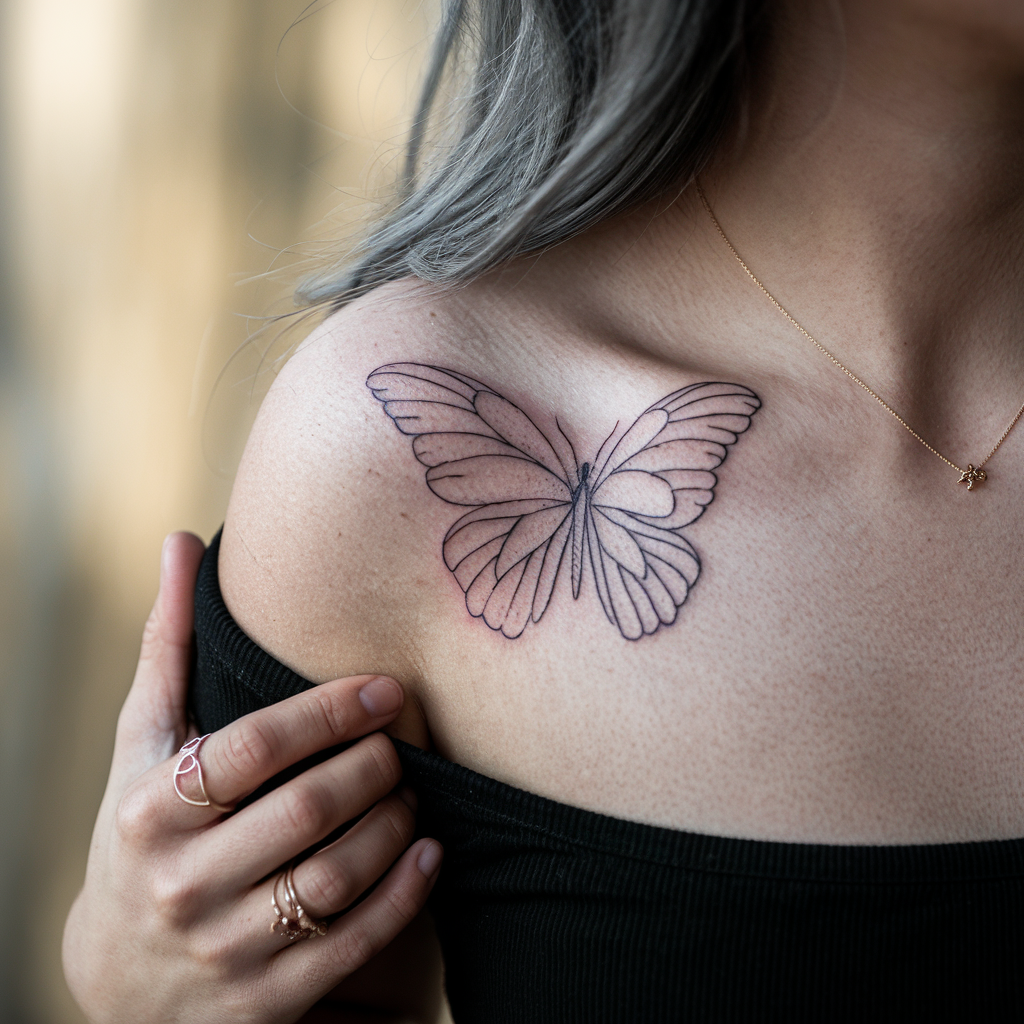
| Something small and private | Single needle, micro fine line | Collarbone, ankle, behind the ear | Going too small guarantees a touch-up within a few years |
| I want to cover an old tattoo | Heavy shading, neo-traditional, large wings | Wherever the old piece already is | The result will be bigger and darker than your reference |
Why Butterfly Symbolism Is So Layered
Most tattoo motifs carry one dominant meaning and a few fringe readings. The butterfly is unusual because it carries at least five strong meanings that are all equally legitimate, and they do not always sit comfortably together.
The reason is that the butterfly earned its symbolism independently in cultures that had no contact with one another. Greece, China, Japan and Mesoamerica all landed on the butterfly as a symbol of the soul without borrowing from each other. That kind of convergence is rare.
What they share is the metamorphosis. A caterpillar enters a chrysalis, breaks down almost completely, and emerges as something structurally unrecognisable. No other common tattoo motif carries a metaphor that literal, which is why every culture that watched it happen reached for the same conclusion.
The practical consequence for you is that your butterfly will be read differently by different people, and you have limited control over that. What you can control is which reading you build in deliberately, through colour, companion elements and placement.
In my experience the people happiest with their butterfly years later are the ones who could answer a simple question at the consultation: which of these meanings is mine? The ones who said transformation and left it there tend to be the ones who come back wanting to add to it.
What a Butterfly Tattoo Means: The Six Main Readings
1. Transformation and Rebirth
This is the dominant meaning and the reason most people book the appointment. It marks a hard before-and-after: recovery, the end of a marriage, surviving an illness, leaving a career or an identity that no longer fit.
It is worth being precise about the distinction, because it changes what the tattoo says. A butterfly does not symbolise change you are hoping for. It symbolises change you have already come through.
Artists I have spoken to describe the difference in the room. People who get one mid-crisis talk about it later as a promise to themselves. People who get one afterwards describe it as a receipt. Both are valid, but they lead to different designs.
If yours is the promise version, I would push you toward something you can build on later, such as a single butterfly with room around it, rather than a finished composition you will want to expand.
2. Grief, Memorial and the Returning Soul
The second most common reason is loss. Butterflies appear at gravesides and funerals across a lot of cultures, and the folk belief that a butterfly arriving unexpectedly is a visit from someone who died is remarkably widespread.
Designed as a memorial, the butterfly behaves like any other remembrance piece and benefits from the same planning. Our guide to memorial tattoo ideas covers the layout decisions that matter most, particularly around adding names and dates.
The one thing I would flag from experience: decide at the start whether a name or date is going in. Squeezing text into a finished butterfly later almost never looks intentional, and artists will tell you the same thing.
3. Freedom and Escape
Freedom is the reading that has grown fastest in the past decade, and it tends to belong to people leaving something behind rather than commemorating it.
Design-wise it looks different from the transformation version. Freedom pieces are usually in motion: wings mid-beat, a loose scatter of butterflies rather than one centred insect, often trailing upward across the body.
If movement is the point, size matters more than detail. A butterfly small enough to be delicate rarely reads as flight. Every artist I have asked about this says the same thing about scatter designs, which is that they need space to work.
4. Femininity, Beauty and Self-Possession
The butterfly has carried a feminine association in Western tattooing for decades, and for a long time that was used to dismiss it as a decorative choice rather than a meaningful one.
That reading has shifted. A lot of people now choose it specifically for its association with beauty that is self-owned rather than performed, and the design language has shifted with it toward botanical pairings and larger, more architectural compositions.
It is also worth saying plainly that the feminine association is cultural, not universal. In Japanese tradition the motif was used by samurai families, and it appears regularly in masculine work today.
5. Faith, the Soul and Resurrection
Christian symbolism maps the butterfly onto resurrection almost exactly: the chrysalis as the tomb, the emergence as new life. It is a common choice for people who want a faith piece that is not an overt cross or scripture.
Outside Christianity the soul reading is older and broader. The Greek word psyche meant both soul and butterfly, and the goddess Psyche was depicted with butterfly wings rather than bird wings.
You can read more about that dual meaning at the Psyche entry in the mythological record, which is where most of the Western soul association ultimately traces back to.
6. Impermanence and Living Fully
There is a quieter reading underneath the optimism. Most butterfly species live only a few weeks as adults, which gives the motif a memento mori edge closer to live fully than to everything gets better.
It is the same territory a butterfly skull tattoo occupies far more explicitly, and it borders the meaning of moth tattoos, which trade the butterfly optimism for something considerably darker.
When I have seen this reading done well, the tell is usually a companion element: a clock, an hourglass, a wilting stem. The butterfly alone rarely communicates it.
7. Love, Pairs and Family
A pair of butterflies is its own symbol rather than just two of the same thing. In Chinese tradition it represents enduring love, and in Japanese tradition it signals marital happiness.
Family versions extend the same logic. A cluster at different scales can represent children, siblings or generations, and it is one of the few motifs that scales to a family group without looking like a list.
If the piece is about a specific relationship, design it as a pair from the start. Adding a second butterfly later to an existing one is one of the hardest matching jobs in tattooing, because the original has already aged.
Butterfly Meanings Across Cultures
If your tattoo is about someone you have lost, or about your own heritage, these are the traditions your design is speaking to whether or not you intend it.
Ancient Greece
The insect was understood as the soul made briefly visible. That single association is responsible for most of the Western link between butterflies and the departed.
China
A pair of butterflies represents enduring love, drawn from the legend of the Butterfly Lovers, in which two separated lovers emerge from a grave as butterflies. A single butterfly can also signal longevity.
Japan
The butterfly, or cho, is associated with a woman soul, while a pair signals marital happiness. Samurai families also used the motif, reading the metamorphosis as rebirth rather than fragility, which is worth knowing if you are weighing up butterfly tattoo ideas for men.
Mexico and Dia de Muertos
Monarchs arrive on their long migration around Dia de Muertos, and are widely understood to carry the souls of returning ancestors. The US Fish and Wildlife Service documents the scale of that migration if you want the biology behind the symbolism.
Christian Tradition
The chrysalis is read as the tomb and the emergence as resurrection. Butterflies appear in Christian funerary art for exactly this reason, long before they appeared in tattooing.
How Colour and Style Change the Meaning
Colour
Colour does more work here than most people expect. Monarch orange and black leans on migration, endurance and ancestral return. A blue morpho reads as luck, joy and the slightly unattainable.
Black butterflies are commonly chosen for grief and remembrance, and specifically for rebirth after loss rather than rebirth in general. White suggests a spirit staying close. Purple tends to be picked for spirituality and intuition.
Colour choice has a practical dimension as well as a symbolic one. Bright oranges, blues and purples fade noticeably faster than black and grey, particularly on skin that catches a lot of sun, so a full-colour butterfly will usually need retouching years before a blackwork one does.
Style
Fine line and single-needle work keeps the piece personal and understated, which suits a meaning you would rather not explain to strangers. Blackwork and realism give it weight and permanence, better matched to grief or hard-won survival.
Watercolour emphasises movement and impermanence, playing to the brevity reading rather than the triumphant one. In my experience it also needs a black structural element somewhere, or it softens into a bruise-like shape within a decade.
Pairings
Butterflies with florals layer transformation against growth and are by far the most common combination. With a clock or hourglass, the meaning tilts firmly toward time and mortality.
With a name or a date it becomes a memorial piece and should be designed as one from the start, with the text laid out before the wings rather than after.
Choosing a Placement That Fits the Meaning
Placement is the part people underthink, and it changes both the symbolism and how often you have to talk about it.
Collarbone, chest and shoulder blade placements sit close to the heart and stay easy to cover, which suits meanings that are private or tied to a specific person.
Wrist and forearm placements are visible to you throughout the day, which is why they work well for sobriety, recovery and other markers you actively want to be reminded of.
Ankle and foot placements are discreet and read as grounded rather than decorative. Hands and fingers are the boldest choice, functioning almost as permanent jewellery, though they fade faster and need more retouching than anywhere else on the body.
Larger pieces such as half sleeves and thigh pieces give you room to tell a sequence rather than a single image, which is worth considering if the tattoo is marking a long process rather than one moment.
Practical Advice Before and After You Sit
Butterflies rely on symmetry, and symmetry is unforgiving. A wing that is slightly off will keep catching your eye for years. This is a design worth spending extra time on at the stencil stage, and worth choosing an artist whose linework you have seen up close and healed, not just fresh on Instagram.
Ask to see healed photos specifically. Fine line butterflies photograph beautifully on day one and tell you almost nothing about how that artist line holds at year three. Any artist worth booking will have healed work to show you.
On aftercare, follow the instructions your artist gives you rather than anything you read online, including here. Keep it clean, keep it out of direct sun while it heals, and do not pick. The American Academy of Dermatology has a clear general guide to caring for tattooed skin.
If you see spreading redness, swelling that increases after the first few days, pus, or you run a fever, that is a doctor visit, not a forum question. Allergic reactions to coloured pigment are uncommon but real, and red ink is the usual culprit. This article is not medical advice, and nothing here replaces a conversation with your artist or a clinician.
Common Mistakes and Still Not Sure?
The most common regret I hear is going too small. A micro butterfly at two centimetres has nowhere to put detail, and the wing pattern closes up as the ink settles.
The second is treating a cover-up like a fresh design. Butterflies are among the most requested cover-up motifs because the wing shape is wide, roughly symmetrical and tolerant of heavy shading. If you are covering something, expect the finished piece to be larger and darker than your reference images, and read up on tattoo cover up ideas before you book.
The third is choosing colour without asking about your own skin tone and sun exposure. Ask the artist directly how that specific palette will age on you. Most will tell you honestly, in most cases before you have to ask twice.
Still undecided on the direction? Browse the full butterfly tattoo gallery for composition ideas, then take three references you keep coming back to into the consultation rather than one.
Frequently Asked Questions
What does a butterfly tattoo mean?
A butterfly tattoo most often means transformation and rebirth, drawn directly from the metamorphosis from caterpillar to adult. Beyond that it commonly carries meanings of grief and remembrance, freedom, the soul, faith and resurrection, and the shortness of life. Which of those applies depends on colour, style, companion elements and placement rather than on the butterfly itself. In my experience, the people who decide which meaning is theirs before the consultation end up with a design that holds up better over time.
Does a black butterfly tattoo mean death?
Not usually. Black butterflies are most often chosen for grief and remembrance, meaning rebirth after a loss rather than death itself. In some folk traditions a black butterfly is read as an omen, but that reading is far less common in tattooing than the memorial one. If you want to avoid any ambiguity, adding a name, date or a single colour accent makes the memorial intent clear.
Is a butterfly tattoo only for women?
No. The feminine association is a Western cultural convention rather than anything inherent to the motif. Japanese tradition used the butterfly in samurai family crests, reading the metamorphosis as rebirth and resilience, and it appears regularly in masculine work today. Larger scale, heavier blackwork and neo-traditional styling all shift the piece away from the delicate fine line version most people picture.
Where is the best place to get a butterfly tattoo?
It depends on what you want the piece to do. Collarbone, chest and shoulder blade placements stay private and sit close to the heart, which suits memorial and personal meanings. Wrist and forearm placements keep the tattoo in your own line of sight, which is why they are popular for recovery markers. Hands and fingers are the boldest option but fade fastest and need the most retouching.
How much does a butterfly tattoo cost?
Prices vary widely by region, artist reputation and size, so any single figure would be misleading. As a rough guide, small fine line butterflies usually fall near a studio minimum, while detailed colour work or a half sleeve is priced by the hour or by the session. Ask for a quote in writing at the consultation, and treat an unusually cheap quote as a reason to look closely at healed work rather than a bargain.
Quick Summary
- Transformation and rebirth is the core meaning, and it points to change you have already come through, not change you are hoping for.
- Grief and remembrance is the second most common reason, and it needs names or dates planned in from the start.
- Freedom, femininity, faith and impermanence are all legitimate readings, each built in through design choices rather than the butterfly alone.
- Colour carries meaning: monarch orange for migration and ancestry, blue for joy, black for remembrance, white for a spirit close by, purple for spirituality.
- Style sets the register: fine line for private, blackwork and realism for weight, watercolour for movement and impermanence.
- Placement changes both the symbolism and how often you explain it, with covered placements suiting private meanings and visible ones suiting daily reminders.
- Butterflies depend on symmetry, so spend the extra time at the stencil stage and check an artist healed work, not just fresh photos.
- For anything involving infection, unusual swelling or a suspected pigment allergy, see a doctor rather than relying on an article.
Ink Your Imagination With Tattoobuild’s Tattoo Design Generator
Once you know which meaning you are after, the next step is seeing it. Tattoobuild’s AI tattoo design generator lets you try butterfly designs in fine line, blackwork, watercolour and colour realism, adjust the placement, and generate variations in seconds rather than waiting weeks on a custom commission.
Plans start at $7.50 a month or $20 a year, and you can save every version you like to a personal gallery to take to your artist.