A cover up is not a fresh start on a blank page. It is a negotiation between the tattoo you have and the tattoo you want, and the old ink always gets a vote.
I have sat in on a lot of cover up consultations, and the moment that decides everything is almost always the same one: the artist puts a hand over the old piece, squints, and starts talking about how dark the new design will need to be.
That conversation is where unrealistic ideas go to die. A pale watercolour hummingbird will not hide a solid black tribal band, no matter how much anyone wants it to.
What follows are 18 cover up directions that actually work in practice, with an honest note on what each one demands. Most of them lean on blackwork techniques for a reason.
Which Cover Up Approach Is Right for You?
The right route depends less on taste than on how dark and how large the existing tattoo is. This is roughly how artists triage it.
| Existing tattoo | Best approach | What to expect |
|---|---|---|
| Faded fine line or old script | Botanical, neo-traditional, or mid-tone colour work | The most design freedom of any cover up scenario |
| Mid-density black and grey | Dark floral, animal portrait, mandala overlay | New piece usually 2–3 times the original footprint |
| Solid black tribal or blackout | Laser sessions first, or extend the blackout | Months of fading before a design becomes possible |
| Saturated colour, especially red | Blackwork, or laser then rework | Reds and yellows ghost through more than people expect |
| Raised or scarred work | Texture-friendly designs, or leave it alone | Ink sits unevenly in scar tissue; results vary a lot |
What Actually Makes a Cover Up Work
Three things decide whether a cover up reads as a new tattoo or as a new tattoo with an old one showing through: value, density, and size.
Value is the big one. Every part of the new design that sits over the old ink has to be darker than what is underneath, because tattoo ink is translucent and layers rather than paints over.
Density is what makes the difference between hiding a line and merely blurring it. Open, airy designs leave gaps, and gaps are where old ink shows.
Size matters because the new piece needs room to breathe outside the old one. In my experience an artist will usually ask for at least a third more surface area than the original occupied, and often much more.
Skin tone also affects what is achievable, since contrast behaves differently on deeper complexions. If that applies to you, it is worth reading up on how designs are adapted for dark skin before you commit to a concept.
18 Tattoo Cover Up Ideas That Actually Hold Up
1. Dark Floral Bouquet
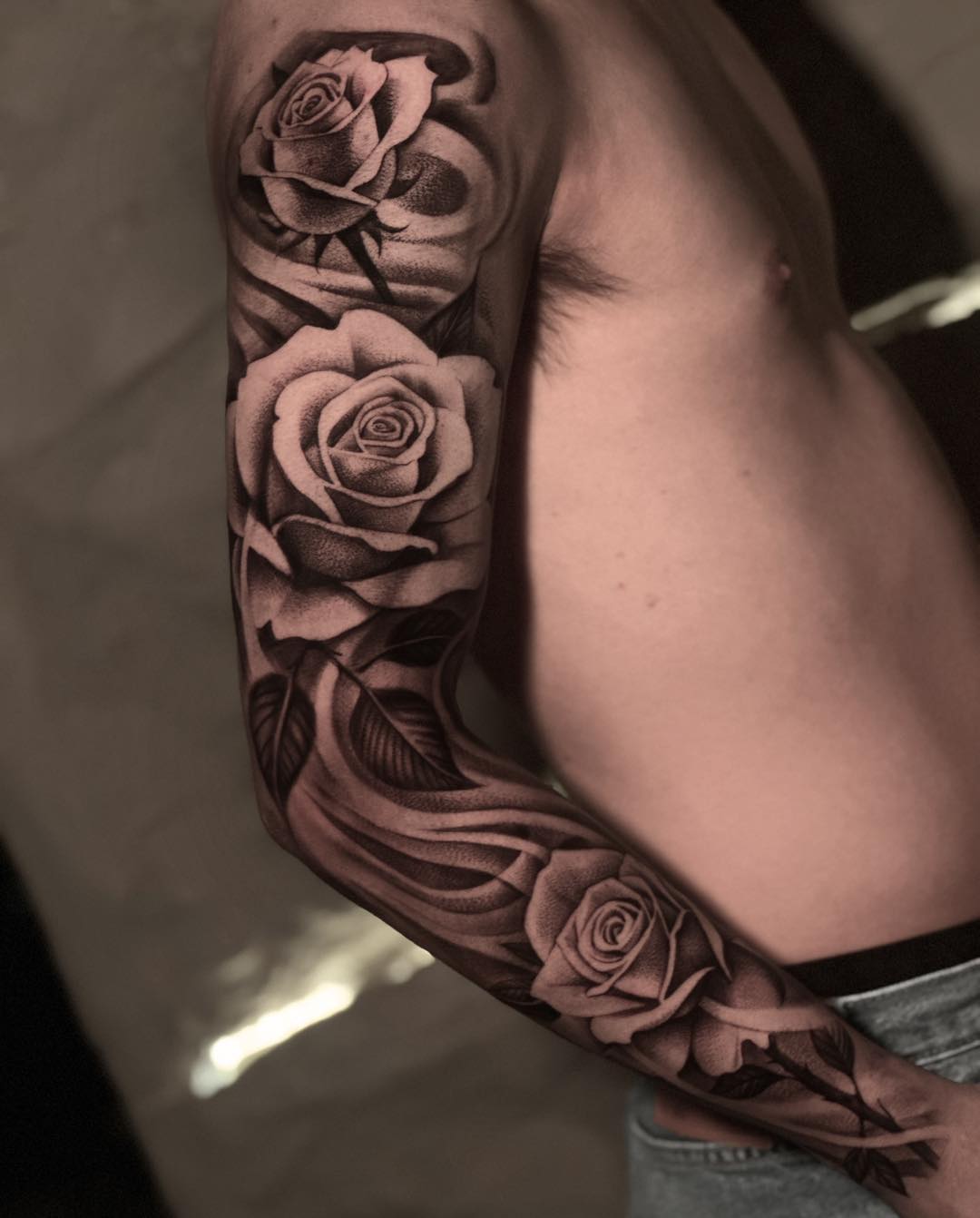
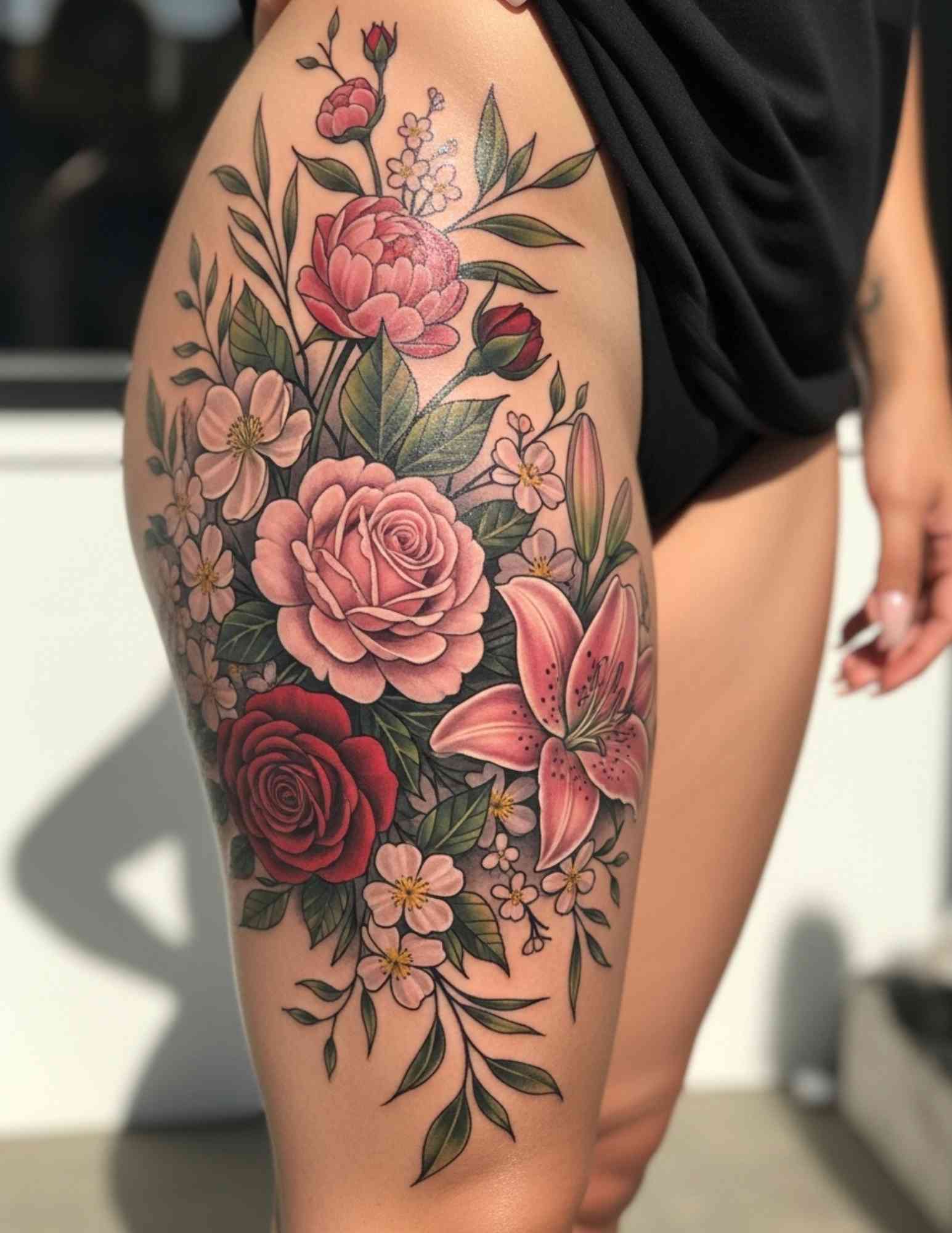
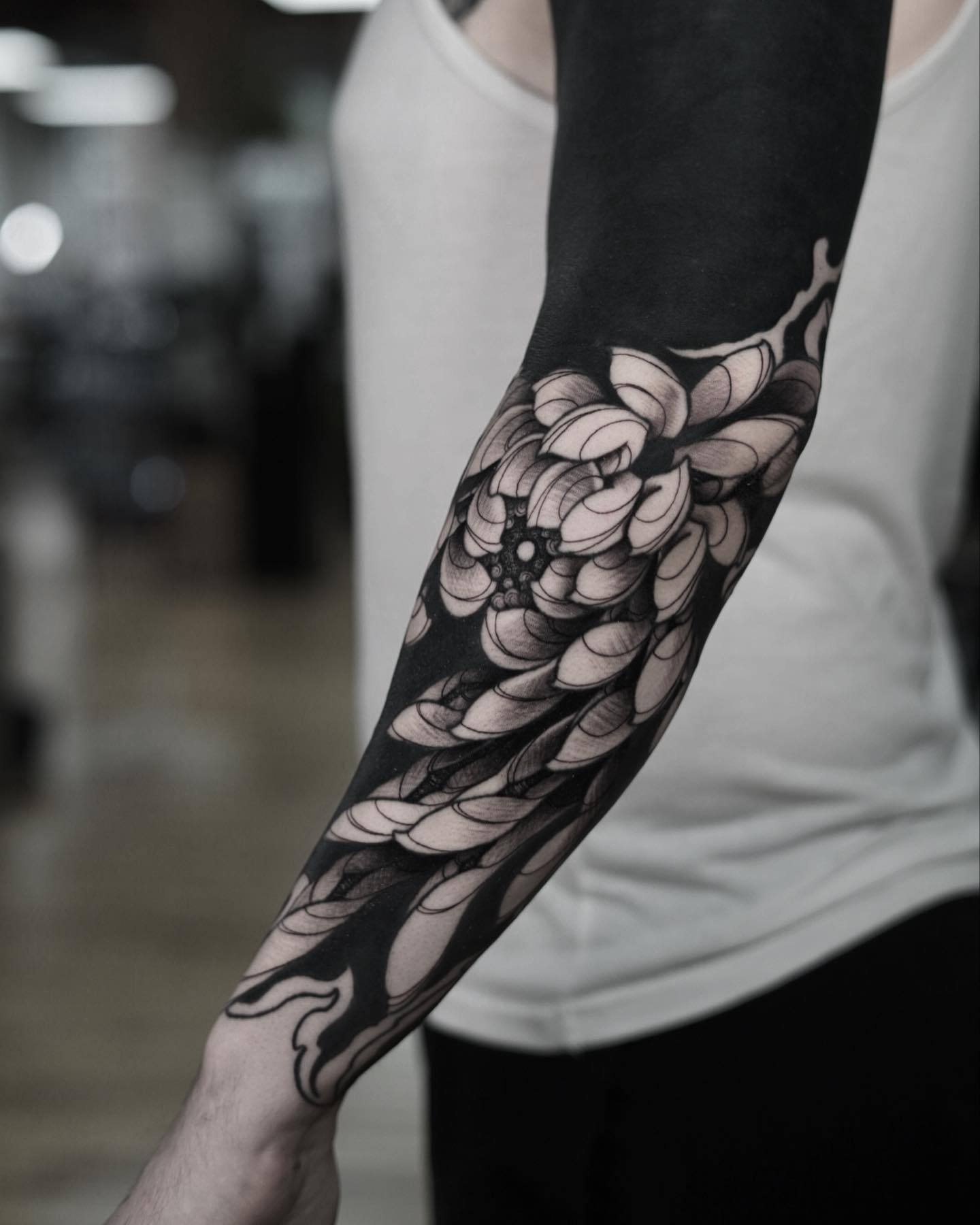
A tight cluster of roses, peonies or dahlias rendered almost entirely in black and grey is the workhorse of cover up design.
The reason is structural: petals overlap, and every overlap is an excuse for a hard shadow.
Ask for the darkest values to land directly on the old outlines, with the lighter petal edges floating in clean skin outside them.
In my experience this is also the most forgiving option if the old piece was mid-tone rather than solid black.
Photo: @rory_rudy
2. Black and Grey Realism Portrait
Realism sounds like a difficult cover up choice and it is, but the style has one enormous advantage: it is built out of shadow.
A portrait with a strong light source gives the artist a whole half of the image to fill with dense black.
The catch is that realism is unforgiving of compromise. If the artist has to darken a cheekbone that should be lit, the likeness suffers.
This one lives or dies on the artist’s skill, so look hard at healed cover up work in their portfolio, not fresh photos.
Photo: @joshschellenberg
3. Blackout Section
A solid blackout band, panel or shape does not so much cover the old tattoo as delete the area it lived in.
It is the only approach that works reliably over saturated black tribal, and it heals into a flat, graphic block.
Be honest with yourself about permanence here. Blacked out skin is very difficult to laser and effectively closes the door on future designs in that spot.
Some artists will leave negative space shapes inside the blackout so it reads as intentional design rather than a redaction.
Photo: @jch.ink
4. Japanese Sleeve or Panel
Traditional Japanese composition incorporates cover up work almost by accident, because the style demands dense background fills regardless.
Wind bars, water, and cloud patterns flow around the primary subject and swallow whatever was there before.
A sleeve or a back panel gives enough real estate that the old tattoo becomes one small dark area among many.
If the aesthetic appeals, it is worth browsing Japanese tattoo designs to see how much background a full composition really involves.
Photo: @capa.tattoo
5. Mandala Overlay
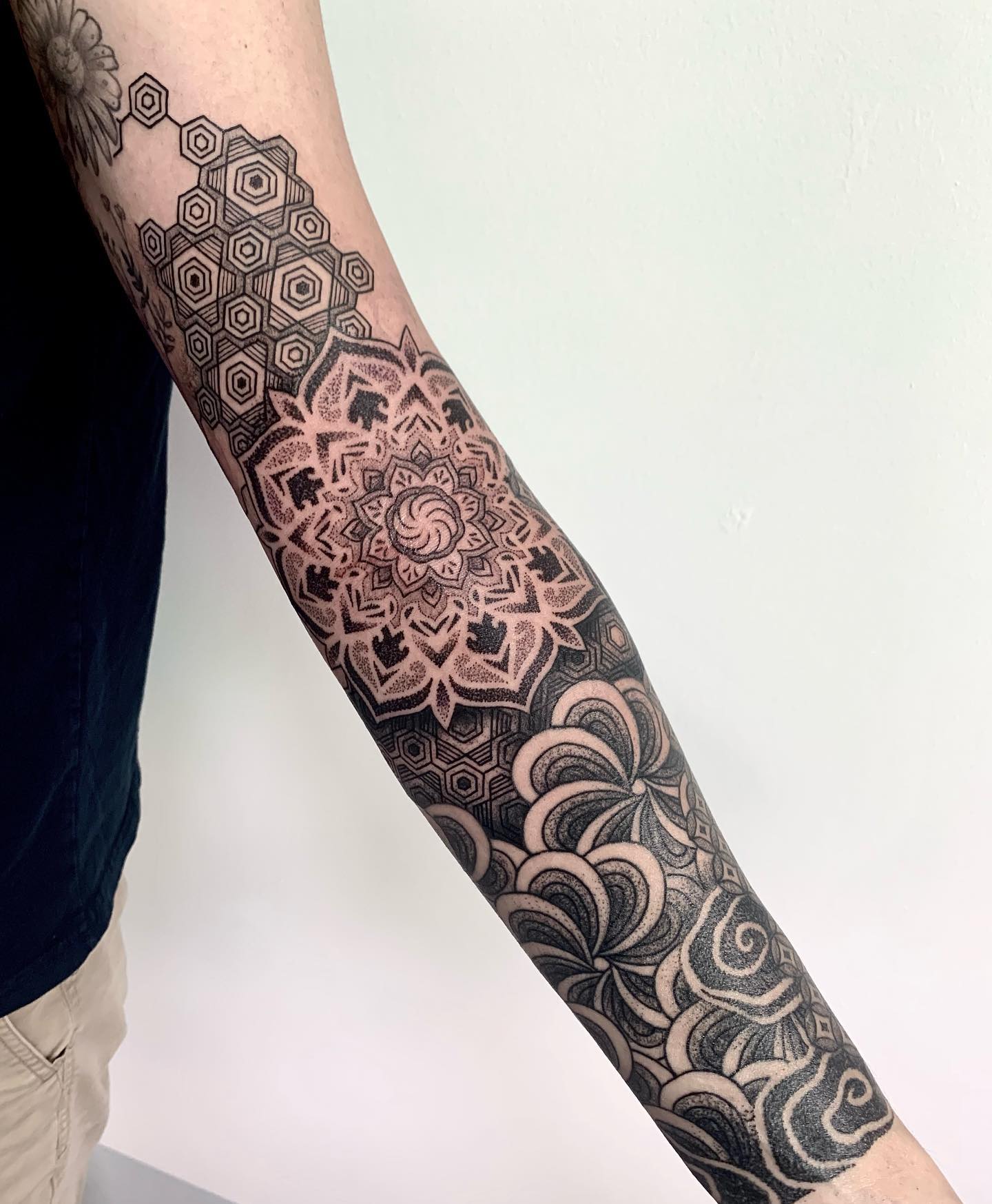
A large mandala centred over the old piece uses radiating geometry and dense dot or line fill to absorb it.
Symmetry does something interesting here: the eye reads the pattern first and stops looking for what is underneath.
The dark bands between rings are where the coverage actually happens, so the design usually needs to be heavier than a decorative mandala would be.
Placement matters more than usual, since a mandala that is off-centre relative to the limb reads as a mistake. Larger mandala sleeve layouts solve this by wrapping the whole arm.
Photo: @gdayinkpakenham
6. Animal Portrait in Blackwork
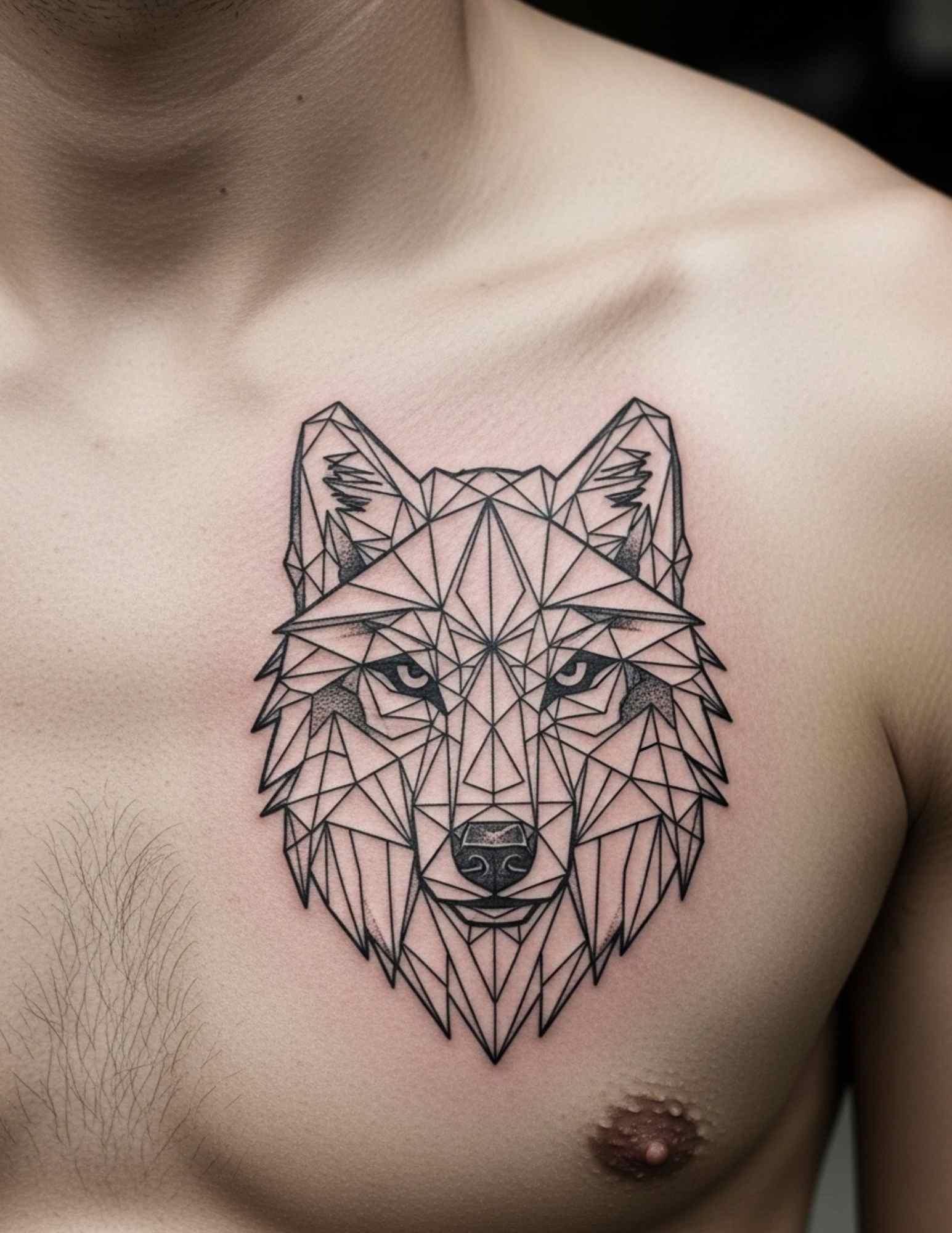
Wolves, bears, ravens and big cats all share a useful quality for cover ups: dense, dark texture across most of the body.
Fur rendered in heavy blackwork is essentially a shading exercise, and shading is what buries old ink.
The eyes and a few highlights stay light, and everything else can be pushed as dark as the coverage requires.
Every artist I have asked about cover ups puts animals near the top of the list, mostly for this reason.
Photo: @ellvee_tattooer
7. Forest or Landscape Scene
A forest scene gives an artist vertical dark shapes they can move around freely.
Tree trunks, undergrowth and shadowed foreground elements can be positioned precisely over the old design without looking arranged.
Landscapes also scale well. A small scene can grow into a half sleeve later without the composition breaking.
The weakness is sky. Open, light areas are where an old tattoo will ghost through, so plan for a night scene or a heavily clouded one.
Photo: @sophie.tattoo.art
8. Neo-Traditional Composition
Neo-traditional work brings two things a cover up wants: thick outlines and saturated colour.
A bold outline cuts a clean boundary that stops the old design bleeding into the new one visually.
Colour helps less than people assume, but saturated jewel tones over a faded mid-tone tattoo genuinely can work.
Ask the artist to keep the palette on the darker end. Pale pinks and yellows sit on top of old ink and usually lose.
Photo: @eileen_tattoos
9. Geometric Blackwork
Geometric blackwork gives up representation in exchange for total control over where the black goes.
Because the design is abstract, the artist can shape the composition around the old tattoo rather than around a subject.
Dense linework, stippling and solid shapes can be tuned area by area to match how dark the underlying ink is.
If you like the language, geometric tattoo designs show how varied the style gets before you commit to a specific layout.
Photo: @sebastian.tattoo
10. Dark Botanical With Thorns
Thorned stems, blackberry vines and thistle give a botanical piece structure without needing to be pretty.
The angular, tangled shapes let an artist route dark lines across the old tattoo in directions a flower alone would not allow.
It suits people who want something organic but not soft.
In practice this one often gets combined with idea one, with thorns handling the awkward edges the bouquet cannot reach.
11. Tribal or Polynesian Extension
If the piece being covered is already tribal, extending it is frequently easier than fighting it.
Bold black curves and filled panels can grow outward, absorbing the original into a larger and better composed design.
This only works if you still like the style, which is a real question worth asking honestly.
Genuine Polynesian patterns carry cultural meaning, so talk with an artist who understands the tradition rather than treating the motifs as decoration.
Photo: @tribal.monkey
12. Reworked Into a New Concept
Not every cover up needs to hide the old tattoo. Sometimes the better answer is to change what it means.
A faded name can become part of a banner. A shaky old rose can be rebuilt with new linework and shading into something competent.
Reworking preserves whatever the tattoo meant while fixing how it looks, and it usually needs far less new surface area.
This is the option most people never consider and the one artists raise most often in consultations.
13. Watercolour Over Fine Line
Watercolour is a weak cover up style in general, with one narrow exception: very faded fine line work.
Old single-needle script or a thin outline that has softened over a decade can genuinely disappear under saturated washes.
Do not expect this to work on anything with weight to it. A bold outline will show straight through a wash.
Ask the artist to photograph the area in flat daylight first, since fine line tattoos often look fainter in person than they photograph.
14. Layered Botanical Sleeve
When there are several old tattoos scattered across an arm, covering them individually rarely looks coherent.
A layered botanical sleeve connects them instead, with dark foliage routed deliberately over each problem area.
It is a long commitment, usually multiple sessions across several months, and the design has to be planned as a whole before the first needle.
The payoff is that the arm reads as one piece rather than a repair history.
Photo: @wes.pratt
15. Dark Portrait: Adding Depth
If the existing tattoo is a portrait that was competently drawn but flatly executed, adding depth can be enough.
Deepening shadows, rebuilding contrast and tightening edges can transform a piece without covering it at all.
This is the cheapest and least invasive option on the list when it applies, which is not often.
It also requires an artist willing to work on someone else’s tattoo, and not all of them are.
Photo: @tonyraztattoo
16. Scarification Camouflage
Covering raised scar tissue, whether from old scarification or a badly healed tattoo, is a different problem from covering ink.
Ink behaves unpredictably in scar tissue: it can spread, sit patchily, or refuse to hold at all.
Designs with irregular organic texture hide inconsistent saturation far better than clean linework does.
Any reputable artist will want the scar fully mature, generally at least a year old, before tattooing over it, and some will decline entirely. If the skin is still changing, see a doctor rather than an artist.
17. Laser Pre-Treatment Then Cover Up
You do not need full removal to get a much better cover up. A few laser sessions to lighten the old piece can open up options that were impossible before.
Partial fading is a standard, widely used approach, and many artists will send clients for it before agreeing to a design.
Expect a real timeline: sessions are spaced weeks apart, and the skin needs to settle before new work goes over it. The American Academy of Dermatology is a reasonable starting point on what removal actually involves.
Budget accordingly. Laser plus a cover up costs more than either alone, and removal pricing varies widely by size and ink colour.
18. Starting Over: Full Blackout
For a heavily tattooed limb that has become a patchwork, some people choose to black the whole thing out and start fresh.
It is drastic, it takes multiple long sessions, and it hurts more than most work because of the sheer volume of saturated packing.
Some artists later add white or red ink designs over healed blackout, though results are inconsistent and it is not something to count on.
Think of it as a destination rather than a step. Choose it because you want solid black, not because you are out of patience.
Photo: @felipexsanto
When a Cover Up Is Not the Right Answer
Covering is one option among several, and it is not always the best one.
Full Laser Removal
If you want the skin back rather than a different tattoo, removal is the honest route, and it takes many sessions spread over a year or more.
Results depend heavily on ink colour, depth, age and your own skin. Black fades most readily; some greens and light blues are stubborn.
A Touch Up by a Better Artist
Plenty of tattoos people hate are not badly designed, just badly healed or poorly saturated.
Before booking a cover up, it is worth asking one good artist whether the piece can simply be redone properly. Sometimes the answer is yes.
Expanding Instead of Covering
A tattoo that looks wrong in isolation can look intentional inside a larger composition.
Adding around a piece is usually cheaper, less painful and more reversible than covering it.
Waiting
Cover ups made in a hurry are the ones people come back to regret twice.
If you cannot describe what you want beyond “anything but this”, that is a reason to wait a few months rather than book.
Healing a Cover Up Is Harder Than Healing a New Tattoo
This is the part people underestimate. A cover up puts far more ink into the skin than a comparable first tattoo, because the artist is saturating heavily to achieve opacity.
Expect more swelling, more weeping in the first two days, and a longer scabbing phase. The area often stays tender several days past what you would expect from the size alone.
Follow whatever aftercare your artist gives you rather than what you read online, since they know how hard they packed the ink. Our general tattoo aftercare guide covers the basics if you want a reference alongside their instructions.
Heavily saturated work is also more prone to patchy healing, so plan on at least one touch up session and do not panic if the piece looks uneven at week three.
Watch for genuine warning signs rather than normal healing: spreading redness, heat, pus, or a fever are reasons to see a doctor, not to ask an artist. The Mayo Clinic’s overview of tattoo risks is a sensible reference, and nothing in this article is medical advice.
Common Cover Up Mistakes, and What to Do Instead
The most common one is bringing a reference image that is lighter than the tattoo being covered, then being disappointed when the artist changes it.
The second is insisting on keeping the new design the same size as the old one. Coverage needs room, and refusing to give it is how you end up with a visible ghost.
The third is booking with whoever is available. Cover up work is a specialisation, and not every excellent artist does it well.
Ask to see healed cover up photos specifically, taken months after the session, and ask what was underneath. An artist who is proud of their cover up work will have those photos ready.
Still unsure what direction fits? It helps to know how the ink settles over the first month, which our guide to the tattoo healing stages walks through in order.
Frequently Asked Questions
Can any tattoo be covered up?
Almost any tattoo can be covered in some way, but not with any design you like. Solid black, heavily saturated work, and dense scarring narrow the options sharply, sometimes down to a blackout or nothing. In those cases artists usually recommend laser fading first. The honest answer from most artists is that the question is not whether, but what you are willing to accept.
How much bigger does a cover up have to be?
There is no fixed ratio, but expect meaningfully larger. In consultations I have watched, artists commonly sketch something around twice the footprint of the original, and more when the old ink is dark. The extra area is not decoration; it gives the composition somewhere to resolve outside the covered zone. If an artist tells you a same-size cover up will work, ask to see a healed example.
Will the old tattoo eventually show through?
It can, particularly as the new work softens over years and the contrast between layers narrows. Well-executed cover ups on suitable candidates usually hold up fine, but sun exposure accelerates the problem considerably. Daily sunscreen on the area once it is fully healed is the single most useful thing you can do. A touch up every several years is normal for heavy cover up work.
Does a cover up hurt more than a normal tattoo?
Usually yes, though not because the technique is different. Cover ups involve more passes over the same skin and heavier ink packing, so the session runs longer and the area gets worked harder. People who found their original tattoo manageable often describe the cover up as noticeably rougher. Splitting the work across sessions helps more than any numbing product.
Should I get laser treatment before a cover up?
It depends entirely on how dark the existing tattoo is and what you want over it. If your desired design is lighter or more detailed than the old piece allows, a few fading sessions can make it possible. If you are happy with a dark, dense design, laser may be unnecessary expense and delay. The most reliable approach is to ask a cover up artist first and let them decide whether to send you for fading.
Quick Summary
- Every part of a cover up that sits over old ink must be darker than what is underneath.
- Dense designs cover; open, airy designs leave gaps where old ink ghosts through.
- Plan for a new piece substantially larger than the original, often around double.
- Dark florals, blackwork animals, mandalas, Japanese panels and geometric work are the most reliable styles.
- Reworking or expanding an existing tattoo is often better than covering it, and rarely considered.
- A few laser fading sessions can unlock designs that are otherwise impossible.
- Cover ups heal harder than fresh tattoos, so expect swelling, patchiness and at least one touch up.
- Book a cover up specialist and ask specifically for healed photos with the original visible.