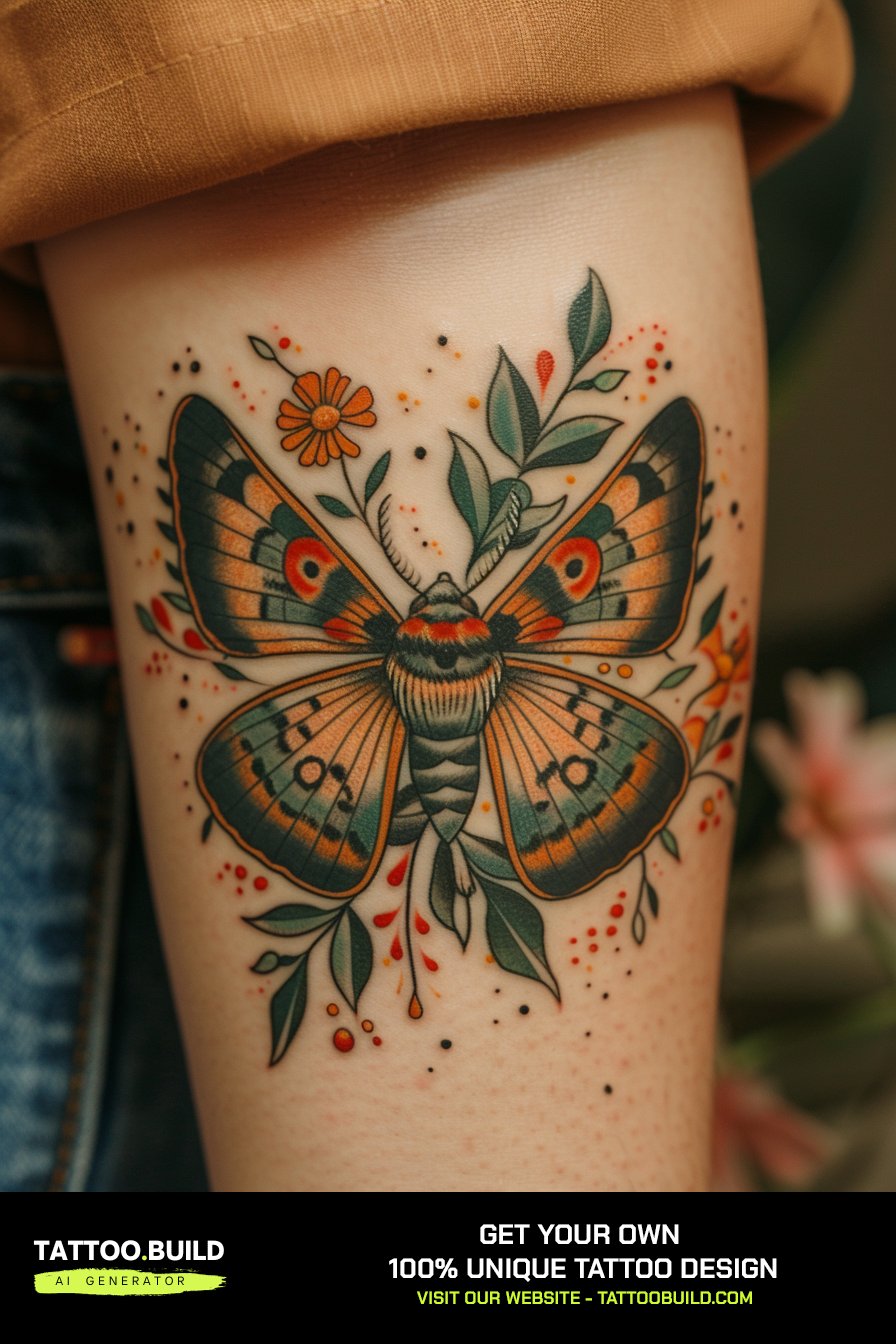
A moth tattoo is not a darker butterfly — it is a completely different idea wearing similar wings. Butterflies chase the sun. Moths navigate by the moon, and get it wrong often enough that “drawn to the flame” became shorthand for wanting something that might hurt you.
I have been writing about tattoo design for years, and moths are one of the few motifs where almost everyone who asks for one already has a reason. It is rarely a spur-of-the-moment choice.
This guide covers what moths actually symbolise, the design variations worth knowing, honest advice on placement and longevity, and 56 real moth tattoo ideas to take to your artist. If you want the softer, brighter version of this symbolism instead, our butterfly tattoo ideas guide covers that side.
Every image below is a real design. Use them as reference for a conversation with an artist, not as something to copy line for line.
Which Moth Tattoo Style Is Right for You?
Style matters more than subject with moths, because the wings can carry an enormous amount of detail — or almost none — and both can look excellent.
This is the comparison I keep coming back to when someone is stuck between approaches.
| Style | Best For | Typical Size | How It Ages | Watch Out For |
|---|---|---|---|---|
| Fine line | Delicate, quiet pieces | 2–5 inches | Softens noticeably over 5–10 years | Antennae and thin wing lines closing up |
| Blackwork / dotwork | High contrast, bold statement | 4–8 inches | Very well — solid black holds | Long single sessions; it is a lot of ink |
| Neo-traditional | Colour and strong shape | 4–9 inches | Excellent, thanks to the heavy outline | Finding an artist who genuinely does the style |
| Realism | Species accuracy, wing texture | 6 inches and up | Good if sized correctly, poorly if small | Cramming realism into a small space |
| Illustrative / sketch | Personality and looseness | 3–7 inches | Usually well; depends on line weight | Sketch lines reading as a mistake later |
| Ornamental / geometric | Symmetry and pattern | 4–8 inches | Well, if dot spacing is generous | Tight dotwork blurring into grey |
If you are torn, my honest advice is to size up and simplify rather than shrink and add detail. That single decision fixes most of the regret I hear about.
What Moth Tattoos Actually Mean
The core meaning is transformation that happens in the dark. Moths go through the same complete metamorphosis butterflies do, but the whole story plays out at night and mostly unwatched.
That is why moths tend to appeal to people marking a private change — grief, recovery, leaving something behind — rather than a public one.
The second meaning is attraction to light, and it cuts both ways. It can read as pursuing something meaningful, or as being pulled toward what will burn you. Most people I have spoken to about their moth tattoo like that the symbol refuses to pick a side.
Third is intuition and the unseen. Moths are associated with the moon, with dreams, and in a lot of folk traditions with messages from the dead — though those associations vary widely by culture, so I would not present any single reading as universal.
And sometimes there is no symbolism at all. Some people just think moths look better than butterflies, which is a perfectly good reason to get one.
Popular Moth Tattoo Ideas and What They Mean
These are the variations that come up most often, roughly in order of how frequently I see them requested.
1. Death’s-Head Moth Tattoo
The skull-shaped marking on the thorax of the death’s-head hawkmoth is genuinely there — it is not a tattoo artist’s invention. The species is Acherontia atropos, named after a figure from Greek myth, and you can read the entomology on its Wikipedia entry.
It became a cultural fixture after appearing on the poster for The Silence of the Lambs, and a fair share of requests still trace back to that image.
Design-wise, this is the moth that most rewards size. The skull marking needs room, and at three inches it turns into a grey smudge within a few years.
Best in: blackwork or black and grey realism, five inches or larger, on the forearm, thigh or sternum. If dark imagery is your direction generally, blackwork tattoo designs are worth browsing alongside this.
2. Luna Moth Tattoo
The luna moth (Actias luna) is the pale green one with long trailing hindwing tails. Adults have no functional mouthparts and live only about a week, which is where the “beautiful and brief” symbolism comes from — the species description confirms the short adult lifespan.
Those tails are the whole design. Tell your artist to exaggerate them slightly; they read better on skin than in a reference photo.
Luna moths are also the strongest argument for colour in this category. That soft green is the point of the species — though be honest with yourself that pale greens fade faster than black, particularly on sun-exposed skin.
Best in: soft colour wash or fine line black and grey, on the sternum, spine or outer forearm where the vertical shape has room.
3. Moth and Moon Tattoo
This is the pairing I see requested more than any other, and it makes structural sense: a circle behind a symmetrical shape is just a good composition.
The moon gives you contrast for free. A solid or heavily shaded circle behind pale wings does more for legibility than any amount of extra wing detail.
Adding a moon phase band above or below turns it into a piece about cycles rather than a single moment — useful if the tattoo is marking something ongoing.
Best in: any style. See moon phase tattoo ideas for how the band is usually laid out, which is also where most of the star and filler work comes from.
4. Moth and Skull Tattoo
Distinct from the death’s-head: here an actual human skull is worked into the design, often replacing the moth’s body entirely.
It is the most explicitly memento mori version of the motif — transformation and mortality in one image, with no ambiguity left.
The design risk is competition. A skull and a detailed moth both want to be the focal point, so one has to give. In the pieces that work, the wings are simplified and the skull carries the detail.
Best in: blackwork or black and grey, six inches or more. Related: butterfly skull tattoo meaning covers the lighter cousin of this design.
5. Moth and Lightbulb or Flame Tattoo
The flame version is the older one and reads as classical. The lightbulb version is the modern update, and I find it lands harder — it is a more honest picture of what actually draws moths in now.
Both carry the same meaning: pursuit of something bright, with the risk built in rather than edited out.
Compositionally, keep the light source small. A large bulb overwhelms the moth and the piece stops being a moth tattoo.
Best in: illustrative or neo-traditional, four to seven inches, on the inner arm or calf.
6. Floral Moth Tattoo
Adding florals is the standard fix when someone loves the moth but does not want the piece to read as dark.
Roses, peonies and lavender are the three I see most. Peonies fill space fastest, lavender keeps things airy, roses sit in between.
One warning from experience: florals expand. What starts as “a moth with a couple of flowers” often ends up a half sleeve. Decide the outer boundary before the stencil goes on.
Best in: illustrative or neo-traditional, on the upper arm, thigh or shoulder. Keep the flower count low if you want the moth to stay the subject.
7. Geometric and Ornamental Moth Tattoo
Because moths are bilaterally symmetrical, they take geometry better than almost any other insect. Mandala work inside the wings looks intentional rather than imposed.
The catch is dot spacing. Dotwork that looks crisp on paper can migrate into flat grey after a decade, so ask your artist to space it more generously than the drawing suggests.
Ornamental versions — gems, chains, filigree beneath the body — turn the moth into jewellery. These sit particularly well on the sternum.
Best in: dotwork and blackwork, four to eight inches, on the sternum, spine or centre chest. See sternum tattoo ideas for placement reference.
8. Realistic Moth Tattoo
Realism is the highest-skill option here and the least forgiving. Wing scales, feathered antennae and subtle colour shifts need both a specialist and real estate.
Six inches is roughly the floor. Below that, the texture that makes realism worth doing simply cannot be resolved on skin.
If you want a specific species — an atlas moth, a rosy maple, an io — bring several reference photos from different angles. Every artist I have asked says a single flat reference is the most common reason a realistic insect comes out looking wrong.
Best in: black and grey or full colour realism, six inches and up, on the thigh, back or upper arm.
Alternatives and Variations Worth Considering
If the standard moth is not quite right, these are the directions people usually move in.
Wings Without a Body
Abstracting the moth down to two wings across the collarbones or shoulder blades keeps the symbolism and drops the insect-on-skin quality that some people find off-putting.
Micro Moths
Coin-sized moths behind the ear, on the finger or on the ankle look lovely fresh. They are also the pieces most likely to need a touch-up inside five years.
If you go this route, insist on the simplest possible design — a silhouette and two antennae, nothing more.
Matching and Companion Moths
Moths work well as matching pieces because the shape is instantly recognisable even when reduced to eight or nine lines.
Keep both simple and identical. Matching tattoos that differ in detail level age at different rates and stop matching.
Butterfly or Dragonfly Instead
A butterfly reads brighter and more hopeful; a dragonfly gives you similar wing detail with an association to water and adaptability rather than night.
If you are still weighing it up, what a butterfly tattoo means is the honest side-by-side.
Moth Combined With an Object
Hourglasses, daggers, keys and eyes all pair with moths without fighting them, because each adds a layer of meaning rather than competing visually.
Placement, Size and What to Expect From the Session
Moths are vertical and symmetrical, which narrows the placement question considerably.
The four placements that suit the shape best are the sternum, the spine, the inner or outer forearm, and the thigh. All four give you a natural centre line for the body of the moth.
Sternum and spine are the most visually correct and among the more uncomfortable spots — both sit close to bone. The most painful tattoo spots guide is worth reading before you book either.
For session length, expect roughly two to three hours for a mid-size fine line moth and five hours or more for a large blackwork or realistic piece. Artists vary, so ask for their own estimate rather than trusting a general figure.
On the hands, feet and fingers, ink breaks down faster than anywhere else because of constant friction and sun exposure. It is still a valid choice — just budget for touch-ups rather than being surprised by them.
Beyond those four, the shoulder blade, calf and back of the upper arm all work well and are easier to keep covered day to day.
Tips for a Moth Tattoo That Still Looks Good in Ten Years
Size up and simplify. If I could give one piece of advice about moth tattoos specifically, this is it. Detail that cannot survive is worse than detail you never had.
Ask to see healed work, not just fresh photos. Fresh line work looks sharper than it will ever look again, and a portfolio of day-one photos tells you very little about how an artist’s tattoos settle.
On aftercare, follow whatever your artist tells you — they know their inks and their technique. The general principles are well summarised by the American Academy of Dermatology: keep it clean, moisturise lightly, do not pick at it, and keep it out of the sun.
Once it is healed, sunscreen is the single biggest factor in how long the piece stays sharp. Fine line work on a forearm that never sees SPF fades noticeably faster than the same tattoo on a covered thigh.
If you notice spreading redness, swelling that worsens after the first few days, pus, or a fever, that is a matter for a doctor rather than a tattoo forum. The same goes for a rash or persistent itching that could be an ink allergy — this article is design guidance, not medical advice.
Common Mistakes — and What to Do If You Are Still Not Sure
The most common mistake is booking a small realistic moth. It is the one combination that reliably disappoints, because realism needs texture and texture needs space.
Second is picking a species without checking what it looks like. Death’s-head, luna and atlas moths are visually distinct, and an artist working from a vague brief will fill the gap with a generic moth.
Third is going in with one flat reference image. Bring three or four, and be clear about which parts of each you actually want.
Fourth is choosing an artist by price rather than portfolio. A moth is a symmetry test — flaws show immediately in a way they would not on an abstract design.
Still undecided? It is often useful to look sideways rather than harder. Fine line tattoo ideas will tell you whether that style suits you at all, moth tattoo drawings show the same subject at sketch stage, and moon tattoo ideas cover the companion element most people end up adding.
Frequently Asked Questions
What does a moth tattoo symbolise?
Most commonly transformation, intuition and attraction to light. Because moths metamorphose at night rather than in daylight, the symbolism leans toward private or difficult change rather than a celebratory one. The moth-to-flame association adds a second layer about pursuing something that carries risk. Cultural readings vary a lot, so the meaning your tattoo carries is largely the one you assign it.
Is a moth tattoo bad luck?
No. Some folk traditions associate moths with death or with messages from those who have died, but there is no broad tradition treating them as unlucky. Many people choose a moth precisely because of the connection to mortality and change, and read it as grounding rather than ominous. If a specific cultural association matters to you, it is worth researching that tradition directly.
How much does a moth tattoo cost?
It depends far more on size, style and your artist’s rate than on the subject. A small fine line moth is a short session; a large blackwork or realistic piece can run several sessions. Rates vary enormously by city and by artist experience, so the only reliable number is a quote from the artist you actually want to book. Be wary of prices well below local norms.
What is the difference between a moth and a butterfly tattoo?
Visually, moths have fuller bodies, feathered antennae and wings that rest spread flat, while butterflies are slimmer with club-tipped antennae and often fold their wings up. Symbolically, butterflies read as rebirth, lightness and joy, and moths as transformation in darkness, intuition and risk. Moths also tend to suit black and grey work better, while butterflies carry colour more naturally.
Where does a moth tattoo look best?
The sternum, spine, forearm and thigh suit the shape best, because each gives the symmetrical body a natural centre line to sit on. Sternum and spine are the most visually striking and also among the more painful placements. Forearm and thigh are gentler and easier to size up. Hands and fingers are possible but fade faster and need more touch-ups.
Quick Summary
- Moths mean transformation in the dark — private change, intuition, and attraction to something bright and risky.
- The death’s-head skull marking is real anatomy of Acherontia atropos, not an artistic addition.
- Luna moths are the strongest case for colour, but pale green fades faster than black.
- Moon pairings are the most requested variation and give you contrast for free.
- Sternum, spine, forearm and thigh suit the symmetrical shape best.
- Size up and simplify — small realistic moths are the most common regret.
- Ask to see healed work, bring three or four references, and choose on portfolio rather than price.
- Follow your artist’s aftercare, use sunscreen once healed, and see a doctor for any sign of infection or allergic reaction.