A mermaid tattoo lives or dies on the tail — the face gets the attention, but the tail is what makes the whole design read as underwater instead of just a woman with long hair. That is the single most useful thing I have learned from looking at hundreds of these designs.
I have been collecting and comparing mermaid tattoos for this site for years, and the pattern is consistent. The ones that still look good after a decade are the ones with clear silhouettes and deliberate negative space.
Mermaids sit at a useful crossroads: fantasy, ocean symbolism, and old sailor superstition all in one figure. If the water side is what draws you, it is worth browsing broader ocean tattoo ideas alongside this guide.
Below you will find 24 designs grouped by style, an honest comparison of which approach suits which body part, and the practical questions to ask before you book.
Which Mermaid Tattoo Style Is Right for You?
There is no single best style — there is the style that matches your placement, your budget and how much you sit still.
| Style | Best placement | Typical session | How it ages |
|---|---|---|---|
| Minimalist / fine line | Forearm, ankle, ribs | 1–2 hours | Softens; may need a touch-up sooner than bolder work |
| Cartoon / neo-traditional | Upper arm, calf, thigh | 3–5 hours | Very well — bold outlines hold the shape |
| Black and gray realism | Thigh, back, full forearm | 6–12 hours, often split | Predictably, if the artist leaves contrast |
| Watercolour | Shoulder, upper back | 3–6 hours | Fades faster without a line structure underneath |
| Blackwork / silhouette | Spine, calf, upper arm | 2–4 hours | Excellent; solid black is the most durable ink |
If the middle two rows appeal to you, it is worth reading up on watercolour tattoo ideas before committing, because that style has the widest gap between how it looks fresh and how it looks at year five.
What Mermaid Tattoos Actually Mean
Meaning is personal, but a few readings come up again and again when I ask people why they chose a mermaid.
The most common is duality — half at home on land, half in the water. People in the middle of a big life change gravitate to it.
Then there is freedom and self-possession. In folklore, the mermaid answers to nobody, which is a large part of her staying power as an image; the folkloric background is genuinely old and cross-cultural.
Sailors historically read mermaids as a warning rather than a blessing, which is why some traditional flash pairs them with wrecks and anchors. If you want the old-school reading, tell your artist that up front.
And plenty of people choose one for no symbolic reason at all. Loving the ocean is a complete answer, and in my experience the people who say that are the least likely to regret the tattoo.
Mermaid Tattoo Ideas by Style
Each of the sections below groups real designs so you can see how the same subject changes with technique and placement.
1. Minimalist Mermaid Tattoo
A minimalist mermaid is mostly silhouette: one continuous outline, a suggestion of hair, and a tail that does the storytelling.
When I have compared these side by side, the successful ones keep the tail slightly oversized. A realistic proportion reads as thin and fussy at small scale.
This style is the cheapest entry point — usually a single short session — and it sits comfortably next to other minimalist tattoo ideas if you already have small work.
The honest downside: fine lines spread over time. Most artists I have asked expect a touch-up somewhere between year five and year ten, especially on high-friction spots.
2. Cute Mermaid Ankle Tattoo
The ankle suits a small mermaid because the curve of the bone gives the tail a natural place to wrap.
Keep the design under roughly three inches. Past that it starts to fight the ankle rather than follow it.
Ankles are also easy to hide under socks, which matters if your workplace is conservative. There are more placement options in our guide to ankle tattoo ideas.
Be warned that the ankle is bony and the healing week involves shoes rubbing the tattoo. Every artist I have asked rates it as more uncomfortable than the forearm.
3. Cartoonish Mermaid Tattoo
Cartoon and neo-traditional mermaids use heavy outlines and flat colour, and they are the most reliable long-term choice on this page.
Bold outlines are what keep a tattoo legible at arm’s length twenty years on. That is not an aesthetic opinion; it is how ink behaves as it spreads.
This style also gives you room to play — a shell top, a starfish, an exaggerated wave — without the design collapsing into visual noise.
Expect three to five hours for a palm-sized piece with solid colour packing. Colour packing hurts more than linework, and it needs the most careful aftercare.
4. Mermaid and Sun Tattoo
Pairing a mermaid with a sun solves a compositional problem: it gives the artist a background element that fills the space behind her.
The two usual approaches are a rayed sun arcing over the figure, or a solid circle behind her as a halo.
The circle version is easier to place on an upper arm; the rayed version needs width. If you want the sun to lead, look through these sun tattoo designs first and pick the sun before the mermaid.
One practical note from experience: a heavily rayed sun is a lot of black in one area, which means a longer heal and more scabbing than people expect.
5. Mermaid and Bubbles Tattoo
Bubbles are the cheapest way to make a mermaid look like she is actually underwater rather than pasted onto skin.
They also fill awkward gaps. When I have watched artists sketch these, the bubbles almost always get placed last, once the body is positioned.
Ask for varied bubble sizes and a little clustering. Evenly spaced identical circles look mechanical and are the most common way this idea goes wrong.
Small open circles are one of the first details to blur with age, so it is worth having a few of them drawn slightly larger than feels necessary.
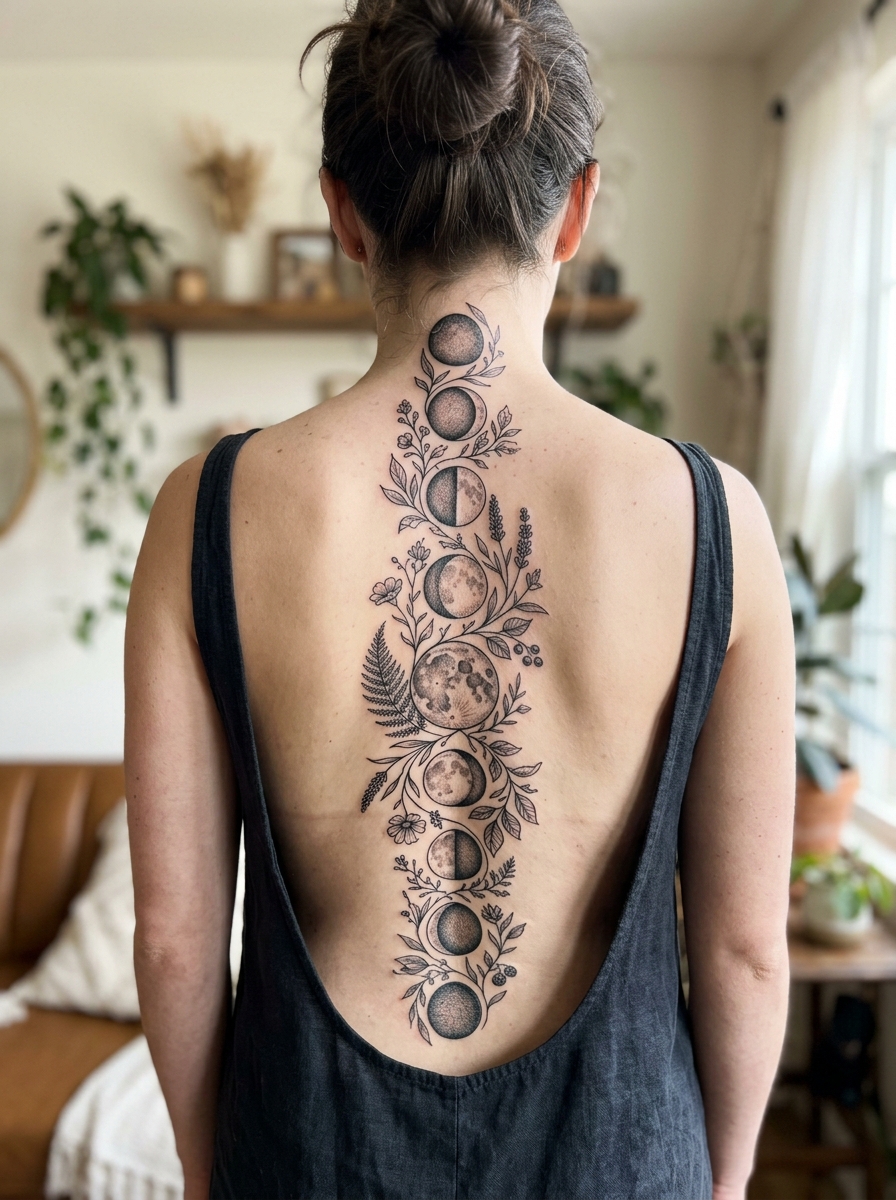
6. Mermaid Spine Tattoo
The spine is the most flattering placement for a mermaid, because a long vertical tail matches the shape of the space exactly.
These are usually done in fine line or blackwork, running anywhere from the nape to the mid-back.
It is a genuinely painful placement — thin skin directly over bone, and the vibration carries. Read our honest rundown of spine tattoo ideas before you book a long session.
Plan the alignment while standing, not lying down. A spine piece drawn on a curved back can sit crooked when you straighten up.
7. Mermaid and Flower Tattoo
Florals soften a mermaid and, more usefully, help her blend into an existing collection of botanical tattoos.
Roses, lotus and loose wildflowers are the ones I see most often, usually framing the figure rather than overlapping her.
Keep the flowers in one visual weight class. Highly detailed realistic blooms next to a simply drawn mermaid make the mermaid look unfinished.
This combination scales well: it works at four inches on a forearm and at fifteen on a thigh, which is not true of most designs here.
8. Mermaid and Moon Tattoo
The moon-and-mermaid pairing has an actual logic to it, since the moon drives the tides.
A crescent gives the figure something to sit in, curl around, or be framed by, which is why it appears more often than a full moon.
Fine line versions of this suit the inner forearm particularly well. If the celestial half is the draw, our moon tattoo ideas guide covers phases and placements in more depth.
If you add stars, ask for uneven spacing. Symmetrical star fields are the detail that most often makes a piece look like clip art.
Variations Worth Considering
If none of the eight above fit, these two directions cover most of what is left.
Black and Gray Mermaid Tattoos
Black and gray is where mermaid tattoos get serious. Realistic shading on scales and hair is a long sit, but it ages more predictably than colour.
The thing to insist on is contrast — real black in the shadows and genuine untouched skin for highlights. Grey-on-grey turns into a smudge. Our black and grey tattoo gallery shows the difference clearly.
Budget six to twelve hours for a large piece, usually split across two or three sittings with two to four weeks between.
Mermaid and Wave Tattoos
Adding a wave anchors the mermaid in water instead of leaving her floating on bare skin.
Japanese-influenced wave linework is the most common approach, and it wraps limbs better than almost any other background element.
Waves also give you a clear direction of flow, which matters if you eventually want to extend the piece into a sleeve.
The trade-off is time: a full wave background can double the hours of an otherwise simple mermaid.
Practical Tips Before and After You Get Inked
Bring reference images of tails specifically, not just whole mermaids. Tail shape is the detail people are most particular about and the one they describe worst in words.
Ask to see healed photographs of the artist’s work, not just fresh ones. Fresh tattoos all look good; healed work is where technique shows.
For aftercare, follow the instructions your artist gives you over anything you read online, including this page. General guidance on tattoo risks and healing from the Mayo Clinic is a reasonable baseline, but your artist knows your skin and their ink.
Two things are worth taking seriously: signs of infection — spreading redness, heat, pus or fever — mean a doctor, not a forum, and reactions to red and yellow pigments do happen. The FDA notes that tattoo inks are not comprehensively pre-approved, so ask what your artist uses if you have pigment sensitivities.
Once healed, sunscreen is the single most effective thing you can do. Colour mermaids on forearms and shoulders fade faster than anything else on this page, and it is almost always sun exposure.
Common Mistakes and Still Not Sure?
The mistake I see most often is going too small for the level of detail requested. A realistic face plus scales plus a background does not fit in three inches, and no artist can make it.
The second is choosing the artist by price rather than portfolio. A mermaid is a figure piece, and figure work is where skill gaps are most visible.
If you are still undecided, browsing adjacent subjects usually settles it. Jellyfish tattoos scratch a similar underwater itch with far less commitment, and a beach or shoreline piece carries the ocean association without a figure at all.
Sit with the design for a month before booking. In my experience, the ideas that survive a month unchanged are the ones people are still happy with years later.
Frequently Asked Questions
How much does a mermaid tattoo cost?
It depends far more on hours than on the subject. A small fine line mermaid is typically a single one to two hour sitting, while a shaded black and gray thigh piece can run six to twelve hours across multiple sessions. Most artists charge either an hourly rate or a flat day rate, so ask which applies before you book. Always confirm the deposit terms in the same conversation.
Where is the best place for a mermaid tattoo?
The best placements are the ones with a long vertical space: the spine, the outer thigh, the calf and the full forearm. A mermaid is a tall, narrow figure, so squeezing her into a wide shallow space forces awkward compromises in the tail. Ankles and wrists work well for small minimalist versions. In my experience the thigh is the most forgiving option for a first large piece.
Do mermaid tattoos hurt more than other designs?
The design does not change the pain, but the placement does. Spine, ribs and ankle are consistently reported as the most uncomfortable spots on this list, because the skin there is thin and close to bone. Outer thigh and outer forearm are usually the easiest. Long colour-packing sessions also tend to feel worse toward the end than linework does.
Are mermaid tattoos only for women?
No. Traditional sailor flash featured mermaids heavily and was worn almost entirely by men, and blackwork or Japanese-influenced mermaid pieces remain popular across genders. The perception that they are feminine comes mostly from the modern fine line and pastel versions. Choose the style that matches the rest of your work rather than the assumption.
How long does a mermaid tattoo take to heal?
The surface usually closes within two to three weeks, while the deeper layers generally settle over two to three months. Larger and more heavily shaded pieces sit at the longer end of that range. Avoid swimming, hot tubs and direct sun until the surface has fully healed. If you see spreading redness, swelling or discharge, contact a doctor rather than waiting it out.
Quick Summary
- The tail carries the design — oversize it slightly, especially at small scale.
- Bold outlines and solid black age best; fine line and watercolour need touch-ups sooner.
- Long vertical placements suit mermaids: spine, thigh, calf, full forearm.
- Backgrounds matter — bubbles, waves, a sun or a crescent moon stop the figure floating on bare skin.
- Black and gray realism is the biggest time and money commitment here, at roughly six to twelve hours.
- Bring tail references specifically, and ask to see the artist’s healed work.
- Follow your artist’s aftercare over anything online, and see a doctor for signs of infection.
- Sunscreen after healing is the single best thing you can do for the tattoo’s lifespan.