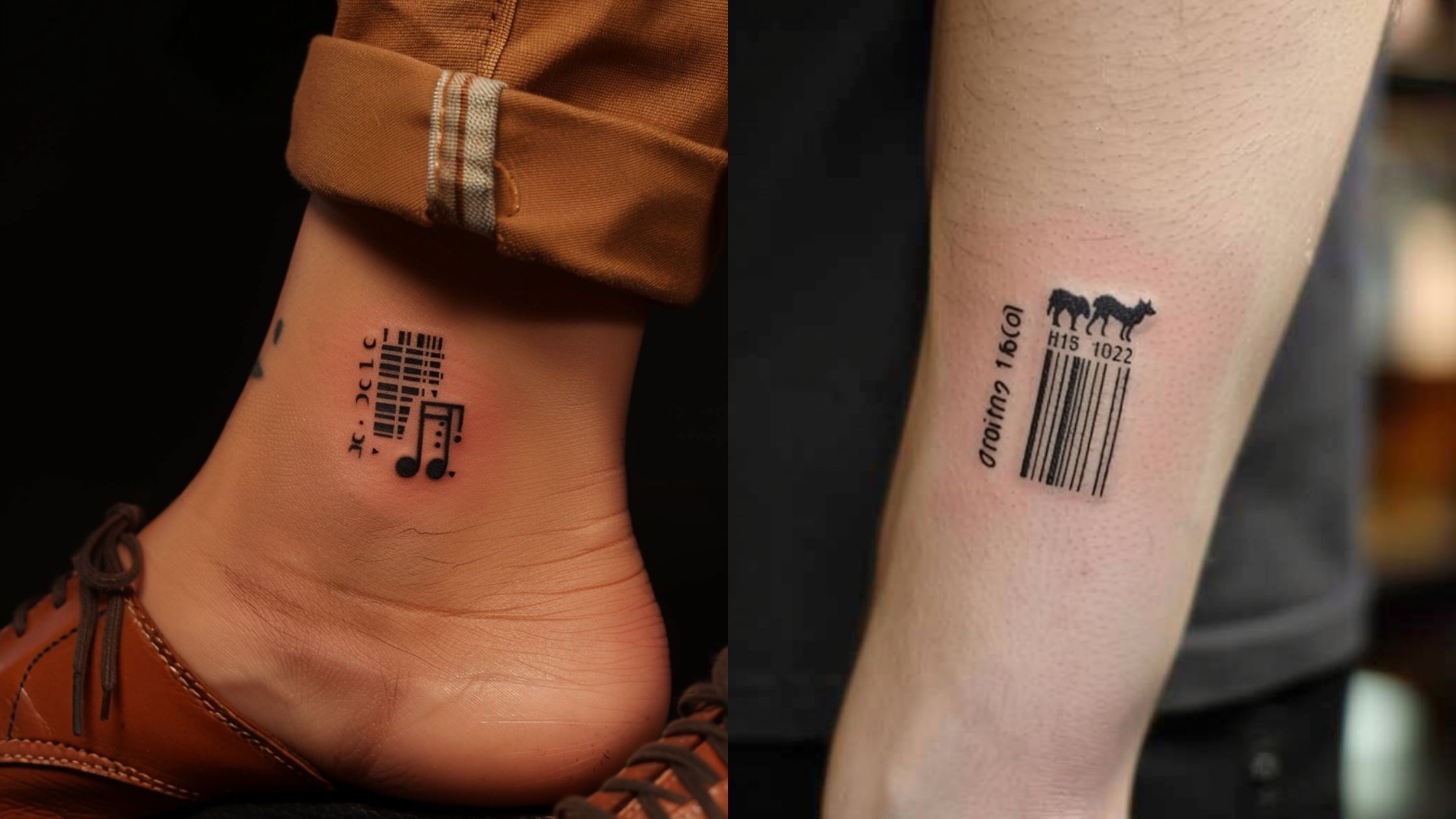
A barcode tattoo only works when the bars are doing a job — carrying a date, a song, a scan code, or a piece of a bigger image — because a barcode with nothing behind it is just a striped rectangle.
I have watched this design go from an edgy outlier to a genuinely flexible motif, and the difference between the ones that land and the ones that look like a shipping label is almost always intent.
In my experience the strongest barcode tattoo designs fall into two camps: brutally simple, or heavily integrated into something else. The awkward middle — a medium barcode floating alone with no context — is the version people tend to regret.
Below I have collected the barcode tattoo ideas I keep coming back to, plus the practical stuff nobody mentions: how the bars age, where they sit best, and why a tattooed barcode almost never scans. If you like this kind of stripped-back linework, the same logic drives good minimalist tattoo ideas as well.
Which Barcode Tattoo Style Is Right for You?
Every style below is a real option, but they do not cost the same, sit the same, or age the same. Use this to narrow things before you walk into a consultation.
| Style | Best Placement | Typical Session | How It Ages | Good If You Want |
|---|---|---|---|---|
| Minimalist strip | Wrist, inner forearm, ankle | 30–60 minutes | Bars thicken slightly; gaps can close over many years | Something quiet you can cover with a watch |
| Blackwork bars | Outer forearm, upper arm, calf | 1–3 hours | Very well — solid black holds longer than thin lines | High contrast that still reads from across a room |
| Barcode with numbers or a date | Inner forearm, ribs, back of arm | 1–2 hours | Depends entirely on font size; tiny digits blur first | A private meaning hidden in plain sight |
| Barcode plus illustration | Forearm, thigh, upper back | 3–6 hours, sometimes split | Well if the artist keeps enough space between elements | A full scene rather than a symbol |
| Color or watercolor barcode | Areas that stay out of the sun | 2–4 hours | Softens fastest; expect touch-ups sooner | Something that does not look like everyone else’s |
| Soundwave or music barcode | Inner forearm, bicep | 1–3 hours | Fine, as long as the wave is not micro-thin | A specific song attached to your skin |
Session times are ranges I have seen quoted rather than fixed prices — a heavily detailed piece from a specialist will always run longer than the same design from a generalist.
What a Barcode Tattoo Actually Says
The barcode is one of the few tattoo symbols that arrived pre-loaded with meaning, and that cuts both ways.
Historically it reads as a comment on being processed, labelled, counted — the person as product. That is the interpretation most people assume when they see one on a stranger.
But the readings have widened a lot. I have seen barcodes used for identity and self-ownership, for a specific date encoded in the digits, for a favourite album, and for straightforward graphic reasons with no message at all.
The honest position is that you do not control how strangers read it. If the association with dehumanisation or with historical forced marking bothers you, that is a real reason to choose a different motif rather than something to talk yourself out of.
One more thing worth knowing before you commit: the barcodes you scan at a till follow published standards maintained by GS1, and those standards assume flat, high-contrast printing. Skin is neither flat nor high-contrast, which is why most tattooed barcodes are decorative rather than functional.
Barcode Tattoo Designs Worth Considering
These are grouped by what the design is actually doing, not by body part, because the concept should drive placement rather than the other way round.
1. The Minimalist Barcode Strip
This is the version most people picture: a short block of vertical bars, black, no numbers, usually two to four inches wide.
It is quick, it is cheap relative to almost anything else in this list, and it is the easiest barcode tattoo to place somewhere you can cover.
The catch is that thin bars set very close together will blur into each other over the years as ink spreads under the skin. Every artist I have asked about this says the same thing: keep the white gaps at least as wide as the bars themselves, and do not go smaller than the design needs to be.
If you want it tiny, accept fewer bars rather than thinner ones. A six-bar barcode that stays legible for twenty years beats a twenty-bar barcode that turns into a smudge.
The wrist is the classic spot for this, and it works, though it is also one of the higher-friction areas for fading. Wrist tattoo ideas covers the placement trade-offs in more detail.
2. Barcode With Numbers, Dates or Initials
Adding a number string underneath is what turns a graphic into a personal piece.
The most common approach is a date rendered as digits — a birth date, an anniversary, a sobriety date — sitting in the position where a UPC number would normally go.
I like this because the meaning is completely private. Nobody reads a row of digits and works out what they are looking at.
Size is the whole ballgame here. Digits smaller than a few millimetres tall are the first thing to go soft, so give the font room even if that means the overall piece grows. If you want a dated approach with more visual weight, Roman numeral tattoo ideas solve the same problem differently.
3. Barcode Merged With a Portrait
Here the barcode stops being the subject and becomes structure — a frame, a background, or a band the portrait emerges from.
It is a demanding piece. Portrait work and crisp geometric linework are close to opposite skill sets, and not many artists are strong at both.
When I have seen it done well, the artist kept the bars looser and softer than a real barcode so the two elements sat in the same visual world.
Ask to see healed photos, not fresh ones. Fresh portrait work always looks better than it will in three years, and the barcode section will hold its contrast longer than the shading will.
4. Barcode Dissolving Into Landscape
This is my favourite category, and the one I would push most people toward if they want something more than a symbol.
The trick is simple: the bars start as a normal barcode at one end and gradually become something else — tree trunks, a mountain silhouette, a city skyline, a forest edge.
It reads as a barcode from a distance and as a scene up close, which is a genuinely satisfying thing for a tattoo to do.
It also solves the aging problem neatly, because the varied bar heights and thicknesses mean the design does not depend on perfectly uniform spacing to look right.
The tree version is the one I see most often, and it suits long narrow spaces like the outer forearm or the calf.
5. Music Barcodes and Soundwave Strips
Two related ideas that get lumped together: a barcode styled after an album or streaming code, and a soundwave rendered as bars.
The soundwave version is the more honest of the two — it is genuinely derived from your audio, and the uneven bar heights make an interesting shape on their own.
A word of caution on scannable streaming codes specifically: platforms redesign those codes periodically, and a code that resolves today may not resolve in five years. Get it because you like how it looks, not because you expect it to work forever.
I would treat any “scan me” tattoo as decorative from day one. That way nothing about it can disappoint you later. If music is the actual point, music tattoo ideas has approaches that do not depend on a platform staying still.
6. Blackwork and Heavy-Contrast Barcodes
Scale the bars up, make them solid, and the barcode stops being a small novelty and becomes a proper graphic statement.
Solid black is also the most durable thing you can put in skin. Blackwork barcode designs are the version I would bet on still looking sharp in fifteen years.
This style pairs naturally with negative-space work — letting an unlinked strip of skin cut through the bars, or wrapping the block around the arm so it reads differently from each angle.
Expect a longer session and more discomfort than the minimalist version, simply because packing solid black takes repeated passes. Blackwork tattoo ideas shows how the same density approach works across other motifs.
At the other extreme, a fine line treatment keeps the same layout but strips the weight out of it.
Fine line barcodes look beautiful for the first few years and then need more maintenance than people expect — worth reading up on fine line tattoo ideas before choosing that route.
7. Colour and Watercolour Barcodes
Swapping black bars for saturated colour is the fastest way to make a barcode not look like a barcode.
Some versions replace every bar with a different colour; others keep black bars and put a loose colour wash behind them.
Both look striking fresh. Both also fade faster than black, particularly the lighter and warmer pigments, and particularly anywhere that catches regular sun.
If you go colour, plan for touch-ups as part of the cost rather than as a failure. That is the trade you are making for the look.
8. Illustrative, Doodle and Animal Barcodes
This is the loosest group: barcodes drawn deliberately imperfectly, or used as one element in a sketchbook-style composition.
The appeal is that it sidesteps the coldness of the motif entirely. A hand-drawn barcode with wobbly bars reads as human rather than industrial.
Animals sitting on, behind or emerging from the bars are a common pairing — birds are the most frequent, probably because the escape-from-the-system reading is so easy.
These pieces need an artist with a genuine illustration background. A technically clean tattooer who cannot draw loosely will make the doodle look nervous rather than casual.
Variations Worth Considering Instead
If the barcode itself is not quite right, these adjacent ideas scratch a similar itch.
QR Codes and Data Squares
Same concept, different shape, and the same scanning caveat applies — ink spread and skin texture make reliable scanning unlikely.
A QR block also takes up a lot more surface area than a barcode strip for the same visual idea.
Binary and Machine Code
A row of ones and zeros encoding a word or date gives you the technology reference without the retail association.
It is also easier to place, since it flows as a line of text rather than needing a solid block.
Glitch and Cyberpunk Treatments
Displaced bars, scan-line artefacts and offset colour channels push the barcode into science-fiction territory.
This suits people who wanted the tech angle rather than the consumerism angle. Geometric cyberpunk tattoo ideas is the closest neighbouring style.
Barcode as a Filler Element
Rather than a standalone piece, a small barcode can work as a connector inside a sleeve or a larger composition.
In my experience this is the lowest-risk way to get one, because it never has to carry the whole tattoo on its own.
Placement, Healing and Practical Advice
Barcodes are directional, which matters more than people expect. A block of vertical bars wants a flat-ish area that does not fold, because a crease running through the middle will distort the spacing every time you move.
The inner forearm, outer forearm, calf and upper back are the most forgiving. Ribs, the side of the neck, and the inside of the wrist all look great in photos and hurt considerably more — the most painful tattoo spots guide is worth a look if this is your first piece.
Healing a barcode is no different from healing any other linework, but the consequences of getting it wrong are more visible. Picking a scab off a solid black bar leaves a pale notch that reads immediately, where the same damage in a shaded piece might disappear.
Follow whatever aftercare your artist gives you rather than something you read online, including this article — they know the ink and the machine they used. Our general tattoo aftercare guide covers the fundamentals, and the American Academy of Dermatology publishes plain-language guidance on caring for new tattoos and spotting problems early.
If you develop spreading redness, swelling that worsens after the first few days, pus, or a fever, stop treating it as a healing question and see a doctor. Allergic reactions to specific pigments are also possible and can appear weeks later, so tell a clinician which colours were used.
Common Mistakes — and What to Do If You Are Still Unsure
The mistake I see most often is going too small. A barcode is a pattern of gaps, and gaps are exactly what disappears first.
The second is copying a real product barcode from an object without thinking about it. If it does happen to scan, it will scan as a can of soup.
The third is treating the digits as decoration. Random numbers under the bars are a missed opportunity when a meaningful string costs the same to tattoo.
And the fourth is choosing a high-visibility placement for a symbol with contested meanings, before you have lived with the idea for a while.
Still not certain? Draw it at actual size on paper, tape it where you want it, and leave it for a week. The designs that survive that test are the ones worth booking.
It is also fine to decide the barcode is not the piece. Abstract tattoo ideas and word tattoo ideas cover a lot of the same graphic and personal-meaning ground.
On safety, one point that is not negotiable: only get tattooed by a licensed professional in a studio with single-use needles and proper sterilisation. The US Food and Drug Administration has consumer guidance on tattoo ink risks, and home or DIY tattooing carries infection risks that no design is worth.
Frequently Asked Questions
Do barcode tattoos actually scan?
Usually not, and I would plan on the assumption that yours will not. Retail scanners rely on sharp edges and high contrast on a flat surface, and tattoo ink spreads slightly in skin while the skin itself curves and moves. Some very large, very carefully spaced barcode tattoos have scanned when fresh, but the same tattoo often stops working as it heals and settles. Treat scannability as a lucky bonus rather than the reason to get the tattoo.
How much does a barcode tattoo cost?
It depends far more on time and studio than on the motif. A small black barcode strip is typically a shop-minimum piece, while a barcode integrated into a portrait or a landscape is priced as a multi-hour custom tattoo. Rates vary widely by city and by artist experience, so the only reliable answer comes from a consultation. Ask for a range up front and ask whether touch-ups are included.
Where is the best place for a barcode tattoo?
Flat areas that do not crease are best, because the bar spacing stays even. The inner and outer forearm, the calf, and the upper back all suit the shape well. The wrist and the side of the neck are popular and look sharp, but both are more visible day to day and the wrist sees more friction. Think about coverability before you think about aesthetics.
Do barcode tattoos age well?
Solid, well-spaced bars age very well — heavy black is one of the most durable things you can put in skin. Thin bars packed tightly together are the risk, because ink migrates slightly over decades and the white gaps close. Colour and watercolour versions soften fastest and are the most likely to need a touch-up. The single best thing you can do for longevity is sunscreen on the healed tattoo.
Are barcode tattoos still popular in 2026?
They are less of a trend statement than they were and more of a steady niche, which I would argue is a good thing. The versions getting the most attention now are the integrated ones — barcodes turning into landscapes, or used as structure inside larger compositions — rather than the plain standalone strip. A well-executed integrated piece is not going to look dated in the way a generic one might.
Quick Summary
- Give the bars a job. A barcode carrying a date, a soundwave, or a landscape beats a barcode on its own.
- Do not go too small. Fewer, wider bars will outlast more, thinner ones every time.
- Keep the gaps wide. The white space is what makes it read as a barcode, and it is the first thing to close up.
- Choose flat placements. Forearm, calf and upper back keep the spacing even; creasing areas distort it.
- Assume it will not scan. Skin curves and ink spreads, so treat scannability as a bonus.
- Black lasts, colour fades. Budget for touch-ups if you go with colour or watercolour.
- Match the artist to the style. Crisp geometry and soft portrait work are different skill sets — check healed photos.
- Licensed studio, always. Single-use needles, proper sterilisation, and a doctor for anything that looks infected.