A sun tattoo works for guys because it reads clearly from ten feet away and still holds detail up close — very few symbols manage both.
I have been collecting and comparing sun designs for years, and the pattern is consistent: the ones that age well are built from bold outlines and deliberate spacing, not from clever detail.
When I first started asking artists about sun pieces, almost every one of them told me the same thing — the rays matter more than the disc. Get the ray rhythm right and the tattoo looks intentional forever.
Below are ten designs I keep coming back to, plus the placement, cost and healing notes I wish someone had given me before my first one. If you want a broader sweep of the symbol, our guide to sun tattoos for men covers the wider range.
Which Sun Tattoo Style Is Right for You?
Most guys arrive at the shop knowing they want a sun and nothing else. This is the table I sketch out for friends who ask.
| Style | Best Placement | Typical Session | How It Ages |
|---|---|---|---|
| Bold blackwork | Forearm, outer bicep, calf | 2–4 hours | Excellent — thick lines stay readable for decades |
| Fine-line / minimalist | Inner arm, wrist, ankle, ribs | 45–90 minutes | Softens noticeably; often wants a touch-up in 5–8 years |
| Tribal / neo-tribal | Neck, shoulder, chest | 2–5 hours | Very well, provided negative space is generous |
| Dotwork / stippled | Upper arm, sternum, spine | 3–5 hours | Good, though dense dot fields can blur together over time |
| Scenic sunset (realism) | Calf, thigh, upper back | 5+ hours, often multiple sittings | Needs sun protection and periodic touch-ups to stay crisp |
| Sun and moon duo | Inner forearm, upper arm, back | 2–4 hours | Well, if the two halves are given equal weight |
Session times above are the ranges I have been quoted and have sat through personally. Your artist’s estimate for your size and skin is the one that counts.
Why the Sun Still Means Something
The sun is one of the oldest images in human art, and cultures across the world built symbols around it long before tattooing looked anything like it does now.
That long history is exactly why the symbol is flexible. It is not owned by one movement or one decade, so it does not date the way a trend-driven design does.
For most guys I have talked to, the meaning lands somewhere personal: a new start after a hard stretch, a person they associate with warmth, or simply a reminder to keep moving.
You do not owe anyone an explanation for it. Some of the best sun pieces I have seen were chosen purely because the shape looked right on that arm.
Pairing matters too. A sun beside a crescent reads as balance rather than repetition, which is why the moon tattoo ideas collection is worth a look before you commit to a solo piece.
10 Sun Tattoo Designs for Guys Worth Stealing
These are grouped by the problem they solve rather than by body part, because placement is usually the last decision, not the first.
1. The Bold Forearm Sun
This is the design I recommend most often to guys getting their first piece, and the reason is durability.
The rays alternate between straight spikes and wavy tongues of flame, which gives the eye something to follow instead of a flat starburst.
The outer forearm is forgiving skin — decent healing, moderate pain, and a flat enough surface that a circular design does not distort when you bend your arm.
When I sat for something similar, the linework took under two hours. Ask for line weight on the heavier side; thin outlines on a forearm are the ones that need fixing first.
2. The Dotted-Center Sun
If you want a hint of colour without committing to a full colour piece, this is the compromise that works.
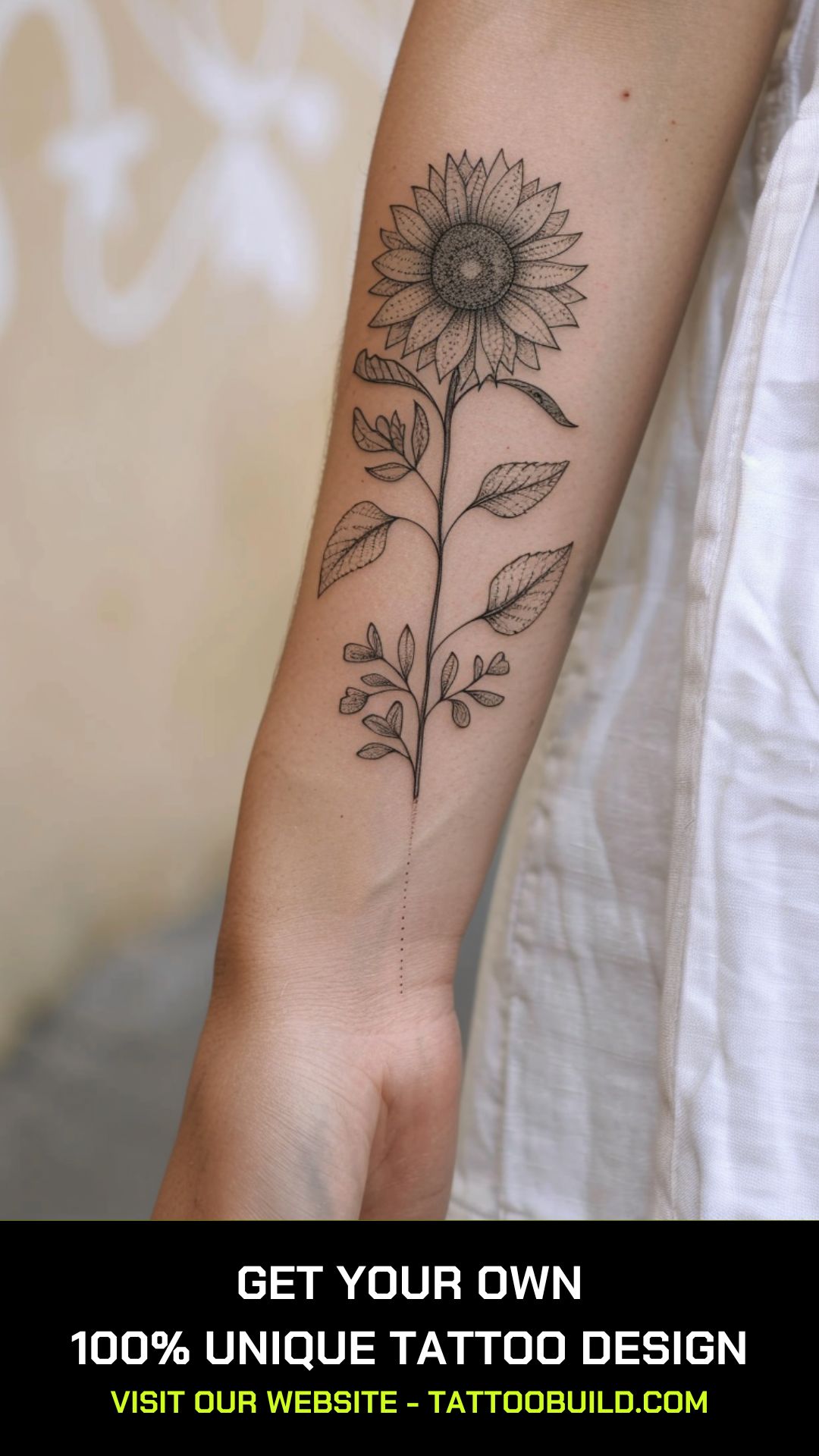
The centre is stippled like a sunflower head, and the rays roll outward in soft waves rather than sharp points.
A single warm yellow packed into the disc does most of the work. Every artist I have asked about small colour accents says the same thing: one pigment, applied properly, beats three applied thinly.
Worth knowing — yellows and light warm tones generally fade faster than black, especially on skin that sees a lot of daylight.
3. The Tribal Neck Sun
Small, sharp, and placed where a collar can hide it — this one gets more attention per square inch than anything else on the list.
It is built from clean triangular rays and a scatter of dots, which is what keeps it modern rather than dated.
Be honest with yourself about the placement. The neck sits high on most pain charts, healing is awkward because the skin moves constantly, and visibility is a real consideration in some workplaces.
If the geometry appeals but the spot does not, the same motif transfers cleanly to a shoulder blade. Our tribal tattoo ideas guide has more on how these patterns are constructed.
4. Sunset and Palm Scenes
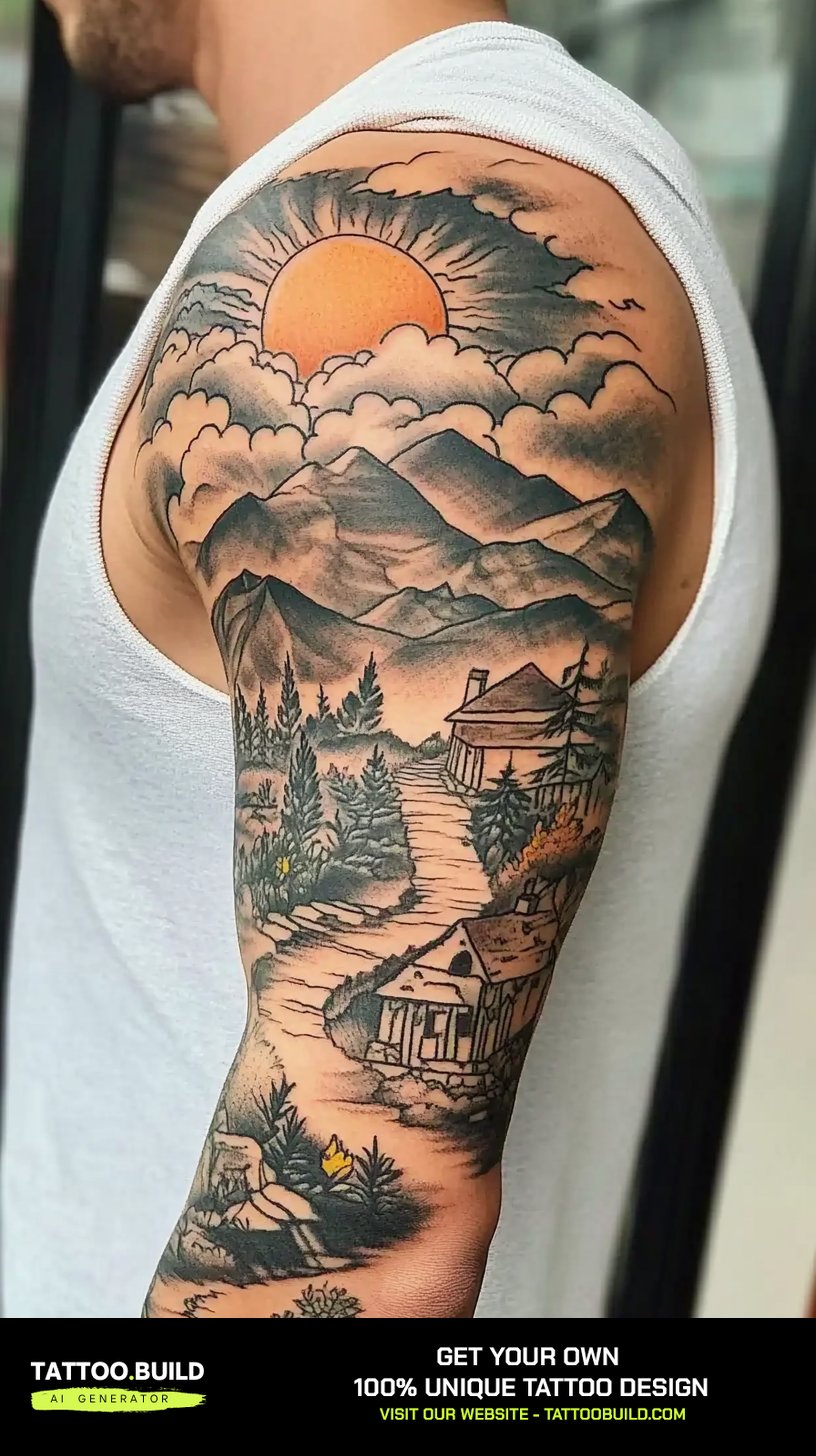
A sun dropping behind palms is the most requested scenic sun I have come across, and it scales in both directions.
On a calf you get room for real shading — banded light across the water, silhouetted trunks, a horizon line that actually sits level.
On an ankle the same scene compresses into a coin-sized silhouette, sometimes framed inside the outline of a palm tree itself.
Scenic work carries the highest maintenance cost on this list. Soft grey wash is the first thing to go, and in my experience a scenic piece looks its best when it gets a touch-up somewhere around the five-year mark.
5. The Sun-and-Moon Embrace
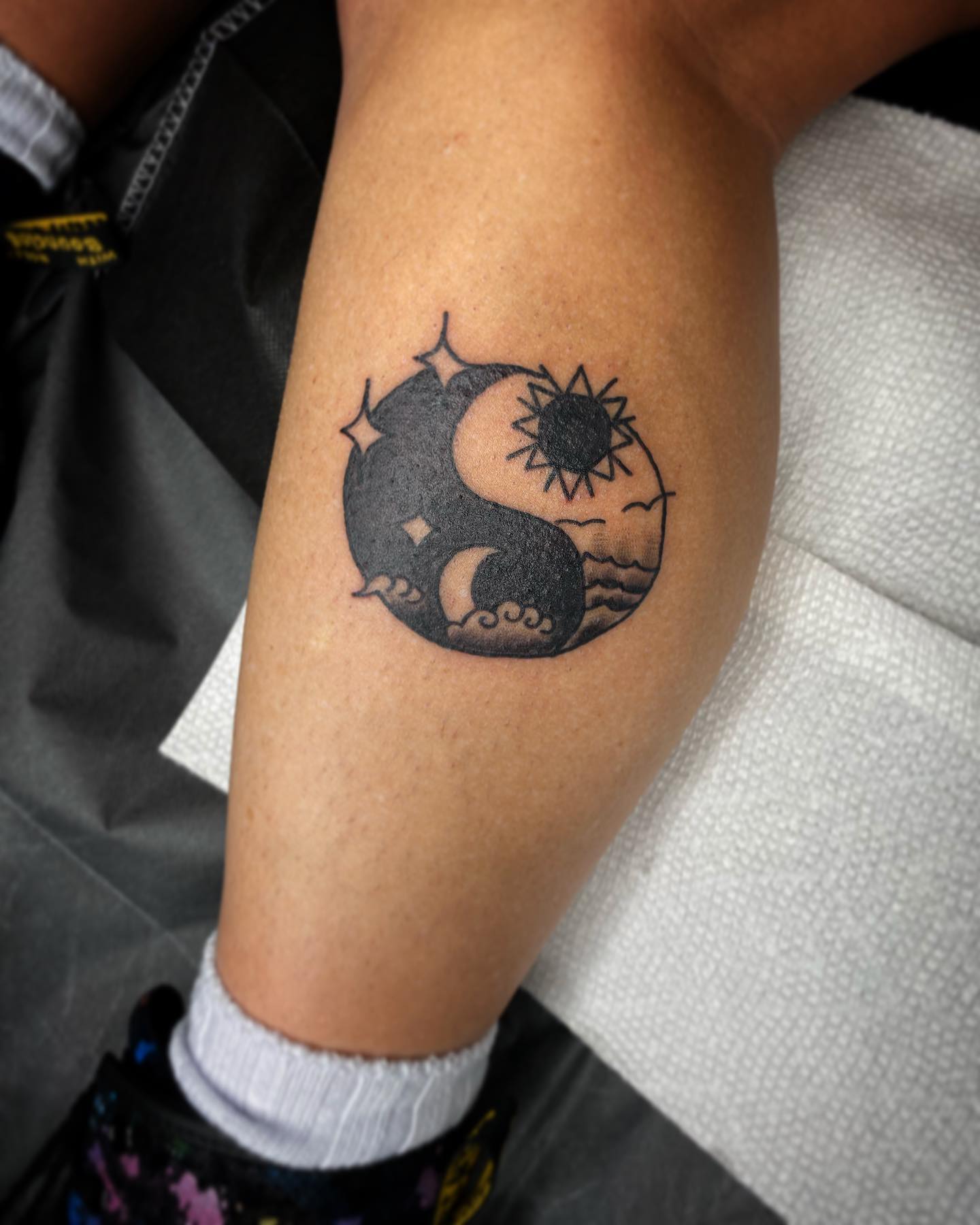
Two celestial bodies interlocking is a design older than modern tattooing, and it still holds up because the composition is inherently balanced.
The version I like best has the crescent cutting into the disc rather than sitting politely beside it — overlap gives the piece depth.
A close relative is the sun ringed with small stars, which pushes the whole thing further toward a night-sky reading.
The mistake to avoid is imbalance. When one half is heavily rendered and the other is bare outline, the eye reads it as unfinished rather than contrasted.
6. The Oceanic Sleeve
This is the big commitment on the list — a rising sun above breaking waves, wrapped around the full arm.
What makes it work is contrast: dense black water below, open skin and clean rays above.
Expect several sittings. A full sleeve is normally mapped out in stages — outline first, then black fill, then shading — and artists I have spoken to schedule these weeks apart to let each stage settle.
Budget for the consultation, not just the ink. A sleeve that flows with your arm has to be drawn on your arm, and that design time is part of what you are paying for. More in our ocean tattoo ideas guide.
7. The Minimalist Sun
A clean circle, evenly spaced rays, nothing else. It is harder to execute than it looks.
With no shading to hide behind, every wobble in the circle and every uneven gap between rays is visible.
I always ask to see healed photos before booking minimal work. A fresh fine-line photo tells you very little about how that artist’s lines settle after a year.
Give it slightly more size than feels necessary. Very small fine-line pieces tend to thicken as ink spreads under the skin, and a design with tight gaps can close up. Our minimalist tattoo ideas page covers this trade-off in more depth.
8. The Sun With a Face
Giving the sun human features turns a symbol into a character, and that changes how people react to it.
The expression is everything. A stoic, half-closed-eye face reads as calm and old; wide eyes and a grin tip straight into cartoon.
Rays flowing out like hair is a common treatment and it solves a real problem — it stops the face and the rays from looking like two separate tattoos.
Hands are the hardest place to keep this crisp. The skin regenerates fast and gets constant use, so hand work usually needs touch-ups sooner than anywhere else — see our hand tattoo ideas for men before you commit.
Variations Worth Considering
If none of the ten above is quite it, these variations come up constantly in consultations.
Geometric and Sacred-Geometry Suns
Swap organic rays for repeating triangles, hexagons or concentric rings and the design shifts from natural to engineered.
These live or die on symmetry, so they need an artist comfortable with stencils and measured layout rather than freehand.
Negative-Space and Blackout Suns
Here the sun is the untouched skin and the surrounding area is filled solid. The effect is striking and unusually resistant to fading.
It is also close to permanent in practice — heavy black fill is difficult to cover or remove later, so treat it as a final answer rather than a first experiment.
Ancient and Cultural Sun Motifs
Aztec sun-stone faces, Egyptian winged discs and Norse sun wheels all give the design historical weight.
Do the reading first. Some of these carry specific cultural or religious meaning, and a few historical sun-wheel forms have been appropriated by groups you would not want to be associated with — worth checking before you wear one permanently.
Watercolour and Splash Suns
Loose washes of orange and gold behind a black-line sun give a painterly effect that photographs beautifully.
Fade is the honest caveat. Watercolour styles rely on soft, low-density pigment, and in my experience they need a black structural line underneath to still make sense in a decade.
Placement, Healing and Aftercare
Placement decides pain, healing speed and how long the tattoo stays sharp — usually more than the design does. Ribs, sternum, neck and hands sit at the sharper end; outer arm, thigh and calf are gentler. Our most painful tattoo spots breakdown maps this out properly.
The single biggest thing you control after the session is sun exposure. UV light breaks down tattoo pigment, and a sun tattoo that lives on an exposed forearm all summer will lose crispness faster than the same design on a thigh.
Follow whatever aftercare instructions your artist gives you — they know their inks and their technique. General guidance on keeping tattooed skin healthy is available from the American Academy of Dermatology, and the FDA’s fact sheet on tattoos and permanent makeup covers ink safety and reaction risks.
This article is not medical advice. If a healing tattoo becomes hot, swollen, unusually painful, oozes, or you develop a rash or fever, contact a doctor promptly rather than waiting it out — and never attempt to remove or rework a tattoo yourself. Removal is a medical procedure and belongs with a qualified professional.
Still Not Sure? Common Mistakes to Avoid
Going too small is the mistake I see most. A sun has a lot of internal detail for its footprint, and shrinking it closes the gaps between rays.
Second: picking a reference photo of a fresh tattoo. Fresh ink always looks sharper than healed ink, so ask any artist you are considering for healed work in the same style.
Third: choosing the placement before the design. Decide what the tattoo is, then find the body part whose shape suits it.
Fourth: booking on price alone. A cheap piece you cover up later costs far more than the good version would have.
If a sun is not quite landing for you, two adjacent directions are worth browsing: our forearm tattoo ideas for placement-first thinking, and star tattoo designs if the celestial angle is what pulled you in.
Design Your Own Sun Tattoo in Three Steps
Bringing a rough concept to your consultation saves time and gets you closer to what you actually want.
- Open the design tool. Start with Tattoobuild’s tattoo design generator and try it before choosing a plan.
- Describe the sun you want. Name the size, the style (blackwork, fine-line, tribal), the ray shape, and any colour. The more specific the prompt, the closer the result.
- Generate and shortlist. Produce several variations, keep the two or three closest to your idea, and take those to your artist as a starting point — not as a final stencil.
A generated image is a conversation starter. Your artist still has to redraw it to fit your body, and that redraw is where a good tattoo actually comes from.
Frequently Asked Questions
What does a sun tattoo mean for guys?
Most commonly it stands for energy, renewal, resilience or a fresh start, though the sun has carried different meanings across many cultures and eras. There is no single fixed interpretation, which is part of the appeal. In my experience the men wearing them attach a personal story — a turning point, a place, a person — rather than a textbook symbolism. Choose the meaning that matters to you and let the design follow it.
Where is the best place for a sun tattoo?
The outer forearm, outer bicep and calf are the easiest places to get a circular design to sit correctly, because the surface is relatively flat and does not distort much when you move. Necks, hands and ribs look striking but hurt more and generally need touch-ups sooner. If you want the option to cover it, the upper arm and back are the practical picks. Talk placement through with your artist while looking at the stencil on your skin.
How much does a sun tattoo cost?
It depends almost entirely on size, style and your artist’s hourly rate, which varies enormously by city and by reputation. A small minimalist sun is usually a shop-minimum job of under an hour; a scenic sunset calf piece or a full sleeve runs to multiple sessions. Ask for a written estimate that covers the whole piece rather than a per-hour figure alone. Most shops will also quote touch-up policy at the same time, which is worth knowing upfront.
Should I get my sun tattoo in colour or black?
Black and grey generally holds up better over time and is easier to touch up or build on later. Colour — especially warm yellows and oranges, which suit a sun — looks fantastic fresh but typically fades faster, particularly on skin that gets regular sun exposure. A common middle path is a strong black structure with one colour accent in the disc. Your artist can advise on how specific pigments tend to sit and heal on your skin tone.
How long does a sun tattoo take to heal?
The surface usually looks settled within two to three weeks, but the deeper skin continues healing for a couple of months, which is why tattoos often look slightly cloudy before they sharpen up. Keep it out of direct sun, out of pools and out of the bath during that window. Follow your artist’s specific aftercare instructions over anything you read online, including this page. If anything looks infected or you react badly, see a doctor rather than troubleshooting it yourself.
Quick Summary
- Bold blackwork suns age best — thick lines and generous spacing survive decades.
- The ray rhythm matters more than the disc; mixing straight and wavy rays adds movement.
- Outer forearm, bicep and calf are the most forgiving placements for a circular design.
- Fine-line and minimalist suns need slightly more size than you think, or the gaps close up.
- Scenic sunsets and watercolour styles carry the highest long-term maintenance.
- UV exposure is the main enemy of a healed sun tattoo — cover it or protect it.
- Check the history behind cultural sun motifs before committing to one permanently.
- Ask every artist for healed photos, not fresh ones, before you book.