I have sat in on more sun tattoos than any other celestial design, and the ones that still look good years later almost never come down to the artist’s skill alone. A sun tattoo lives or dies on how much open skin you leave between the rays.
That is the single thing I wish someone had told me before my first one. Rays that sit too close together fill in as the ink settles, and a crisp starburst slowly turns into a dark blob.
The good news is that the sun is one of the most forgiving subjects in tattooing once you get the spacing right. It works at wrist scale, it works as the centrepiece of a full sleeve, and it pairs with almost anything — mountains, waves, a moon, a compass, a key.
Below is what I have learned about picking a style, choosing a placement that suits your build, and avoiding the handful of mistakes that show up again and again. If you are weighing a solar design against a lunar one, our guide to sun and moon tattoo ideas covers that pairing in more depth.
Which Sun Tattoo Style Is Right for You?
Style choice matters more than size. Here is how the five approaches I see most often actually compare in practice.
| Style | Best Size | Typical Sitting | How It Ages | Touch-Ups |
|---|---|---|---|---|
| Fine line | 2–4 in | 1–2 hours | Softens fastest; thin lines widen | Likely within 5–8 years |
| Blackwork / tribal | 4–8 in | 2–4 hours | Excellent; solid black holds shape | Rarely needed |
| Black and grey realism | 6 in and up | Multiple sessions | Good if contrast is strong | Occasional grey refresh |
| Geometric | 3–6 in | 2–3 hours | Good; symmetry shows any drift | Line clean-up eventually |
| Colour accent | Any | Adds 1–2 hours | Warm tones fade first in sun | Most likely of the five |
If you are choosing purely on longevity, blackwork wins. If you are choosing on how quickly you can get it done and how quietly it sits on the body, fine line wins.
Why the Sun Still Means Something
The sun is probably the oldest symbol humans have tattooed, worn, and carved. Ancient Egyptian religion built an entire cosmology around Ra, the sun god who crossed the sky each day and the underworld each night.
That daily death-and-return structure is why so many men choose a sun after something hard. It is a symbol of the thing that keeps coming back.
Polynesian, Aztec and Indigenous North American traditions all developed their own solar imagery, each with its own rules about who could wear what. If you are drawn to a specific cultural style rather than a generic sunburst, it is worth asking an artist from that tradition rather than copying the shapes.
In my experience most guys land somewhere less specific and more personal: a marker for sobriety, for a kid’s birth, for the year they got out of something. The sun carries that weight without needing a caption.
It also happens to be a genuinely good design object — radial, symmetrical, instantly readable from across a room. Very few subjects do that. Our wider round-up of celestial tattoo ideas shows how it sits alongside moons, stars and planets.
Sun Tattoo Styles for Men That Hold Up
These are the six approaches I keep coming back to, roughly in order of how often I see them requested.
1. Fine Line Sun Tattoos
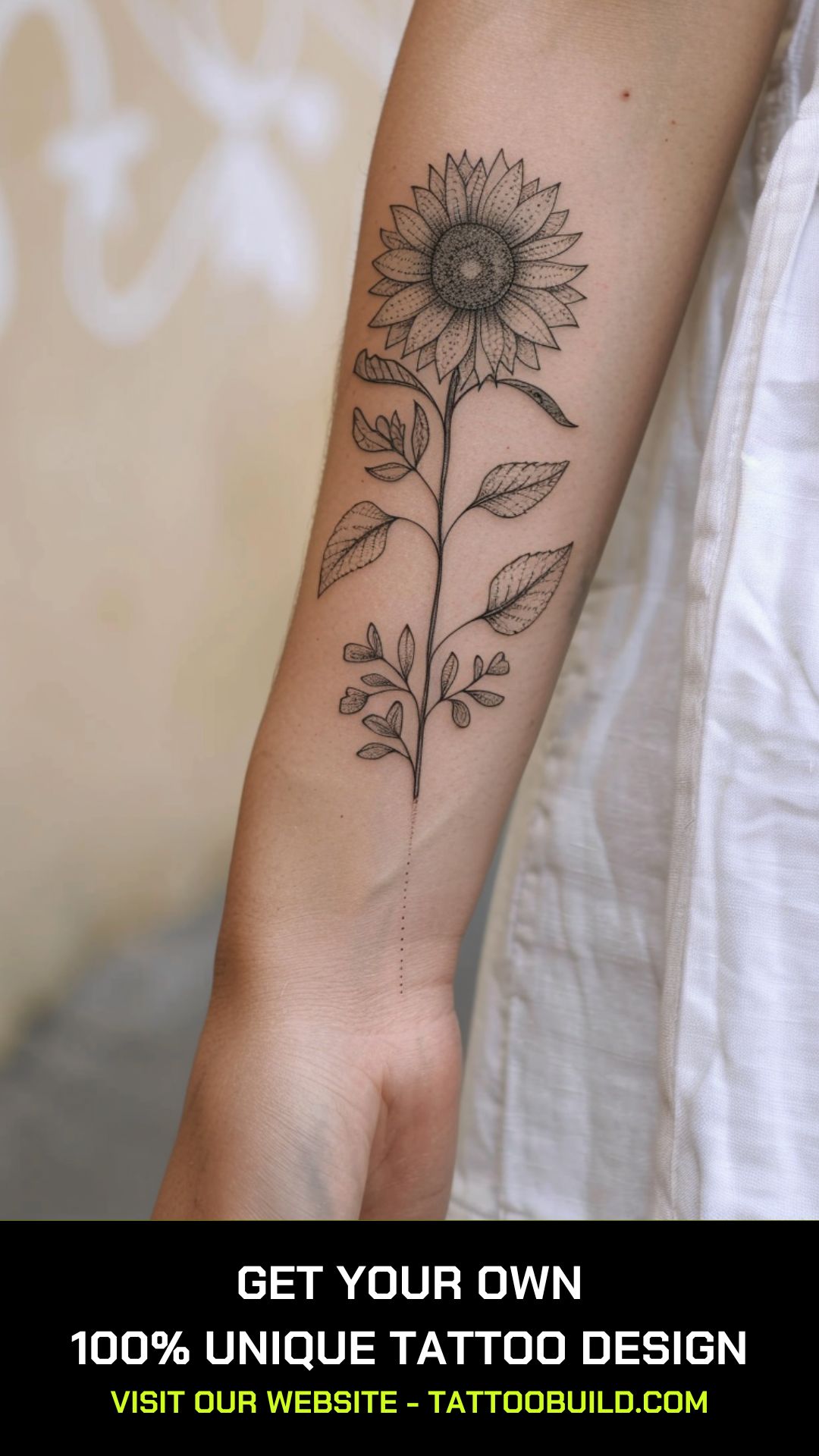
Thin single-weight lines, no shading, lots of bare skin. This is the entry point for most first-timers and it suits the wrist, the inner forearm and the ankle.
The trade-off is honest: fine line work is the least durable style on this list. Thin lines spread slightly as they settle, and a design with rays 2mm apart will look noticeably softer in a decade.
Every artist I have asked about this gives the same advice — size up slightly and space the rays wider than the drawing looks like it needs. A design that seems a little sparse on paper reads correctly on skin.
If you want something this size, our guide to small forearm tattoo ideas for men covers placement options that keep small work legible.
2. Blackwork and Tribal Suns
Solid black, bold shapes, deliberate negative space. This is the oldest way to tattoo a sun and still the most durable.
Blackwork uses the gaps as part of the design rather than filling everything in, which is exactly why it survives. The shape is carried by contrast, not by detail.
When I tested placements for a piece like this, the forearm and outer shoulder were the clear winners — both are flat enough that the symmetry does not distort when you move.
Expect a longer sitting than the size suggests. Packing solid black takes time and the skin gets sore faster than it does under line work. More options in our blackwork tattoo ideas for men.
3. Black and Grey Realism
Shaded suns, cloud cover, engraving-style texture. This is where a sun stops being a symbol and starts being a picture.
Realism needs room. Under roughly six inches the mid-greys collapse into each other and you lose the depth you paid for.
The pieces that age best are the ones with genuine black in them — a strong dark somewhere in the composition gives the greys something to sit against. Contrast is what keeps realism from turning into a grey smudge.
Plan for more than one session and budget accordingly. Most realistic sun work I have seen quoted runs across two or three sittings.
4. Sun and Landscape Sleeves
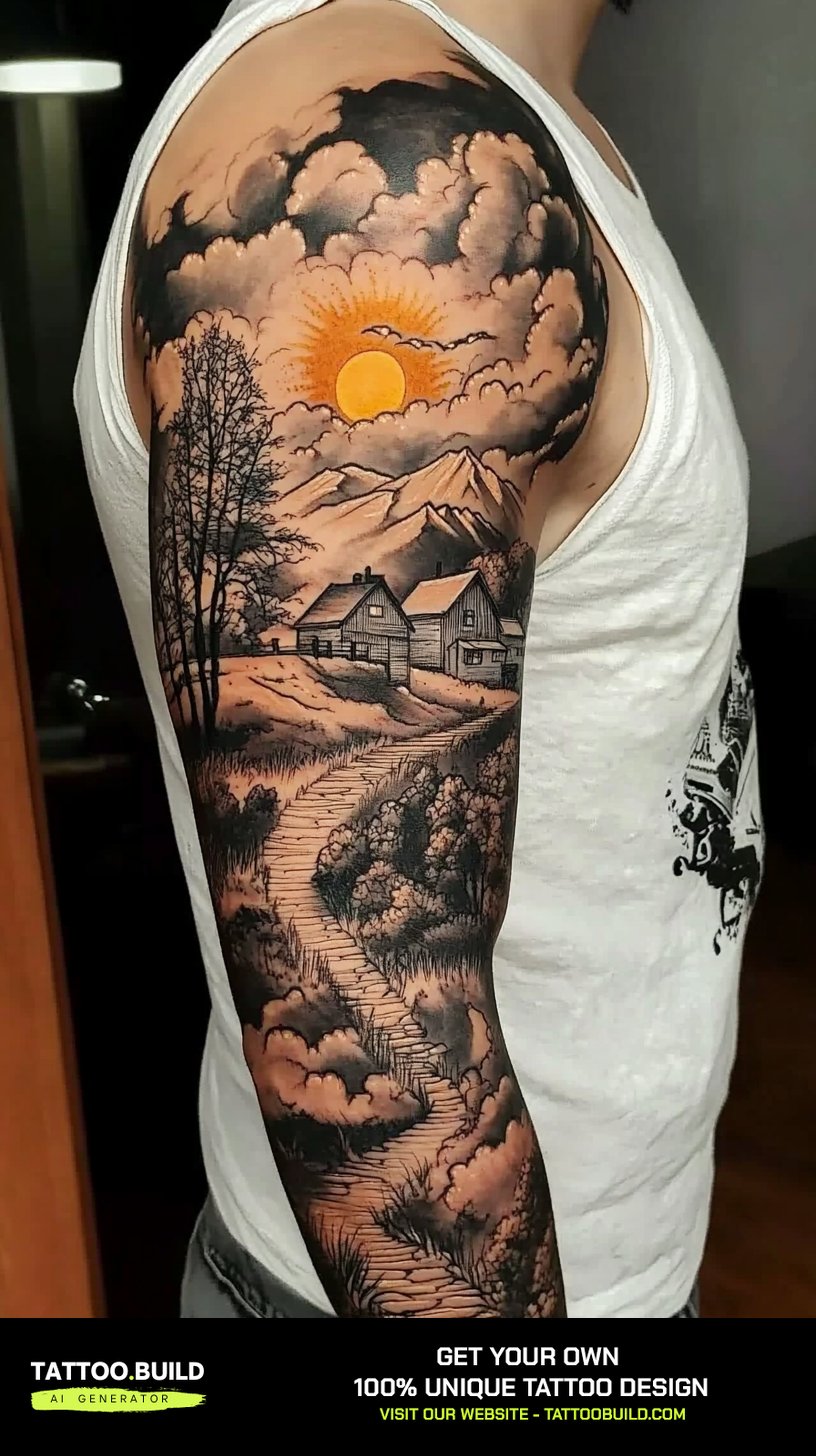
Here the sun is the light source for an entire scene: mountains, a river, cloud banks, sometimes a cabin or a treeline.
This is the most popular sun request I see from men in their thirties and forties, and it makes sense — it carries meaning without announcing it.
The design logic is simple. The sun goes high on the arm or shoulder, everything else flows down and away from it, and the eye travels the same route every time.
A full sleeve is a real commitment of time and money. If that is the direction you are heading, start with our men’s sleeve tattoo ideas before committing to a first session.
5. Geometric and Compass Suns
Rays reduced to measured spokes, circles drawn with a stencil, occasionally a compass point built into the centre.
Geometric suns look sharp immediately and they suit men who want something ordered rather than organic.
The catch is that symmetry is unforgiving. Any drift in a line, any stretch from a joint nearby, is visible in a way it never would be in a landscape piece.
Pick a flat, stable spot — the outer forearm or the upper back — and pick an artist whose healed geometric work you have actually seen. Our geometric tattoo ideas for men has more on that.
6. Sun as Backdrop
Sometimes the sun is not the subject at all. It sits behind trees, behind a skyline, behind a figure, doing the job of a light source.
I like this approach for men who want the symbolism without a big graphic sun on their arm. It reads as a landscape first and a sun second.
Technically it is easier to age well than a bare starburst, because the sun is usually a simple circle with texture around it rather than a mass of thin rays.
7. Suns With a Single Colour
One warm tone — orange, amber, a soft yellow — against otherwise black linework. It is the cheapest way to make a sun unmistakably a sun.
Be realistic about fading. Warm pigments are the first to go, and sun exposure is what takes them. A design that depends entirely on the orange will need refreshing sooner than a black one.
The fix is to build the piece so it still works in black and white, then add the colour on top as an accent rather than as the structure.
Sun Tattoo Variations and Pairings
Once the style is settled, the next question is usually what to put with it.
Sun and Moon
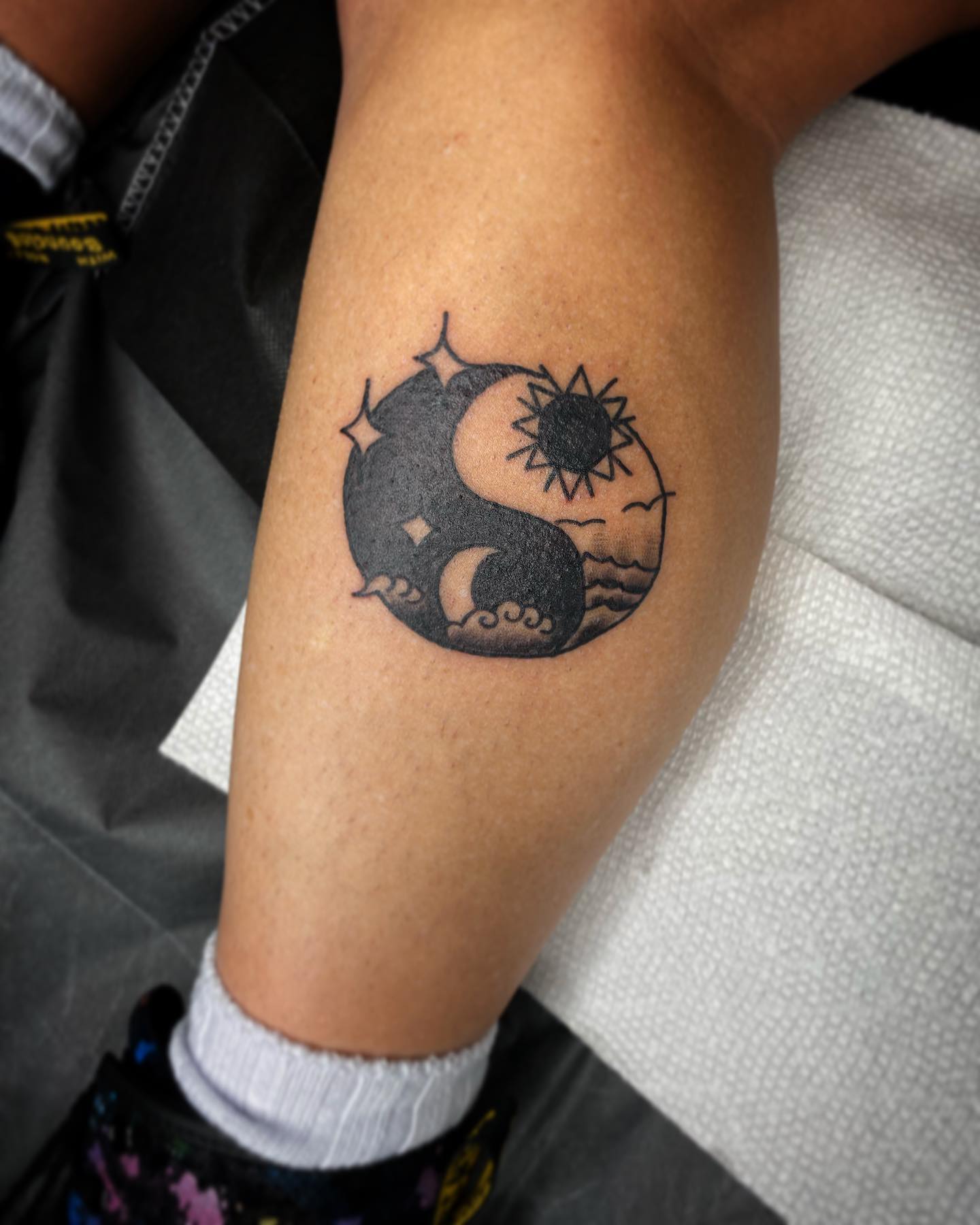
The classic duality piece — balance, opposites, two halves of one circle. It works especially well on the forearm where the two shapes can share a single outline.
Sun and Waves
A sunrise over water is one of the few compositions that looks right at wrist size and at rib size. The horizon line does most of the work.
Sun and Mountains
Common for a reason: mountains give the sun something to rise behind, which turns a flat symbol into a scene with depth.
Sun With an Object
A key, a compass, an anchor, a clock — the sun becomes a halo of rays behind the object. Keep it to one object, or the rays lose their focal point.
Sun With a Date or Name
If the piece marks something specific, small lettering under the sun usually beats lettering woven into the rays, which crowds fast.
Placement, Pain and Healing
Flat, stable areas suit radial designs best. The outer forearm, the outer shoulder, the calf and the upper back all keep a circular shape circular as you move.
Ribs, the inner bicep and the hands distort more, and they hurt considerably more. If it is your first piece, our guide to the most painful tattoo spots is worth reading before you book.
Healing is where most people go wrong. Keep it clean, keep it lightly moisturised, do not pick, and stay out of pools and direct sun until it has fully settled — usually two to four weeks on the surface, longer underneath.
Sun exposure is the number one cause of faded tattoos, and it is entirely preventable. Once healed, sunscreen on the piece whenever it is uncovered will do more for its lifespan than anything else. Our full tattoo aftercare guide walks through the first month day by day.
On safety: tattoo ink reactions and infections are uncommon but real, and the Mayo Clinic and US FDA both publish plain-language guidance on the risks. This article is design advice, not medical advice — if a healing tattoo is hot, swollen, weeping or getting worse after a few days, see a doctor rather than asking the internet.
Still Not Sure? The Mistakes I See Most
Cramming too many rays in. This is the big one. Rays that look tight in the stencil will look tighter healed.
Going too small for the style. A realistic sun at two inches is not a realistic sun, it is a grey circle. Match the size to the technique, not to your nerve.
Choosing an artist by price rather than by healed work. Ask to see photographs of pieces that are a few years old, not fresh-off-the-needle shots.
Picking a placement you have not lived with. Draw it on with a marker and leave it for a day before you commit.
Still weighing options? Browse mandala tattoo ideas for men for radial designs with the same symmetry, or simple tattoo ideas for men if you want to start smaller.
Frequently Asked Questions
How much does a sun tattoo for men cost?
It depends far more on time than on the design itself, since most shops charge an hourly rate or a minimum for small work. A simple fine line sun usually falls within a shop minimum, while a shaded realistic piece runs across several hours or multiple sessions. Ask for a quote based on the actual drawing rather than a general estimate. Prices vary widely by city and by artist demand, so treat any figure you read online as a rough guide only.
Does a sun tattoo hurt more than other designs?
The design does not change the pain much; the placement does. A sun on the outer forearm or calf is manageable for most people, while the same design on the ribs, sternum or hands is significantly sharper. Solid black packing tends to feel more irritating over time than line work because the same area is worked repeatedly. If you are worried, start somewhere fleshy and flat.
What does a sun tattoo symbolise for men?
Most commonly rebirth, resilience, and starting again — the idea that the sun returns every morning regardless of the night before. It also carries older associations with strength, life and clarity across many cultures, from Egyptian solar worship to Polynesian and Indigenous traditions. Plenty of men choose it for something entirely personal, like sobriety or the birth of a child. The symbol is broad enough to hold whatever you attach to it.
Where is the best place for a sun tattoo?
Flat, stable areas keep a circular design looking circular: the outer forearm, outer shoulder, upper back and calf are all reliable. Curved or high-movement spots like the inner bicep, ribs and hands distort the shape more and fade faster. Size matters too — anything under about three inches belongs on the wrist, ankle or forearm rather than the chest or back. Test the position with a marker before committing.
Will a sun tattoo fade quickly?
Black ink holds up well for decades with reasonable care; warm colours like orange and yellow fade faster, and UV exposure accelerates all of it. The most effective thing you can do is keep the healed tattoo covered or sunscreened whenever you are outdoors for long. Thin fine line work also softens over time regardless of colour, which is worth factoring in before you choose the style. A touch-up every several years is normal, not a sign something went wrong.
Quick Summary
- Leave more space between the rays than the drawing seems to need — this is the single biggest factor in how a sun tattoo ages.
- Blackwork and tribal styles last the longest; fine line work looks best soonest but softens fastest.
- Black and grey realism needs at least six inches of skin and strong dark contrast to stay readable.
- Sun-and-landscape sleeves put the sun high on the arm and let the scene flow downward.
- Geometric suns need a flat, stable placement because symmetry shows every millimetre of drift.
- Build a coloured sun so it still works in black and white, then add the warm tone as an accent.
- Sunscreen on the healed tattoo does more for its lifespan than any product used during healing.
- Judge an artist on photographs of healed work from years ago, not on fresh shots.