There is a persistent assumption in tattooing that more detail means more impressive. After a decade of sitting in shops, booking my own work and asking artists what they would actually put on themselves, I have found the opposite is closer to the truth.
Some of the most considered ink I have seen is three lines, one symbol, or a shape no bigger than a coin.
Simple tattoo ideas for men are not a compromise or a starter option. They are a specific aesthetic position, and a technically demanding one — there is nowhere for a shaky line to hide.
The 21 ideas below are pared back to the point where nothing is left to remove. If you want to see how far the approach can be pushed, the guide to single line tattoo ideas covers the same discipline in more depth.
Photo: @jasminwalshtattoo
Which Simple Tattoo Style Is Right for You?
Not all minimal work is the same. These four approaches ask different things of your artist, your skin and your patience.
| Style | Best For | Typical Sitting | How It Ages |
|---|---|---|---|
| Fine line | Delicate symbols, script, one-line drawings | 20–60 minutes | Softens fastest; may want a touch-up in 5–10 years |
| Bold blackwork | Geometric shapes, silhouettes, small skulls | 30–90 minutes | Holds its shape best of the four |
| Dotwork / stippling | Shading a shape without solid fill | 45–120 minutes | Dots can merge if placed too tightly |
| Single continuous line | Mountains, faces, animals, abstract forms | 20–45 minutes | Good, provided the line weight is not hairline |
Sitting times above are what I have been quoted and charged for small pieces; your artist’s pace and your placement will shift them. For pricing expectations, the breakdown on how much a small tattoo costs is worth reading before you book.
Why Minimal Tattoos Age Better
Fine detail fades. Dense shading blurs. Colour shifts. This is not pessimism, it is just how ink behaves in living skin over decades.
A simple tattoo built on clean, confident linework survives the years better than almost any other approach, because there is less information to lose.
When a portrait softens by twenty percent it stops looking like the person. When a triangle softens by twenty percent it is still a triangle.
The trade-off is that simplicity exposes the artist. There is no texture to bury a wobble in, which is why I always ask to see healed photos of linework rather than fresh ones.
Placement matters as much as style. Hands, fingers and feet see the most friction and sun, and they tend to break down first.
If you still prefer the hand, our guide to small and simple hand tattoos for men explains how to simplify a subject and plan its placement.
21 Simple Tattoo Ideas for Men
Each of these has been chosen because it holds up small, holds up simple, and does not need explaining.
1. Single Line Mountain
A mountain silhouette drawn in one continuous, unbroken line — like the piece at the top of this guide — is a concept that rewards economy.
The constraint forces the design into something graphic rather than illustrative. It stays legible at two inches, which very few landscape tattoos manage.
Inner forearm and outer wrist both suit it. If you want something with more mass behind it, the mountain tattoo ideas for men collection shows how far the same subject scales.
2. Minimalist Arrow
An arrow stripped to shaft, point and fletching, rendered in hairline weight, carries its symbolism without any elaboration at all.
Forward. Directed. Finished. It is one of the few simple tattoo ideas for men that works at almost any size and almost any placement.
I have seen it done two inches along a wrist and twelve inches down a spine, and it reads the same either way.
Photo: @tattooistic__
3. Small Cross
A cross in its simplest geometric form — four lines meeting at a centre point — carries personal or spiritual weight without visual complexity.
Scale and placement change everything here. A small cross behind the ear reads entirely differently from the same design on an outer forearm.
In my experience this is the design men most often ask to have made smaller in the stencil stage, and they are usually right to.
Photo: @alejandro.fragapane
4. Outline Circle
A circle is the most complete shape in geometry, and a closed one reads as exactly that — whole, resolved, self-contained.
An almost-closed circle with a deliberate gap says something else entirely: the Ensō form from Zen Buddhism, which is drawn in a single breath and left unfinished on purpose.
Both versions work. Choose based on what the shape means to you rather than which one looks tidier on the stencil.
Photo: @tattoobychang
5. Minimal Wave
A single curved line evoking the arc of a wave. No shading, no foam, no horizon.
Just the movement of water caught in one stroke, which is far harder to draw well than it looks.
For anyone with a real relationship to the ocean, this reads as deeply personal without ever being literally explained to anyone.
Photo: @3pleitattoo
6. Small Anchor
The anchor carries a long history in tattoo culture, and in its simplest outline form it sheds the nautical clutter that usually surrounds it.
No rope, no banner, no ship. Just the shape, which is strong enough on its own.
It sits well on the inner bicep, the ankle, or the outside of the calf where the vertical line has room to run.
Photo: @miss_brows_aesthetics
7. Geometric Triangle
Three straight lines. It is the most reductive shape you can tattoo and still have it register as a design rather than an accident.
Open, filled, or intersected with a second triangle — each version changes the meaning without adding complexity.
Straight lines are unforgiving, so this is one to book with someone whose healed geometric work you have actually seen. The geometric tattoo ideas for men gallery is a good place to calibrate what good looks like.
Photo: @liseth.tattoo
8. Roman Numerals
A date compressed into Roman numerals becomes visual pattern as much as text, which is the whole appeal.
The numerals have an architectural quality that Arabic numbers simply do not, and that is why they turn up so consistently in minimal work.
Upper arm, forearm and collarbone all handle them well. Check the spacing on the stencil twice — see roman numeral tattoo ideas for layouts that do not crowd.
Photo: @inkdbysunny
9. Single Feather
A feather with the barbs suggested rather than drawn in full is a study in how little information a viewer actually needs.
The spine of the feather does the structural work; a handful of angled strokes on either side finish it.
It follows the curve of a forearm or a calf naturally, which is why it has stayed popular for so long without becoming a cliché.
Photo: @joyofinktattoos
10. Sun Outline
A circle with rays, drawn the way a child would draw it, is one of the oldest visual symbols we have and it has not needed updating.
Keep the rays even and the centre clean and it reads as considered rather than naive.
It works particularly well on the shoulder cap, where the curve of the muscle gives the circle something to sit against.
Photo: @jinnytattoomechanic
11. Dog Paw Print
A paw print in solid black is about as direct as tattoo symbolism gets, and there is nothing wrong with that.
Some artists will take an actual print from your dog and reduce it to a clean silhouette, which is worth asking about.
Small on the inner wrist or the ribs. I would keep it under two inches; larger it starts to read as clip art.
Photo: @tatuagens_deliicadas
12. Compass Rose
A compass stripped to its four cardinal points, in fine linework with no fill or shading, is a minimal tattoo that still has real visual structure.
It suggests navigation and direction without veering into the overly literal territory that ruins a lot of travel tattoos.
Inner forearm and shoulder blade both work. The piece on compass tattoo meaning is worth reading first if the symbolism matters to you.
13. Single Leaf
One leaf, outlined, with the central vein and maybe two side veins. Nothing else.
Botanical work usually goes maximal, so a single leaf reads as a deliberate restraint rather than an unfinished sleeve.
Olive, oak and fern all have distinct enough silhouettes to survive being drawn this small.
Photo: @drawing_with_dots_tattoo
14. Minimal Portrait: One Line
A face suggested by a single continuous line is the hardest thing on this list to execute and the most striking when it lands.
The likeness is implied rather than rendered, which is exactly what makes it feel like art rather than a photograph in ink.
Ask for the line to be drawn slightly heavier than looks right on paper — hairline single-line portraits are the pieces I most often see needing a touch-up.
Photo: @pauline.son
15. Small Lightning Bolt
Two or three angled strokes. Energy, suddenness, a bit of humour depending on where you put it.
It is one of the fastest tattoos you can get — often under twenty minutes — which makes it a common first piece.
Solid black holds up better here than an outline, because the shape is narrow enough that an open version can close up over time.
Photo: @witchinthewoodstattoos
16. Initials
One or two letters, in a typeface you have actually chosen rather than defaulted to.
The font is the whole tattoo here, so spend real time on it. I have watched people pick a script in ninety seconds and regret it for years.
Serif letterforms tend to age more gracefully than very thin scripts, and a wider letter spacing keeps them readable as the ink softens.
Photo: @skin.deep.with.hope
17. Straight Horizon Line
A single horizontal line, precisely placed and precisely weighted, is a tattoo most people will not register as a tattoo from across a room.
Up close it reads as entirely intentional. The absence of a subject is the subject.
That is a specific taste rather than a universal one, but it is a genuine one, and the men I know who have it have never wavered on it.
18. Small Skull
A skull reduced to its essential planes — cranium, eye sockets, jaw — with no rendering and no texture.
It keeps the memento mori weight while shedding the heavy-metal association that a fully shaded skull carries.
Under two inches it is subtle enough for a wrist. Bigger versions live in the skull tattoo ideas for men collection.
Photo: @babbit.tattoo
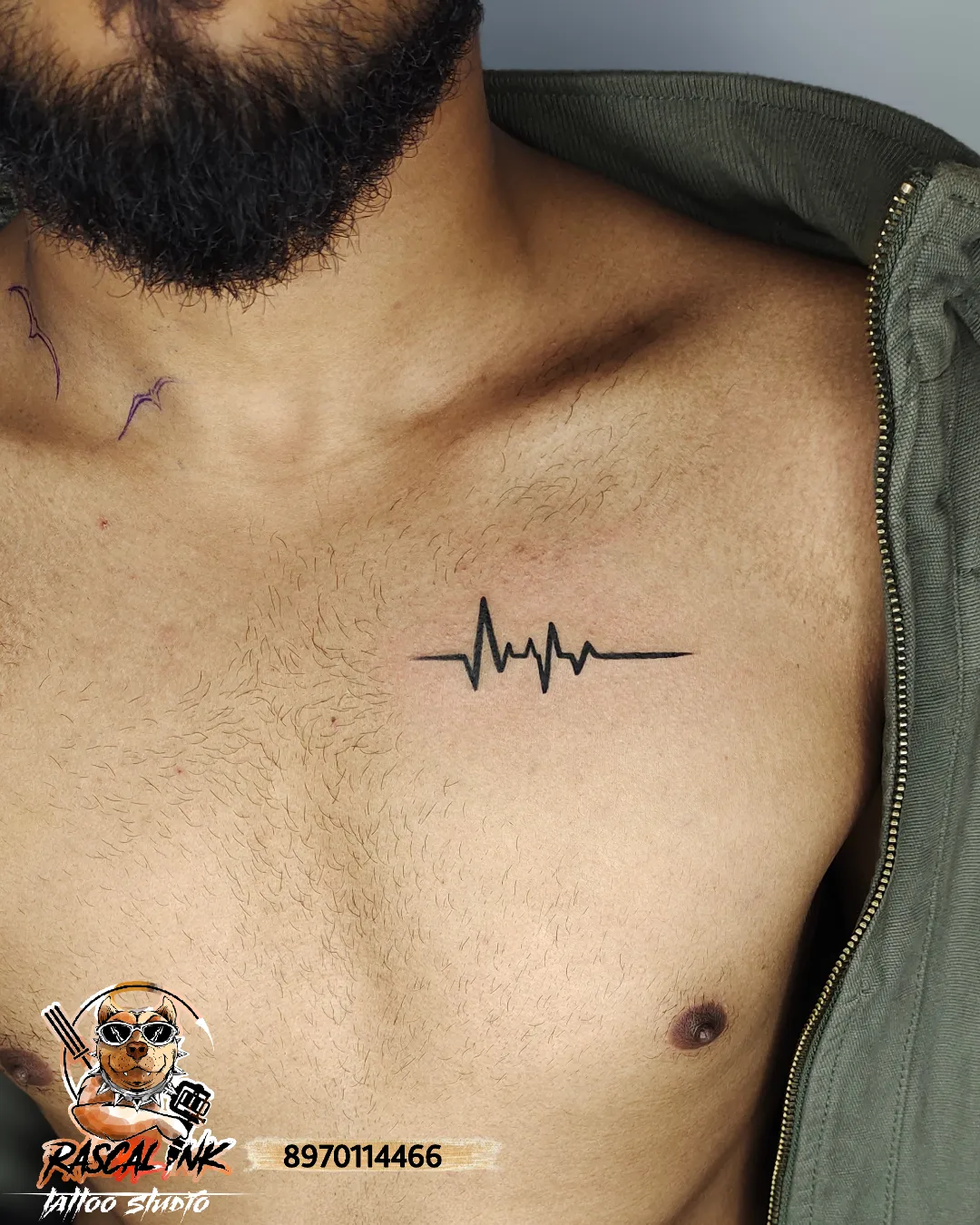
19. Heartbeat Line
An ECG trace — flat, one spike, flat again — carries obvious emotional meaning without needing a single word of text.
Scale and placement decide how much presence it has. On a wrist it is intimate; across a ribcage it becomes a statement.
Keep the flat sections genuinely flat. A wobble there is far more visible than a wobble in the spike.
Photo: @rascalinktattoos
20. Small Infinity Symbol
The infinity loop is common enough that it needs to be executed cleanly to avoid looking generic.
Done with an even line weight and a genuinely symmetrical crossing point, it is a quietly satisfying shape.
Some artists integrate a name or a date into one of the loops. In my experience that usually crowds it — the plain version ages better.
Photo: @buzzinkatattoos_mumbai
21. Fingerprint
A fingerprint — yours, or a family member’s — rendered as concentric linework is about as personal as a simple tattoo gets.
The ridges need enough spacing to survive healing, so the artist will simplify the real print rather than copy it exactly. That is correct, not lazy.
Ask for a version with fewer, cleaner ridges. The literal scan will blur into a solid smudge within a few years.
Photo: @salvationbeautyink
Variations Worth Considering
If none of the 21 lands exactly, these adjustments usually get people the rest of the way there.
Negative Space Instead of Line
Rather than drawing the shape, block in the area around it and let untattooed skin form the subject.
It requires more ink and a longer sitting, but the result is graphically much stronger at small sizes.
Micro Scale
Anything under an inch. It works, but only for designs with three or four elements at most.
Line weight is the limiting factor, not the design. Very small work with very thin lines is the combination most likely to need a touch-up.
Repeating the Same Mark
Three small identical shapes in a row, or a set of tally marks, gives you rhythm without adding complexity.
It also scales — you can add to it over years, which very few single-subject tattoos allow.
Placing It Where Only You See It
Inner bicep, ribs, the inside of the ankle. A simple tattoo you rarely show reads differently from one on a hand.
Several men I know chose placement first and design second, and none of them regret that order.
Getting a Simple Tattoo Right
Book on the strength of healed linework, not fresh photos. Fresh ink always looks sharp; healed photos are the honest test, and any artist confident in their lines will have them.
Ask for the stencil to be placed and then walk to a mirror and look at it for a full two minutes. Almost every adjustment I have ever asked for came out of that two minutes.
Expect a shop minimum. Even a five-minute tattoo is usually charged at the shop’s floor rate, which is entirely reasonable given the setup, the needles and the sterilisation involved.
Follow the aftercare your artist gives you rather than anything you read online, including here. Keep it clean, keep it out of the sun, and do not pick at it while it heals.
If you notice spreading redness, heat, swelling that worsens after a few days, pus, or a fever, that is not normal healing — contact your artist and see a doctor. The FDA’s guidance on tattoo safety and the American Academy of Dermatology’s tattoo care advice are both worth reading before your appointment. Nothing in this article is medical advice.
Common Mistakes, and What to Do Instead
Going too thin. Hairline work looks incredible for about eighteen months. Ask your artist what the thinnest line is that they would personally get, then use that.
Cramming meaning in. A simple tattoo that has been loaded with a date, a name and a symbol is no longer a simple tattoo. Pick one.
Choosing the design before the placement. The body curves; a design that works flat on paper can distort badly on a calf or a ribcage.
Still not sure where to start? The first tattoo ideas for men guide is built for exactly this stage, and small meaningful tattoo ideas for men covers the same scale with more weight behind the symbols.
If pain rather than the design is the sticking point, ask your artist which of your shortlisted placements they find people struggle with most. They will tell you honestly.
Frequently Asked Questions
How long does a simple tattoo take?
Most of the designs on this list take between twenty minutes and an hour and a half of actual needle time. Setup, stencil placement and aftercare instructions add to that, so budget an hour or two at the shop even for something tiny. Bold or filled designs sit at the longer end because solid black takes more passes. Your artist will give you a realistic estimate once they see the placement.
Do simple tattoos hurt less?
They generally hurt for less time, which is not quite the same thing. Pain is driven mostly by placement — ribs, sternum, hands and feet are consistently reported as the worst, while outer arm and calf are easier for most people. A twenty-minute wrist piece is a very manageable experience for the majority of first-timers. If you are worried, tell your artist beforehand rather than during.
Will a fine line tattoo fade faster than a bold one?
Usually, yes. Thinner lines carry less ink, so the same amount of natural fading removes proportionally more of the design. Sun exposure and friction speed this up, which is why hands and feet age worst. A touch-up somewhere between five and ten years is common for fine line work and is not a sign anything went wrong.
What is the best placement for a first simple tattoo?
Inner or outer forearm is the most forgiving starting point in my experience: flat enough to hold a clean line, easy to keep clean while healing, and simple to cover or show as you prefer. Upper outer arm and calf are close seconds. I would avoid hands, fingers and feet for a first piece, since they fade fastest and are the most likely to need repeated touch-ups.
Can a simple tattoo be added to later?
Often, but it depends on the design. Standalone shapes with clear space around them — a triangle, a small symbol, a line — extend into larger compositions readily. Designs that already fill their space, or that are placed awkwardly relative to the limb, are harder to build on. If you think you might expand later, say so at the consultation and your artist will place it accordingly.
Quick Summary
- Simple tattoo ideas for men are an aesthetic choice, not a beginner’s compromise — and simplicity gives a shaky line nowhere to hide.
- Minimal linework generally ages better than dense shading or colour, because there is less detail to lose.
- Line weight matters more than design size; the thinnest lines are the ones most likely to need touching up.
- Bold blackwork holds its shape best over time, with fine line work the fastest to soften.
- Choose your placement before you finalise the design — the body curves, and paper does not.
- Judge an artist on healed linework photos, not fresh ones.
- Expect a shop minimum charge even for a five-minute piece.
- Follow your artist’s aftercare, and see a doctor for anything that looks like infection rather than normal healing.