The biggest mistake with a first tattoo is not over-thinking it — it is under-thinking it.
In my experience the guys who research for three months and ask four artists for quotes almost always end up happy. The ones who walk in on a Saturday night with a screenshot are the ones asking about removal two years later.
This guide is a working list of first tattoo ideas for men that hold up: designs that age well, sit comfortably on beginner-friendly placements, and do not demand a specialist to execute. Most of them work at the kind of size I usually recommend for a starter piece, roughly the span of your palm.
If you are still deciding where to put it, the inner and outer forearm is where I send most first-timers — there is a whole set of small forearm tattoo ideas for men worth looking through before you commit to placement.
Which First Tattoo Style Is Right for You?
Style matters more than subject for a first piece. The same wolf can look brilliant in American traditional and muddy in fine line, depending on who is holding the machine.
| Style | Best for | How it tends to age | Good first placement |
|---|---|---|---|
| American traditional | Eagles, roses, anchors, skulls, daggers | Excellent — heavy outlines and solid fills stay readable for decades | Outer forearm, upper arm, calf |
| Fine line / minimalist | Small animals, coordinates, single symbols | Softens and can blur, especially at very small sizes | Inner forearm, inner bicep |
| Black and grey realism | Portraits, wolves, detailed nature | Good with a specialist, poor with a generalist | Outer forearm, upper arm |
| Script / lettering | Quotes, names, dates, Roman numerals | Good if spacing is generous and the font is not too thin | Inner forearm, inner bicep, ribs |
| Geometric / blackwork | Mountains, mandalas, sleeve foundations | Very good — solid black holds, though fine grids can fill in | Upper arm, outer forearm, shoulder |
| Japanese | Dragons, snakes, koi, waves | Excellent, but the style has rules worth respecting | Outer forearm, upper arm |
What Actually Makes a Good First Tattoo
A good first tattoo has meaning beyond how it looks, sits somewhere you can show or cover depending on the room, and is drawn by an artist whose healed work you have actually seen.
Healed photos are the single most useful thing you can ask for. Fresh tattoos all look sharp. A portfolio full of day-one shots and nothing from six months later tells you something.
Size is the other lever most first-timers get wrong. Every artist I have asked says the same thing: people ask for designs too small for the detail they want, then come back to have it redone bigger.
Placement drives comfort as much as visibility. Outer arm and outer forearm are usually the mildest spots on any tattoo pain chart, while ribs, sternum and inner elbow sit at the other end.
Budget for quality rather than shopping for the lowest quote. Shop minimums and hourly rates vary widely by city and artist, so ask directly — our breakdown of how much a small tattoo costs explains what usually drives the number.
21 First Tattoo Ideas for Men
These are ordered roughly from lowest commitment to highest, not from worst to best.
1. A Quote That Has Always Been True
A short line from a book, a family saying, something a grandparent repeated until it stuck. The script piece at the top of this article is exactly this idea executed well.
Keep it to one line if you can. Two lines double the space needed and triple the chance the spacing looks awkward in ten years.
Ask for a slightly heavier weight than the font you mocked up on your phone. Thin script is the most common thing I see blur on healed forearms.
Inner forearm and inner bicep both work. If you want more options, there is a fuller set of quote tattoo ideas for men to borrow from.
2. Traditional American Eagle
An American traditional eagle on the upper arm or outer forearm is about as proven as tattooing gets.
The style was built for longevity: thick outlines, limited palette, shapes that stay legible when the ink spreads slightly with age.
It is also one of the few designs almost any competent artist can execute well, because the vocabulary is so well established.
3. Birth Year in Roman Numerals
A year, a date, or a set of initials rendered in Roman numerals — private enough that most people will not decode it at a glance.
Proofread it twice, then have the artist proofread the stencil on your skin before they start. I have seen a transposed numeral go through, and it is a miserable fix.
A serif face usually holds up better than a hairline one. Browse Roman numeral tattoo ideas for spacing and placement examples.
4. Compass
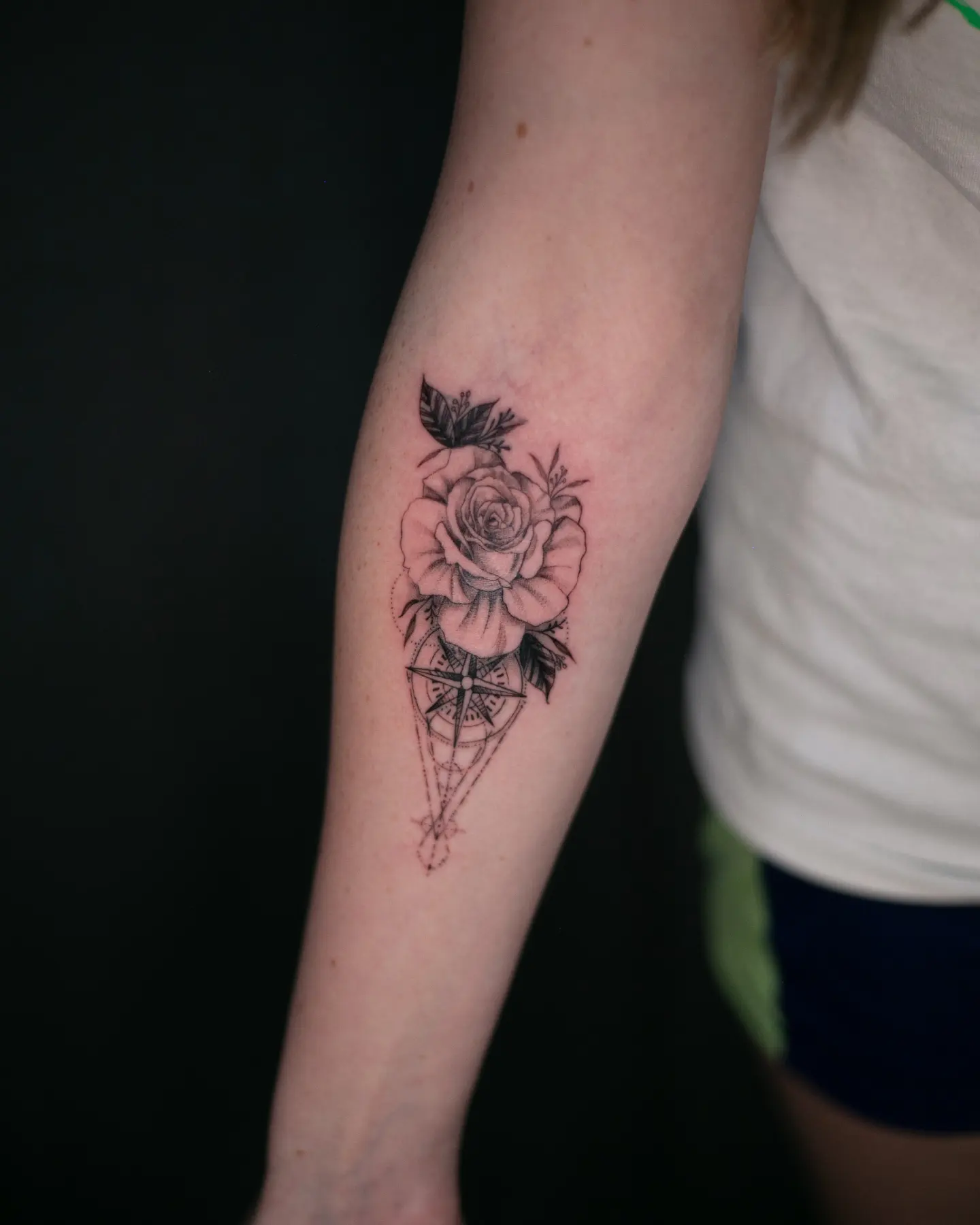
A compass is the rare first tattoo that works in almost every style — traditional, black and grey, geometric, or fine line.
It reads as direction and self-determination without needing a caption, which is part of why it stays popular.
Ask for four to five inches at minimum. Below that, the rose points and cardinal lettering start to merge. The compass forearm tattoo gallery shows what a good size looks like in practice.
5. Small Traditional Rose
A single traditional rose, palm-sized, on the outer forearm or upper arm.
It is the most forgiving design on this entire list. The petal structure is bold, the shading is simple, and a rose never looks like it is trying too hard.
It also gives you an anchor point if you ever decide to build outward into a half sleeve. Roses fill gaps better than almost anything else.
6. Geometric Mountain
Mountain ranges rendered in clean geometric linework suit men who want something modern rather than old-school.
The catch is that geometric work exposes a shaky line instantly. Straight lines have nowhere to hide.
When I have looked at geometric portfolios, the tell is always the long unbroken lines — if those wobble, keep scrolling.
7. Family Member’s Name or Initial
A child’s name, a parent’s initials, a date attached to someone who matters.
This is the category with the lowest regret rate in every conversation I have had with artists, for the obvious reason: the meaning does not expire.
The usual caution applies to romantic partners rather than family. Most artists will tell you the same thing, gently, if you ask them directly.
8. Japanese Kanji for a Meaningful Concept
A single kanji character for a concept you actually live by — discipline, patience, family.
Get the characters verified by someone who reads Japanese before you book. Translation apps produce results that are technically correct and contextually strange more often than people expect.
Stroke weight matters too. A kanji drawn with brush-like variation looks considered; one drawn with uniform lines can look like clip art.
9. Wolf Head
A black and grey wolf head on the outer forearm or upper arm is one of the most requested men’s tattoos going.
Popular does not mean bad, but it does mean you should push for a version that is yours — a specific angle, a specific mood, not the first image on a search page.
Fur detail eats space. Under about five inches, it tends to compress into grey mass. See wolf tattoo ideas for the range of approaches.
10. Anchor
The anchor is one of the oldest motifs in Western tattooing and still one of the cleanest small pieces available.
Stability, home, staying put — the symbolism is straightforward and does not need explaining at a barbecue.
It works small in a way most designs do not, because the silhouette is so distinct even at three inches.
11. Coordinates of a Significant Location
The latitude and longitude of a hometown, a hospital, a place something changed.
Nobody reads it as anything but numbers unless you explain it, which is exactly the appeal for men who do not want to discuss their tattoos.
Check the decimal places before the stencil goes on. Two coordinates one digit apart can be a hundred kilometres apart on the ground.
12. Minimalist Fine Line Animal
A single-weight line drawing of an animal that means something to you — a bird, a stag, a dog you had.
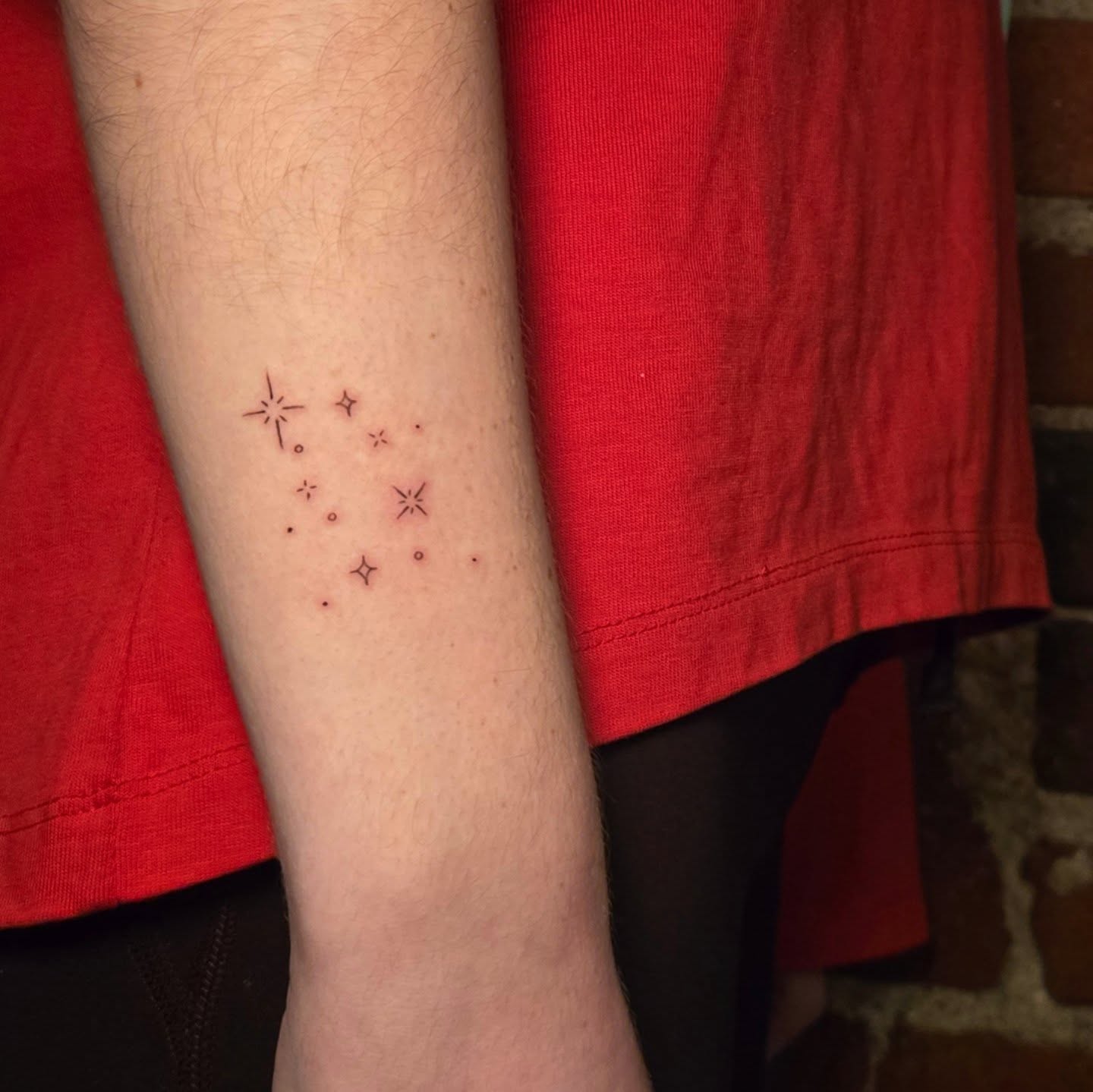
Be honest with yourself about how fine line ages. Very thin lines placed very close together tend to soften and merge over years, and hands and fingers are the worst offenders.
Keeping it on the inner forearm and asking for slightly more space between lines than looks necessary buys you a lot of time.
13. Traditional Skull
A traditional skull is graphic rather than grim — bold outline, simple shading, a lot of negative space.
It is also endlessly extendable. Skulls pair with roses, daggers, snakes and moths without looking crowded later.
If you want variations before you decide, the skull tattoo ideas for men collection covers traditional through realism.
14. Cross
A cross is the most common faith-based first tattoo for men, and it scales from two inches to a full forearm panel.
Keep the proportions simple if it is small. Ornate Gothic detail at three inches turns into a dark smudge faster than you would like.
Inner forearm and inner bicep are the placements I see age best for this one.
15. Black and Grey Portrait
A portrait of a grandparent, a parent, someone you lost. Enormous meaning, and by some distance the hardest thing on this list to get right.
This is specialist work. A portrait artist is a different job from a general tattooer, and booking the wrong one produces a result that is worse than no tattoo at all.
When I have asked portrait specialists about first tattoos, most say the same thing: wait, get something smaller first, learn how you sit, then come back with a high-resolution reference photo.
16. Traditional Snake
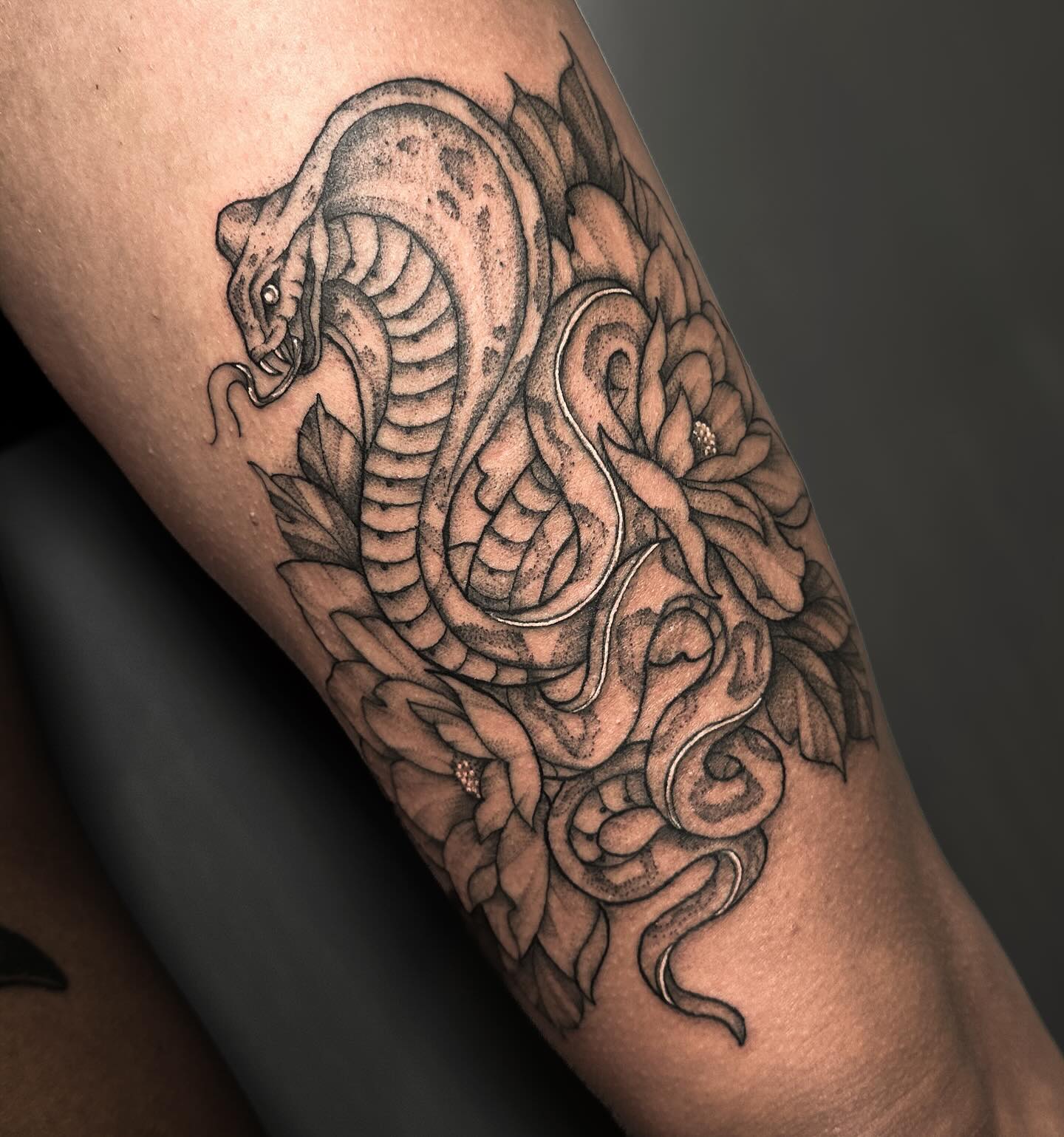
A snake wrapping the forearm follows the shape of the limb instead of sitting flat on it, which is why it looks so natural in motion.
Symbolically it covers rebirth and transformation, and it carries those meanings across a lot of cultures without being tied to one.
It is also a natural first panel if a sleeve is somewhere in your future.
17. Geometric Sleeve Start
If you already know you want a sleeve eventually, starting with a deliberate first panel beats collecting unrelated pieces and trying to connect them later.
Tell the artist at the consultation. A good one will design the first piece with the eventual layout in mind, even if the rest is years away.
The trade-off is that it usually ties you to one artist, or at least one style, for a long time.
18. Mountain and Sun
A mountain range with a rising sun behind it, usually contained inside a circle or a soft frame.
The circular composition is what makes it work — it gives the design an edge, so it never looks like it drifted onto your arm.
It suits men who spend real time outdoors and want something referencing that without a literal landscape photograph on their skin.
19. Japanese Dragon in Small Scale
A Japanese dragon scaled down to a single forearm panel rather than a body suit.
Japanese tattooing has genuine conventions about flow, background and composition, and a dragon drawn without them reads as off even to people who cannot say why.
Find someone who works in the style specifically. It is worth waiting three months for the right artist here.
20. Family Crest or Heritage Symbol
A family crest, a national symbol, a pattern tied to where your people came from.
The meaning arrives fully formed, which is a real advantage for a first tattoo.
One caution worth taking seriously: check how the symbol is read by other people, not just by your family. Some heraldic and national imagery has picked up associations the original owners never intended.
21. Something That Has Always Mattered
The best first tattoo is often not on any list. It is the thing you have been drawing in the margins of notebooks since you were fifteen.
If an idea has survived five years in your head, it will survive on your arm. That is the only durability test that has ever mattered.
Bring it to a consultation as a rough sketch and a few reference images, and let the artist translate it into something that works on skin.
If None of These Fit
Not every good first tattoo comes from a list of ideas. Three alternatives are worth considering before you settle.
Pick From the Artist’s Flash
Flash sheets are designs the artist has already drawn and wants to tattoo. They are usually cheaper, faster to book, and executed with total confidence because the artist has done that exact piece before.
For a first tattoo, that confidence is worth more than most people realise.
Let the Artist Design It
Give a subject, a size, a placement and a style, then get out of the way. Artists consistently produce their best work when they are not being art-directed line by line.
Every artist I have asked about this says the same thing, usually with feeling.
Matching or Memorial Pieces
A matching piece with a sibling or a memorial for someone you lost carries meaning that does not depend on the design being clever.
Keep them simple. The weight is in what it stands for, not in the rendering.
Before and After: Practical First-Tattoo Advice
Eat a proper meal beforehand and skip alcohol the night before. Thinner blood means more wiping, and more wiping means a harder session for both of you.
Follow your artist’s aftercare instructions over anything you read online, including this page. They know what ink and wrap they used on you. Our general tattoo aftercare guide is a starting point, not a replacement.
Expect the surface to look settled in roughly two to three weeks, while the deeper layers keep healing for a couple of months. Peeling and itching in the first fortnight is normal; picking at it is how you lose detail.
Spreading redness, swelling that worsens after the first few days, pus, or a fever is not normal healing — see a doctor rather than waiting it out. The American Academy of Dermatology and the US Food and Drug Administration both publish plain-language guidance on tattoo risks and ink safety. Nothing here is medical advice.
One more, and it should not need saying: never let someone tattoo you outside a licensed studio, and never attempt it yourself. Sterilisation is the entire safety story.
Still Not Sure? The Mistakes Worth Avoiding
Choosing by price is the one that produces the most regret. A cheap tattoo costs more once you add the cover-up or the removal sessions.
Choosing by convenience is a close second. The shop nearest your flat is not necessarily the shop that does your style.
Going too small is the most common technical mistake. Detail needs room, and skin is not paper.
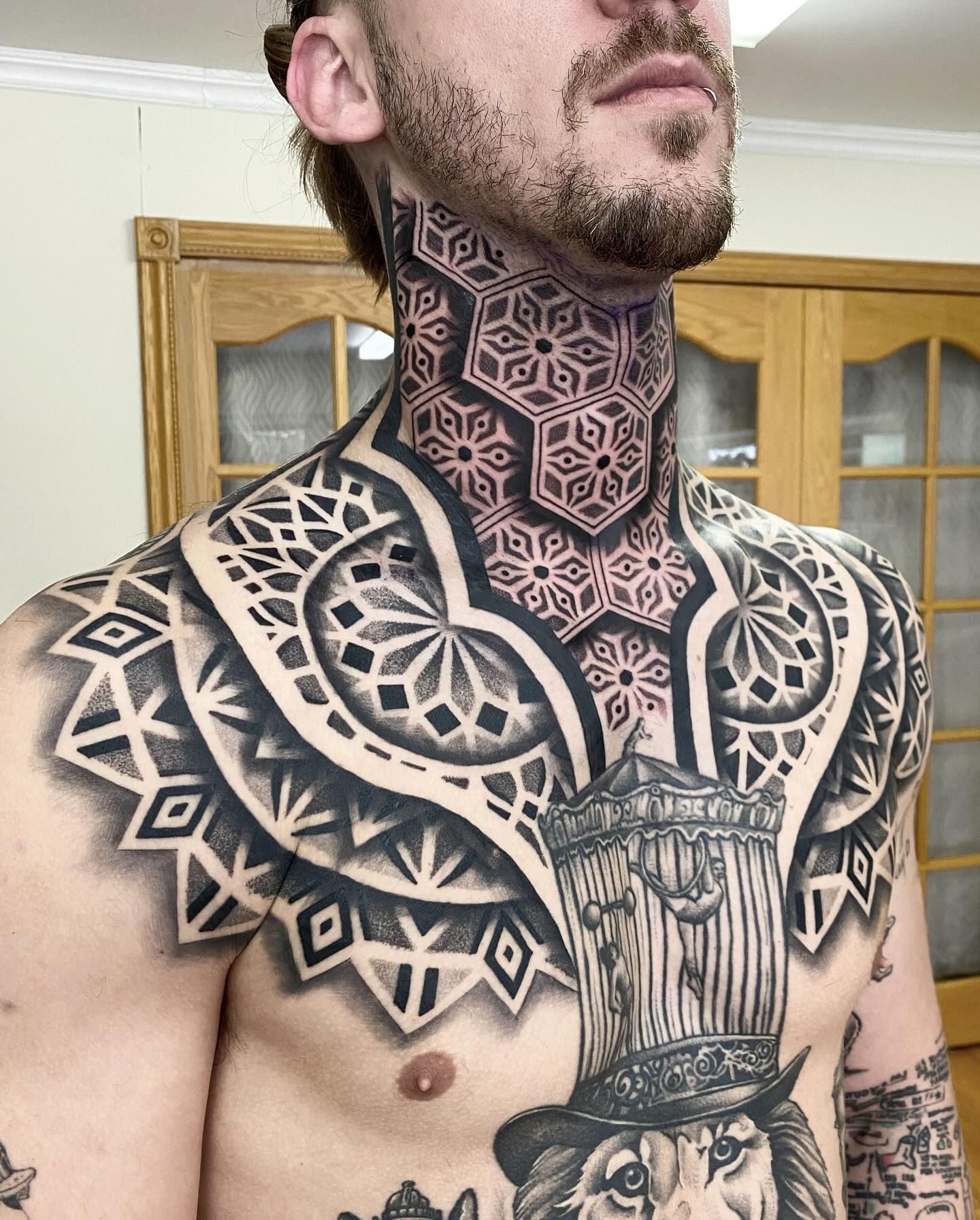
And starting on the hands, neck or face is the placement mistake. Those are last-chapter spots, not first-chapter ones.
If everything above has you leaning smaller and simpler, that is a sound instinct — our roundup of simple tattoo ideas for men is built for exactly that.
Frequently Asked Questions
What is the best first tattoo for a man?
There is no single best design, but the safest starting profile is a palm-sized piece in a bold style, placed on the outer forearm or upper arm. American traditional roses, anchors, eagles and simple script all fit that description. They age predictably, most competent artists can execute them well, and they can be built on later if you decide to keep going. In my experience, men who start there are the ones still happy with the piece years on.
How much does a first tattoo usually cost?
It depends heavily on your city, the artist’s experience and the shop’s minimum charge, so any single figure would be misleading. Most studios set a minimum that covers setup and sterile supplies regardless of how small the piece is, and price larger work by the hour or by the piece. Ask for a quote at consultation rather than over direct message, since artists need to see the placement and size. Treat an unusually low quote as information about the shop, not a bargain.
Where does a first tattoo hurt least?
Outer arm, outer forearm and outer thigh are generally the mildest areas, because there is more muscle and fat between the needle and the bone. Ribs, sternum, inner elbow, knees, feet and anywhere directly over bone are usually reported as the sharpest. Pain tolerance varies a lot between individuals, so treat any chart as a rough guide rather than a promise. A first session of two hours or less on the outer arm is a comfortable introduction for most people.
How long should I think about it before booking?
A common rule of thumb among artists is that if you have wanted the same idea for a year, you are unlikely to tire of it. That is not a scientific threshold, just a useful filter against impulse. The more practical step is spending that time finding the right artist rather than second-guessing the design. Good artists are often booked weeks or months out anyway, which builds in a cooling-off period for free.
Can a first tattoo be part of a future sleeve?
Yes, and planning for it early makes the eventual sleeve far easier to build. Tell the artist at consultation that you may extend the work, and ask them to design the first panel with flow and background in mind. Snakes, dragons, geometric panels and traditional roses all connect well to later pieces. The trade-off is that you are effectively committing to one style, and usually one artist, for the long haul.
Quick Summary
- Pick meaning first, style second, subject third — the design follows from those.
- Bold styles like American traditional and blackwork age most predictably.
- Go bigger than feels necessary; detail needs room to survive.
- Outer forearm and upper arm are the most beginner-friendly placements.
- Ask every artist for healed photographs, not just fresh ones.
- Choose the artist on portfolio and hygiene, never on price or proximity.
- Follow your artist’s aftercare instructions, and see a doctor if healing goes wrong.
- Leave hands, neck and face until you know how you feel about being tattooed.