The skull is one of the oldest subjects in tattooing, and it has never gone out of fashion for a reason. A skull is the only image that every person on earth recognises instantly and reads the same way: this is what we all are underneath.
I have watched skull designs come through shops for years, and the ones that stay powerful are never the ones trying hardest to look scary.
They are the ones where the artist treated the anatomy seriously and let the form do the work. If you are still gathering references, it is worth browsing skull tattoo drawings alongside finished tattoos, because a design that photographs well on paper does not always translate to skin.
Below are 20 directions worth considering, each in the style that handles it best, with honest notes on how they age.
Which Skull Style Is Right for You?
Style choice matters more than subject choice here. The same skull tattooed by a traditional artist and a realism artist are two entirely different tattoos with two entirely different lifespans.
| Style | Best For | How It Ages | Sitting Time (typical) |
|---|---|---|---|
| American traditional | A first skull, or anything on a high-wear spot | Excellent — bold lines survive spreading | 2–4 hours |
| Blackwork | Large-scale sleeves and back pieces | Very good, though solid black may need a touch-up | 4–8 hours, often multiple sessions |
| Black and grey realism | Portrait-style skulls with real depth | Softens over time; needs a specialist to hold up | 5–10+ hours |
| Dotwork | Textured, meditative, ornamental skulls | Good if dots are spaced with age in mind | 4–8 hours |
| Geometric | Clean, modern, architectural designs | Good, but crooked lines show forever | 3–6 hours |
| Fine line / minimalist | Small, discreet placements | Fades fastest; expect a refresh eventually | 1–2 hours |
| Colour neo-traditional | Sugar skulls and decorative work | Good in saturated colour; pastels fade first | 3–6 hours |
Why the Skull Still Works
The human skull is one of the most recognisable forms on earth. It reads at almost any size, in almost any rendering, from across a room.
That visual resilience is what makes it exceptional tattooing material. Most subjects lose their identity when they are shrunk or simplified; a skull does not.
It also ages better than nearly any other subject, because the essential shape survives even as fine detail softens over the decades. A skull that loses ten percent of its crispness is still unmistakably a skull.
There is a longer tradition behind it too. The skull as a reminder of mortality runs through European memento mori painting, funerary sculpture and folk art long before it reached a tattoo machine.
In my experience the men who are happiest with their skull tattoos years later are the ones who wanted the reminder, not the shock value. The shock wears off within a month. The reminder does not.
20 Skull Tattoo Ideas for Men
1. American Traditional Skull
Bold outlines, a flat graphic quality, and the deliberate simplification that defines the style. An American traditional skull strips the subject to its essential form and holds that form for decades.
This is the most age-resistant version of skull tattooing, and in my experience it is the one people regret least. There is nothing fussy in it to go wrong.
It sits well almost anywhere, but it is especially good on the outer forearm, the calf, or as a filler element between larger pieces. Ask for slightly heavier line weight than the flash looks like it needs.
Photo: @schampie_tattoos
2. Sugar Skull (Calavera)
The decorated skull of the Mexican Día de los Muertos tradition, with floral patterns filling the eye sockets and ornamental detail across the cranium.
The sugar skull celebrates life through the image of death rather than mourning it, which is a genuinely different emotional register from most skull work.
It is worth understanding that context before wearing one. If the style pulls you in, our guide to sugar skull tattoo ideas goes deeper on the symbolism and the colour choices that keep it from turning muddy.
Photo: @inkloveplayadelcarmen
3. Skull With Snake
A snake threading through the eye socket or coiling around the jaw is one of the oldest pairings in tattooing, and it works because the two forms are opposites.
The skull is rigid and symmetrical. The snake is fluid and asymmetrical. Together they create movement in a subject that would otherwise sit still.
It is also a practical composition: the snake’s body can be routed to follow a limb, which makes this a strong choice for a forearm or calf wrap.
Photo: @thstpl
4. Geometric Skull
The organic complexity of a skull rebuilt from straight lines, repeated angles and clean facets. The tension between the natural subject and the mathematical treatment is the whole point.
This one lives or dies on execution. Every artist I have asked about geometric work says the same thing: a wobble of half a millimetre in a straight line is visible forever.
See more of the approach in our geometric tattoo ideas for men, and look hard at healed photos before booking, not just fresh ones.
Photo: @btn_tattoos
5. Blackwork Skull Sleeve Element
Heavy solid black, high contrast, and negative space used as a design element rather than an afterthought. Blackwork skulls anchor a larger composition rather than standing alone.
When I have seen this done well, the skull is not the loudest thing in the sleeve; it is the thing your eye returns to.
If you are planning a full arm, look at blackwork tattoo ideas for men first, because solid black areas need to be planned around the whole limb from the start.
Photo: @allsacredtattoo
6. Skull With Rose
Death and beauty in a single image. The pairing is old enough to be a genuine tattoo tradition rather than a trend, and it survives because the contrast is real rather than decorative.
The rose softens the skull without weakening it. It also gives the artist somewhere to put colour or heavy shading if the composition needs balance.
There are dozens of ways to arrange the two — through the eye socket, clenched in the teeth, growing from the cranium. Our rose and skull tattoo ideas covers the layouts that read best at arm size.
Photo: @jamesbtattoos
7. Half-Face Skull Portrait
One side living face, one side exposed bone. The split makes explicit what is true of everyone, which is why it hits harder than a straight skull.
It is technically demanding work. The living half has to be convincing as a portrait or the whole concept collapses into a costume mask.
In my experience this is a design worth waiting six months for the right artist rather than taking the next available appointment.
Photo: @xinaink
8. Crystal Skull
The skull rendered as if cut from quartz or glass, with faceted planes, refracted highlights and translucency suggested through careful contrast.
It is a showcase for technical skill more than a symbolic statement, and there is nothing wrong with that.
The catch is that the illusion depends on very precise highlight placement. Ask to see healed work specifically, because highlights that looked sharp on day one can soften considerably.
Photo: @jakkistorm
9. Viking or Norse Skull
Horned helmets, knotwork, runes and the visual language of Norse mythology built around a skull. The combination speaks to fate, warrior death and a particular attitude toward mortality.
One honest note: the horned helmet is a nineteenth-century invention, not a historical Norse artefact. Plenty of people wear one anyway, and that is a fair choice — just make it knowingly.
If accuracy matters to you, our Viking tattoo ideas for men covers the motifs that do have historical grounding.
Photo: @fantinitattoo
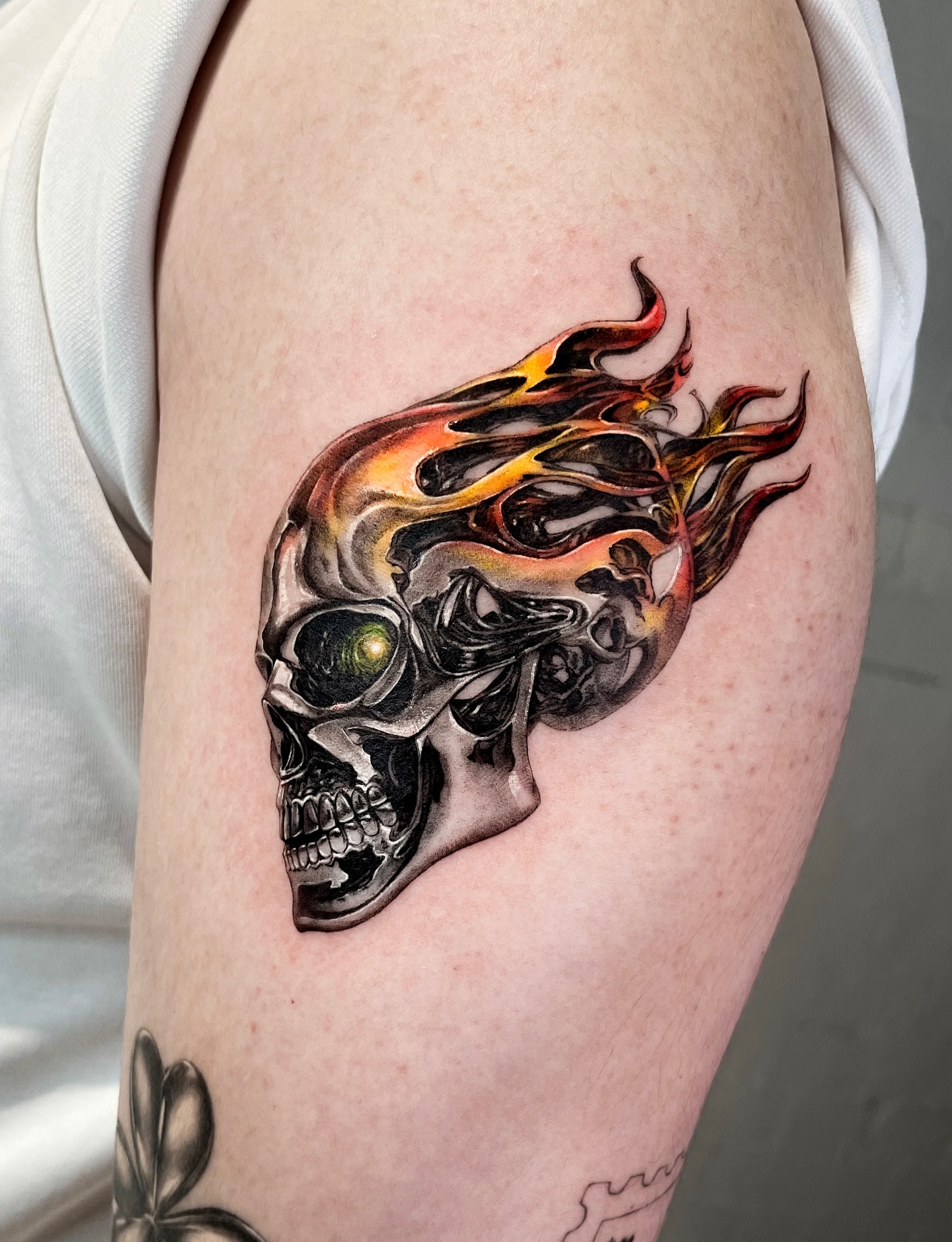
10. Flaming Skull
Fire sweeping back from the cranium, with flames doubling as movement, energy and destruction. It is a hot-rod and biker classic for good reason.
The flames also solve a design problem: they give an otherwise round subject a direction, which helps the tattoo sit correctly on a curved limb.
Keep the flame shapes bold. Fine wispy fire is the first thing to blur as a tattoo settles.
Photo: @uworida
11. Skull With Helmet or Crown
Adding a crown, a war helmet or a gas mask changes the statement entirely: this is no longer a skull, it is a specific dead person with a specific station.
A crown reads as authority outlasted by death. A helmet reads as a life spent in conflict. Choose deliberately, because the accessory carries more meaning than the skull does at that point.
These designs need more room than a plain skull. I would not put one below about four inches without losing the detail that makes it work.
Photo: @shanetattoos315
12. Dotwork Skull
Shading built entirely from stippled dots instead of solid black or smooth gradient. The texture it produces is unlike anything else in tattooing.
It suits skulls particularly well because bone has a granular quality that dotwork imitates almost naturally.
It is slow, patient work and priced accordingly. Our dotwork tattoo ideas shows what the style does at different scales, which is useful before you commit to a session count.
Photo: @fantinitattoo
13. Skull and Dagger
A blade through the cranium, one of the foundational images of Western tattooing. It reads as violence, but it is more usually read as victory over death.
Traditional flash handles this best, because the composition was designed for bold lines and flat colour in the first place.
The symbolism has layers worth knowing before you wear it — our note on skull with dagger tattoo meaning unpacks the older readings.
Photo: @jeffgleasontattoo
14. Realistic Skull
Photographic rendering: accurate anatomy, real bone texture, deep shadow in the sockets and nasal cavity. Done properly, it looks like the skull is under the skin rather than on it.
This is the least forgiving option on the list. Anatomy that is slightly wrong will bother you every time you look at it.
Every realism artist I have talked to would rather work larger than the client first suggests, because detail needs space. Take that advice.
Photo: @kierantattoo
15. Skull With Clock
A skull paired with a pocket watch, hourglass or clock face makes the mortality theme literal: time running, time spent, time left.
Some artists set the hands to a birth time or a time of death. It is a small detail nobody else will notice and you will never forget.
The clock face also gives the composition a second focal point, which stops a large piece from feeling like one heavy object floating on the arm.
Photo: @josetattoos.nyc.studio
16. Laughing Skull
An open jaw, a tilted cranium, and a posture that reads as genuine amusement rather than menace. It is the most underrated idea on this list.
A laughing skull says something more interesting than a grim one: that the joke is on all of us and you are in on it.
It works especially well in traditional and neo-traditional styles, where exaggeration is already part of the visual language.
17. Skull With Octopus
Tentacles wrapping through and around the cranium, filling eye sockets and trailing off the composition. Two very different textures forced into one image.
Practically, the tentacles are a gift for placement: they can be extended or shortened to fit a shoulder, a calf or a full sleeve panel.
It is a large-scale idea. Below a certain size the tentacles merge into a dark mass and the whole thing stops reading.
Photo: @laurahendersontattoo
18. Animal Skull
A bull, ram, deer, wolf or bird skull instead of a human one. Each carries a different set of associations, and none of them are the same as a human skull’s.
A bull or steer skull reads as the American Southwest. A ram skull carries occult and astrological weight. A deer skull reads as wilderness and solitude.
In my experience these age extremely well, because horns and antlers give the design a strong silhouette that survives any softening.
Photo: @el.mago.jin
19. Skull With Wings
Wings emerging from a skull suggest the death that liberates: the soul leaving, rather than the body ending.
In religious contexts it references resurrection. In secular ones it reads as the spirit escaping its container. Both readings work, and you do not have to pick one.
Compositionally it is one of the strongest ideas here, because wings naturally fill the horizontal space across a chest or upper back.
Photo: @drewface_tattoos
20. Minimalist Skull
A skull reduced to essential geometry: two circles for sockets, the simplified dome of the cranium, a minimal jaw line. No ornament, no narrative.
The reduction forces the subject to carry all of its meaning unassisted, which it manages easily.
The honest caveat is longevity. Fine, sparse line work fades sooner than bold work, and most people with fine-line tattoos should expect a refresh at some point.
Photo: @altar_tattoo_studio
Placement, Size and Variations
The design is only half the decision. Where a skull sits changes how often you see it, how much it hurts, and how long the detail survives.
Forearm and Outer Arm
The most common home for a skull, and the most forgiving. Flat, stable skin, moderate pain, and enough room for a detailed piece at four to six inches.
It is also the placement you will look at most, which is worth thinking about with a subject this loaded.
Chest and Upper Back
The right choice for winged skulls, large blackwork and anything symmetrical. There is space here for a piece that would be cramped anywhere else.
Sternum work is genuinely painful for most people. The outer chest and shoulder blade are considerably easier.
Hand, Neck and Head
High visibility, high commitment, faster fading. Hands especially need bold designs and periodic touch-ups because of constant wear and sun exposure.
Most reputable artists will ask about your job before agreeing to a hand or neck skull. That question is them looking out for you.
Small and Discreet
A minimalist skull works at an inch or two on an inner arm, ankle or ribcage. Complex designs do not; they turn into a dark smudge.
The rule of thumb I use: if you cannot describe the design in one short sentence, it is too complex to go small.
Getting It Right: Practical Advice
Bring reference images of finished, healed tattoos rather than digital art or AI renders. Healed photos show you what you will actually live with.
Ask to see the artist’s healed skull work specifically, not just their portfolio highlights. Any artist confident in their work will have it.
Expect a good custom skull to take longer than you think. Realism and dotwork in particular are often multi-session pieces, and rushing either one is how you end up with something you want covered later.
On aftercare, follow whatever your artist tells you over anything you read online, including this. Standard guidance from the Mayo Clinic is to wash the area gently twice a day, moisturise it, and keep it out of the sun until it has healed. If you see spreading redness, swelling that worsens after the first few days, pus or a fever, that is a doctor’s call and not a tattoo forum’s.
Sunscreen once healed is the single cheapest thing you can do to keep the piece sharp. It matters more for fine work than for bold work, but it matters for both.
Still Not Sure Which Direction to Take?
The most common mistake I see is choosing the subject before the style. A skull is not a design; it is a starting point that seven different artists will take seven different places.
The second most common is going too small for the level of detail wanted. Detail needs room, and no artist can fit realism into two inches no matter how good they are.
The third is picking an artist by price or availability. A dotwork specialist, a traditional artist and a realism portraitist are three completely different jobs, and the wrong one will give you a competent version of the wrong tattoo.
If you have not settled on someone yet, our guide on how to find a tattoo artist covers what to look for. And if pain is the thing holding you back, the most painful tattoo spots breakdown will tell you what you are signing up for before you book.
Frequently Asked Questions
Do skull tattoos have a negative meaning?
Not inherently, and most wearers do not read them that way. Across tattoo history the skull has usually meant an acceptance of mortality rather than a celebration of death, which is closer to the memento mori tradition than to anything sinister. Some people do choose them for the darker association, and that is their business. In my experience, what the tattoo means to the person wearing it settles the question far more than what a stranger assumes.
How much does a skull tattoo cost?
It depends almost entirely on size, style and the artist’s rate, so any single number would be misleading. A small traditional skull is a short session; a realistic full-arm skull composition is many hours across several appointments. Most shops quote either an hourly rate or a flat piece price after seeing your reference and placement. Ask for the estimate in writing before the first needle goes in, and expect a deposit.
Which skull style ages the best?
American traditional and heavy blackwork, without much argument. Both rely on bold lines and solid shapes that stay legible even after ink spreads slightly under the skin over the decades. Fine-line and minimalist skulls look sharpest on day one but fade soonest. If you want something you will not need to revisit, weight the line thickness up rather than down.
Does a skull tattoo hurt more than other designs?
The subject makes no difference to pain — placement and session length do. A skull on the outer forearm feels much like anything else on the outer forearm. The same design on the sternum, ribs or the top of the foot will be considerably harder to sit through. Long shading sessions, common with realism and dotwork skulls, are usually more tiring than they are sharply painful.
Can a skull tattoo be covered up or reworked later?
Often, yes, but a skull is a difficult cover-up because of its high contrast and recognisable silhouette. A skilled artist can frequently rework one into a larger composition rather than hiding it, which usually gives a better result than trying to bury it. Laser lightening beforehand widens the options considerably. Talk to a cover-up specialist rather than assuming either way.
Quick Summary
- Pick the style before the subject — traditional, blackwork, dotwork, realism and geometric produce completely different tattoos from the same skull.
- Bold styles age best. American traditional and blackwork skulls stay legible for decades; fine-line work will need a refresh.
- Detail needs size. Realism, crystal and octopus designs fail below roughly four inches.
- Pairings change the meaning: a rose softens it, a dagger makes it a victory, a clock makes it about time, wings make it about release.
- Animal skulls carry their own separate symbolism and hold a strong silhouette as they age.
- Placement drives pain and longevity far more than the design does — forearms are forgiving, hands and ribs are not.
- Ask every artist for healed photos of their skull work, not just fresh portfolio shots.
- Follow your artist’s aftercare, keep it out of the sun, and see a doctor rather than the internet if healing goes wrong.