I have watched people walk into a studio asking for a sugar skull and walk out with something far more personal than they expected. The sugar skull is not a death symbol in the gothic sense at all — it is a celebration, and the tattoos that work best are the ones that understand that difference.
The calavera comes from Dia de los Muertos, the Mexican tradition in which families build altars for their dead and welcome them back for a night. UNESCO added the festivity to its Representative List of the Intangible Cultural Heritage of Humanity, which tells you something about how seriously the tradition is held.
In my experience the people who love their sugar skull ten years later are the ones who chose their flowers, their colours and their ornament for a reason. The ones who regret it usually picked a design off a wall because it looked busy and bright.
What follows is 20 directions this design can go, grouped by what each one actually does on skin, along with what I have learned about scale, colour longevity and choosing an artist. If you want the wider tradition first, our guide to Day of the Dead tattoo ideas covers the surrounding imagery.
Which Sugar Skull Style Is Right for You?
Every version below reads differently at a distance, heals differently, and asks for a different amount of skin. This is the comparison I sketch out for people who cannot decide.
| Style | Best For | Smallest Size That Works | How It Ages |
|---|---|---|---|
| Full-colour traditional | Maximum impact and the most faithful reading of the tradition | Palm-sized and up | Strong, but reds and yellows soften first without sun protection |
| Black and grey | Sombre, memorial-leaning pieces and existing blackwork collections | Roughly three inches | The most forgiving option over decades |
| Fine-line / small scale | Wrists, ankles, discreet placements | Two inches, with simplified ornament | Detail closes up over time; needs a design built for that |
| Watercolour | Soft, painterly colour around a crisp skull | Four inches and up | Softest edges of any option; a black anchor line helps |
| Large-scale back or sleeve | Dense ornament, portraits, full narrative scenes | Multiple sessions by design | Best of all, because the detail is large enough to survive |
What Actually Makes a Sugar Skull Tattoo Work
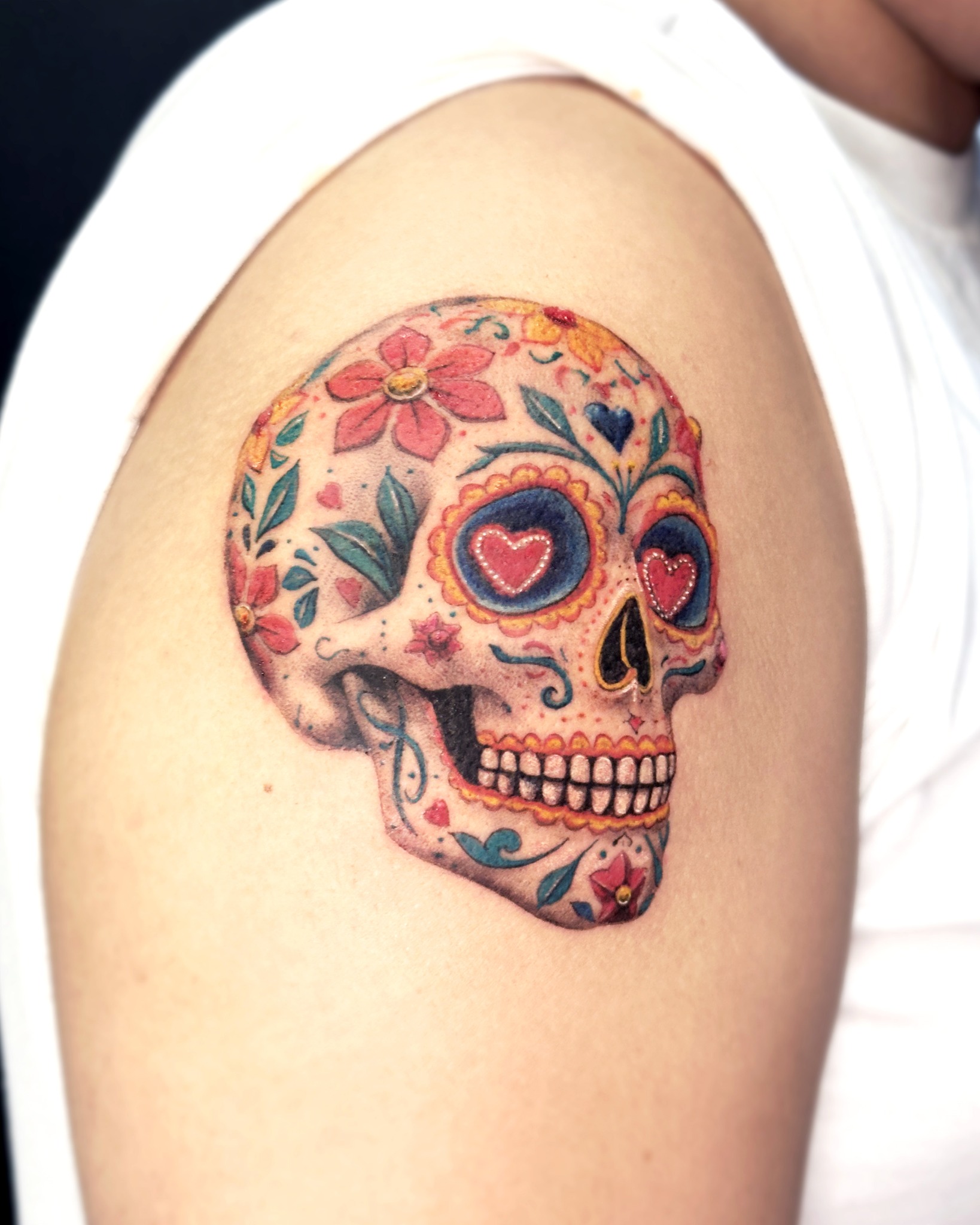
The decoration is the whole point. A sugar skull without ornament is just a skull, and the ornament is what carries the meaning — the flowers, the patterned brow, the filled eye sockets.
The traditional calavera on an ofrenda is often inscribed with a name. That single detail is why a sugar skull is almost always more powerful when it points at a specific person rather than at death in general.
Scale matters more here than in most styles. The design is built from dense small elements, and when you shrink those below a certain point they blur into a grey mass as the tattoo settles.
Every artist I have asked about this says the same thing: the skull structure has to be right before any decoration goes on it. Symmetry across the brow and cheekbones is unforgiving, and a slightly crooked skull is obvious forever.
Colour choice is the last variable. The marigold orange, hot pink, turquoise and deep red palette is traditional for a reason, but I have seen muted and desaturated versions that read beautifully on darker skin tones where high-saturation pinks can disappear.
20 Sugar Skull Tattoo Ideas, Grouped by What They Do
1–3. Traditional Calaveras in Full Colour
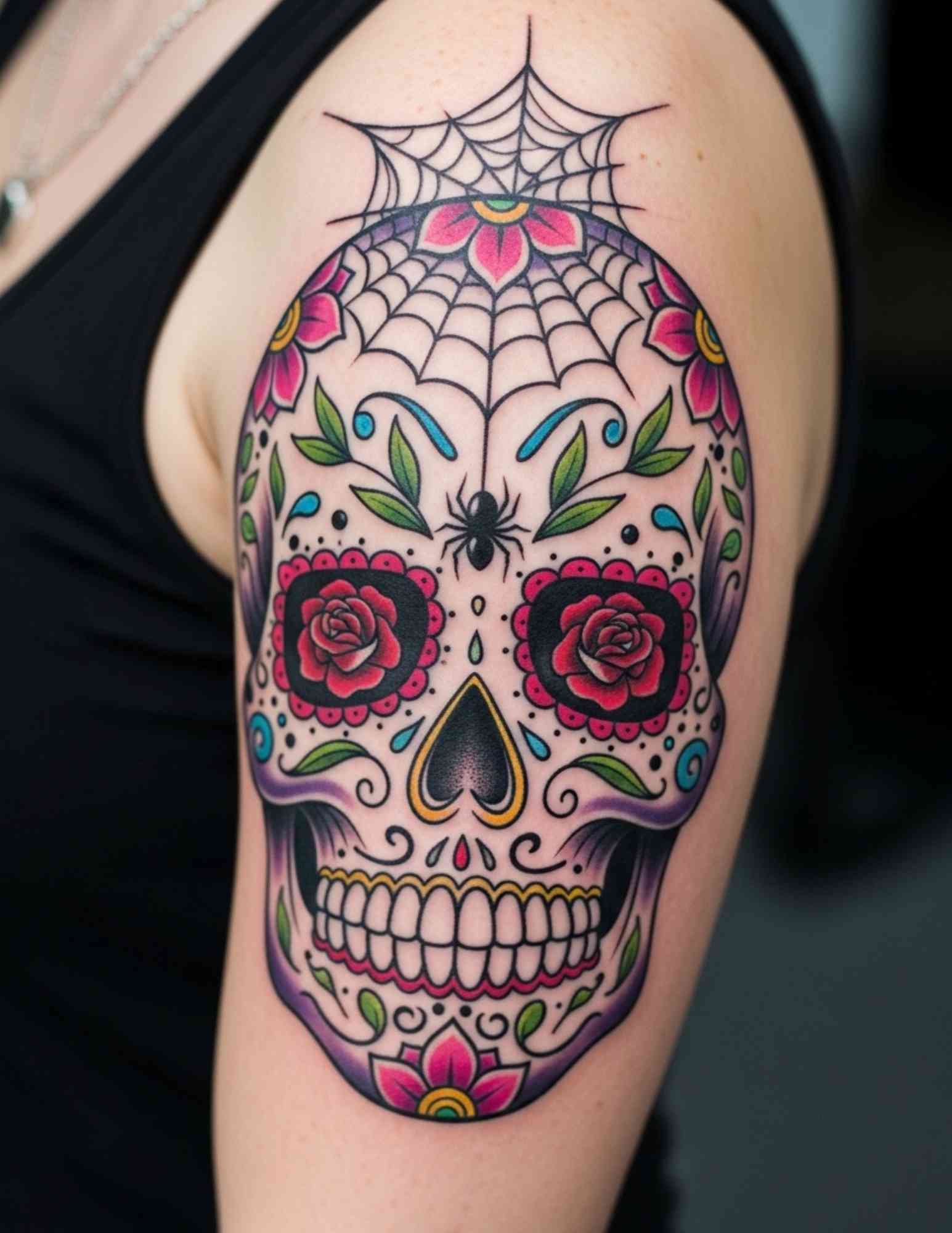
Idea 1 is the classic: a skull with floral patterns, ornate eye designs and the signature palette of marigold orange, hot pink, turquoise and deep red, flowers in the orbital cavities and pattern running across the cheekbones.
Idea 2 turns that format into a tribute. The decorative elements are personalised to one person: their favourite flowers, a name inscribed across the brow, colours that reference something they loved.
This is the most traditional use of the symbol and, in my experience, the one that holds up emotionally. The tribute versions are the ones people still talk about years later.
Idea 3 leans on the cempasuchil, the marigold, whose strong scent is traditionally said to guide spirits to the altar. A skull surrounded by or filled with marigolds is rooted in the specific botanical vocabulary of the tradition, with warm orange and gold dominating.
4, 12 & 15. Black and Grey, Geometric and Abstract
Idea 4 strips the colour out entirely. Without the signature palette, a sugar skull in grey wash relies completely on pattern and form, and the result reads more sombre than celebratory.
I usually suggest this to people who want the symbolism without the visual brightness, or who already have a black and grey collection that a full-colour piece would fight with.
Idea 12 replaces organic ornament with geometry: mandala segments, repeating triangles, dot-worked shading following the planes of the skull. It is a modern reading rather than a traditional one, and it should be described that way.
Idea 15 pushes further. The decorative elements become so elaborate and densely interlocking that the underlying skull almost disappears into the pattern — abstract enough to reward close inspection, but only if the artist keeps that tension deliberate rather than accidental.
5, 11 & 18. Floral Pairings That Change the Meaning
Idea 5 is roses: deep red blooms in the eye sockets, trailing from the chin, or filling the space behind the skull. The rose’s associations with love and loss sit naturally beside the tradition, and skull and rose combinations are among the most established pairings in tattooing.
Idea 11 pairs the calavera with a lotus, borrowing a rebirth symbol from a different tradition. It is a hybrid, and worth knowing that before you commit — mixing symbolic systems is a choice, not a neutral default.
Idea 18 uses higanbana, the red spider lily, associated with death and the afterlife across several Asian traditions. Visually it is dramatic: thin red filaments radiating out from a dense skull, which gives the composition movement without adding bulk.
Of the three, roses are the safest bet for ageing. Spider lily filaments are thin lines that soften noticeably, so I would size that one generously.
6, 7 & 17. Faces, La Catrina and Couples
Idea 6 is the half face: one side decorated in the calavera style, the other side left as a living face or as negative space. The format speaks directly to the duality of the living and the remembered dead.
Idea 7 is La Catrina, the elegantly dressed female skeleton with the elaborate hat who has become the most recognisable figure of Dia de los Muertos. She is a satirical figure in origin, which most people do not realise.
La Catrina asks for a skilled portrait artist. The face is essentially a skull with human expression layered onto it, and the failure mode is a stiff, mask-like result that never quite comes alive.
Idea 17 is a pair of skulls, male and female, facing each other — matching calaveras for a couple whose bond is understood to continue past death. I would still recommend two independently good tattoos over two halves that only make sense together.
8 & 13. Butterflies and Animal Calaveras
Idea 8 adds butterflies, often rising from the crown of the skull. Monarch butterflies arrive in central Mexico around the same season as the festivity, and the association between the two is widely made — if you want the fuller symbolism, we cover what a butterfly and skull tattoo means separately.
Butterflies also solve a compositional problem. They give the artist a way to break the hard outline of the skull and lead the eye up the arm or shoulder.
Idea 13 applies the calavera vocabulary to an animal — most often a cat, sometimes the xoloitzcuintle, the hairless dog traditionally associated with guiding the dead. Decorated animal skulls keep the ornamental language while changing the subject entirely.
These are frequently memorial pieces for a pet, and they work well at that job. Our wider collection of cat tattoo ideas has more directions if that is where you are heading.
9, 10 & 16. Scale: Sleeve Element, Small Piece or Back Piece
Idea 9 uses the skull as an anchor inside a larger sleeve rather than as a standalone tattoo. It sits at the shoulder or forearm with filler flowing around it, which is the most common way I see calaveras used on collectors.
Idea 10 goes the other way: a simplified skull sized for the wrist or ankle. This is the version that most often disappoints, because the ornament that defines the style is the first thing to go when you shrink it.
If you want small, ask the artist to redraw the design for that size rather than scaling a large drawing down. A good small calavera has fewer, bolder elements, not the same elements made tiny.
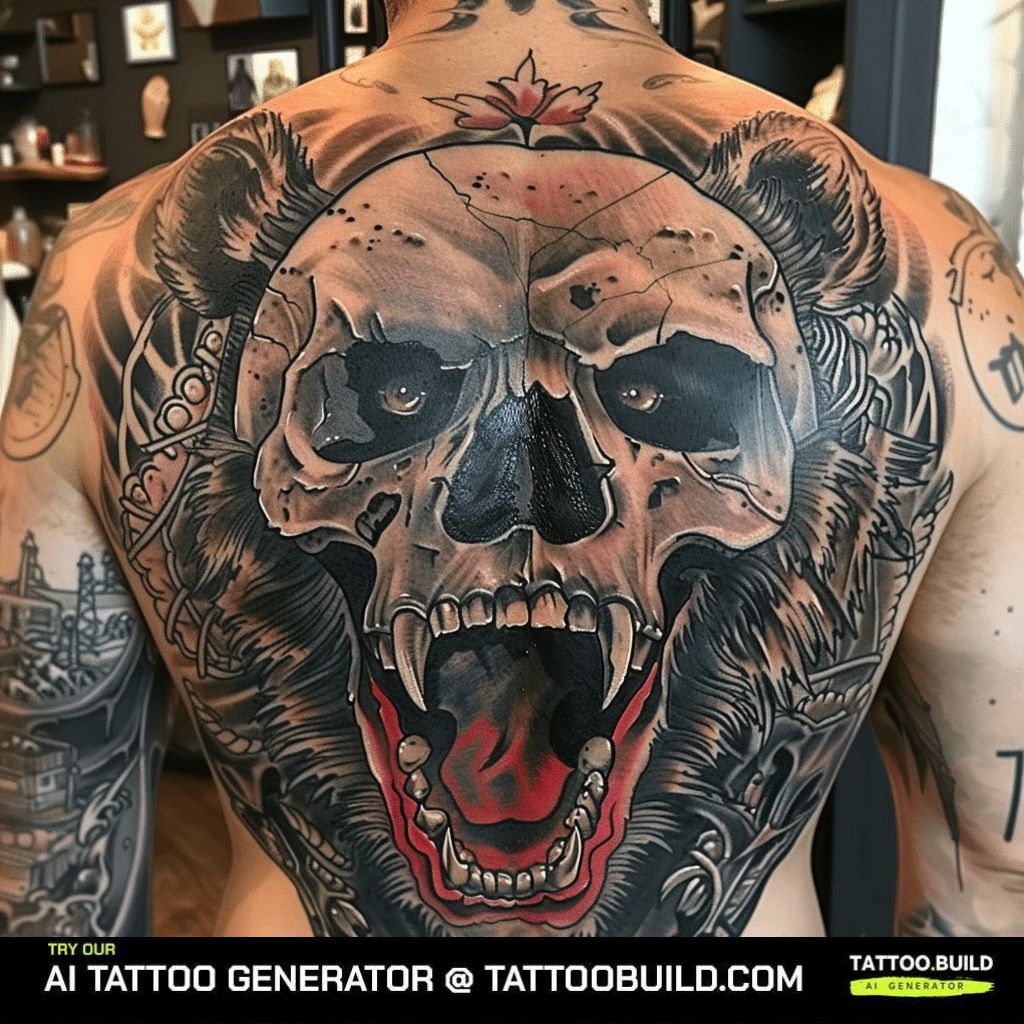
Idea 16 is the opposite extreme — a large calavera centred on the upper or full back, where the ornamentation can be as detailed as the artist wants. It is usually multiple sessions, and it is the format where this style genuinely shines. Our guide to back piece tattoo ideas covers how those projects are usually planned.
14 & 19. Candles, Watercolour and the Handling of Light
Idea 14 brings in candles, which are placed on the ofrenda to light the way for returning spirits. A skull ringed by lit candles with the flame caught in the decorative eye design is one of the most specific references you can make.
Candles also give the artist an excuse to use warm light on a cool palette, which is where a lot of the visual drama in these pieces comes from.
Idea 19 is watercolour: crisp linework for the skull, loose washes bleeding past the edges in the traditional colours. The effect is that the colour feels alive while the skull beneath it is not.
I will be honest about the trade-off. Watercolour softens more than any other approach as it ages, and the versions that hold up best keep a real black structure underneath — a point our watercolour tattoo guide goes into properly.
20. Your Own Skull
The last idea is the one I recommend most often. Design a calavera decorated with the flowers, colours and objects that would appear on your own ofrenda.
What flowers do you actually love? What objects would someone put on an altar to make it unmistakably yours? Those answers make a better reference sheet than any Pinterest board.
It also turns the tradition toward its most direct application: a reminder of mortality and a celebration of the specific life being lived right now.
Alternatives If a Sugar Skull Is Not Quite Right
A Plain Skull and Roses
If the ornament is what you are unsure about rather than the skull, an undecorated skull with roses gives you the memento mori without the cultural specificity of the calavera.
A Direct Memorial Piece
When the point is one person, sometimes the honest answer is a portrait, a handwriting piece, or a date — not a skull. Our memorial tattoo ideas cover the formats that carry that weight without borrowing an imagery set.
Marigolds Alone
A band of cempasuchil with no skull at all still points at Dia de los Muertos for anyone who knows the tradition, and it reads as pure florals to everyone else. It is the quietest version of this idea.
A Full Ofrenda Scene
At larger scale, an altar scene with candles, photographs and marigolds tells the whole story rather than compressing it into one object. It needs real estate — thigh, back or a full sleeve panel.
Keeping a Colour-Heavy Tattoo Looking Right
Sun is the single biggest factor I have seen in how these age. Bright pinks, oranges and yellows fade fastest, so a healed calavera on a forearm or calf really does want daily sunscreen once it is fully settled.
During healing, follow the aftercare your artist gives you rather than advice from the internet, including this page. Studios differ on wrapping and washing routines, and the person who put the ink in your skin knows what they used.
Colour work does carry a genuine, if uncommon, risk of allergic reaction — red pigments are the ones most often named in reports. If you develop persistent itching, swelling, raised skin or anything that looks infected, see a doctor rather than waiting it out; the FDA’s tattoos and permanent makeup fact sheet is a reasonable plain-language starting point on what can go wrong.
On choosing an artist: ask specifically for healed photos of colour work, not fresh ones. Fresh colour always looks incredible, and healed colour is the only honest test of whether someone can pack pigment properly. If placement pain is part of your decision, our guide to the most painful tattoo spots is worth reading before you book.
Still Not Sure? The Mistakes I See Most
The first is going too small. A calavera at two inches on a wrist loses the ornament that made you want it, and no artist can fully rescue that.
The second is choosing a generic design when a specific one was available. Nothing is wrong with a classic skull, but people who inscribe a name or use a grandmother’s favourite flowers rarely regret it.
The third is picking an artist by price rather than by portfolio. Dense symmetrical ornament in colour is a specialist job, and it is not the tattoo to bargain-hunt.
The fourth is wearing the symbol without knowing what it means. Dia de los Muertos is a living tradition in Mexican and Mexican-American communities, recognised by UNESCO as intangible cultural heritage, and understanding the context of celebration and remembrance is basic respect for the source.
If after all of that the calavera still is not landing for you, browsing broader skull tattoo ideas is a good way to work out whether it is the skull or the decoration you actually want.
Frequently Asked Questions
Is it disrespectful to get a sugar skull tattoo if I am not Mexican?
Opinions differ, and it is worth knowing that before you decide. In most conversations I have had, wearing a calavera is understood as appreciation rather than appropriation when the wearer knows what the symbol means and why it exists. What tends to bother people is the symbol used purely as decoration, stripped of the remembrance it comes from. Learning the tradition first is the reasonable middle ground.
How small can a sugar skull tattoo be?
Around three inches is where most artists I have asked start getting comfortable with a colour calavera. Below that, the ornament has to be simplified deliberately rather than shrunk. A two-inch piece can work, but it will be a stylised suggestion of a sugar skull rather than a detailed one. Ask your artist to redraw at final size before you commit.
Does a sugar skull tattoo have to be in colour?
No. Black and grey calaveras are common and they age better than colour does. You lose the celebratory brightness that is part of the tradition, and the piece reads more sombre as a result. Some people split the difference with a black and grey skull and one colour accent, usually marigold orange. It is a legitimate choice, not a compromise.
How many sessions does a large sugar skull take?
It depends entirely on size and density, so treat any number as a rough guide. A palm-sized colour piece is often a single sitting of a few hours. A back piece is usually planned as several sessions spaced weeks apart to allow healing between them. Your artist will give you a realistic schedule once they have drawn the design.
Will the bright colours fade?
They soften, yes, and usually the warm tones go first. Sun exposure is the main driver, so sunscreen on healed work makes a real difference. Well-packed colour by a specialist holds far longer than lightly applied colour. Most colour pieces benefit from a touch-up at some point, and many artists expect that.
Quick Summary
- The sugar skull comes from Dia de los Muertos and is celebratory, not gothic — the meaning is remembrance, not death.
- Tribute versions, personalised to one person with their flowers and colours, are the ones people value most over time.
- Full colour gives maximum impact; black and grey ages best; watercolour softens fastest without a black structure.
- Around three inches is the practical floor for a detailed calavera — smaller designs need to be redrawn, not shrunk.
- Marigolds, roses, spider lilies, butterflies and candles each shift the meaning, so choose them deliberately.
- Back pieces and sleeve anchors are where this style genuinely shines, because the ornament has room to exist.
- Sunscreen on healed colour work is the single highest-value habit for keeping the palette bright.
- Learn the tradition before you wear it, and see a doctor rather than your artist if anything looks infected or allergic.