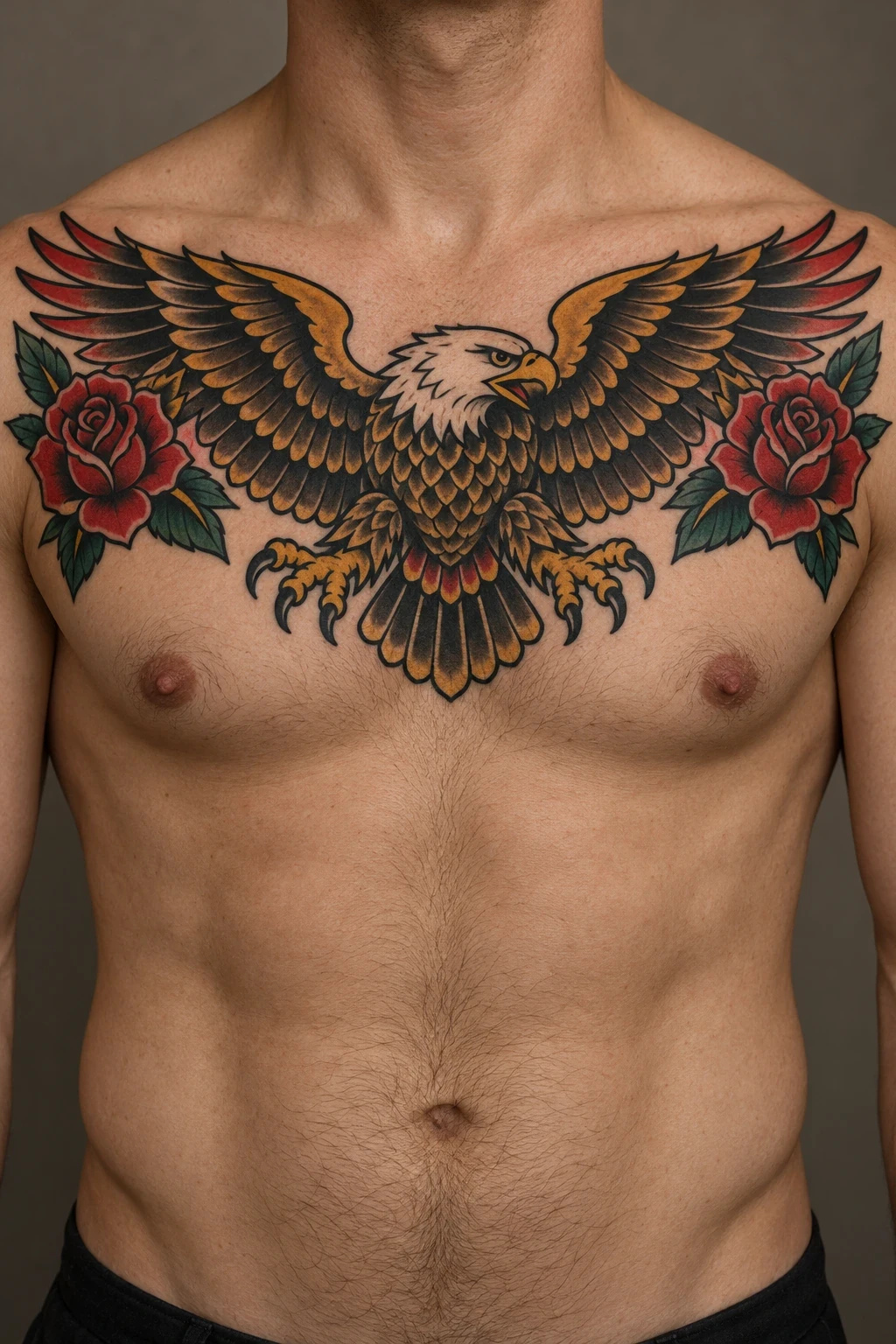
American traditional chest tattoo designs make a strong impression with a few clear elements: a spread-wing eagle, two swallows, a red heart or a pair of roses. The chest gives those shapes room, but the design still needs a deliberate center, a sensible width and space between its parts.
These 16 ideas compare a full chest piece, balanced pairs and smaller one-sided placements. Look at the silhouette first, then the palette and supporting details. The goal is to bring a useful direction to an artist who can draw the tattoo for your body.
Image disclosure: All images here are AI-generated design concepts. They are not real tattoos, healed client photographs or a particular artist’s work. Use them as references for a consultation; an experienced artist needs to review and redraw the details before tattooing.
Start with the layout, then choose your motif
For the concepts below, American traditional means an emphasis on confident black outlines, clear shapes and a restrained palette. The designs use familiar flash subjects rather than soft photographic realism or highly intricate ornamental backgrounds. If you are comparing styles, our tattoo styles guide can help you describe the direction you prefer.
The Sailor Jerry tattoo archive shows examples of eagles, swallows, anchors, ships, hearts and other subjects associated with his work. It is a useful reference for the visual vocabulary, not a reason to copy a complete design or assume every wearer assigns it the same meaning. These concepts are original modern interpretations.
Choose whether you want one large centerpiece, two separate motifs or a compact tattoo on one pectoral. That decision will shape the composition more than adding another symbol. For broader placement comparisons, see our chest piece tattoo ideas.
1. Spread-wing eagle
A wide eagle naturally creates a horizontal chest composition. The wings stretch toward the shoulders while the head and tail establish a center over the sternum. Brown, black and cream keep the bird readable, with a small red accent adding contrast without requiring a busy background.
Start by deciding the wingspan, not the number of feather details. The outer tips should look intentional when your arms rest at your sides. Ask the artist to balance the bird on your actual torso rather than assuming a perfectly mirrored drawing will appear perfectly even on the body.
2. Paired swallows with small flowers
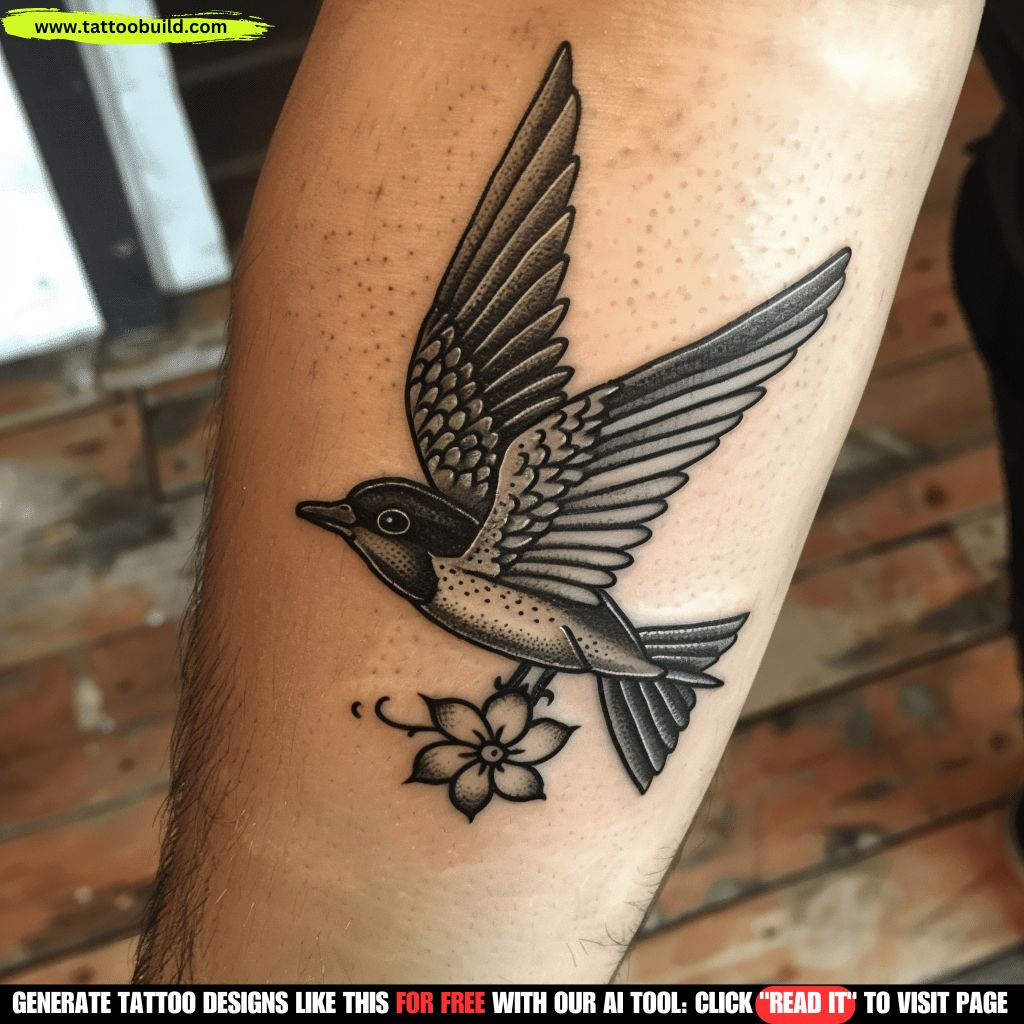
Two swallows create a balanced arrangement without joining everything into one solid chest piece. Blue backs, pale bellies and red accents make the birds distinct from their small supporting flowers. Open space at the center keeps each silhouette easy to recognize.
The birds can face inward, outward or follow slightly different flight angles. Agree on that relationship before adding decoration. Keep the forked tails and wings legible, and use the flowers as supporting elements rather than matching them to the birds in size. Compare a darker palette in our traditional swallow tattoo guide.
3. Clipper ship above blue waves
A ship provides a centered, upright focal point, while the waves spread the composition across the chest. Cream sails stand out from the black hull and blue water. The red disc behind the ship gives the scene a simple background without filling every gap.
The rigging is the detail most likely to become crowded in the drawing. Ask the artist how they will simplify it while preserving the ship’s structure. The mast height, sail arrangement and width of the wave base should fit the available chest area together; avoid enlarging the sails after the lower scene has already been fixed.
4. Panther head between red roses
A black panther face gives the center of the chest a compact, dark anchor. Red roses on either side create a wide frame, while green leaves help separate the flowers from the face. Yellow eyes and a red mouth provide small focal accents within the black shape.
Review the eyes, ears and muzzle before judging the surrounding roses. Those features determine whether the head reads clearly as a panther. Keep space between the face and outer flowers instead of letting every leaf overlap the animal. Our American traditional animal tattoos offer more subjects to compare.
5. Tiger head with golden flowers
An orange tiger creates a brighter central face than the panther. Clear black stripes, a pale muzzle and a red mouth give it a graphic expression. Golden flowers frame the lower sides without introducing another large subject.
A forward-facing head emphasizes the sternum, while a turned head would shift attention toward one pectoral. Choose the expression and direction deliberately. Ask the artist to keep the facial stripes understandable at the final size, particularly around the eyes and mouth, rather than preserving every mark from the generated reference.
6. Heart pierced by a dagger
A vertical dagger adds a strong center line to a broad red heart. The gold hilt sits above it, and the exposed lower blade gives the piece a clear endpoint. Leaf sprays and short rays widen the design without changing its main silhouette.
This layout can stay relatively compact or become the center of a larger chest arrangement. Decide how much empty skin you want around it before adding side motifs. If you later include a banner or a name, give that lettering its own space; these concepts leave it out so the heart and dagger remain the focus.
7. Anchor and rose on one pectoral
A one-sided anchor offers a smaller commitment in coverage than a full-width chest piece. The black anchor, gold rope and red rose form a complete cluster on their own. Leaving the opposite side open makes the asymmetry an intentional part of the design.
Check the anchor’s angle against the collarbone and the edge of your usual neckline. The rope should follow a clear route around the metal shape rather than becoming a tangle of loops. If you expect to add a second chest tattoo later, discuss the future balance now instead of placing this piece wherever a reference happens to show it.
8. Sacred heart with golden rays
The sacred heart concept uses a red heart, thorn ring, flame and small cross as one central devotional composition. Golden rays extend outward, giving it width while keeping the main subject compact. The limited palette lets the flame and cross remain visible.
Choose this subject with its religious imagery in mind rather than treating the cross as an interchangeable filler. Tell the artist which elements matter to you and whether you want a restrained or more elaborate version. Review the thorn ring and flame separately so their outlines do not merge into the heart at the size you choose.
9. Ivory skull framed by roses
An ivory skull creates a light central shape between two red roses. Dark eye sockets and a simple jaw provide contrast without turning the concept into a realistic portrait. The flowers broaden the chest piece while leaving the skull as the primary subject.
Check the skull’s proportions in the artist’s drawing: the eyes, nose opening and jaw should form a coherent structure. The rose centers can be less detailed than the skull so they do not compete for attention. If you prefer a quieter piece, reduce the leaves before shrinking the skull or squeezing the flowers closer together.
10. Two nautical stars
Paired nautical stars are a clean option when you want a graphic chest arrangement with little surrounding imagery. Alternating dark and red sections create the familiar dimensional effect within each five-point star. Small gold accents can provide a finish while the center stays open.
The matching pair needs careful placement even though the shapes look simple. Ask to compare their size and angle on the body with your shoulders relaxed. Decide whether the stars should follow the collarbones or sit more level across the chest, and make sure the center divisions remain crisp in the final drawing.
11. Snake wrapped around a dagger
A green snake introduces movement around the straight line of a central dagger. The head at one side and a small rose at the other create an asymmetric balance. The gold handle and grey blade help separate the weapon from the animal’s body.
Trace the snake from head to tail in the drawing before approving it. Each visible section should reconnect plausibly after passing behind the dagger or rose. Keep the snake’s head large enough to read, and let the artist simplify the coils if the composition starts to crowd the center of the chest.
12. Coiled green dragon
A compact dragon can span the chest without the background coverage of a Japanese-inspired sleeve composition. Green scales, a red underside and gold accents give the animal a strong flash-style palette. A single continuous body carries the eye from the head into the coil.
Ask for a clear outline before evaluating scales or claws. The limbs need understandable connections, and the head should remain the strongest focal point. This concept uses an American traditional interpretation; describe that preference to the artist so the piece does not drift into the denser background or finer detail of a different style.
13. Horseshoe with red and yellow flowers
A gold horseshoe provides a simple curved frame with an open center. Red and yellow flowers at the lower ends add color and weight where the arc finishes. The dark holes and outline keep the metal shape easy to distinguish from the surrounding leaves.
Choose the orientation as part of the composition rather than assuming there is one required way to wear the symbol. If it has a personal association for you, explain that to the artist. The inner opening should stay generous enough that the flowers and leaf tips do not turn the horseshoe into an indistinct circle.
14. Lighthouse over rolling waves
The lighthouse uses the sternum for a tall focal point and extends light beams toward both pectorals. Red and cream sections make the tower readable, while blue waves and a dark rock base give it a clear lower boundary. It is a landscape direction with a relatively simple silhouette.
Keep the window and lantern details secondary to the tower shape. Decide how wide the beams should spread and how close the waves should approach the chest edges. For more variations on the subject, see our traditional lighthouse tattoo drawings and bring the specific features you prefer to your consultation.
15. Bear head with oak leaves
A brown bear head makes a broad, substantial center without the long stripes or coils of other animals. Rounded ears and a strong muzzle establish the subject, while green oak leaves extend it across the chest. Small acorns give the supporting foliage a distinct identity.
The expression changes the character of this piece: a closed mouth, an open mouth and a turned head would each create a different emphasis. Review those options before committing to the foliage. Our traditional bear tattoo guide can help you compare approaches while keeping your own reason for choosing the animal central.
16. Three roses across the chest
A floral chest piece can stay firmly in a traditional visual direction through bold outlines, broad petals and dark green leaves. Three red roses form a horizontal arrangement, with the middle bloom slightly lower to create a shallow curve. The flowers share a palette without needing to be exact duplicates.
Vary the bloom sizes or angles enough to make the arrangement feel drawn for the chest. The leaves should connect the flowers while preserving their outer edges. For a broader floral comparison, browse our flower chest tattoo ideas and decide whether you prefer this full-width shape or a smaller cluster.
Choose full-chest, paired or one-sided placement
A full-chest piece works around a shared center. An eagle uses width, while a ship or lighthouse uses height with a wider base. Establish the outer edges early, especially if you already have shoulder or upper-arm work that the tattoo might eventually connect to.
A paired layout gives each side its own subject. Swallows and stars can leave the sternum open while still feeling balanced. Matching does not have to mean every small detail is identical; the important question is whether the two pieces have a convincing relationship on your body.
A one-sided piece can feel complete without covering both pectorals. An anchor and rose, a single bird or a smaller heart can occupy one side deliberately. If you might expand later, tell the artist so the current placement does not use the space a future centerpiece would need.
Have the artist check the placement with your shoulders relaxed and with ordinary arm movement. Compare it to the neckline of clothes you actually wear. A centered stencil can look different once posture changes, so assess the drawing on your body rather than only on paper.
Keep the traditional direction clear
Start with a short brief: your primary motif, approximate coverage, preferred palette and any elements you do not want. Use a few references to explain the outline, shading or arrangement you like. Ask the artist for an original drawing rather than an exact copy of another person’s chest tattoo.
Review the large shapes before small details. If an eagle’s outline works but its feathers feel crowded, simplify the feathers. If two roses hide the main face, change their placement. Adding more detail cannot solve an unclear silhouette.
Traditional and neo-traditional references can look related while suggesting different amounts of detail, color and shading. Show the artist the specific examples you mean and discuss their own approach. Their portfolio should demonstrate the result you want; these generated images are not proof that any particular technique or placement will produce the same result.
Look for healed examples in the artist’s own portfolio as well as fresh photographs. Compare how they use outlines, black areas and open skin in chest pieces. Ask about their experience with your skin tone when evaluating a palette instead of treating the skin and ink in an AI image as a prediction.
Color choices and open space
A restrained palette can make a large chest piece feel coherent. Red roses, green leaves and a darker animal create clear roles for each color. You can also ask the artist to redraw a preferred subject in black and grey, but that requires a new contrast plan rather than simply removing the color from the reference.
Uninked space is part of the composition. An open sternum separates paired birds, and a gap between a face and its flowers keeps their edges visible. Agree on the amount of coverage before using stars, dots or other filler to occupy every remaining space.
If you want a banner, name or date, tell the artist at the beginning. Lettering changes the layout and needs its own readable area. The concepts in this article omit text so the main motifs stay easy to compare. Do not ask the artist to squeeze a long phrase into a narrow gap after the image has been finalized.
What to settle at the consultation
- Size and endpoint: Mark the intended width and lower boundary, including whether the design stays on the chest or extends onto the upper abdomen.
- Existing tattoos: Show clear photographs of nearby work so the artist can judge spacing and possible connections.
- Reference limits: Identify which features matter and which can change as the artist redraws the design.
- Appointments: Ask how the work will be divided, what preparation is needed and when to discuss breaks.
- Quote: Request the artist’s current estimate for the actual size and design, including what could change it.
Do not choose a fixed session count or price from a reference image. A small one-sided anchor and a full-width eagle are different projects, and the artist needs to assess your final drawing. Ask for written booking and aftercare instructions so each appointment is easier to plan around your routine.
Care and expectations
Follow your artist’s instructions for a fresh tattoo and seek medical advice for concerning skin changes. The generated images do not show healing, long-term wear or how your skin will respond.
For healed tattooed skin, the American Academy of Dermatology recommends sun protection because ultraviolet light may fade some inks. Its advice includes broad-spectrum, water-resistant SPF 30 or higher sunscreen before sun exposure, reapplied at least every two hours. A new or changing reaction should be assessed by a dermatologist.
American traditional chest tattoo FAQs
Do I need a full chest piece?
No. A one-sided piece or a pair of smaller motifs can form a complete arrangement. Decide on the coverage you actually want, then have the artist build a composition for that area instead of enlarging a favorite subject simply to fill the chest.
Can a traditional chest tattoo be black and grey?
You can request that direction. Review an artist’s own black-and-grey work and discuss how they will separate the main subject, background and open skin. A colored reference is a starting point for a redraw, not a finished black-and-grey plan.
Can I combine several traditional motifs?
Yes, but give them a hierarchy. A large panther with supporting roses reads differently from a collection of equally sized animals, flowers and stars. Choose the main subject first and add only the elements that improve the arrangement.
Should the two sides be perfectly symmetrical?
Symmetry is one option. Paired birds, flowers or stars can be balanced without every detail matching. Let the artist assess the placement on your body and compare the stencil in a relaxed stance before you decide.
What if I want a personal meaning?
Explain it directly to the artist. A heart, ship or animal can have your own association as well as references within tattoo history. Choose the subject and any accompanying text consciously rather than assuming a symbol communicates the same story to everyone.