A black and gray traditional swallow tattoo is the design I keep recommending to people who want something with real history behind it without committing to a chest full of color. Stripping the color out of an American traditional swallow does not weaken it — it pushes all the attention onto the linework and the shape of the bird, which is where the style was always strongest.
I have watched this design get tattooed on a forearm in under ninety minutes and I have seen it built into a half sleeve over three sessions. It scales in a way very few traditional motifs do.
What makes it worth the ink is the story. The swallow has carried the same core idea for well over a century: leaving, travelling far, and finding your way back, which is the thread running through nearly every version of the swallow bird tattoo meaning.
Below is everything I have learned about getting this one right — design choices, placement, how black and gray actually ages, and the mistakes I see most often.
Black and Gray vs. Full Color Swallow: Which Is Right for You?
Most people arrive already leaning one way, but the trade-offs are worth seeing side by side before you book.
| Factor | Black & Gray Swallow | Full Color Swallow |
|---|---|---|
| Session time | Shorter — no colour packing stage | Longer, often a second pass for saturation |
| How it ages | Softens evenly; outlines hold the shape | Reds and yellows usually fade first |
| Skin tones | Reads clearly on the full range of skin tones | Lighter pigments sit better on fair skin |
| Blending later work | Easy — drops into a sleeve without clashing | Locks you into that palette for neighbours |
| Touch-ups | Quick line and shade refresh | Re-packing colour takes more time |
| Best for | Symbolism, subtlety, long-term plans | Classic flash-sheet punch |
If you already know you want a sleeve one day, black and gray is the safer opening move. It plays nicely with almost anything you add later.
Why the Swallow Still Carries So Much Weight
The symbolism is not marketing invented after the fact — it comes from the bird’s actual behaviour.
Barn swallows migrate enormous distances between breeding and wintering grounds, and they are strongly site-faithful, returning to the same nesting area season after season (Barn swallow, Wikipedia).
Sailors took that literally: a bird that always comes home was the perfect thing to wear on a body that might not.
The familiar rules you hear — one swallow for a set number of nautical miles, a second for the return voyage — are maritime folklore rather than documented regulation, and different ports told the story differently.
I treat that as a feature, not a problem. Nobody can tell you your swallow means the wrong thing, because the tradition was never standardised in the first place.
Every artist I have asked about this design says roughly the same thing: clients almost always bring their own version of the meaning, usually a move, a loss, or a long road back from something.
Traditional Swallow Tattoo Designs That Work in Black and Gray
The Classic Swallow in Flight
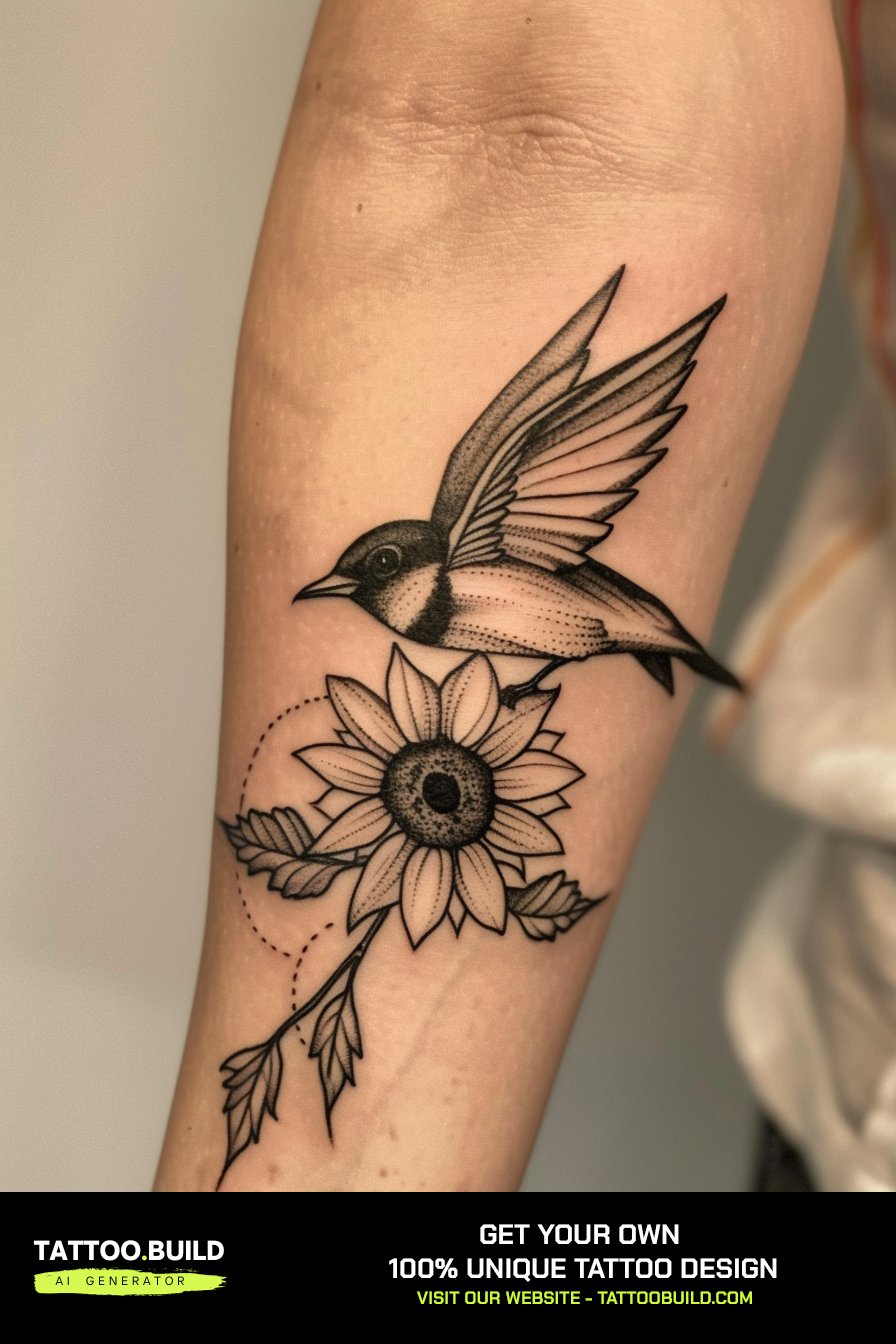
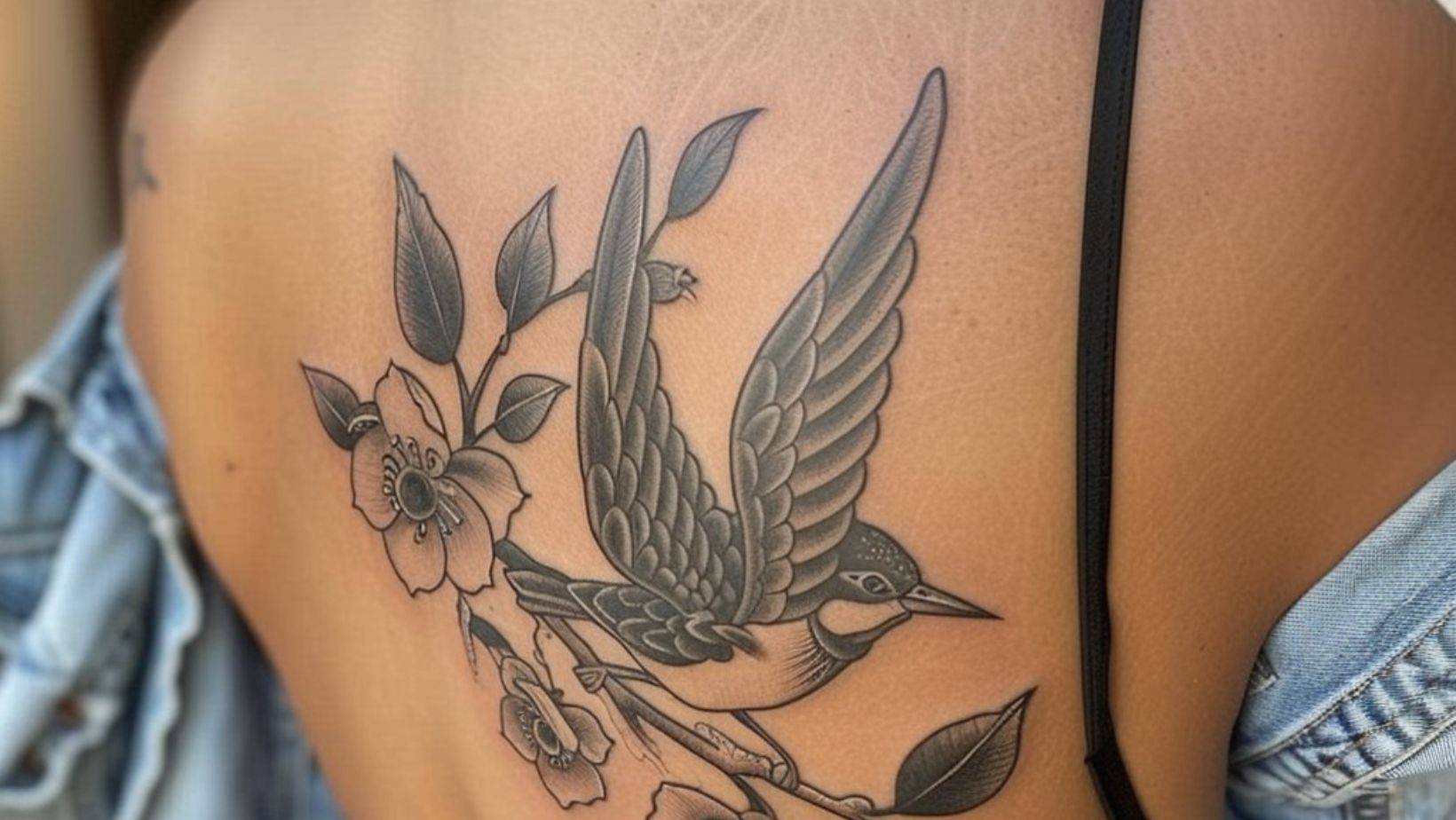
The standard pose is a three-quarter view: wings spread, body angled upward, forked tail trailing behind.
That angle is not a stylistic accident. It gives the artist two clean wing shapes at different sizes, which is what creates the sense of movement.
The single most important line in the whole tattoo is the forked tail — it is the silhouette cue that tells a viewer “swallow” rather than “generic bird” from across a room.
When I have seen this design go wrong, it is usually because the tail fork was made too shallow or too short to survive a few years of natural line spread.
Symbolism Built Into the Details
Direction is the easiest detail to personalise, and the one people think about least.
A swallow angled upward reads as departure and ambition; one angled down toward the hand or hip reads as arrival and return.
A banner across the chest of the bird lets you add a name, a date, or a port without cluttering the wings — in my experience, three to four short words is the practical ceiling before the letters start to close up over time.
Small additions like a sprig in the beak, a star behind the wing, or a single rose below all sit comfortably inside the traditional vocabulary.
Why Black and Gray Suits This Bird
American traditional was built around heavy outlines and simple internal shapes, and greywash sits inside those outlines without fighting them.
You get a wider tonal range than colour allows in a small piece: deep black on the wing tips, a mid tone through the body, a whisper of gray on the breast.
That tonal ladder is what makes a two-inch bird look three-dimensional instead of flat. The same approach carries across the whole traditional bird tattoo in black and gray family.
It is also the more forgiving option long term. Black pigment and diluted black hold their value better than most coloured inks, so the piece softens rather than shifting hue.
Line Weight and How It Ages
This is the conversation I would push hardest on at the consultation.
Tattoo lines spread slightly over years as ink settles in the dermis, which is exactly why traditional flash used thick outlines in the first place.
A swallow tattooed with very fine lines at a small scale can lose its internal detail first — the feather separations blur together before the outline does.
My rule of thumb: the smaller you go, the fewer internal lines you should ask for. Detail you cannot see in ten years is detail you paid for twice.
Ask your artist to show you healed photos of their own black and gray work from at least three or four years ago, not just fresh shots. Healed work is the honest portfolio.
Placement That Flatters the Shape
A swallow is a wide, shallow shape, so it wants a surface that is wider than it is tall.
The inner and outer forearm are the placements I see most, partly because the flat plane keeps both wings at the same visual distance from the viewer — there are plenty more options in this round-up of forearm tattoo ideas.
Chest placement is the traditional home, with one bird under each collarbone, and it gives the wings the most room to open.
Hands, necks and ribs all work visually but are higher-commitment spots — hands and fingers in particular tend to need touch-ups sooner because of constant wear.
How Small Can You Realistically Go?
Roughly two inches wide is where I stop worrying, and around an inch and a half is where I start.
Below that, the tail fork and the wing separation start competing for the same millimetre of skin.
If you want something genuinely tiny, ask for a simplified silhouette version rather than a shrunken copy of a full design.
A simple bird done well beats a detailed bird done small. Every artist I have raised this with has agreed without hesitation.
Popular Variations and Design Add-Ons
Neo-Traditional and Fine-Line Takes
Neo-traditional keeps the bold outline but adds depth: layered feathers, a stronger light source, more graduated shading.
It costs you session time and usually a larger footprint, but it is the version that holds up best when the piece is six inches or more.
The fine-line interpretation goes the other way — thin outlines, minimal shading, almost illustrative. If that is your direction, look through fine line tattoo ideas first so you know what you are trading away.
Fine-line swallows look stunning fresh and demand a more honest conversation about touch-ups — which is a fair trade if you go in knowing it.
Paired Swallows and Companion Elements
Two swallows is the most common upgrade, usually mirrored across the chest or stacked diagonally on a forearm.
Mirroring is harder than it looks — ask to see the stencil on your skin from a few feet back, not just in a hand mirror at arm’s length.
The nautical companion pieces are the natural fit, and an anchor underneath the bird is the pairing I see most often; the meaning behind an anchor tattoo sits on the same stability-and-return theme.
Roses, banners, daggers and compasses all belong to the same flash tradition and will not look grafted on.
Swallows Inside Larger Pieces
In a sleeve or a back piece, the swallow usually stops being the subject and becomes the connective tissue.
Artists use them to fill awkward negative space between bigger elements, because a small bird can sit at almost any angle and still look deliberate.
That is worth knowing before your first tattoo: a swallow placed with a future sleeve in mind is far easier to build around than one dropped dead centre on the forearm. The same logic applies to ship tattoo designs and the rest of the nautical set.
Tell your artist your five-year plan even if it is vague — it changes where they put the stencil today.
Shoulder and Upper-Back Versions
The shoulder cap is an underrated spot for this design because the curve gives the wings a natural sense of depth.
It is also one of the easier areas to sit through and one of the easiest to keep covered while it heals.
The trade-off is that you will rarely see it yourself without a mirror, which genuinely bothers some people more than they expect.
Aftercare That Protects the Gray Wash
Follow the aftercare instructions your artist gives you — they know what they put in your skin and which products they trust.
The general shape of it is consistent: keep the area clean, wash gently with plain soap and water, apply a thin layer of whatever ointment your artist recommends, and do not pick or scratch as it flakes. Our fuller tattoo aftercare guide walks through the first two weeks.
Sun is the thing that will actually cost you the soft gray tones. Once the tattoo is fully healed, sunscreen over it is the single cheapest way to keep the shading where it belongs.
Watch for warning signs while it heals. Spreading redness, swelling that gets worse instead of better after the first few days, heat, pus, or a fever are reasons to contact a doctor rather than wait it out — the American Academy of Dermatology’s guidance on caring for tattooed skin covers what healthy healing should look like.
Allergic reactions to pigment are uncommon but real, and they can show up long after healing. Dermatology bodies such as the American Academy of Dermatology, on tattoo skin reactions recommend seeing a professional rather than self-treating a persistent reaction.
None of this is medical advice — it is what to look for and who to ask. A licensed artist and a doctor are the two people who should actually be answering health questions about your skin.
Common Mistakes and How to Avoid Them
The most frequent one is picking an artist by price rather than by portfolio.
Black and gray is unforgiving about shading transitions — a blotchy gray wash cannot be hidden the way a colour packing error sometimes can. If budget is what is driving the decision, our breakdown of what tattoo designs typically cost is a more useful starting point than shopping for the cheapest chair.
The second is choosing a placement based on a photo rather than on your own anatomy. What looks perfect on someone else’s forearm may not sit the same way on yours, and pain tolerance varies wildly by spot — worth checking against a guide to the most painful tattoo spots before you commit to ribs or hands.
The third is over-designing. I have seen people ask for feather-by-feather detail on a three-inch bird and end up with a dark smudge after five years.
If you are still undecided, book a consultation and bring three reference images rather than thirty. A good artist will tell you honestly which of the three will still look like a swallow in a decade.
Frequently Asked Questions
What does a black and gray traditional swallow tattoo mean?
The core meaning is safe return — travelling far and finding your way home. It comes from sailor tradition, which borrowed it from the barn swallow’s habit of migrating long distances and coming back to the same nesting site. Choosing black and gray does not change the meaning; it changes the mood, making the design read as quieter and more personal. Most people I have talked to attach their own story to it on top of the traditional reading.
Does black and gray fade faster than colour?
Generally the opposite. Black and diluted black pigments usually hold their appearance better over time than bright colours, particularly reds and yellows. What black and gray does do is soften — the lightest gray tones lose contrast first, especially on sun-exposed skin. Sunscreen on a fully healed tattoo is the most effective thing you can do about it.
Where is the best place for a swallow tattoo?
Forearm and chest are the two placements that suit the shape best, because a swallow is wider than it is tall and wants a broad surface. The chest is the traditional home, often with a mirrored pair under the collarbones. Shoulders and upper backs work well too and are usually more comfortable to sit through. Hands, fingers and necks look striking but tend to need touch-ups sooner.
How much does a traditional swallow tattoo cost?
It depends on your city, the artist’s experience and how large you go, so any figure you read online is a rough guide at best. Most shops set a minimum charge that covers setup and sterile supplies, and a small single swallow often lands close to that minimum. A larger neo-traditional piece with heavy shading is priced by the hour instead. Ask for a quote at the consultation rather than over text — artists price from the actual design and placement.
Is a swallow tattoo a good first tattoo?
It is one of the better first choices. The design is small enough to keep the session short, the style is one almost every artist can execute confidently, and the placement options are flexible. The bold traditional linework also ages predictably, which matters more on a first tattoo than most people realise. Just avoid going too small in the name of caution — that is the choice people regret more often than the tattoo itself.
Quick Summary
- A black and gray traditional swallow keeps all the history of the design while putting the focus on linework and shape.
- The meaning comes from real bird behaviour — long migration and a reliable return to the same nesting site.
- Bold outlines plus a graduated gray wash is what makes a small bird look three-dimensional.
- The forked tail is the detail that identifies the bird, so never let it be shortened for the sake of size.
- Forearm and chest suit the wide, shallow shape best; hands and fingers need more upkeep.
- Around two inches wide is a safe minimum — below that, simplify the design instead of shrinking it.
- Sun exposure, not ink quality, is what usually costs you the soft gray tones over the years.
- Judge an artist by healed black and gray work in their portfolio, not by fresh photos or price.