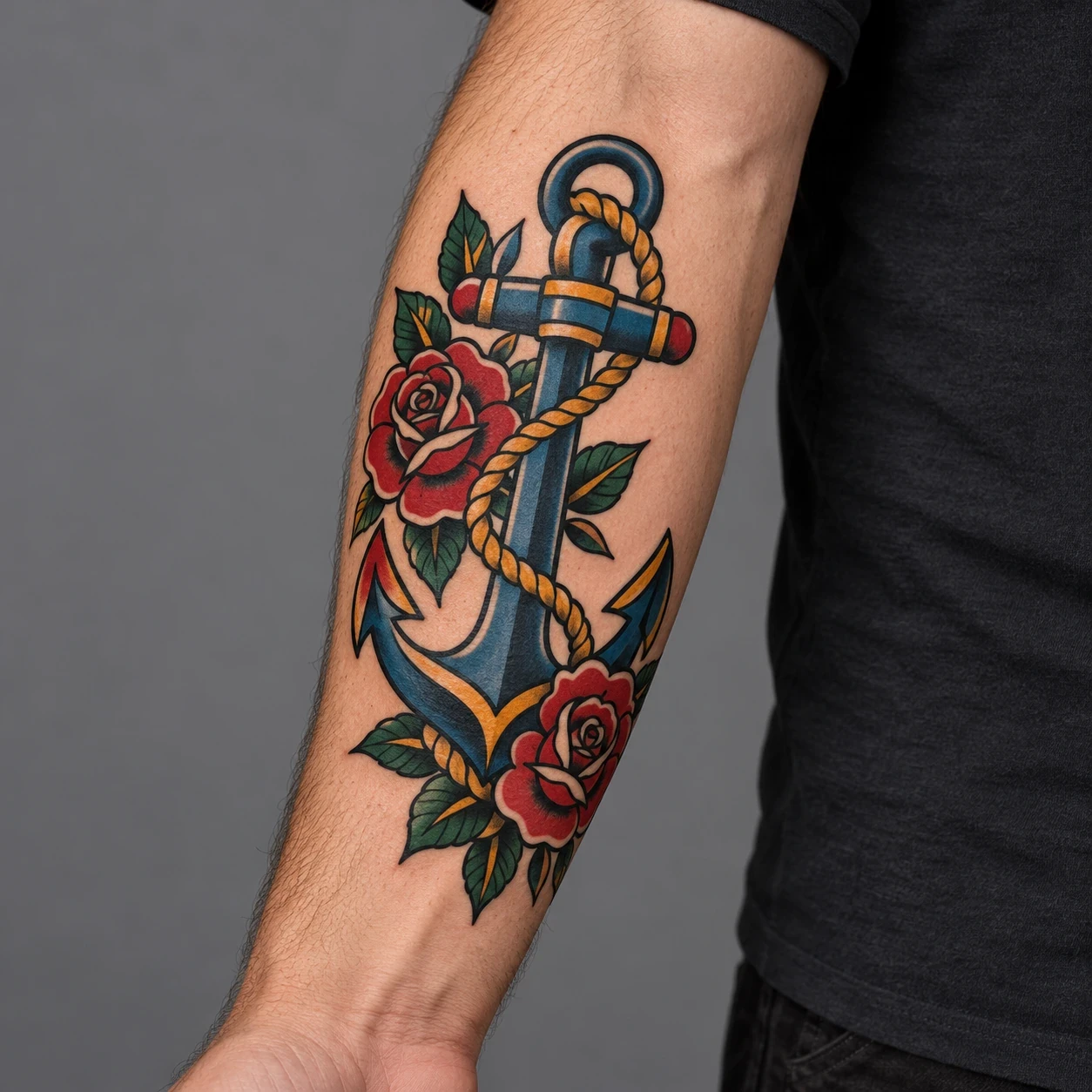
American traditional tattoo ideas for men can begin with one clear subject: an anchor, swallow, rose, animal or sailing ship. Before collecting more detail, decide what outline you want to wear and how it should sit on the part of the body you have chosen.
These 16 original concepts use heavy black outlines, a limited colour palette and broad, readable shapes. The collection compares different subjects and footprints, from a tall torch to a wide moth. It answers a men’s inspiration brief, but the motifs are not restricted to one gender.
Image disclosure: Every image is AI-generated. The hero is a placement mockup, and the 16 design illustrations are original concepts, not real or healed client tattoos, historical flash or ready-to-transfer stencils. Ask an artist experienced in the style to redraw and fit your chosen idea.
Choose a subject and an outer shape
Look at the whole silhouette before the small details. A dagger and torch create a tall shape; an eagle and moth spread sideways; a rose or animal head gives you a more contained outline. That choice can help you compare placements without assuming every design should be made the same size.
For a wider style comparison, see our tattoo styles guide. Here, judge how the black outline, coloured sections and open areas work together. The paper colours are references for a discussion, not a prediction of how pigment will appear on your skin.
| Shape to compare | Examples in this collection | Planning question |
|---|---|---|
| Tall | Dagger, lighthouse, torch | Where should the top and bottom stop? |
| Wide | Eagle, swallow, moth | Does the full wingspan fit the chosen area? |
| Rounded | Rose, tiger head, heart | How much clear space should surround it? |
| Curved | Snake, crawling panther | How should the curve follow the body? |
1. An anchor with rope and a rose
The blue anchor provides an upright center and a broad lower curve. Gold rope supplies a contrasting line, while the red rose gives the base a rounded focal point. The objects remain distinct without a larger nautical scene.
Ask the artist where the anchor’s ring and lower point should end at the proposed placement. Check the rope’s route before adding more loops. If you want a plainer emblem, the rose can be reduced or removed while keeping the anchor as the main subject.
2. A swallow in flight
A blue and cream bird uses the wings and forked tail to create a directional silhouette. The red throat gives the body a clear accent. This design depends on the shape of the bird rather than many small feather marks.
Compare how it looks facing in each direction on a placement photograph. Include both wing tips and the tail when judging the overall width. For a different palette, our black-and-grey swallow ideas provide a useful companion comparison.
3. A single red rose
Broad red petals, green leaves and dark outlines make one complete floral subject. The stem gives the design direction while the bloom supplies its main rounded shape. A single rose can be a standalone piece without a second object behind it.
Decide how many leaves and how much stem you want before choosing a final size. Ask the artist to show which petals overlap and where open gaps should remain. More folds do not automatically make the drawing clearer; a few well-defined layers may suit your brief better.
4. A dagger beside a rose
The dagger supplies a tall center line, and the rose offsets its lower section. Gold on the handle contrasts with the blue-grey blade. The flower sits beside the object, leaving the connection between the handle, guard and blade visible.
Check the length of the entire composition, including the handle and lowest blade point. Ask whether you want the dagger straight, angled or slightly turned for the placement. Keep the guard readable instead of letting extra leaves hide how the object is constructed.
5. A green coiled snake
The snake’s curved body creates movement through a narrow area. A cream belly contrasts with the green back, while the red tongue adds a small accent. The body remains one continuous form with a single head and tapering tail.
Ask the artist to trace the body’s route through the proposed drawing before refining scales. Open gaps between the curves help separate one section from another. If the design needs to be more compact, simplify the bends rather than adding more coils to occupy the space.
6. A crawling black panther
The panther makes a curved diagonal composition. Its dark torso, extended paws and long tail create the main outline, while small light and red areas define the head. The animal is shown as a connected figure rather than a floating portrait.
Include the tail and every paw when comparing the placement footprint. Ask the artist to check the leg connections and where the curve should turn on your body. The design needs a resolved animal shape before extra fur marks or decorative elements are considered.
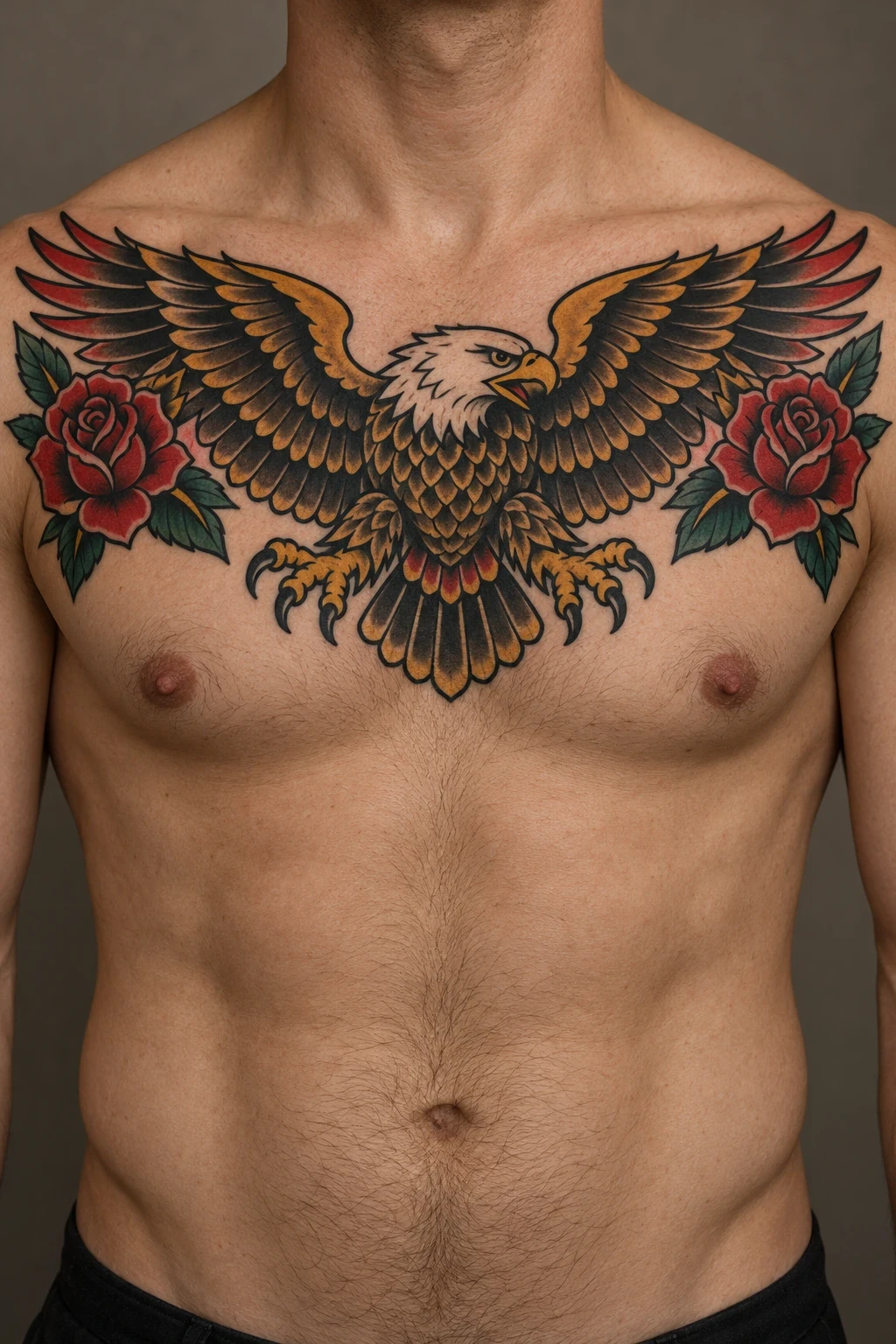
7. An eagle with spread wings
The wings create the widest part of the design, with the cream head and gold talons drawing attention toward the center. Large feather groups keep the silhouette readable. There is no flag or lettering in this concept.
Check the full wing-tip width at the intended size, not just the body. A broad area may let the wings spread, while another placement may need a more folded pose. Ask the artist to adapt the wings and tail together so the bird remains one coherent drawing.
8. An orange tiger head
The tiger uses black stripes and cream facial sections to divide the orange head. The open red mouth gives it a more forceful expression. The outer cheek shapes make a compact alternative to a full animal with a long body and tail.
Review the eyes, muzzle and jaw before concentrating on stripes. If the mouth becomes crowded at the proposed size, ask for fewer interior marks or a different expression. The stripe pattern should support the face rather than obscure it.
9. A lighthouse above blue waves
The lighthouse gives the design a tall central shape, with a broader wave base below. Red and cream bands separate the tower from the blue water. The lantern room remains a distinct upper section rather than a collection of tiny window marks.
Ask how high the lantern should sit and how wide the wave base should spread on your placement. If you want more room around the tower, reduce the number of wave shapes. This is an imagined illustration, not an accurate drawing of a named lighthouse.
10. A sailing ship over waves
Three masts and large cream sails create a broad upper shape above a gold-brown hull. Blue waves form a separate base. The drawing keeps the rigging comparatively sparse so the ship does not depend on a web of fine lines.
Judge the whole hull-and-sail outline before choosing the size. Ask the artist which sail divisions or rigging lines should be omitted for the placement. If you want a particular vessel, provide a reliable reference and have the construction redrawn rather than treating this decorative ship as a technical plan.
11. A skull with one red rose
The cream skull and red flower give the composition two different shapes. Dark sockets and broad jaw lines define the skull, while the rose sits beside its lower edge. A few leaves connect the flower to the rest of the outline.
Decide whether the skull or rose should dominate before adding more objects. Check the jaw and tooth divisions at the proposed size. If the design is personal or commemorative, describe that to the artist in your own terms rather than assuming everyone reads the combination the same way.
12. A heart with an unlettered ribbon
The red heart supplies a clear center, while the cream ribbon creates a lighter horizontal section. Green leaves finish the outer shape. The ribbon is deliberately blank, so the generated illustration does not invent a name or phrase.
If you want lettering, choose and verify the wording separately. Ask the artist whether it fits at a readable size and whether the ribbon needs to change shape. A short phrase may require a different layout from a longer dedication; do not force both into the same space.
13. A horseshoe with a small flower
The horseshoe creates an open U-shaped outline, with a red flower at its lower curve. Gold and black distinguish the main object, while simple leaves add a small supporting shape. The center stays open instead of becoming another filled panel.
Discuss which way you want the opening to face and how the flower should relate to nearby tattoos. If the horseshoe carries a personal association, explain it to the artist. The concept does not require a single meaning or orientation rule shared by everyone.
14. A grey wolf head
Pointed ears and broad cheek shapes give the wolf a different outline from the tiger. Grey, cream and black divide the face, with red used sparingly. The drawing uses large fur groups rather than realistic individual hairs.
Check how the ears and lower cheek points fit within the full boundary. Ask the artist to make the expression clear before adding more marks. Our traditional animal tattoo ideas can help you compare subjects if the wolf is only one option on your shortlist.
15. A torch with a red and yellow flame
The torch gives the collection another tall object-based design. A gold handle connects to a broad bowl, with the flame providing the upper silhouette. Small leafy sprigs frame the lower part without introducing a second main subject.
Include the top of the flame when measuring the total footprint. Ask whether the leaves are necessary or whether the torch would look clearer on its own. Keep the bowl, handle and flame connected in the drawing before adding decorative details.
16. A gold and rust moth
The moth creates a broad symmetrical shape with a narrow central body. Black markings and light sections divide the wings without requiring a realistic species illustration. Its paired pattern offers a different visual rhythm from an asymmetric flying bird.
Check both wing tips, the antennae and the lowest body point when fitting the stencil. Ask how the pattern should turn with the body surface. These are decorative markings, not a claim to an exact species or a fixed meaning for every moth tattoo.
Match the footprint to the placement
Bring a photograph of the intended area and ask the artist to show the complete outline at the proposed size. Include leaf tips, wing tips, ribbon ends and the lowest points of the design. Those edges determine how much space the tattoo needs, even when the main subject looks compact.
Forearm, upper arm or calf
Compare the tall subjects with the available length, then check how their wider sections turn around the limb. A dagger or lighthouse does not need to be squeezed into a narrow strip, and a rounded rose can be placed at an angle rather than made taller. Ask for a view with your limb relaxed.
Chest, shoulder or a broader area
A wider area gives you different choices, including an eagle, moth or a pair of separate motifs. Decide whether one design should be the focal point before adding others. For placement-specific comparisons, see our American traditional chest tattoo designs.
One piece or a growing collection
If you want a standalone tattoo, give it a deliberate ending and enough surrounding space to read on its own. If you intend a larger collection, discuss the placement of future pieces while keeping the current drawing complete. You do not need to fill every gap in the same appointment.
Keep the brief clear
Choose the subject, placement and palette before collecting more embellishments. A useful brief might be: “A blue anchor and one red rose on the forearm, with a clear rope route and open space around the outline.” Another could be: “A wide moth on the upper arm, using gold, rust, cream and black, without lettering.”
Tell the artist what you like about a reference rather than asking them to reproduce every generated mark. A thick outline still needs a resolved drawing beneath it. Check animal anatomy, object connections, overlapping petals and any lettering before agreeing to the stencil.
The gold areas in these illustrations are colour suggestions, not a promise of reflective metallic ink. The ivory paper can indicate lighter sections or open space, but it does not establish how white pigment will look on your skin. Review the artist’s healed work when discussing those choices.
These are original traditional-inspired concepts, not authenticated historical flash or copies attributed to a named artist. If historical accuracy, a particular emblem or a specific cultural reference is important, bring a reliable source and work with someone familiar with it. Choose a personal meaning if you want one, without treating a symbol dictionary as a rule for everyone.
Discuss practical expectations directly
Ask about the final drawing process, estimate, appointment plan, deposits and touch-up policy. Bring photographs of nearby tattoos so the artist can compare spacing, outlines and colour. There is no standard price, session count or pain score established by these illustrations.
Look after the actual tattoo
Get written aftercare instructions for the placement and discuss clothing, work and other practical arrangements with the artist. Ask a doctor or dermatologist about individual skin or health concerns. A design article cannot assess whether tattooing is suitable for you.
For healed tattooed skin, the American Academy of Dermatology recommends broad-spectrum, water-resistant SPF 30 or higher before going outside, reapplied at least every two hours when exposed to the sun. It notes that UV light can fade some tattoo inks. Follow the artist’s fresh-tattoo instructions rather than substituting healed-skin guidance.
The AAD recommends seeing a dermatologist for a reaction or a change in tattooed skin. Source checked 21 October 2026. The generated images do not show healing stages or guarantee a particular long-term result.
American traditional tattoo questions
How do I choose the first design?
Start with a subject you want to wear and a clear placement. Compare the full outer shape, then decide which details matter. One well-resolved motif can be enough without a background, banner or second animal.
Do these tattoos have to use colour?
No. Ask the artist to redraw the idea with a deliberate balance of black and open areas if you prefer black and grey. Removing colour from a crowded illustration is not the same as designing it clearly for that palette.
Can a rose or moth be a tattoo for a man?
Yes. Choose the subject because you like the drawing or its personal significance. The collection answers a men’s inspiration brief without assigning flowers, animals or decorative objects exclusively to one gender.
Can I combine several of these subjects?
Choose one main subject and decide how the others support it. Check the total footprint and the spaces between outlines. If the drawing becomes difficult to follow, separate the motifs or remove an element instead of shrinking everything.
Can I use the generated image as a stencil?
Use it as a reference for an original fitted drawing. Ask the artist to correct the details, adapt the proportions and check the placement on your body. The paper concepts and hero mockup are not measured templates or evidence of healed work.