If you have been scrolling through American flag tattoo ideas for weeks and still cannot commit, the problem is almost never the flag itself. It is deciding how much of the flag to show, how it should sit on your body, and whether it needs to stay readable twenty years from now.
I have spent a long time looking at patriotic tattoos in shops, at conventions and in artists’ healed portfolios, and the pattern is consistent: the flag pieces that still look sharp after a decade are the ones that were simplified early rather than crammed with detail.
This guide walks through the designs that actually work in skin, the placements that hold up, and the trade-offs between full colour and black and grey. If you are still weighing where to put it, the forearm tattoo ideas guide pairs well with this one.
Nothing here is medical advice. Anything involving healing, reactions or removal is a conversation for your artist and, where relevant, a doctor.
Which American Flag Tattoo Style Is Right for You?
Most people land in one of four camps. This is the quickest way I know to narrow it down before you sit with an artist.
| Style | Best For | Typical Size | Ageing | Watch Out For |
|---|---|---|---|---|
| Traditional colour flag | Bold, readable patriotism | 4–8 inches | Very good with thick lines | Red fading faster than blue on sun-exposed skin |
| Flag with eagle | Chest, back, upper arm statements | 6–12 inches | Good if feathers are not over-detailed | Fine feather texture blurring together over time |
| Torn or distressed flag | Military and service tributes | 5–10 inches | Depends heavily on contrast | Rips reading as smudges without strong dark anchors |
| Minimalist or fine line | Small, discreet placements | 1–3 inches | Needs touch-ups sooner | Thin stripes closing into a solid block |
What Actually Makes a Flag Tattoo Work
The American flag is a graphic made of thirteen stripes and fifty stars. That is a lot of repeated parallel lines packed into a small shape, and skin does not treat parallel lines kindly over decades.
Every artist I have asked about this says the same thing in different words: the gap between the stripes matters more than the stripes themselves. Ink spreads slightly as it settles, so lines that look crisp on day one can creep toward each other over ten or fifteen years.
In practice that means a flag under roughly three inches wide usually needs its stripe count implied rather than literally drawn. Good artists will suggest five or seven stripes instead of thirteen at small sizes, and most people never notice the difference.
The same logic applies to the star field. At small scale, a cluster of six or nine stars reads as “the union” far better than fifty dots that will eventually merge into a blue rectangle.
Colour is the other fork in the road. Full red-white-blue is the obvious choice, but a black and grey flag with a single red accent stripe can be just as recognisable and often holds its edges longer. It usually comes down to how much sun the placement will take.
Popular American Flag Tattoo Ideas
These are the designs I see most often in healed portfolios, roughly in order of how frequently they come up.
1. Traditional Waving Flag
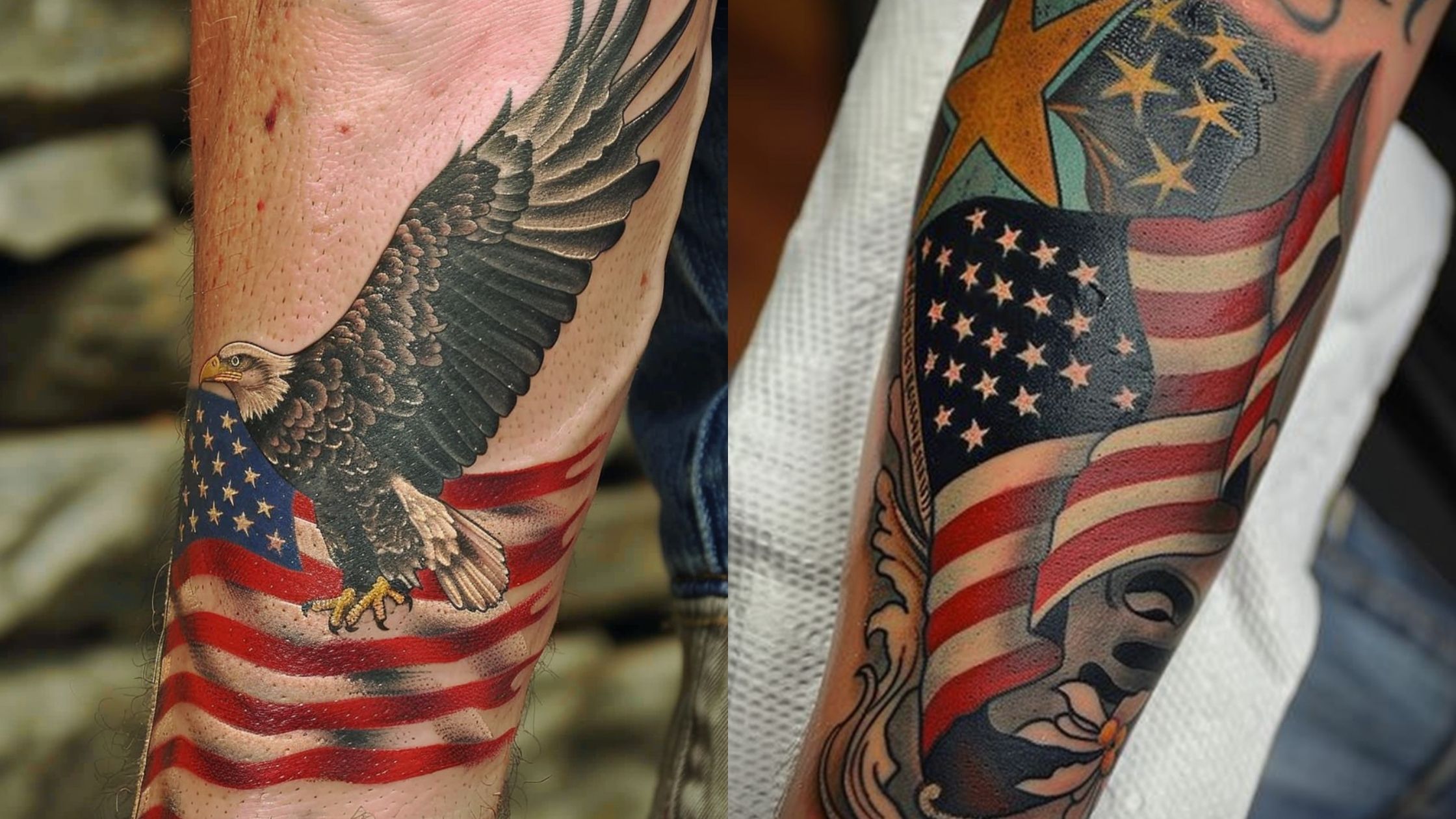
The classic. A flag caught mid-wave, drawn with bold outlines and solid colour packing, usually placed on the upper arm, calf or chest.
This is the safest bet for longevity because it borrows from American traditional tattooing, a style built specifically around lines heavy enough to survive decades in skin.
The waving fold is what saves it from looking like a flat sticker. Ask for the fold to create at least one deep shadow — that dark anchor is what keeps the shape readable from across a room.
Sizes in the four-to-eight inch range give an artist enough room to render the stripes honestly. Below that, expect a stylised version.
2. American Flag and Eagle
The bald eagle is the most common companion to the flag, and for good reason — the two symbols share a visual language of wings, folds and movement.
The failure point here is almost always feather detail. When I have compared fresh photos to the same tattoo healed five years later, the individual feather barbs are the first thing to go.
A stronger approach is to render feathers in grouped shapes with strong value separation rather than hundreds of fine strokes. It looks slightly graphic up close and dramatically better at ten feet.
Chest and upper back are the natural homes for this design because the eagle’s wingspan wants horizontal room. Squeezing a full wingspan onto a forearm usually means losing the wings entirely. If you like the bird but want something softer, the eagle tattoo designs gallery has more delicate takes.
3. Military and Soldier Tributes
Service tributes are the most personal category on this list, and usually the ones people plan longest.
Common elements include the kneeling soldier silhouette, the fallen soldier battle cross of rifle, boots and helmet, dog tags, unit insignia, and dates rendered in clean lettering.
If you are including dates, names or unit numbers, check the spelling three times with your artist before the stencil goes on. Lettering corrections are among the hardest things to fix cleanly.
I would also say plainly: if this is a memorial piece, give yourself time. The memorial tattoo ideas guide covers how people usually approach designs tied to grief, and there is no prize for rushing it.
4. Torn and Distressed Flags
A flag tearing away to reveal something underneath — skin, muscle, another symbol — is one of the most requested variations.
Contrast is everything with this design. The illusion only works if the torn edge has a genuinely dark shadow behind it, and that shadow needs to be dark enough to still read as a shadow after it lightens with age.
A tear that relies on mid-grey alone tends to flatten out within a few years and starts to look like a smudge rather than a rip. Ask to see healed examples specifically, not fresh ones.
Ribs, chest and outer arm all work. Ribs will hurt more than most placements — the most painful tattoo spots breakdown is worth reading before you book a long session there.
5. Flag and Cross Combinations
Faith and country pairings are extremely common, usually a cross overlaid on or emerging from flag stripes.
The composition problem is that both elements are strong verticals and horizontals competing for the same space. The cleanest versions I have seen let one element dominate and use the other as background texture.
Rays of light behind the cross are a popular device because they give the eye somewhere to travel and break up the stripe repetition.
Inner forearm is the most common placement, though the inner arm holds ink slightly differently than the outer and may soften a touch faster on some people.
6. Black and Grey Flags
Dropping the colour entirely is an underrated option, especially for anyone who works outdoors or spends a lot of time in the sun.
A black and grey flag relies on value, not hue — the union becomes a dark block, the red stripes become mid-grey, the white stripes stay open skin. It reads instantly once you see it.
A common hybrid is the subdued or “thin line” style, where the whole flag is monochrome except for a single coloured stripe. Ask your artist how that one colour is likely to hold, since a lone accent has nowhere to hide as it fades.
Black and grey also blends into larger sleeves more easily. If a flag is going to be one panel in a bigger piece, monochrome usually integrates better than a block of saturated colour.
7. Minimalist and Fine Line Flags
Small, simple and discreet — a wrist, ankle, finger or behind-the-ear flag reduced to a handful of lines.
Be honest with yourself about maintenance here. Fine line work in a small format generally needs a touch-up sooner than bold work does, and stripes packed within a couple of millimetres of each other are the first thing to blur.
The version that survives best is a simplified flag with deliberately generous spacing — fewer stripes, larger gaps, a few suggested stars. It is less literal and considerably more durable.
If this is the direction you are leaning, the minimalist tattoo ideas and fine line tattoo ideas collections will give you a feel for what holds up at small scale.
Variations Worth Considering
If none of the seven above feel quite right, these are the directions people most often pivot toward.
Flag as Fill, Not as Subject
Instead of tattooing a flag, tattoo something else and fill it with flag stripes — a state outline, a skull, an anchor, a set of initials.
This tends to feel more personal and gives the artist a shape to work with that is not a rectangle.
Map and State Silhouettes
The continental US outline or a home-state silhouette filled with flag colours is a clean, self-contained design that scales down well.
It also sidesteps the stripe-spacing problem entirely, since the outline carries the recognition instead of the stripes.
Flag with Script
A banner or handwritten line under the flag — a family motto, a service date, a lyric. Keep it short.
In my experience, script that runs longer than four or five words at small scale is the single most common regret people mention.
Combined with Other Symbols
Flags pair naturally with skulls, roses, compasses and firearms depending on the story you are telling. The skull tattoo ideas gallery shows how a hard-edged subject sits beside softer flag folds.
The rule I would keep: one hero element, everything else supporting. Two heroes in one tattoo usually means neither wins.
Placement, Ageing and Aftercare
Sun exposure is the biggest long-term threat to a colour flag. Forearms, calves and shoulders take far more UV than a chest or inner arm, and the U.S. Food and Drug Administration notes that some tattoo inks can change or fade with light exposure.
Once healed, sunscreen on an exposed flag tattoo is the cheapest thing you can do for it. Not during healing — after. Your artist will tell you when the skin is ready.
Follow whatever aftercare instruction your artist gives you rather than what you read online, including here; they know their inks and their local climate. The tattoo aftercare basics guide covers the general shape of it if you want background reading.
Watch for signs that go beyond normal healing — spreading redness, heat, pus, fever, or a rash that appears weeks or months later. The American Academy of Dermatology has clear guidance on tattoo reactions and when to see a doctor, and that is a medical question, not an artist question. See a healthcare professional if anything looks wrong.
Common Mistakes — and What to Do If You’re Still Not Sure
The mistake I see most often is choosing a size that cannot support the detail requested. A photorealistic eagle inside a three-inch flag is a request for a blurry patch in ten years.
The second is skipping the healed portfolio. Fresh photos flatter everyone; healed photos tell you whether an artist’s linework actually survives.
The third is treating placement as an afterthought. A flag that has to bend around a bicep or wrap a calf needs to be drawn for that curve, not pasted onto it.
If you are still undecided, the useful move is usually to widen the reference pool rather than narrow it. Browse chest piece tattoo ideas to see how large patriotic work sits on a torso, or sleeve tattoo cost if the flag is likely to grow into something bigger.
And on flag etiquette — the U.S. Flag Code (4 U.S.C. §8) sets out respect guidelines for the physical flag. It carries no penalties for private citizens and does not govern tattoos, but some people like to know what it says before designing a torn or altered version.
Frequently Asked Questions
Do American flag tattoos have to be in full colour?
No. Black and grey flags are common and often age more predictably, because they rely on value contrast rather than colour saturation. A popular middle ground is a monochrome flag with a single coloured accent stripe. Ask your artist how that one colour is likely to hold in your chosen placement, since a lone accent has no neighbouring colour to disguise fading.
How small can an American flag tattoo be and still look good?
Most artists I have spoken with put the practical floor around one and a half to two inches for something still recognisable years later. Below that, the stripes need to be implied rather than literally drawn. A simplified flag with five or seven generously spaced stripes reads far better long term than a miniature with all thirteen. Expect small fine line work to need touch-ups sooner than bold work.
Is a torn or distressed flag tattoo disrespectful?
Opinions genuinely differ on this, and it is worth knowing that before you commit. Many veterans and service members wear torn flag designs specifically as a symbol of sacrifice and endurance. Others read any damaged flag imagery as disrespectful. Since it is your body and your meaning, the only opinion that has to satisfy you is your own — but if you are getting it as a tribute to someone specific, asking them first is rarely a bad idea.
Where does an American flag tattoo hurt the least?
Fleshier, less bony areas with fewer nerve endings — the outer upper arm, outer thigh and calf — are usually reported as more tolerable than ribs, sternum, hands or feet. Pain is highly individual, though, and a long colour-packing session anywhere will wear you down. Eat beforehand, stay hydrated and tell your artist if you need a break.
How long will an American flag tattoo take to heal?
The surface usually looks settled within roughly two to three weeks, while the deeper skin generally continues repairing for a couple of months. Larger colour-packed pieces tend to take longer than small line work. Follow your artist’s specific aftercare instructions rather than general advice, and contact a healthcare professional if you see spreading redness, heat, pus or fever.
Quick Summary
- Simplify early — stripe spacing matters more than stripe count, especially under three inches.
- Bold traditional linework is the most reliable choice for a flag that has to last decades.
- Eagles need horizontal room; chest and upper back suit them better than a forearm.
- For torn flag designs, insist on genuinely dark shadows and review healed photos, not fresh ones.
- Black and grey is a legitimate option, not a compromise, and integrates into sleeves more easily.
- Minimalist flags look great and will need touch-ups sooner — budget for that.
- Sunscreen after healing is the cheapest protection for any colour flag on an exposed limb.
- Anything beyond normal healing — spreading redness, heat, pus, fever, a late rash — is a doctor’s call, not an artist’s.