An eagle tattoo works on a woman for exactly the same reason it works on anyone else: the shape of a bird with its wings open fits the human body almost perfectly. The wings follow the shoulder blades. The tail follows the spine.
I have spent a long time looking at bird tattoos, and the eagle is the one people most often get wrong — not because the idea is bad, but because they pick a design made for a chest and put it on a wrist.
So this guide is organised the way the decision actually happens: what the eagle means to you, which style will still look good in a decade, and where on the body the pose you like will physically fit. If birds in general interest you, the wider bird tattoo meanings guide is worth reading alongside this one.
Every design below is a real piece of reference art, and I have been honest about which ones are a two-hour appointment and which are a project.
Which Eagle Tattoo Style Is Right for You?
Style matters more than subject. The same eagle in six different styles gives you six different tattoos, and they do not age the same way.
| Style | Best size | How it ages | Pick it if |
|---|---|---|---|
| Fine line / engraving | Palm-sized and up | Lines can soften and blur together if packed too tightly | You want detail without heavy black |
| Black and grey realism | Forearm, thigh or back | Holds well when contrast is strong; the palest greys go first | You want the bird to look like a photograph |
| American traditional | Anything from two inches up | The most forgiving of all — bold outlines keep the shape readable | You want it to look good in twenty years |
| Neo-traditional colour | Shoulder, upper back, thigh | Good, though colour usually needs a touch-up sooner than black | You want strong outlines but a richer palette |
| Ornamental / mandala wings | Full back or full chest | Dense patterning can lose separation over decades | You want symmetry and are committed to a big piece |
| Minimalist silhouette | Under two inches | Small solid shapes spread slightly; fine internal detail disappears | This is your first tattoo, or you want it hidden |
If you take one thing from that table: bold outlines are the most forgiving thing you can ask for. Everything else is a trade between detail now and clarity later.
What an Eagle Tattoo Actually Means
The eagle carries meaning in a lot of cultures at once, which is part of its appeal and part of the reason it is worth being specific.
In broad Western symbolism it stands for power, vision and freedom — the bird that sees further and flies higher than anything around it.
In many Indigenous North American traditions the eagle and especially the eagle feather carry deep spiritual and ceremonial weight. If you are drawn to that specific imagery and it is not your heritage, it is worth reading about it properly and talking to your artist rather than borrowing the visual language casually.
There is also the plain natural-history version, which I find people underrate. A bald eagle has a wingspan of roughly six and a half feet according to the Audubon field guide, and pairs build nests they return to and add to year after year. Strength and permanence, without any symbolism required.
In my experience the women who are happiest with these tattoos years later are the ones who could say in one sentence why they wanted an eagle. That sentence usually decides the pose too — freedom tends to become wings open, resilience tends to become a dive, watchfulness tends to become a perched profile.
Eagle Tattoo Ideas for Females, by Style and Placement
Here is the reference, grouped so you can see how the same bird changes character depending on how it is drawn and where it lands.
Back-Piece Eagles With the Wings on the Shoulder Blades
This is the placement the shape was made for. Wings open across the upper back means the design has a natural centre line and two symmetrical halves to fill.
It is also the most flattering way to wear a large eagle, because nothing has to be squeezed. A back piece can go as wide as your shoulders allow.
The practical catch is that you cannot see it easily, which some people love and some people quietly regret. Ask for photos of the stencil on your own back before you commit.
Adding flowers under the body, as in the middle piece here, is the single most common way to soften an eagle without losing it. Roses and peonies are the usual choices because their shapes contrast with feathers. If back work in general appeals to you, the symbolic back tattoo roundup covers other subjects that use the same canvas.
Ornamental Wings That Span the Whole Back
This is the maximalist version: feathers stacked into a pattern, filigree running down toward the waist, symmetry treated as the point rather than a by-product.
Be realistic about what it involves. A piece at this scale and density is multiple long sessions, spaced weeks apart for healing, and the cost scales with the hours.
It is also the style where dense patterning is most likely to lose separation over decades, so leaving deliberate gaps of bare skin between elements matters more here than anywhere else. Every artist I have asked about back ornamental work says the same thing: negative space is what keeps it readable.
Fine Line and Engraving-Style Eagles
These are built from short parallel strokes rather than solid black — the look of an old book engraving translated onto skin.
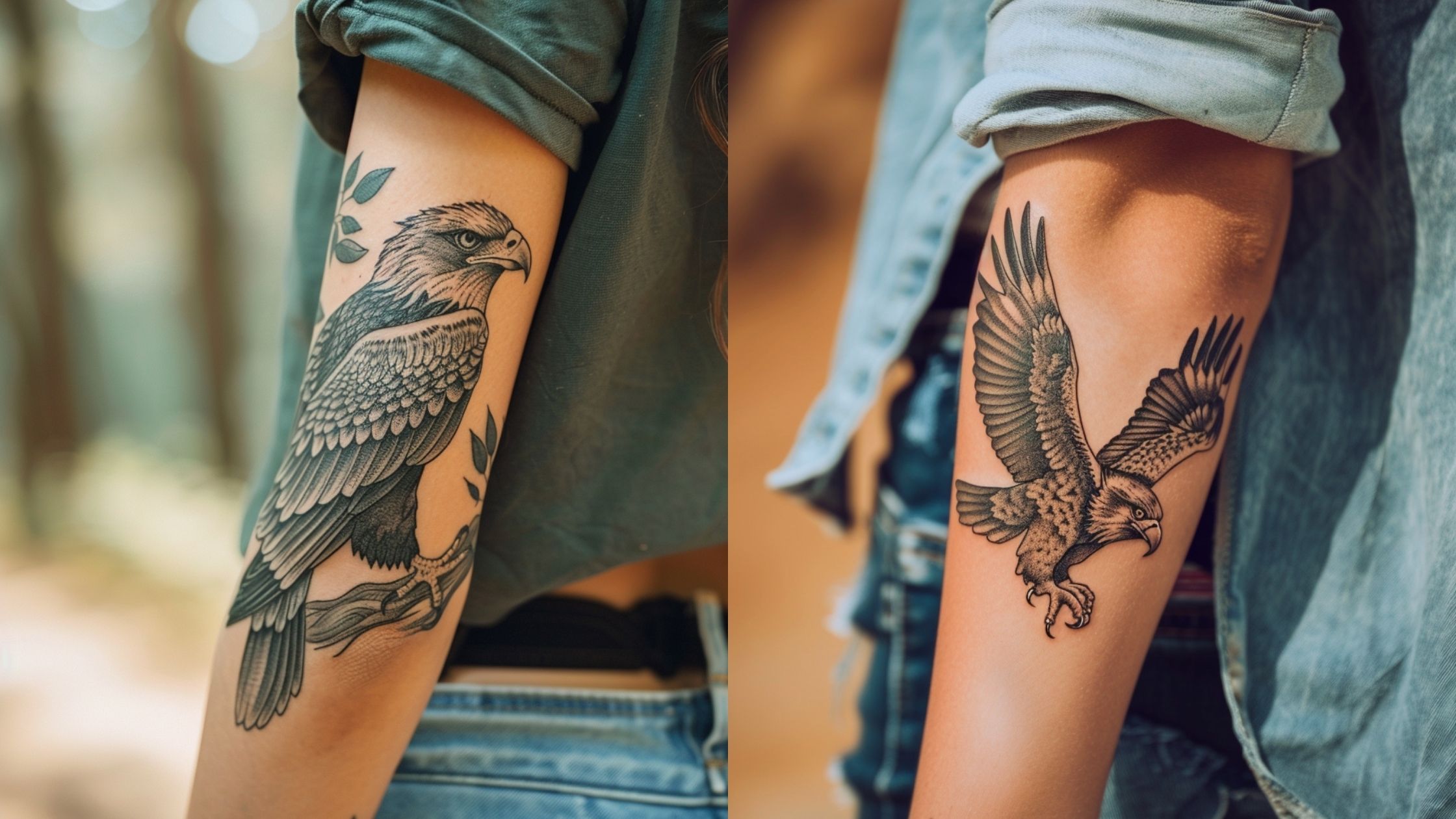
They photograph beautifully and they sit well on the forearm and inner arm, where the vertical shape of a flying bird fits the limb.
When I have compared healed examples, the ones that held up best were the ones with the most breathing room between lines. Packed too tightly, fine hatching can blur into a single grey mass over the years.
If you like this on the arm specifically, there are more layout ideas in the forearm tattoo ideas for females guide.
Black and Grey Realism
Realism is where the eagle stops being a symbol and starts being a bird — individual feathers, a real eye, weight in the wings.
It needs room. On a forearm you can get a convincing dive; on a thigh you can get the full moonlit scene in the third image here without cramming.
The honest limitation is contrast. Soft grey washes and smoke backgrounds look extraordinary fresh, and they are usually the first thing to lighten. A good realism artist will build enough dark anchor points that the piece still reads when the mid-tones drop.
Ask specifically to see healed work, not just fresh photos. The female black and grey tattoo collection shows how this style settles across different subjects.
Shoulder and Half-Sleeve Eagles
The deltoid is a naturally rounded canvas, so a landing or perching pose sits on it without distortion.
This is also the easiest starting point for a half sleeve. An eagle head anchored with peonies and foliage, like the third piece here, gives an artist an obvious direction to grow into later.
In my experience the shoulder is the placement women pick most often when they want something substantial that is still easy to cover for work. A short sleeve hides most of it.
If you are already thinking past a single piece, the sleeve tattoo for women guide covers how to plan the flow before you commit to the first session.
It is worth seeing a design on a moving body rather than flat on a portfolio page, which is what makes the photo below useful.
Small and Minimalist Eagle Tattoos
At wrist and finger scale, a silhouette is the whole design. Detail at this size does not survive.
Simplicity here is a technical requirement, not an aesthetic preference. Ink spreads slightly in the skin over the years, so anything under a couple of inches needs open shapes and clear gaps.
Fingers and hands are their own category: high friction, constant sun and washing, and touch-ups are commonly needed. The finger piece here looks fantastic, and I would still tell a first-timer to start elsewhere. There are gentler options in the cute hand tattoos for females roundup.
Colour and Neo-Traditional Eagles
Neo-traditional keeps the heavy outline of the old school style and swaps in a richer palette and more modelling.
The two pieces below use muted greens, golds and rust rather than primary colours, which tends to sit better against a wider range of skin tones.
Colour usually asks for a refresh sooner than black and grey, and it is worth budgeting for that rather than being surprised by it. If the phoenix side of firebird imagery appeals to you too, the phoenix tattoos for women guide is a close cousin to this one.
Choosing a Placement That Fits the Pose
Most disappointing eagle tattoos are placement problems wearing a style costume. Match the shape of the drawing to the shape of the body part.
Wide poses: upper back, chest, under the collarbones
Wings fully spread need horizontal room. Squeeze them onto a forearm and the artist has to fold the wings up, which changes the design into something else.
Vertical poses: forearm, calf, spine
A diving eagle or a bird seen from the side is a tall shape and works on tall canvases. This is why forearm eagles so often use the dive pose.
Curved surfaces: shoulder, thigh, hip
Rounded placements suit designs with a clear focal point and detail that fades outward, so nothing important lands where the body curves away from view.
Small and hidden: wrist, ankle, behind the ear
Reserve these for silhouettes. If you want something delicate but larger, the classy feminine thigh tattoo ideas show how a bigger design can still stay private.
Before You Book: What Actually Improves the Result
Find an artist who already tattoos birds in the style you want, and judge them on healed photos rather than fresh ones. Fresh work flatters everybody.
Bring reference for the feel you want, not a picture to be copied. Asking for someone else’s exact tattoo puts a good artist in an awkward position and usually produces a weaker drawing.
Check the stencil standing up, in a mirror, in your normal posture. Placement that looks perfect while you are lying on a table can sit oddly when you are upright.
On the day: eat properly beforehand, stay hydrated, and skip alcohol. Then follow the aftercare your artist gives you rather than advice from the internet, because their instructions match the technique and ink they used. Keep the healing tattoo out of the sun and out of pools. If you notice spreading redness, worsening swelling after the first few days, pus or fever, contact a doctor — the FDA’s tattoo fact sheet notes that both infections and allergic reactions are real risks, and that reactions can appear even years after the tattoo was done. This article is not medical advice.
Common Mistakes, and What to Do Instead
Going too small for the level of detail you want. This is the single most common regret I hear. If your reference has individual feathers, it needs a canvas that can hold them.
Picking a style because it is trendy rather than because it ages the way you want. Fine line is having a long moment; it is also the style that needs the most maintenance.
Choosing an artist by price. Cheap tattoos and good tattoos overlap far less often than people hope, and fixing a bad one costs more than getting a good one.
Still weighing it up? Browsing adjacent subjects sometimes settles the question faster than more eagle photos: try bird tattoos on the neck for the same wide-wing shape on a smaller canvas, or rib tattoos for women if you want something delicate on the ribs.
Frequently Asked Questions
Do eagle tattoos suit women, or are they seen as masculine?
In my experience the “masculine” reputation comes from one specific style — the heavy American traditional eagle with a banner — rather than the subject itself. An eagle drawn in fine line, in soft black and grey, or paired with florals reads completely differently on the same body. Every artist I have asked says the flow of the design matters far more than the animal. Choose the style and the placement, and the question mostly answers itself.
How much does an eagle tattoo usually cost?
Prices vary enormously by city and by artist, so treat any number you read online as a rough starting point. Most shops charge either a flat rate for small pieces or an hourly rate for larger work, and detailed realism takes far more hours than a simple silhouette. A back piece like the ornamental wings above is realistically several sessions, not one. Ask for a written quote at consultation, and be suspicious of a price that seems dramatically below everyone else in town.
Where does an eagle tattoo hurt the least?
Pain is personal, but the outer arm, outer thigh and calf are generally described as easier because there is more muscle and less bone underneath. Ribs, sternum, spine, the top of the foot and the hand are usually reported as sharper. The finger piece pictured above is a good example of a placement that looks great and is not comfortable. If you are worried, start with an outer-arm design rather than talking yourself out of a tattoo entirely.
How long does an eagle tattoo take to heal?
The surface usually looks settled within about two weeks, while the deeper layers of skin generally take a couple of months to finish healing. Follow the aftercare your artist gives you, since their instructions are matched to the ink and technique they used. If you see spreading redness, swelling that gets worse after a few days, pus, or you develop a fever, contact a doctor rather than a tattoo forum — those can be signs of infection. The US Food and Drug Administration notes that reactions can also appear long after a tattoo is done, so persistent itching or bumps are worth having looked at.
Should I get colour or black and grey?
Black and grey tends to be the safer long-term choice, because contrast is what keeps a design readable as it softens. Colour can be stunning, especially in neo-traditional work with strong outlines, but it usually needs refreshing sooner. In most cases I suggest matching the choice to the rest of your body — a colour eagle sitting alone among black and grey work can look disconnected. If you are undecided, ask your artist to mock up both and sit with the drawings for a week.
Quick Summary
- Decide the meaning first — freedom, resilience or watchfulness each points to a different pose.
- Spread wings belong on wide canvases: upper back, chest, under the collarbones.
- Vertical poses like the dive suit the forearm, calf and spine.
- Bold outlines age most predictably; fine line and soft grey need more upkeep.
- Realism needs space and strong dark anchor points to stay readable.
- Under two inches, use a silhouette — fine detail disappears at that scale.
- Colour usually needs refreshing sooner than black and grey, so budget for it.
- Judge artists on healed portfolio photos, and follow their aftercare, not the internet’s.