Calf tattoo ideas for men work best when the full design fits the lower leg's curve. A long stem, blade or lighthouse creates a vertical line; a portrait uses the broader middle of the calf; a framed landscape gives the eye a clear boundary. Choose the shape before adding detail.
These 21 concepts compare animals, florals, landscapes, blackwork and mechanical motifs. The emphasis is on composition: where to put the focal point, how to taper the lower edge and what to ask an artist to simplify. Any of these subjects can suit any gender; this collection is organized around the men's calf-placement brief.
All 22 images, including the hero, are AI-generated concepts or placement mockups. They are not real tattoos, healed client work or finished stencils. A tattoo artist should redraw the selected idea for accurate anatomy, clear spacing and your individual leg.
Start with the calf's outline
Look at the available space while standing normally. Mark the upper and lower limits you want to use, then compare the leg from the back and both sides. The best front-facing view of a flat drawing may not be the best main view once it sits on a curved surface.
- Back of the calf: discuss a centered portrait, vertical emblem or framed panel.
- Outer calf: compare side-facing animals, a long stem or a curved wave.
- Wraparound design: plan the connecting shapes with the artist rather than extending a flat drawing blindly around the leg.
- Future leg sleeve: leave room for the edges to connect to later work.
A useful brief includes the intended viewing angle, the space you want covered and whether you want a standalone piece or a future sleeve element. For a broader placement comparison, see our leg tattoo ideas for men.
1. Vertical compass
The extended lower point makes the compass a tall emblem rather than a compact round badge. Open space around the center keeps the shading from becoming the only thing you notice.
Ask the artist which point should lead along the leg. This version avoids tiny letters; add coordinates only if you can supply and check the exact characters separately.
2. Dagger beside a laurel branch
A straight blade supplies a clear vertical axis, while the curved branch softens one side. The contrast gives the drawing shape without requiring a large background.
Keep the blade, guard and handle aligned in the stencil. The branch should remain separate enough that leaves do not make the blade edge look chipped or irregular.
3. Long-stem red rose
The bloom provides a broad upper focal point and the stem narrows the lower end. Red and green make this a color option with a simple overall silhouette.
Discuss where the flower should sit on the calf before extending the stem. Fewer well-spaced leaves may fit more clearly than adding a vine around the entire leg.
4. Layered black and grey peony
A peony creates a rounded focal point with many overlapping shapes. The leaves give it a lower taper, making the arrangement less circular than a flower alone.
Ask the artist to organize the petals into clear light and dark groups. At stencil size, the bloom should read as a flower rather than a collection of equally dark lines.
5. Owl with folded wings
The owl keeps its width contained by folding the wings into a tall oval. The eyes become the focal point, with feather layers carrying the detail below.
Check that the eyes, beak and facial discs are balanced. If you want less detail, simplify the lower feathers before shrinking the features that make the face readable.
6. Wolf in side profile
A side-facing head gives the placement a direction. The muzzle projects from a tapering neck, while selective grey shading separates the ear, cheek and fur edge.
Choose which way the wolf should face on the actual leg. Bring a species photograph for anatomy and let the artist redraw the concept rather than copying every generated fur strand.
7. Lion with a tapered mane
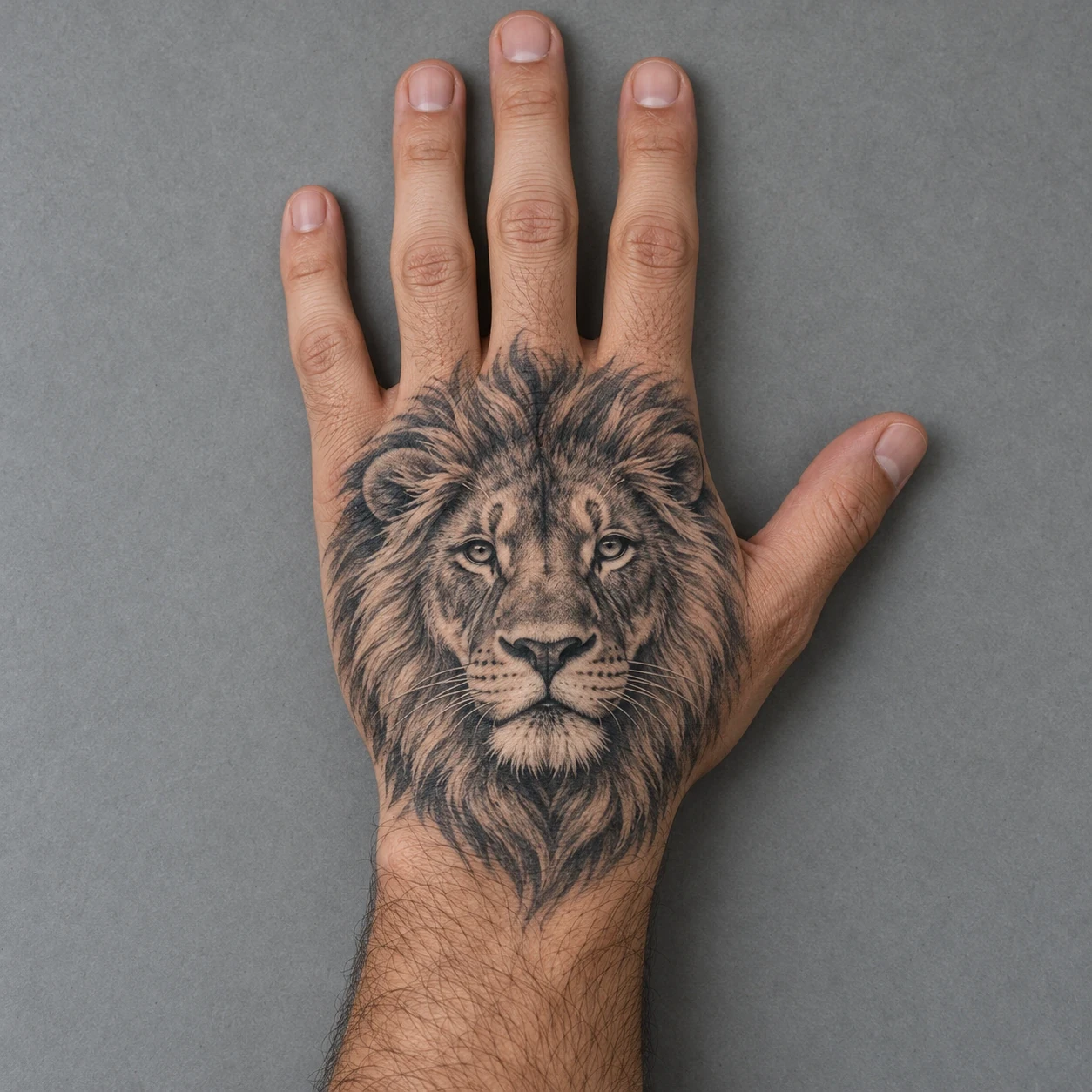
The mane gives a frontal portrait a long outer shape. A dark center and lighter surrounding fur can keep attention on the eyes and muzzle without adding a crown or extra symbols.
Check the face from the main viewing angle once the stencil is on your leg. The mane can wrap slightly while the important facial features remain visible together.
8. Perched eagle
Folded wings keep the eagle in a vertical composition. A small branch anchors the feet and gives the body a clear endpoint below the feather detail.
Ask the artist to trace each leg into its talons and check the grip on the branch. The beak and eye should remain distinct even if the lower feather groups are simplified.
9. Upward swimming koi
The curved body creates movement along the calf, while orange and ivory patches break up the surface. A few ripples provide context without a full water background.
Decide whether you want a particular fish pattern or a loose koi-inspired drawing. Keep the fins, tail and body continuous, and discuss the direction on your actual leg.
10. Snake in a vertical S curve
A single winding body lets the artist explore the calf contour. The curve can remain open and readable without adding multiple coils, flowers or a second subject.
Follow the body from head to tail in the stencil. Every turn should connect clearly; scales are secondary to a believable uninterrupted silhouette.
11. Mountain scene in a narrow frame
A rounded rectangle gives the landscape a deliberate boundary. The peaks create a focal point inside it, while the tall frame makes the scene a panel rather than a wide panorama.
If the mountains refer to a real place, bring a photograph. Discuss how the frame looks from the side and whether you want it to remain closed for future leg work.
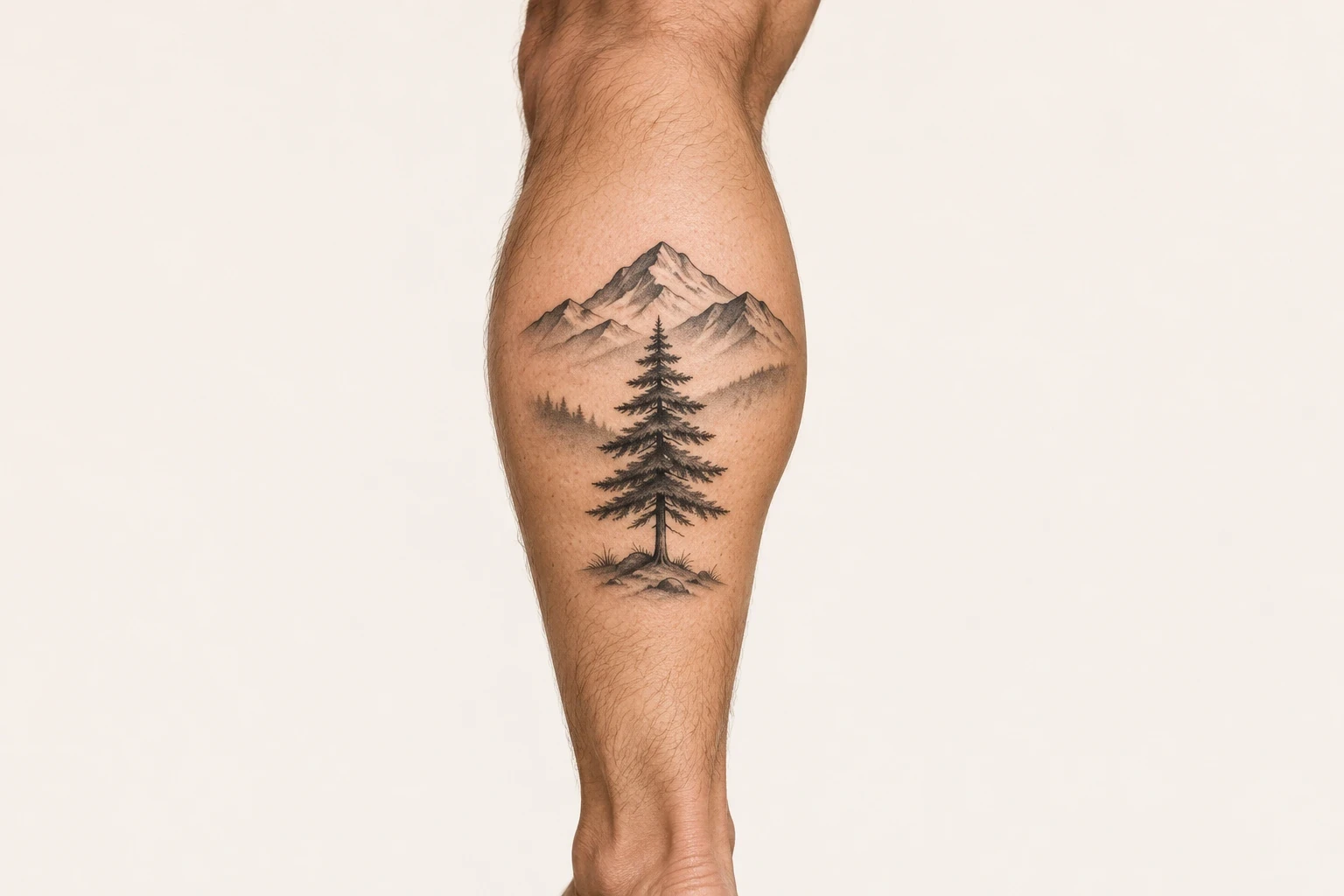
12. Single pine silhouette
A tapering tree gives you a simple tall outline. Repeated branch layers add rhythm while leaving the trunk as the central line.
Check the outer edge at the chosen size. Keep gaps between branch groups rather than compressing the entire tree until its crown becomes a solid triangle.
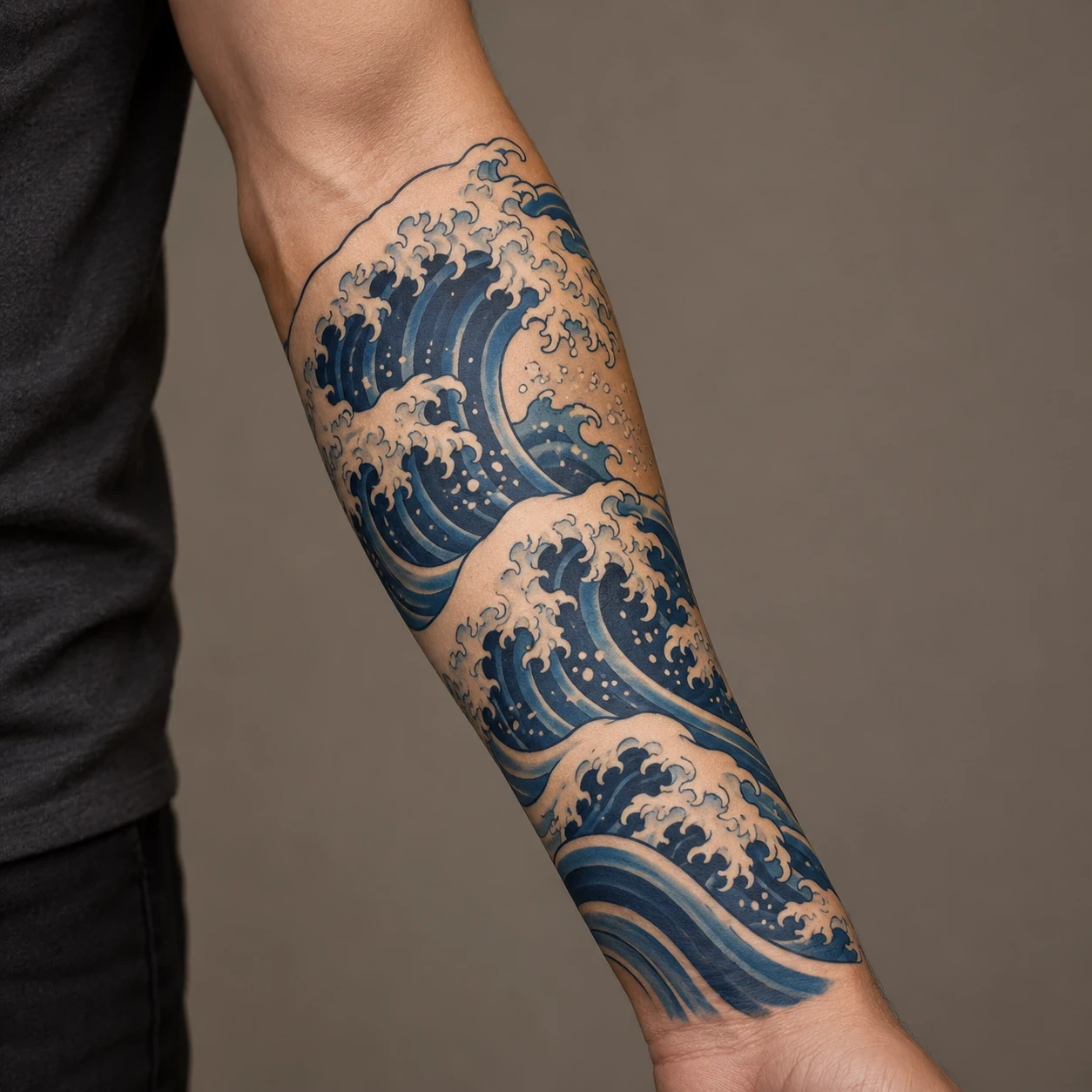
13. Wave beneath an open circle
The circle supplies a light upper boundary and the wave adds a heavier curve below. Blue accents can give the water a focal area without filling the whole composition.
Ask which direction the curl should face on your leg. Keep enough separation between the wave and circle that the border does not look like an accidental extra waterline.
14. Stacked geometric forms
An open circle, faceted diamond and inverted triangle create a tall sequence of shapes. Different densities make the middle form the focal point without adding lettering. A small lily within the lower triangle softens the otherwise angular arrangement.
Ask for precise alignment along the intended axis. Check the gaps with your leg relaxed, and make sure each shape remains a deliberate form rather than a cramped connector.
15. Ornamental rosette
The rosette is a decorative geometric flower with a tapered extension. It offers symmetry and repeated lines without needing a religious interpretation or a written motto.
Discuss the amount of fine ornament you want to keep. The artist may enlarge the center gaps or reduce the smallest loops so the structure reads at stencil size.
16. Mechanical gear panel
Gears, ribs and bolts create a tall industrial texture. A contained outline gives the artist a way to organize the machinery without using a torn-skin effect.
Follow the overlaps in the artist's drawing and decide which gear should be the focal point. A clear hierarchy will be easier to read than equally dark detail across every surface.
17. Overlapping armor plates
Three plates give the calf a segmented outer structure. Rivets and curved edges provide detail while the broad shaded surfaces keep the motif relatively simple.
Ask how the plates should follow the leg and where the lower edge should stop. Keep the overlaps consistent so the design reads as one arrangement of metal forms.
18. Moth beneath a crescent
The moth provides a broad center with a slimmer body underneath. A small crescent adds height while leaving a clear gap above the wings.
Check the symmetry and wing attachment in the final drawing. Treat the crescent as a personal or decorative addition rather than assuming the combination has one universal meaning.
19. Upright hourglass
The frame creates two wider ends around a narrow waist. The glass and falling sand give the artist a small internal story without requiring a quote or date.
Ask for the sand level and stream to remain easy to identify. If you want a smaller piece, the frame can be simplified before reducing the space around the glass.
20. Lighthouse and waves
A lighthouse gives a clear vertical subject with a natural base. The rocks and waves can widen the lower area slightly without turning the composition into a full coastal sleeve.
Check the tower perspective and lantern room in the drawing. Use a reference if it is a particular lighthouse, and keep the base quiet enough that the tower remains the main subject.
21. Fine-line dragonfly
Four long wings create a broad center above the slender segmented body. Open wing areas offer a lighter alternative to shaded animal portraits or solid blackwork.
Count and trace the wings in the final stencil, then check the small legs. The artist should simplify vein detail around a coherent insect structure rather than copying every generated line.
Choose the shape before the size
| Design direction | Why it is useful to compare | Stencil check |
|---|---|---|
| Dagger, rose stem, pine or lighthouse | A clear vertical line with a naturally narrowing end | The top and bottom do not feel squeezed into the chosen limits |
| Lion, owl or peony | A wider focal point over the main calf area | The face or bloom stays readable from the main viewing angle |
| Snake, koi or wave | A curved subject that can follow the placement | The far edge remains identifiable from the side |
| Panel, armor or geometric forms | A deliberate outer boundary | Border lines look intentional when standing and walking |
These are design comparisons, not fixed measurements. Let the artist size the stencil around the details that must remain visible. A small dagger and a detailed owl may occupy different amounts of space even when both drawings look equally large on a screen.
Make the artist brief practical
Bring two favorites and name the feature you like in each. For example: the tall outline of the lighthouse, the amount of grey in the wolf, or the open spacing of the dragonfly. Explain which parts are essential and which are flexible. That gives your artist room to create one coherent drawing.
Check the design at actual stencil size. In portraits, look at the eyes and muzzle; in mechanical pieces, follow the overlaps; in geometric work, check the center and gaps between shapes. Ask to see the complete design from the viewing angle that matters most to you.
For more solid silhouettes and dark shapes, compare our blackwork tattoo ideas for men. If you prefer fewer marks and more open space, browse our minimalist tattoo ideas. Choose the line treatment from an artist's healed portfolio, not only from a generated picture.
Plan clothing and care before the appointment
Ask your artist what clothing and activity adjustments they recommend while your tattoo heals. Tell them about footwear, work clothing or sports equipment that touches the planned area. Follow their written instructions and ask a clinician about a skin reaction or healing concern.
For established tattooed skin, the American Academy of Dermatology notes that UV light can fade some inks and recommends broad-spectrum, water-resistant SPF 30 or higher sunscreen when in the sun. Ask your artist or clinician when products are appropriate on a fresh tattoo. Our tattoo aftercare guide can help you prepare questions.
Frequently asked questions
What designs suit the calf?
Vertical objects, tapered portraits, curved animals and framed scenes are useful starting shapes. The strongest choice is the one your artist can fit clearly to your available space and viewing angle. A design does not need a masculine symbol or a particular subject to work for a man.
Should I use the back or outer calf?
Compare both with a stencil. A centered back view emphasizes symmetry, while the outer calf can give a side-facing subject a clear direction. Neither is automatically better; clothing, nearby tattoos and your preferred viewing angle can guide the choice.
Can a calf tattoo become part of a leg sleeve?
Yes, but plan the boundaries before the first session. Tell the artist what you might add above, below and around it. A closed frame creates a different starting point from a loose branch or animal silhouette.
Is the calf a painless placement?
No tattoo placement is guaranteed painless, and an illustration cannot predict your experience. Discuss the exact site, session length and breaks with your artist. Ask a clinician about medical concerns or medication rather than following a generic numbing-product recommendation.
Care guidance checked November 5, 2026. Placement and style comparisons are editorial design suggestions.