The strongest skull and crossbones tattoo ideas keep the emblem easy to recognize: one skull, two crossing bones and enough open space to separate them. You can make that structure bold and traditional, delicate and graphic, or frame it with flowers, rope or a flag. Start with the shape you want to see from across a room, then choose the details you want to discover up close.
These 16 concepts explore different line treatments, frames and accents. Every design retains crossed bones, so the collection stays focused on this particular emblem rather than becoming a general skull gallery.
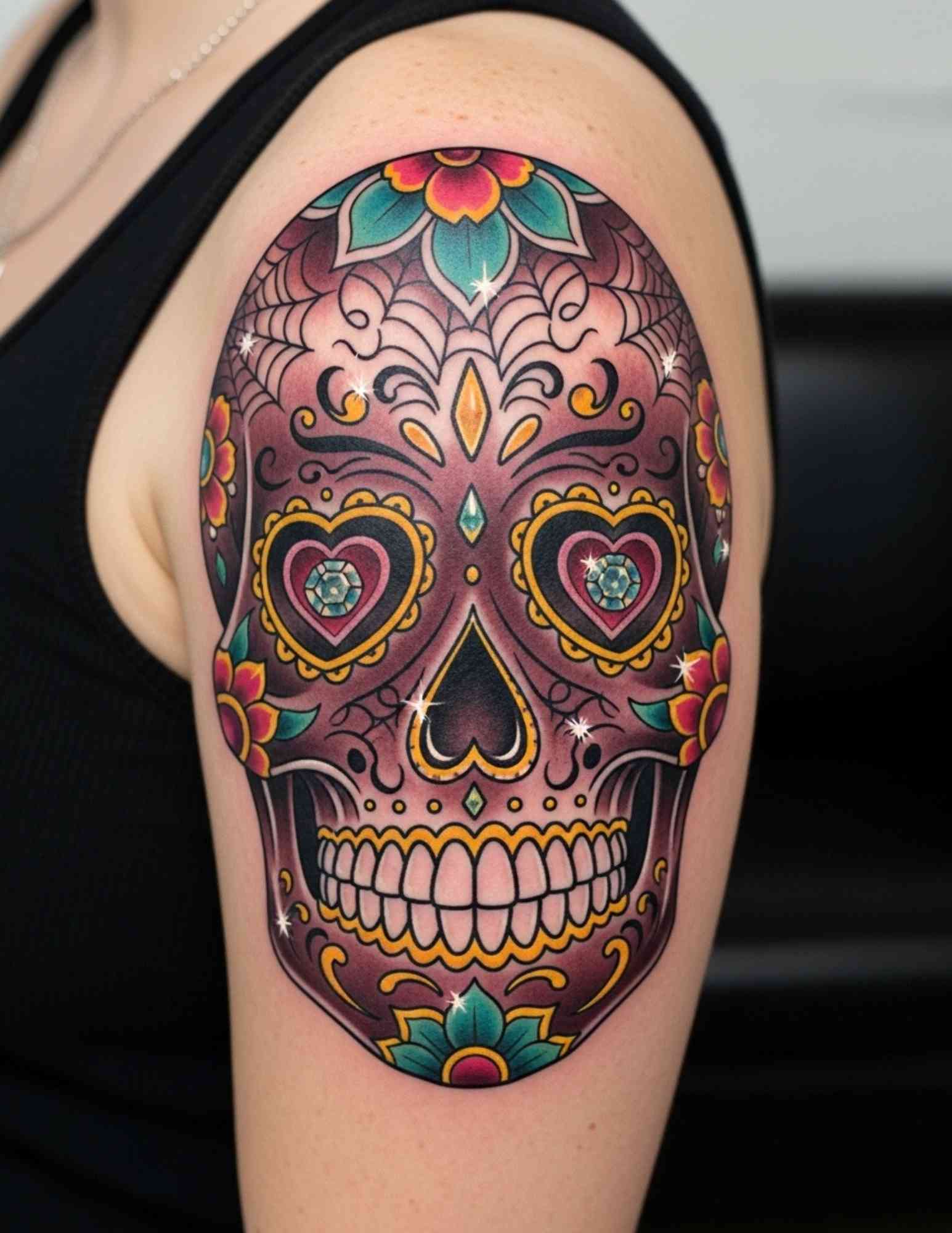
All 17 images, including the hero, are AI-generated tattoo concepts or placement mockups. They are not photographs of real tattoos, healed client work or finished stencils. A tattoo artist should redraw your chosen direction for your body and intended size.
Meaning, history and the first design decision
The skull and crossbones has a documented maritime connection. The Historic Dockyard Chatham's history of the Jolly Roger describes its use by pirates in the seventeenth and eighteenth centuries. Its later life is broader: Royal Museums Greenwich holds a skull and crossbones flag made for the film Windjammer around 1962, subsequently flown in tall-ships racing.
Those references establish a history of use, not a universal tattoo meaning. You might choose the emblem for a maritime interest, a reminder of mortality, a rebellious visual mood or simply its compact silhouette. Explain your own intention to the artist instead of assuming everyone will read it the same way.
Decide whether the skull or the whole emblem should lead. A large skull with short bones feels face-focused; longer bones create a broad badge. Crossed swords, anchors or roses can make interesting alternatives, but replacing the bones changes the composition you are asking for.
For broader skull subjects, compare our skull tattoo ideas. This collection concentrates on the two-bone emblem and its variations.
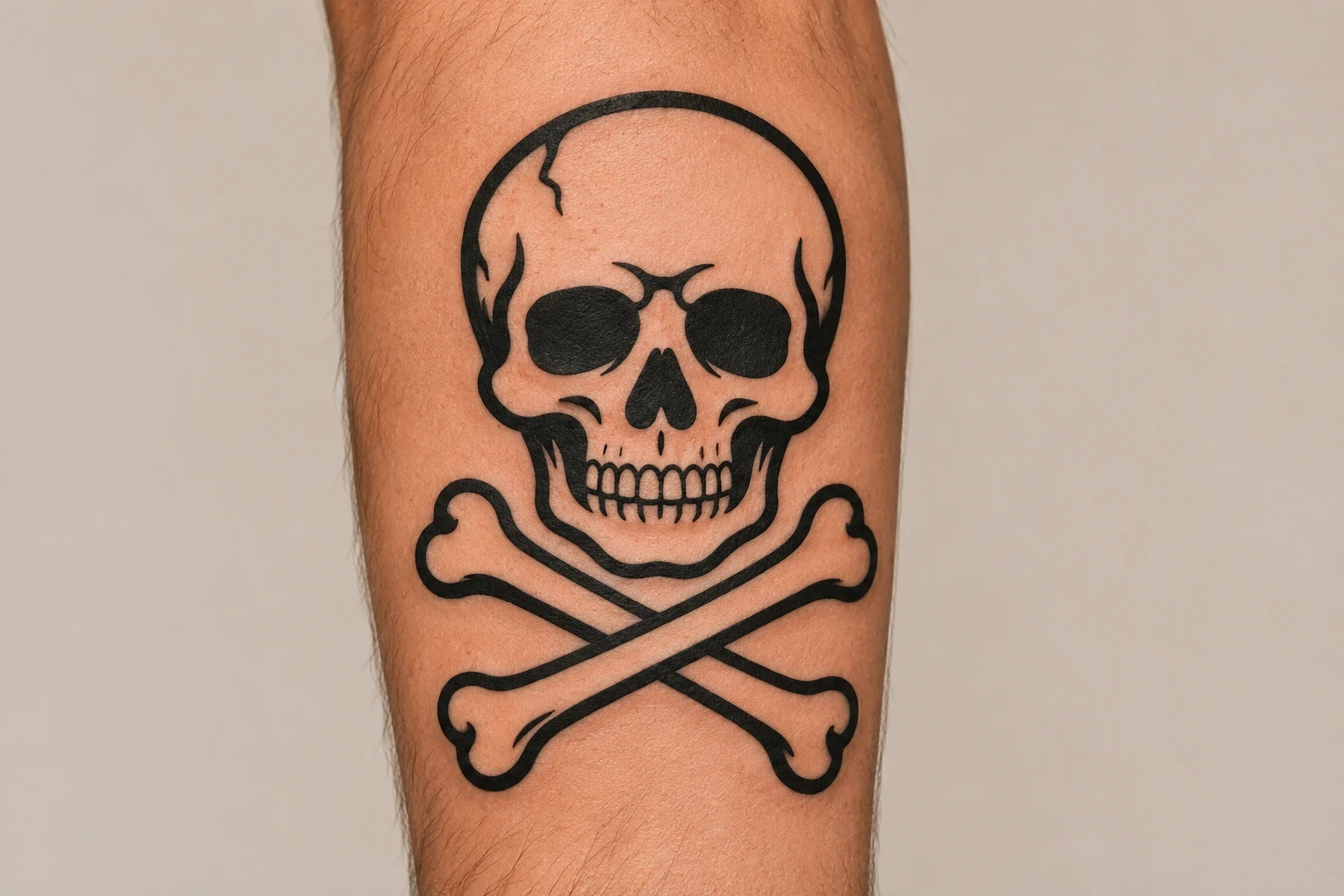
1. Classic black silhouette
This version makes the emblem itself the subject. Solid dark areas around open eyes and a simple jaw give the face a clear focal point, while the bones extend far enough to read as an X.
Keep the space under the jaw open when discussing the stencil. If the skull and upper bone ends merge into one dark mass, shorten or move the bones rather than adding more facial detail.
2. Traditional color flash
Mustard shading and red stars give the familiar emblem a warmer palette. The heavy outer line holds the composition together, and the small side accents make it feel like a self-contained flash piece.
Use this direction if you want a compact addition to a traditional collection. Discuss the amount of red and yellow with your artist; the stars can stay small accents rather than competing focal points.
3. Fine-line outline
An open outline shifts attention from heavy shading to the shape of the skull. The separate bones and roomy eye sockets create a light drawing that leaves much of the composition unfilled.
Ask the artist how much tooth detail they would keep at the chosen size. A cleaner jaw is preferable to squeezing many tiny marks into an area that is already small.
4. Woodcut hatching
Parallel hatch marks give the skull an engraved texture. The contrast comes from grouped strokes and clear white gaps rather than a smooth grey gradient, creating a more illustrative reading of the same emblem.
Allow enough room for the hatching to remain a deliberate pattern. If you want a smaller version, ask for fewer, more selective marks instead of shrinking every stroke in the drawing.
5. Dotwork shading
Stippled shadows soften the transitions between black and open areas. The dots can emphasize the cheekbones and rounded cranium without introducing additional objects or a decorative border.
Look for an artist whose healed dotwork you like. Ask where they would concentrate the darkest dots and where they would leave the paper-white areas as unfilled skin.
6. Negative-space medallion
A dark circular field reverses the usual emphasis: the skull and bones become the light shapes. The surrounding circle makes this a badge with a defined edge rather than a loose emblem.
Discuss how large the light gaps need to be within that dark field. The edge of the circle and the tips of the bones should stay distinct, especially where they approach one another.
7. A single rose beside the skull
The red rose introduces a second focal point beside the temple. It adds a softer shape and a small color area while leaving the eye sockets and crossed bones exposed.
Choose whether the rose is a personal reference or simply a visual accent. Keep its scale subordinate to the emblem if you want the skull and crossbones to remain the first thing someone notices.
8. Laurel wreath frame
An open wreath turns the emblem into a balanced crest. Repeated leaves create a quieter border than a solid circle, with a central opening above the skull to keep the arrangement from feeling sealed shut.
Ask for an even gap between the leaves and bones. A wreath needs its own space; crowding it into the silhouette can make the outer bone ends difficult to distinguish from the foliage.
9. Nautical rope oval
An oval rope frame makes the maritime direction explicit without replacing the crossed bones. The repeated rope turns add texture around a relatively simple center.
This is a useful direction for a more vertical placement. Ask the artist to simplify the rope at the top and bottom if the border starts drawing more attention than the face.
10. Pirate flag composition
The emblem moves onto a waving black flag, changing its silhouette and introducing folds. An ivory skull against dark fabric gives the design a different balance from black ink shapes on open skin.
Treat this as a modern pirate-inspired concept. Do not attach a specific captain or historical claim to it without a separate source; the image is an original interpretation rather than a documented flag reproduction.
11. Geometric skull planes
Angular planes divide the skull into graphic surfaces while the smooth bones keep the base uncomplicated. That difference between faceted face and rounded bones gives the composition its character.
Choose where the darkest planes belong before adding a background. A few decisive value changes can make the face readable without filling every polygon with a different shade.
12. Crescent above the emblem
A thin crescent adds a separate upper accent and makes the overall drawing taller. The empty gap between moon and skull is as important as the extra shape.
Use the crescent as a personal or decorative addition rather than a fixed symbolic code. If the tattoo needs to sit in a narrow space, compare this tall arrangement with a wider framed option.
13. Wildflower stems
Two slim stems soften the outside edge while the crossed bones preserve the central identity. Keeping the flowers outside the skull avoids turning the face into a dense ornamental pattern.
Tell the artist whether the flowers should be identifiable species or loose botanical shapes. Clear separation between stems and bone ends helps preserve both subjects, especially in the lower half.
14. Heart-shaped frame
The heart creates a different outer contour from a circle or wreath. Small red accents can connect the border visually while the skull and bones remain mostly monochrome.
Decide whether you want a romantic, memorial or simply graphic direction. Those are possible personal intentions, not an automatic meaning created by putting these shapes together.
15. Torn-paper border
An irregular shaded edge gives the emblem a rough frame without adding another object. It looks like a paper fragment carrying the symbol, with grey edges around a dark central drawing.
Describe the border clearly in your brief so it reads as paper or a graphic frame. The generated image is not a ripped-skin concept, and the tattoo does not need wound effects to create texture.
16. Cobalt shadow accents
A narrow blue shadow introduces color without filling the whole skull. The black drawing stays dominant, and the offset accent gives familiar shapes a more contemporary poster-like treatment.
Ask the artist to balance the color against the black outlines at stencil scale. Keep the blue selective so it reads as a planned accent rather than a second, misaligned copy of the emblem.
Choose placement by the width of the bones
The X of the bones can be wider than the skull itself. Before deciding on a small wrist placement, print the whole silhouette at the proposed size and check the outer tips, not just the face. On a curved area, ask your artist to show how the far ends appear from the front and side.
| Design direction | Placement to discuss | Detail to check in the stencil |
|---|---|---|
| Compact silhouette or outline | Outer forearm, calf or an existing gap | Clear eye sockets and distinct bone ends |
| Rope, laurel or heart frame | Upper arm, thigh or a broad forearm area | Space between frame and emblem |
| Hatching, dotwork or geometric shading | An area that accommodates the full drawing | Readable shading when viewed at actual size |
| Flag with a pole | A more vertical area such as upper arm or calf | Flag edges and pole remain visually separate |
These are composition suggestions, not minimum-size rules. Your artist's healed portfolio and stencil fitting are better guides than a fixed measurement attached to an AI image.
What to put in your artist brief
Bring two favorites and say exactly what you like about each: the skull shape from one, the open bone crossing from another, or the border from a third. Specify whether you want a full jaw, simplified teeth, color accents or an entirely black design. Ask for a new drawing rather than a literal trace of generated details.
Inspect four things at the final stencil size: the two eye sockets, the jaw opening, the crossing point and all four bone ends. Avoid adding so much ornament that the central emblem becomes difficult to identify. If you like bold outlines and restrained color, our American traditional tattoo ideas offer useful style comparisons. For a quieter approach, see our minimalist tattoo ideas.
Plan for care as well as the drawing
Follow your artist's written instructions for the fresh tattoo and ask a clinician about a skin reaction or healing concern. For established tattooed skin, the American Academy of Dermatology notes that UV light can fade some inks and recommends broad-spectrum, water-resistant SPF 30 or higher sunscreen when in the sun. Discuss when to introduce products on a new tattoo with your artist or clinician.
Our tattoo aftercare guide can help you prepare questions before the appointment. No illustration can promise a particular healed result or a maintenance-free tattoo.
Frequently asked questions
Does a skull and crossbones tattoo always mean piracy?
No. Its maritime history is well documented, but a person's tattoo can have a different intention. A flag makes the nautical reference more explicit; a plain emblem leaves more room for a personal reading. Avoid presenting your interpretation as the meaning for everyone.
Can this design work as a small tattoo?
A simplified version gives you fewer details to fit, but there is no universal size that works for every artist and placement. Compare the stencil at its intended size and keep the eye sockets, teeth and bone crossing readable. Reduce decoration before compressing a complex drawing.
Should I choose crossed bones or crossed swords?
Choose bones if you want the classic skull-and-crossbones structure shown here. Swords introduce blades, guards and handles, making a different outline. Tell the artist which you mean rather than using the terms interchangeably.
Are these designs ready to tattoo?
No. They are visual starting points. Your artist needs to resolve line weight, spacing, anatomy, shading and fit in a fresh drawing. The hero illustrates one possible placement and does not show a real or healed tattoo.
Historical and care sources checked November 3, 2026. Modern design interpretations and placement comparisons are editorial suggestions.