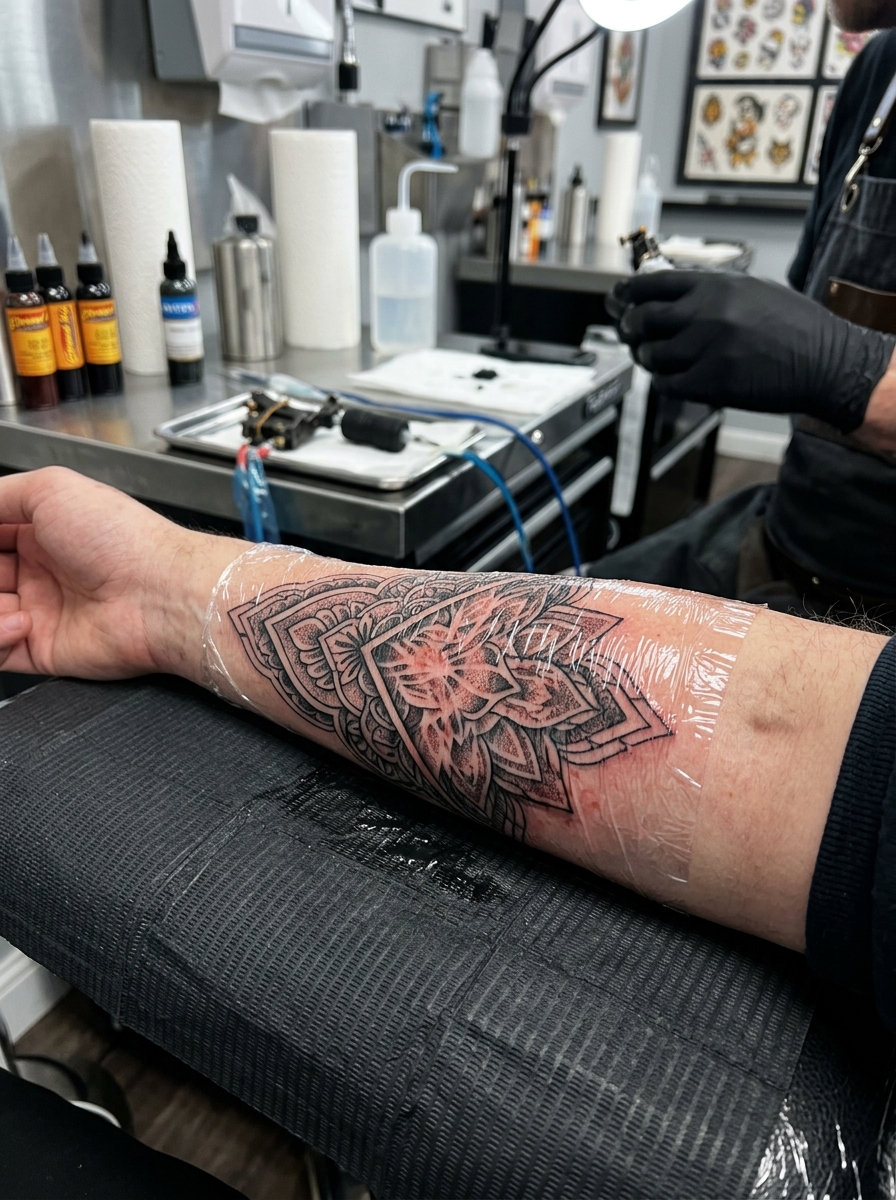
No, there is no proven link between tattoos and cancer. Studies since 2024 have found statistical associations between tattoo ink and lymphoma or skin cancer, but none has shown ink causes either disease, and one 2025 analysis found no association at all. The risk, if any, looks small and unconfirmed.
The headlines have been loud and the research really is unsettled, so the longer answer matters. Here is what is in tattoo ink, what the recent studies measured, where their limits are, and the practical precautions dermatologists care about far more than the cancer question itself.
What Is Actually in Tattoo Ink
Tattoo ink is less regulated than most people assume. In the United States no tattoo ink is FDA-approved, and the agency has historically not exercised pre-market authority over the pigments themselves. A single bottle can hold pigment particles, a carrier solution, preservatives and trace heavy metals left from manufacturing; reviews have counted up to roughly 100 chemicals across commercial inks.
Two groups come up repeatedly. Carbon black, the base of most black ink, can carry polycyclic aromatic hydrocarbons as contaminants, and several PAHs are classed as probable human carcinogens in other contexts such as soot and diesel exhaust. Azo pigments, common in reds, oranges and yellows, are stable in the bottle but can split into primary aromatic amines under strong UV light or a removal laser.
Europe acted on that uncertainty. Under the EU’s REACH rules, thousands of substances were restricted in tattoo and permanent makeup inks from January 2022, with the pigments Blue 15:3 and Green 7 banned a year later. Be precise about what that means: those substances were restricted because safety data was missing, not because anyone showed that tattooed Europeans were developing cancer. Precaution and proof are different things, and most of this topic lives in the gap between them.
What the Lymphoma and Skin Cancer Studies Found
The study that started the current wave came from Lund University in Sweden, published in eClinicalMedicine in 2024. It was a population-based case-control study of 11,905 people: researchers identified lymphoma patients through Swedish registers, matched them to controls of the same age and sex, and asked everyone about tattoos. After adjusting for smoking and age, tattooed people had a 21% higher rate of malignant lymphoma, with 21% of the lymphoma group tattooed against 18% of controls.
The detail the headlines left out is that tattoo size made no difference, the opposite of what the researchers expected. If ink were driving the disease, more ink should mean more risk. The authors stressed that lymphoma is rare, that the result applies at group level rather than to any individual, and that it needs replicating.
A Danish twin study published in BMC Public Health in January 2025 looked at both cancers. Its individual-level analysis of 316 twins reported a hazard ratio of 1.62 for skin cancer. For tattoos larger than a palm the figures rose to 2.37 for skin cancer and 2.73 for lymphoma, but ignoring size, no lymphoma effect appeared at all. The authors listed their limitations plainly: no sun exposure data, very few cases, and no way to separate decorative tattoos from permanent makeup.
Pulling the other way, a 2025 French analysis found no association between tattoos and skin cancer, and a separate 2025 paper reported a lower melanoma rate among people with multiple sessions. When small studies point in opposite directions, the honest reading is that nobody has settled this.
The Risks Dermatologists Flag More Often Than Cancer
Ask a dermatologist about tattoos and cancer and the conversation turns to visibility rather than chemistry. Melanoma is highly survivable when caught early, and catching it early depends on noticing a mole that has changed shape, colour or size. Ink over or immediately around a mole makes that comparison much harder, and dermatoscope assessment becomes unreliable through dense pigment. A good artist routes a design around moles without being asked, but raise it at the consultation anyway, especially for heavy coverage like a full sleeve.
Ink particles also migrate. Pigment reaching nearby lymph nodes is well documented, and stained nodes can look abnormal on imaging, which occasionally complicates staging if cancer is suspected later for unrelated reasons. That is a diagnostic nuisance rather than evidence of harm, but it is a good reason to tell a surgeon where your tattoos are.
Then there are the reactions that have nothing to do with cancer and are far more common. Red pigment is the usual culprit behind delayed allergic responses, which can appear as itching or raised bumps months or years later, so anyone drawn to red ink designs should ask for a patch test. Infection from a poorly run studio is still the most likely thing to go wrong, and early water exposure is a classic cause, which is why there are firm rules about how long to wait before swimming. Removal deserves a thought in advance too, since lasers work by shattering pigment molecules into fragments that can include those aromatic amines, so it is worth knowing what laser removal costs before you start.
How to Lower Whatever Risk Exists
Pick a licensed studio that opens single-use needles in front of you and pours from sealed ink caps. Ask which brands they use and whether those are REACH-compliant; artists who care about their supply chain answer immediately, and the question alone tells you something. Our guide to getting a tattoo for the first time covers what a properly run session looks like.
Never let anyone tattoo directly over a mole, and if you have many moles or a family history of melanoma, get a skin check before a large piece rather than after. Photograph the area for a baseline. Once healed, keep sunscreen on it: that protects the design and addresses UV, the one genuinely established skin cancer risk in this whole discussion. Follow a sensible aftercare routine through the healing stages, and stick to a fragrance-free lotion rather than anything heavily perfumed.
Report anything new, persistent or raised to a doctor instead of assuming the ink is responsible. If your situation is unusual, check first rather than guessing: there are separate considerations around getting tattooed while pregnant, and tattoos still affect eligibility to donate blood in many places. None of this is a reason to avoid tattoos. It is the ordinary care you would take with any permanent change to your skin.
See the Design Before You Commit to It
Most of the advice here comes down to deciding carefully: how much ink, which colours, and where on your body, including which skin you would rather leave clear. That is easier to judge when you can look at the design on the placement you have in mind instead of imagining it.
The Tattoobuild AI tattoo generator lets you do exactly that. Describe what you want and unlimited variations come back in seconds rather than weeks, so you can weigh a dense black version against a lighter fine line treatment, or test a colour-heavy concept before committing to pigment that is hard to remove. Plans start from $6, and every design you like saves to your own gallery, ready to hand to an artist.