Your forearm is the piece of skin you look at more than any other, and that changes how a tattoo there needs to be designed. A forearm tattoo is read from two feet away by you and from ten feet away by everyone else, and the designs that work are the ones that survive both distances.
I have spent a long time looking at forearm work healed rather than fresh, and the gap between the two is where most regret lives. A piece that photographs beautifully at the studio can lose half its detail in five years if the linework was too fine for the placement.
This guide collects more than seventy forearm tattoo ideas for men and women, grouped by subject, with notes on what each design actually needs from an artist. If you are working with a smaller space, our roundup of small forearm tattoo ideas for men is a better starting point.
Nothing here is medical advice. For anything to do with healing, reactions or skin conditions, talk to your artist and, when it matters, a doctor.
Which Forearm Placement Is Right for You?
Before the subject matter, decide where on the forearm the piece sits. It changes the pain, the shape of the design and how the tattoo ages.
| Placement | Pain Level | Detail It Holds | Best Suited To |
|---|---|---|---|
| Inner forearm | Mild to moderate — softer skin, more nerve sensitivity near the wrist | Excellent; the flat panel keeps fine line and script readable | Script, fine line, small symbolic pieces, first tattoos |
| Outer forearm | Mild — usually the easiest arm placement to sit through | Very good, and it takes sun exposure better than the inner side | Bold black and grey, animals, traditional work, sleeve starters |
| Wrap-around | Moderate — the inner elbow side is the part people flinch at | Good, but the design has to be drawn for a curved surface | Dragons, snakes, vines, armbands, banner text |
| Full forearm panel | Moderate, mostly because of the sitting time rather than the spot | Best of the four — enough room for background and depth | Scenes, portraits, half sleeves, layered narrative pieces |
Pain levels above are what I have consistently heard from people in the chair rather than anything measured. Everyone’s tolerance differs, and the inner elbow is the spot that surprises people most.
What Actually Makes a Forearm Tattoo Age Well
Forearms get more sun than almost any other tattooed area, and ultraviolet exposure is the single biggest cause of fading I have seen on healed work.
Line weight is the second factor. Ink spreads slightly in the skin over years, so lines that sit very close together gradually merge into a solid tone.
That is why a design with generous negative space between elements still reads clearly a decade later, while a dense fine-line piece of the same size can turn into a grey patch.
Placement matters too. The inner forearm is protected from sun but sits on softer, more mobile skin; the outer forearm is more stable but takes the weather.
None of this means fine line work is a mistake. It means going in knowing that a delicate piece will probably want a touch-up somewhere down the line, which most artists expect and many will quote for.
Forearm Tattoo Ideas for Men
These ten designs come up again and again on men’s forearms, and each one suits the shape of the arm for a specific reason. If you want subject matter with more personal weight behind it, our list of meaningful forearm tattoos for guys goes deeper on symbolism.
1. Wing Tattoo
Angel wings were the first forearm piece I ever watched go on start to finish, and what surprised me was how much the shape depends on the length of your arm rather than the artist’s drawing. A single wing running from the elbow crease down to the wrist reads clean and intentional. Two wings crammed into the same space usually read cluttered.
In my experience the detail that carries a wing is the feather layering, not the outline. Ask your artist to keep the primary feathers long and the coverts tight, because that contrast is what stops the piece turning into a grey blur after ten years. A wing tattoo is one of the few designs that genuinely improves with more negative space around it.
Most wing forearm pieces I have seen were done in black and grey over one sitting of roughly three to five hours.
2. Compass and Arrow Tattoo
The compass rose is the most requested forearm design I hear artists complain about, and the reason is that most references online are drawn flat. On a curved forearm a perfectly circular compass distorts. Good artists solve this by tilting the rose slightly or by breaking the outer ring.
Pairing it with an arrow gives the composition a direction, which fills the long vertical shape of the forearm far better than a circle alone. If you want a deeper look at the layout options, our guide to the compass forearm tattoo for guys breaks down how the needle placement changes the meaning.
Keep the internal degree markings sparse. Tiny engraved numbers are the first thing to blow out as the tattoo settles.
3. Cross and Flower Tattoo
A plain cross on a forearm can look stark to the point of severity. Adding roses, lilies or a small spray of foliage softens the silhouette without diluting the meaning, and it gives the artist somewhere to put shading.
The version I like best keeps the cross in solid black and the flowers in lighter grey wash, so the eye lands on the cross first. Reversing that balance tends to make the cross disappear into the background.
This is also a forgiving design for a cover-up, because the flower elements can be shaped around whatever is already on the skin.
4. Bear and Nature Scene Tattoo
Nature scenes are where the forearm really earns its reputation as a canvas. The vertical panel suits a bear standing in front of a mountain range with pines below it, and that stacked composition reads clearly from a few feet away.
When I tested how these age, the pattern was consistent: the mountains and the bear silhouette hold up, while very fine tree branches and thin fog lines soften first. Ask for the treeline to be built from solid shapes rather than hairline strokes.
Expect a scene like this to take two sittings if you want real depth in the background rather than a flat backdrop.
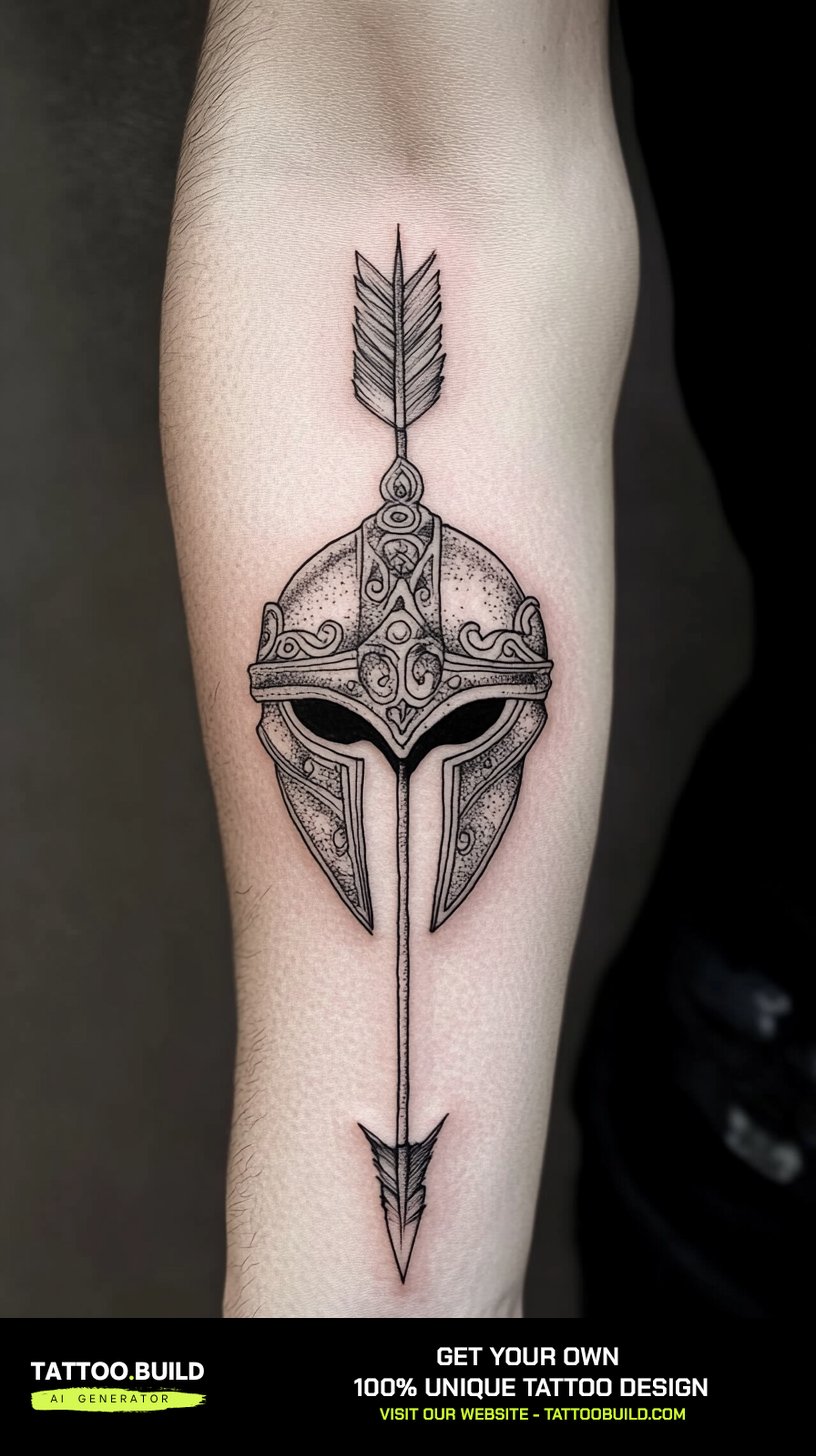
5. Sword Tattoo
A sword is the design that fits the forearm most naturally, because both are long and narrow. Ran down the inner forearm, the blade sits along the tendon line and the crossguard lands near the elbow crease.
The mistake I see most often is scaling the hilt too small. On a real sword the grip is roughly the length of a hand, and if a tattoo shrinks it below that the whole thing looks like a letter opener.
Wrapping the blade in a snake, a banner or roses is a common addition. It works, but only if the artist leaves enough clean steel visible for the highlight that makes the metal read as metal.
6. Dragon Tattoo
Dragons and forearms are made for each other because the body of the dragon can follow the curve of the arm instead of fighting it. A serpentine Japanese-style dragon that wraps from wrist to elbow uses the whole surface, and it looks intentional from every angle.
Scale texture is the part that decides whether it ages well. Solid scale shapes with clear gaps between them stay readable; stippled micro-scales tend to merge. If you want more direction on style, our roundup of dragon tattoo ideas for men covers the main schools side by side.
A wrap-around dragon almost always needs a design session before the tattoo session, because the artist has to draw it on your actual arm, not on paper.
7. Lighthouse Tattoo
The lighthouse is a quiet favourite. It carries an obvious meaning without needing text, and the tower shape fills the vertical panel of the forearm the same way a sword does.
What makes or breaks it is the light itself. The beam has to be built out of untattooed skin rather than white ink, because white ink over black shading rarely stays bright for long.
Add waves at the base and you have a full composition. Skip them and the tower can look like it is floating, which some people like and some people regret about a year in.
8. Warrior Angel Tattoo
A warrior angel is the most technically demanding piece on this list. You are asking for a figure, drapery, armour and wings inside a space roughly the width of a paperback.
Every artist I have asked about these says the same thing: give it the full forearm, not half. Compressed into a small panel the face loses its features within a few years as the linework spreads.
Look at healed photographs of the artist’s figure work before booking this one. Fresh photos flatter everyone; healed photos tell you whether the shading holds together.
9. Crocodile Tattoo
Crocodiles are underrated on the forearm. The long jaw and heavy tail suit the shape, and the scale texture gives an artist an excuse to use real black rather than grey wash.
I have seen the best versions done in a bold traditional or neo-traditional style, where the scales are stylised into repeating shapes. Photorealistic crocodile skin looks incredible for six months and muddy after five years.
If you want the piece to feel less aggressive, artists often set the animal in water with reeds, which breaks up the silhouette.
10. Shark Tattoo
Sharks give you a strong, simple shape that stays recognisable at any size, which is exactly what you want from a forearm tattoo you will see every day.
Traditional sharks with heavy outlines have aged best out of every version I have looked at. Fine-line realistic sharks look striking early on, then lose the gill and eye definition that made them work.
Water is optional. A shark on plain skin has a cleaner, more graphic feel, while adding a wave line or bubbles pushes it towards a scene.
Forearm Tattoo Ideas for Women
The designs below lean towards fine line, botanical and ornamental work, though none of these categories belong to anyone in particular. For a wider set of options, see our gallery of forearm tattoo ideas for females.
1. Floral Tattoo
Florals are the most requested forearm tattoo I come across, and the range inside that one word is enormous. A single stem down the inner forearm is a completely different commitment from a wrapped band of blooms.
The thing worth deciding before you book is whether you want it to read as one flower or as a bouquet. Bouquets need room and usually a wider placement, and they are a natural bridge into a floral half sleeve later on.
Fine-line florals are beautiful and they do soften over time, so if you want the crispness to last, ask for slightly heavier linework than the reference photo shows.
2. Alligator Tattoo
The alligator sits close to the crocodile in look but tends to be drawn heavier and lower to the ground, which suits a placement running along the outer forearm.
In my experience the most successful versions treat the scales as a pattern rather than as anatomy. Repeating diamond shapes with solid black between them hold their shape as the ink settles.
It is also a design that reads well small. A palm-sized alligator near the wrist works where a palm-sized portrait would not.
3. Gun and Flower Tattoo
The revolver-and-roses combination comes out of American traditional tattooing, and it still works because the two shapes contrast so hard: hard metal against soft petals.
Composition matters more than detail here. The barrel usually points down the arm towards the wrist, with the flowers filling the space around the cylinder and grip.
If the imagery feels too heavy, artists often swap the firearm for a dagger or a key while keeping the same layout and the same visual contrast.
4. Lace and Filigree Tattoo
Lace and filigree are the ornamental end of forearm tattooing: scrollwork, beads, drop pendants and repeating curls that follow the arm rather than sit on it.
These pieces live or die on symmetry. Because the forearm rotates, a filigree band that looks perfect while your arm is flat can go crooked the moment you turn your wrist, so ask your artist to check the stencil in several positions.
Leave more space between the scroll elements than the reference image shows. Ornamental work with tight gaps is the design category I have seen blur worst over a decade.
5. Dagger and Flower Tattoo
A dagger through a rose is close to a tattooing cliché, and it survives as one because it genuinely fits the forearm better than almost anything else.
The vertical blade uses the length of the arm, the flower fills the width, and the whole thing reads instantly. There is very little to go wrong.
Modern versions tend to slim the blade and add fine botanical detail, which is lovely but slightly less durable than the old bold-line approach.
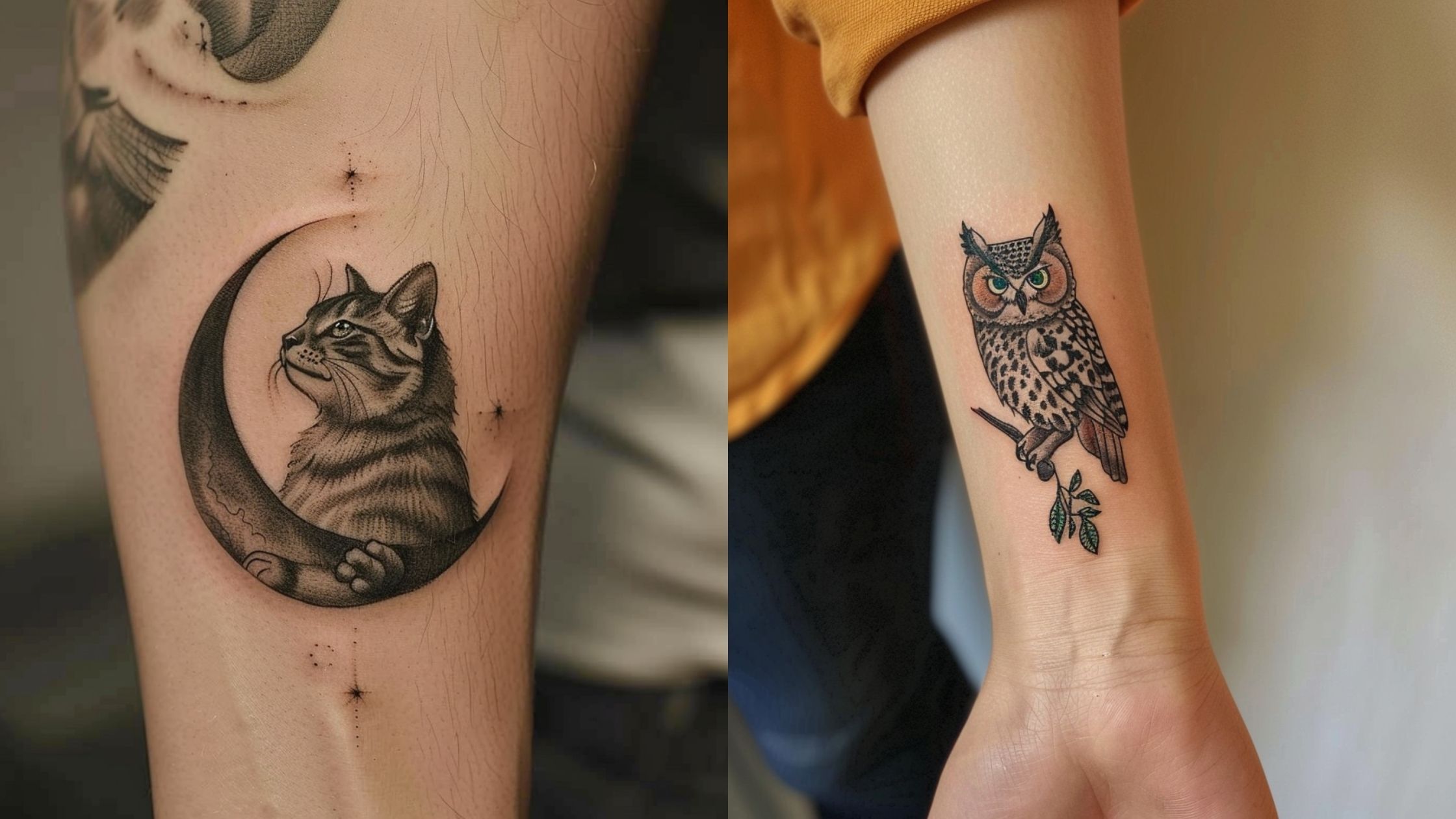
6. Owl on a Branch Tattoo
Owls give an artist everything they enjoy drawing: feather texture, big expressive eyes and a strong silhouette. On the forearm the bird usually perches with the branch running horizontally across the arm.
The eyes are the whole tattoo. If they are placed even slightly asymmetrically the face looks wrong in a way you cannot un-see, which is why I would only book this with someone whose healed animal work you have looked at. Our collection of owl tattoo ideas is a decent place to compare styles first.
Feather stippling is the part that softens with age, so the bird should still read as an owl from its outline alone.
7. World Map and Airplane Tattoo
Travel tattoos are personal by nature, and the map-and-plane version handles the forearm well because a dotted flight path can be drawn to follow the arm.
The trap is detail. A world map with every coastline rendered accurately will not survive at forearm scale, and simplified continents almost always look better a few years in.
Many people add coordinates or a small date. Keep any text large enough that the individual letters are clearly separated, because small script closes up as it settles.
8. Cat and Crescent Moon Tattoo
The cat-and-crescent design is a compact, quiet piece that suits the inner forearm, and it is one of the more common first tattoos I see on that spot.
Because it is usually done in fine line, the size floor matters. Below roughly the width of two fingers the cat’s face stops being readable once the lines spread.
Adding stars or a thin halo of dots gives the composition weight without adding anything that will blur.
9. Tree and Roots Tattoo
A tree with visible roots is one of the few designs that genuinely uses the full length of the forearm, canopy near the elbow and roots reaching towards the wrist.
Solid trunk shapes hold up. Very fine root hairs and individual leaves are the parts that soften, so the tree should be recognisable from its overall shape rather than its detail.
This design is a natural anchor if you ever want to grow the piece into a half sleeve, because the canopy can extend past the elbow without redrawing anything.
10. Phoenix and Flame Tattoo
The phoenix closes out this list because it fills the forearm in a way few designs manage: the tail feathers run down towards the wrist and the wings open near the elbow.
Flames are the risky part. Rendered as thin flickering lines they can blur into the bird; rendered as bold shapes with clear gaps they stay separate and legible.
Colour phoenixes are common, and they do fade faster than black and grey, particularly on an outer forearm that catches a lot of sun.
Variations Worth Considering
If none of the twenty ideas above land exactly right, these variations solve the same problem from a different angle.
Armbands and Wrapped Bands
A band running around the forearm reads as deliberate design rather than as an image placed on skin, and it suits people who want something graphic without a subject.
The catch is that a band has to close cleanly on the inner arm, which is the hardest part of the stencil to get right.
Extending Into a Half Sleeve
Almost every forearm design can grow upward later, and planning for that from the first session saves a lot of awkward joins. Our guide to half sleeve tattoos for men covers how artists usually stage that.
Tell your artist at the consultation if a sleeve is even a possibility. It costs nothing and changes how they place the first piece.
Script and Lettering
Text along the inner forearm is a classic for a reason, but it is unforgiving. Size the letters larger than feels necessary and keep the font simple.
Anything with very thin connecting strokes will close up first, which is how legible script turns into an illegible smudge.
Matching and Companion Pieces
Forearms are the easiest placement for matching tattoos because two arms can sit side by side for a photograph without anyone contorting.
Keep matching pieces simple. The more detail two tattoos carry, the more obvious it becomes that they were done slightly differently.
Aftercare and Best Practices for Forearm Tattoos
Follow whatever your artist tells you first, because they know the ink, the machine and the depth they worked at. What follows is general practice, not a substitute for their instructions or for medical advice.
Keep the fresh tattoo clean and lightly moisturised, avoid soaking it, and do not pick at flaking skin. Our full tattoo aftercare guide walks through the first two weeks day by day.
Sunscreen is the one habit that makes a visible difference on a forearm specifically. Once the tattoo is fully healed, a high-SPF sunscreen on exposed arm work slows fading more than any lotion will. The American Academy of Dermatology has straightforward guidance on caring for tattooed skin.
If you see spreading redness, swelling that worsens after a few days, discharge, or a fever, contact a doctor rather than waiting it out. Allergic reactions to tattoo pigment are uncommon but real, and the FDA’s fact sheet on tattoos and permanent makeup explains what regulators do and do not check.
Never attempt to remove or alter a tattoo yourself. Removal is a medical procedure and belongs with a qualified practitioner.
Common Mistakes and What to Do Instead
The most common mistake is choosing a reference image without checking whether it was drawn for a flat surface. Forearms curve, and a design that ignores that will look distorted from most angles.
The second is going too small. Shrinking a detailed design to fit a modest budget is the fastest route to a piece that needs reworking within a few years.
The third is booking on the strength of fresh photos alone. Ask any artist for healed work in the style you want; good ones are happy to show it.
Still not sure where to start? If the pain question is what is holding you up, our tattoo pain chart maps the forearm against other placements. If you like the delicate end of the spectrum but want to understand its limits first, browse our fine line tattoo ideas before committing.
Frequently Asked Questions
Do forearm tattoos hurt?
Most people describe the forearm as one of the easier placements, particularly the outer side where there is more muscle and less nerve sensitivity. The inner forearm near the wrist and the inside of the elbow are noticeably sharper for many people. Pain is individual, though, and tiredness, hydration and how long you sit all affect it. If you are nervous, book a shorter first session and see how you find it.
How much does a forearm tattoo cost?
Cost depends far more on the artist’s rate and the hours involved than on the placement itself. A small, simple piece may be a single short sitting, while a detailed full-forearm scene can run across several sessions. Ask for an estimate in hours rather than a flat figure, since that is how most artists actually price work. Always confirm whether a deposit is required and what it covers.
Will a forearm tattoo affect my job?
This varies enormously by industry, employer and country, and attitudes have shifted a lot over the past decade. The forearm is easy to cover with a long sleeve, which is part of why it is such a popular placement. If you have any doubt, check your workplace policy before booking rather than after. Some roles still have explicit visible-tattoo rules.
How long does a forearm tattoo take to heal?
The surface usually looks settled within a couple of weeks, while the deeper layers keep healing for longer — often a month or more. During that time the tattoo can look dull or slightly cloudy, which is normal and usually resolves. Follow your artist’s aftercare instructions rather than general advice you read online. If anything looks or feels wrong, ask your artist and see a doctor if there are signs of infection.
Can a forearm tattoo be extended into a sleeve later?
Yes, and it is one of the most common ways sleeves get built. It is much easier when the first piece was placed with that possibility in mind, so mention it at the consultation even if you are only fifty percent sure. An artist can leave breathing room at the elbow and keep the composition open at the top. Retrofitting a sleeve around a tightly boxed-in forearm piece is possible but more work.
Quick Summary
- Decide on placement first — inner, outer, wrap-around or full panel — because it shapes everything else.
- Favour designs built from solid shapes over designs built from hairline detail if you want them to age well.
- Vertical subjects such as swords, trees, lighthouses and phoenixes use the forearm’s shape naturally.
- Wrap-around work needs to be drawn directly on your arm, so expect a separate design session.
- Ask every artist for healed photographs in the style you want, not just fresh ones.
- Sunscreen on healed arm work is the single most effective thing you can do to slow fading.
- Mention any future sleeve plans at the first consultation, even if you are undecided.
- For anything involving infection, reactions or removal, speak to your artist and a doctor rather than improvising.