The forearm is the placement I get asked about more than any other, and I understand why. It is the one spot on the body that you can show off in a t-shirt and hide completely under a long sleeve, which makes it the safest first big tattoo most women will ever get.
I have watched people agonise over a rib piece for a year, then book a forearm design in an afternoon. The reason is simple: you get to look at it. A back piece belongs to everyone else, but a forearm tattoo is yours daily.
This guide covers the styles that actually suit the forearm, how placement changes the design, what the healing is honestly like, and the mistakes I see people make when they rush the decision. If you are still narrowing down your very first design, the first tattoo ideas for women guide is a good companion to this one.
Everything below comes from conversations with artists and from watching how these designs age over years, not from a trend list.
Which Forearm Tattoo Style Is Right for You?
Style choice matters more on the forearm than almost anywhere else, because this is skin that sees daily sun and constant movement.
| Style | Typical Session | How It Ages | Best For |
|---|---|---|---|
| Fine line | 1–3 hours | Softens fastest; expect a touch-up in a few years | Subtle, first-timer, low commitment |
| Botanical / floral | 2–5 hours | Very well if negative space is left between elements | Flowing designs that follow the arm |
| Script / lettering | 1–2 hours | Thin script can blur; medium weight holds up | Quotes, names, dates, meaning-led pieces |
| Blackwork / ornamental | 3–6 hours | Best of any style; bold black lasts decades | Bold statements, cover-ups, wrap bands |
| Illustrative / dotwork | 3–6 hours | Good, though fine dot shading lightens over time | Animals, portraits, storybook detail |
| Watercolour | 2–4 hours | Weakest without black anchoring; fades in sun | Soft, painterly, colour-led designs |
| Half or full sleeve | 3–5 sessions | Depends entirely on the styles inside it | Long-term collectors, big commitment |
What Actually Affects How a Forearm Tattoo Ages
The forearm gets more ultraviolet exposure than almost any other tattooed area on a woman’s body, simply because sleeves get pushed up.
Sun is the single biggest factor in how a forearm tattoo looks in ten years, and it is also the one entirely within your control.
Line weight is the second factor. A hairline stroke placed by a light hand can soften noticeably within a few years, while the same design at slightly heavier weight stays crisp.
Skin on the inner forearm is thinner, paler and less exposed, so detail and colour tend to hold better there than on the outer arm.
Placement over the wrist bone or close to the elbow crease also matters, because skin that folds and stretches constantly will always wear a design faster than flat skin does.
Forearm Tattoo Ideas for Females, Style by Style
These are the seven directions that come up again and again, with an honest note on what each one asks of you.
1. Fine Line and Single Needle
Fine line is the default request for forearm work right now, and for good reason — it is quiet, it heals fast, and it rarely looks dated.
A single-needle artist works with strokes barely thicker than a pen line, which suits small botanicals, constellations, tiny symbols and delicate script.
The honest trade-off is longevity. Ink spreads slightly under the skin over the years, and the thinner the line, the more visible that spread becomes.
In my experience the pieces that hold up best are the ones with breathing room between elements. If you want the look without the fragility, ask your artist for a slightly heavier needle grouping — and browse the fine line tattoo ideas collection to see what different weights actually look like.
2. Botanical and Floral Designs
Florals dominate forearm work for women because the shape of a stem naturally matches the shape of an arm.
A single long-stemmed flower running from wrist toward elbow uses the placement properly, where a wide circular design fights it.
Birth flowers, wildflower bunches, lavender, olive branches and single roses are the requests I hear most often, usually chosen for meaning rather than looks.
Every artist I have asked says the same thing about floral work: leave gaps. Petals drawn tight against each other will merge into a dark mass as the ink settles.
If a botanical piece is where you are heading, the floral forearm half sleeve designs show how the same idea scales up.
3. Script, Quotes and Handwriting
Lettering sits beautifully on the inner forearm, which is the flattest tattooable surface most people have.
Vertical script running down the arm reads more comfortably than horizontal text, which gets cut off by the curve of the limb.
Keep quotes short. A line of four or five words at readable size will outlast a full sentence squeezed into tiny type.
Handwriting from a family member, a date in Roman numerals and a single meaningful word are the three requests that never seem to go out of fashion. The quote tattoo ideas for women guide has more on choosing wording you will not regret.
One practical warning: proofread the stencil yourself, twice, before the needle touches skin. Spelling errors in tattoo script are far more common than people admit.
4. Blackwork and Ornamental
If longevity is your priority, bold blackwork wins outright. Solid black lines hold their shape for decades with minimal touch-up work.
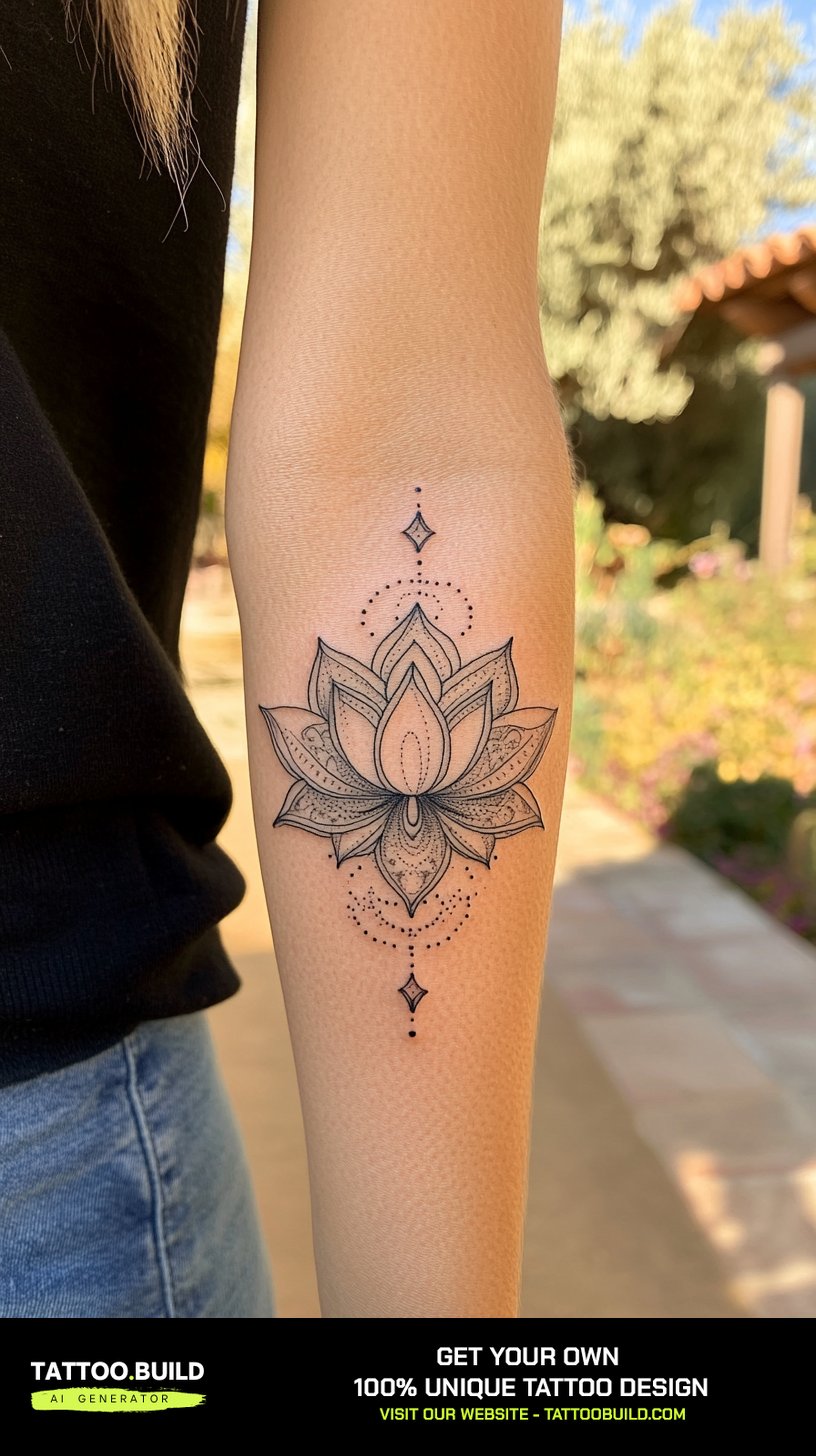
Ornamental designs — mandala segments, geometric bands, lacework patterns — suit the forearm because they can be built symmetrically around the limb.
A wrap-around band is one of the very few designs that genuinely flatters every arm shape and size.
Expect longer sessions. Packing solid black is slower and more uncomfortable than linework, and most artists will split a large ornamental forearm piece across two sittings.
5. Illustrative Animals and Dotwork
Illustrative work is where an artist’s linework quality shows most clearly, so this is the style where portfolio research matters most.
Butterflies, moths, snakes, birds and big cats are the animals I see requested most for female forearm placements.
Dotwork shading — building tone from thousands of individual dots rather than a smooth grey wash — has a soft, engraved quality that suits the arm well.
It also ages a little more gracefully than heavy grey wash in my experience, because as individual dots soften the overall tone stays even rather than going patchy.
6. Watercolour and Soft Colour
Watercolour tattoos mimic paint bleeding across paper, with soft edges and no hard outline.
They photograph beautifully and they are genuinely striking when fresh, which is why they get shared so widely online.
The honest caveat is that colour without black anchoring is the fastest-fading combination you can put on a sun-exposed forearm.
Ask your artist to anchor the design with at least some black linework or dark shading. It keeps the shape readable long after the softest washes have lightened.
7. Half and Full Forearm Sleeves
A forearm sleeve covers wrist to elbow and is usually built across three to five sessions rather than one marathon sitting.
The mistake I see most is collecting unrelated pieces and hoping they will eventually connect. They rarely do without expensive filler work.
If a sleeve is the long-term plan, tell your artist at the first appointment, even if you are only booking one small element today.
A good artist will map the whole arm and place that first piece where it can grow. The full sleeve tattoo ideas for women gallery is worth browsing before you commit to a direction.
Inner, Outer or Wrap-Around: Choosing Your Placement
The forearm is not one placement, it is three, and each behaves differently.
Inner Forearm
Paler, softer, less sun-exposed skin that holds fine detail and colour better than anywhere else on the arm.
It is also more discreet, since it faces your body when your arms hang naturally. Most people rate it as slightly more tender than the outer arm but still an easy sit.
Outer Forearm
The most visible option and the flattest large canvas, which makes it the natural home for bolder designs.
It takes the most sun, so this is where a good sunscreen habit genuinely changes how the tattoo looks in a decade.
Wrap-Around and Wrist-Adjacent
Bands and wrapping stems suit the forearm’s taper well, though they need an artist who is comfortable working in the round.
Designs that run right onto the wrist sit on thinner, more mobile skin and often need earlier touch-ups. The wrist tattoo ideas for women guide covers that boundary in more detail.
Aftercare That Keeps a Forearm Tattoo Sharp
Forearm tattoos are among the easiest placements to heal, mostly because you can actually see and reach the whole thing.
Keep it clean with unscented soap and lukewarm water, pat dry, and apply a thin layer of whatever your artist recommends — thin is the operative word, since a thick layer traps moisture and slows healing.
Do not pick or scratch as it flakes, keep it out of pools, lakes and baths until it is fully closed, and stay out of direct sun during healing. The American Academy of Dermatology publishes clear, non-commercial aftercare guidance worth reading alongside your artist’s instructions.
Once healed, sunscreen is the whole game. A high-SPF product on the forearm whenever it is uncovered will do more for the tattoo’s appearance in ten years than any aftercare balm. Our full tattoo aftercare guide walks through the healing timeline week by week.
If you notice spreading redness, heat, swelling that worsens after the first few days, pus, or a fever, that is not normal healing — contact a doctor rather than waiting it out. The US Food and Drug Administration also documents ink reactions and infection risks, and this article is not a substitute for medical advice.
Common Mistakes — and What to Do If You Are Still Not Sure
Almost every forearm tattoo regret I have heard about traces back to one of these.
- Choosing the artist by price rather than portfolio. Style specialisation matters enormously; a brilliant blackwork artist may not be the right hand for fine line.
- Sizing the design too small. Detail that is legible on paper can become a smudge on skin, especially on an arm that will be viewed from a metre away.
- Booking on a whim while travelling. A permanent piece deserves an artist you can return to for touch-ups.
- Ignoring the long game. If a sleeve is even a possibility, plan the first piece around it.
- Skipping sun protection. The most common cause of a tattoo looking tired is not bad work, it is years of unprotected sun.
If you are undecided on scale, start by looking at minimalist tattoo ideas and simple tattoo ideas for women — small pieces on the forearm are easy to build on later.
If pain is the sticking point, the most painful tattoo spots breakdown will reassure you: the forearm consistently sits at the gentler end of the scale.
Frequently Asked Questions
How painful is a forearm tattoo for women?
Most people describe the forearm as one of the more manageable placements, and artists generally rank it in the lower half of the pain scale. The outer forearm has a good layer of muscle underneath and relatively thick skin, which dulls the sensation. The inner forearm is a little more tender because the skin is thinner, and areas close to the wrist and elbow crease are sharper again. Pain is individual, so treat every ranking as a guide rather than a promise.
How long does a forearm tattoo take to heal?
The surface usually closes within about two weeks, with flaking and itching most noticeable in the first week to ten days. The deeper layers keep settling for roughly a month or more, which is why the tattoo can look slightly dull before it brightens again. Follow your artist’s specific aftercare instructions, since products and timelines vary. If anything looks or feels wrong, speak to your artist or a doctor rather than waiting.
Will a forearm tattoo affect my job?
This depends entirely on your industry and employer, and attitudes have shifted a great deal in recent years. The forearm is one of the easier placements to cover, since any long sleeve conceals it completely. If you work somewhere with a formal appearance policy, it is worth checking that policy before booking. Many people choose the inner forearm specifically because it is less visible in everyday postures.
How much does a forearm tattoo cost?
Cost varies enormously by artist, city, and how much time the piece takes, so any single figure would be misleading. Most artists charge either a flat rate for small work or an hourly rate for larger pieces, and many have a shop minimum. A small fine line design and a full forearm sleeve are different orders of magnitude. Ask for a quote at consultation, and be wary of pricing that seems far below the local norm.
Can a forearm tattoo be covered up or removed later?
Cover-ups are often possible on the forearm because there is a good amount of flat surface to work with, though the new design usually needs to be larger and darker than the original. Laser removal is also an option and the forearm generally responds reasonably well, but it takes multiple sessions spread over many months and results vary. Never attempt at-home removal creams or DIY methods, which can cause scarring and burns. Speak to a qualified professional about either route.
Quick Summary
- The forearm is the best balance of visible and coverable on the body, which is why it suits a first significant tattoo so well.
- Bold blackwork ages best; fine line and unanchored watercolour age fastest.
- Let designs run with the length of the arm rather than across it.
- Leave negative space between floral elements so they do not merge over time.
- Inner forearm holds detail and colour better; outer forearm is more visible and takes more sun.
- Keep script short, vertical and proofread before the stencil goes on.
- Tell your artist early if a sleeve is a long-term possibility.
- Sunscreen on healed skin is the single highest-impact thing you can do for the tattoo’s future.