You want a ship tattoo, and you have probably already noticed the problem: a ship is one of the few tattoo subjects that can look either timeless or like a cluttered mess, and the difference is almost always about how much detail was crammed into how little skin.
I have spent a lot of hours in shops looking at healed ship tattoos, and the ones that still look great years later have one thing in common. They were designed around the space they had rather than shrunk down to fit it.
Ships carry more meaning than most flash subjects. Adventure, survival, a journey you did not choose, a person you sailed away from — it all fits under the same set of sails, which is exactly why the design decisions matter so much.
Below you will find every major ship tattoo direction worth considering, what each one actually costs you in space and healing, and where a ship pairs well with other maritime work like anchor tattoo designs.
Which Ship Tattoo Style Is Right for You?
Before you fall in love with a reference photo, it helps to compare styles on the two things that decide whether you will still like the tattoo in a decade: the space it needs and how it holds up.
| Style | Best Size | How It Ages | Good For |
|---|---|---|---|
| Traditional sailor | Palm-sized and up | Excellent — built for it | Anyone who wants it readable in 30 years |
| Pirate ship | Half sleeve or larger | Good if shading is bold | Storytelling, big dramatic scenes |
| Ghost ship | Medium to large | Fair — soft grey can fade | Moody, atmospheric pieces |
| Minimalist | Two to four inches | Fair — thin lines soften | First tattoos and discreet spots |
| Ship in a bottle | Forearm or calf | Good | A sentimental, contained design |
| Full-rigged tall ship | Large, vertical space | Depends heavily on rigging weight | Detail lovers with room to spare |
| Viking longship | Medium to large | Excellent in blackwork | Norse themes and heavy black styles |
None of these are rules. They are the trade-offs I would want someone to explain to me before I sat down in the chair.
What Ship Tattoos Actually Mean
Ship tattoos come out of working sailor culture, not fantasy. The imagery was earned, and the meanings were specific.
A fully rigged ship traditionally marked a sailor who had rounded Cape Horn — a genuinely dangerous passage in the age of sail. You can read more of that history in the documented tradition of sailor tattoos.
Most people getting a ship today are reaching for the same idea in a modern form: I went through something, and I came out the other side.
That is the honest appeal. A ship is a vessel that carries you somewhere, and it only makes sense in relation to the water around it.
Which is why I always push people to think about the sea in the design too. A ship on blank skin floats in nothing; a ship on real water tells a story. If that idea pulls at you, the wider world of ocean tattoo ideas is worth a look before you commit.
Popular Ship Tattoo Designs
1. Traditional Sailor Ship Tattoos
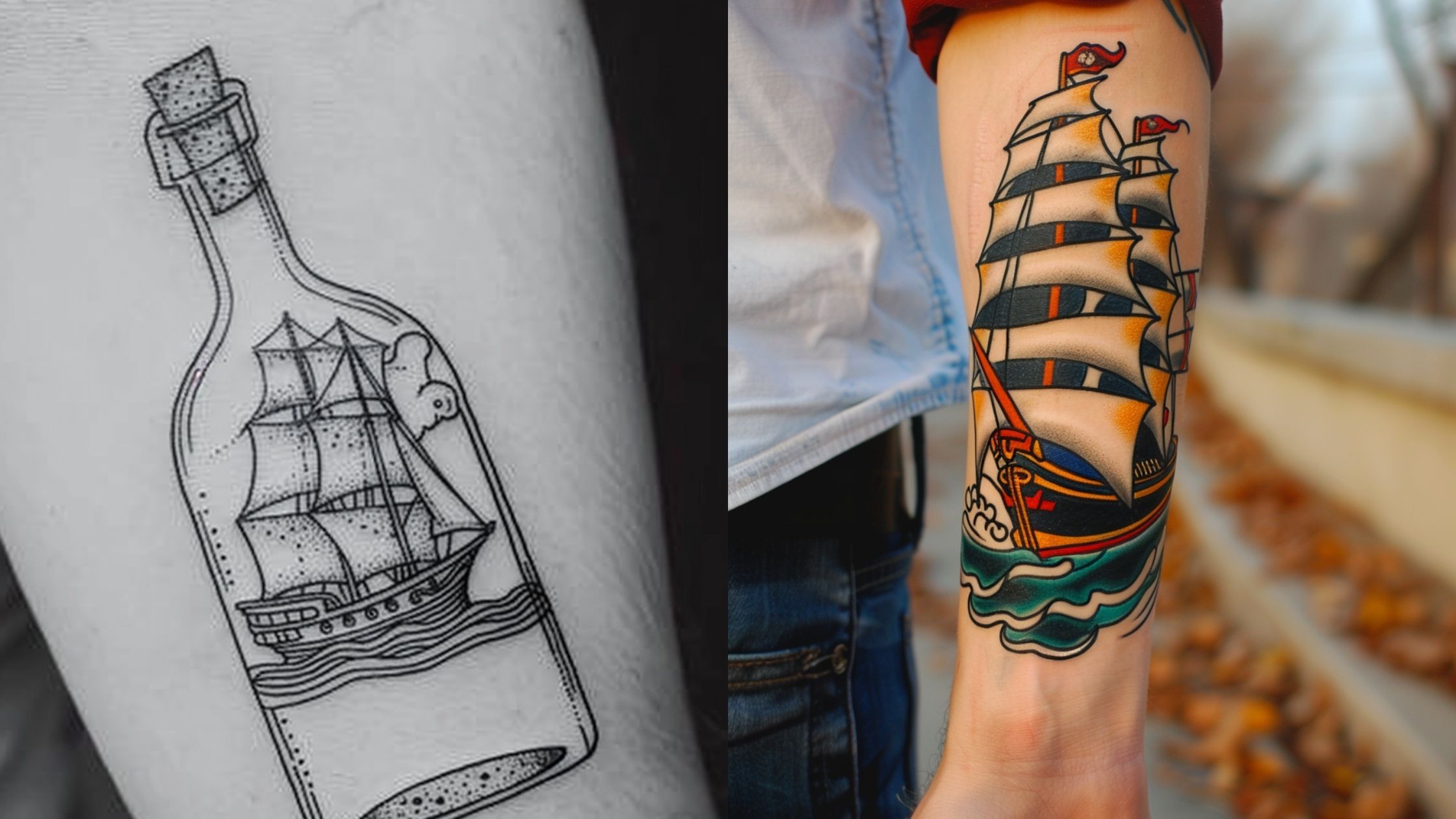
American traditional is the safest ship you can get, and I mean that as a compliment.
Bold outlines, a limited palette and simple shading were developed in an era before touch-ups were routine, so the style was engineered to survive decades of sun and skin turnover.
Expect thick black linework, flat red and gold, and often a banner with a name or a short phrase. If you want a ship that will still read clearly across a room in twenty years, this is the answer.
In my experience this is also the least stressful ship to sit for, because the artist is not chasing tiny rigging detail for hours on end.
2. Pirate Ship Tattoos
A pirate ship is a scene, not a symbol. That is the whole point of it.
Black sails, a Jolly Roger, cannon smoke and a sea that is clearly trying to kill somebody — these designs are built for drama and they need room to deliver it.
I would not attempt one under half-sleeve size. Every pirate ship I have seen crammed onto a small forearm panel lost the waves first, then the rigging, and ended up as a generic boat.
Skull imagery pairs naturally here, and if you like that direction there are plenty of skull tattoo drawings that work as companion pieces rather than clutter.
3. Ghost Ship Tattoos
Ghost ships are the most atmospheric option and the most technically demanding to keep alive.
The look depends on soft grey wash, broken linework and fog swallowing parts of the hull, which is beautiful fresh and vulnerable long term.
Very light grey wash can fade noticeably, especially on skin that gets regular sun. Ask your artist to keep at least some structural black in the hull and masts so the ship does not dissolve entirely after a few years.
Every artist I have asked about this says the same thing: a ghost ship needs an anchor point of solid value, or it stops reading as a ship at all.
4. Minimalist Ship Tattoos
Minimalist ships are usually a hull, a mast, a sail shape and a waterline. Nothing else.
They suit small placements — inner forearm, ankle, behind the ear, along the ribs — and they are genuinely good first tattoos because the session is short and the healing is easy.
The honest limitation is longevity. Single-needle and fine linework tends to soften and spread over the years, more so on high-friction spots like fingers or the side of the hand.
When I have asked artists about small fine line work, most suggest going slightly larger and slightly bolder than the reference photo you brought in. That advice is not upselling — it is what makes the tattoo survive.
5. Ship in a Bottle Tattoos
This is my favourite ship concept for people who want the meaning without the sprawl.
The bottle gives the design a hard border, which means it sits neatly on a forearm or calf without needing wave work spilling in every direction.
It also carries its own idea: something precious, kept intact, deliberately preserved. A lot of people choose it as a memorial piece for that reason.
The technical challenge is the glass. Glass only reads as glass if the highlights and the distortion at the edges are done well, so ask to see healed examples of glass or water in an artist’s portfolio before booking.
6. Full-Rigged Ship Tattoos
A full-rigged ship carries square sails on all three masts, and reproducing that faithfully takes real estate.
This is the design people most often try to shrink, and it is the one that punishes shrinking hardest. Rigging lines placed too close together will blur into a grey smudge as the tattoo heals and settles.
The rule of thumb I have heard repeatedly is to leave a clear gap between parallel lines — wider than looks necessary on paper — because ink spreads slightly in the skin over time.
Vertical placements work best: the outer forearm, the calf, the spine, or the outside of the upper arm. If you are planning something bigger, look at how tall ships sit within full sleeve compositions before you decide on size.
7. Ship and Lighthouse Tattoos
Pairing a ship with a lighthouse changes the story from wandering to arriving.
The lighthouse becomes the focal point and the ship becomes the subject moving toward it, which gives the composition a natural reading order rather than one flat scene.
Composition tip from every artist I have watched build one: stack the lighthouse behind and slightly to the side of the ship rather than beside it, so the piece stays narrow enough for a limb.
If the beacon idea is what draws you, there are more layouts worth studying in this collection of lighthouse tattoo designs.
8. Ship and Compass Tattoos
This is the single most requested ship pairing, and for good reason — direction plus vessel is a complete idea.
A compass rose sitting behind the ship creates a built-in background, which solves the “floating on blank skin” problem without needing a full ocean scene.
The risk is visual noise. A detailed compass and a detailed ship competing in the same space will both lose, so one of them has to be simplified deliberately.
I usually suggest keeping the compass geometric and clean and letting the ship carry the detail. For layout options, this set of compass tattoo designs shows how much the rose alone can vary.
Variations and Alternatives Worth Considering
Ship and Anchor Combinations
An anchor is the counterweight to a ship: one moves, one holds.
Together they read as a balance between freedom and stability, which is why the pairing shows up so often in memorial and family pieces.
Rope work is the practical bonus here — it fills awkward negative space between the two objects and gives the composition a spine.
Viking Longships
A longship is a completely different silhouette from a tall ship: low, wide, dragon-prowed, with a row of round shields along the hull.
It suits heavy blackwork and Norse knotwork far better than realistic grey shading, and it ages exceptionally well because of that solid fill.
If Norse imagery is the actual draw rather than the sea itself, say so to your artist — the design decisions change completely.
Ship With Map or Coordinates
Adding a chart fragment, a coastline or a set of coordinates makes a generic ship specific to you.
Coordinates work best when they are small and secondary — along a banner, a bottle label, or the edge of a map. Check the numbers twice before the needle touches skin, because that is a very public mistake to carry.
For layout ideas, this collection of map tattoo designs shows how chart elements can frame a subject without overwhelming it.
Ship With Sea Creatures
A kraken wrapped around a hull is the classic version, and it solves a real design problem by filling the space around the ship with movement.
Tentacles are extremely forgiving as a background element because they can be thickened, thinned or curved to fit whatever shape your body actually is.
If that direction appeals, these octopus tattoo designs show how the limbs can wrap a limb naturally.
Placement, Sizing and Practical Advice
Ships are tall, narrow subjects, so they want tall, narrow real estate. The outer forearm, the calf, the spine and the outer upper arm are the four placements I see work most consistently.
The ribs and the sternum can look spectacular but hurt considerably more, and thin rigging lines on the ribs are harder for an artist to place cleanly on moving, breathing skin.
Go bigger than you think you need. I have never once heard someone say their ship tattoo turned out too large, and I have heard the opposite many times.
If you are still deciding where it goes, browsing forearm tattoo placement ideas is a useful way to judge scale against a real limb rather than a flat drawing.
Aftercare and Keeping the Detail Sharp
Follow the aftercare instructions your artist gives you over anything you read online, including this page — they know what ink and technique they used on you.
In general terms: keep it clean, keep it lightly moisturised, do not pick at flaking skin, and stay out of pools, hot tubs and open water until it is fully healed. Submerging a healing tattoo is one of the more common ways people end up with patchy linework.
Sun is the long-term enemy, particularly for grey wash and fine line ships. Sunscreen on a healed tattoo is the single cheapest thing you can do to protect the detail.
If you see spreading redness, swelling that increases after the first few days, pus, or you develop a fever, contact a doctor rather than waiting it out. The Mayo Clinic’s guidance on tattoo risks and precautions covers the warning signs clearly. Nothing in this article is medical advice, and an infected tattoo is a medical issue, not a design one.
Common Mistakes and What to Do Instead
The most common mistake by a wide margin is choosing a highly detailed reference image and then asking for it at a fraction of the size. The detail has to go somewhere, and where it goes is into a blur.
The second is skipping the water. A ship with no sea, no horizon and no sky often looks unfinished once it is healed, even when the ship itself is beautifully executed.
The third is picking an artist by price rather than by portfolio. Ask specifically to see healed ship, water or glass work — healed photos, not fresh ones, because fresh photos hide almost every flaw.
Still not sure which direction to take? Compare a bold traditional approach against the softer maritime pieces in these maritime tattoo ideas, then bring two or three references to a consultation rather than one.
Frequently Asked Questions
What does a ship tattoo symbolise?
Most commonly it symbolises a journey, resilience and the freedom to set your own course. In traditional sailor culture the meanings were far more literal, with a fully rigged ship marking a specific voyage a sailor had completed. Today the meaning is usually personal rather than earned through a maritime rank. Whatever meaning you attach to it, the design reads more clearly if the ship is shown in relation to water rather than floating on blank skin.
How big does a ship tattoo need to be?
It depends entirely on the style. A minimalist ship works happily at two to four inches, while a full-rigged tall ship with visible rigging generally needs a forearm, calf or larger to stay readable. The practical test is whether parallel rigging lines have clear space between them at the size you are considering. If they do not, size up or simplify the design.
Do ship tattoos age well?
Bold traditional and blackwork ships age extremely well because they were designed around heavy lines that hold their shape. Fine line and soft grey wash ships tend to soften and lighten over the years, particularly with sun exposure. None of that makes the lighter styles a bad choice, but it does mean you should expect a touch-up at some point. Ask your artist directly how their work has healed on clients with similar skin.
Where is the best place on the body for a ship tattoo?
Tall, narrow placements suit the subject best: the outer forearm, the calf, the spine and the outer upper arm. Ribs and the sternum can look striking but are more painful and harder to place fine detail on cleanly. Consider how much the area moves and stretches, since high-movement spots blur fine linework faster. Your artist will usually have a strong opinion here, and it is worth listening to.
How much does a ship tattoo cost?
Prices vary enormously by region, artist experience and how long the piece takes, so any figure quoted online is close to meaningless. Most artists charge either an hourly rate or a flat piece price, and a detailed ship is realistically a multi-hour or multi-session job. The most useful thing you can do is email two or three artists with your reference images and desired size and compare their quotes. Never choose based on price alone — a cheap ship you dislike is more expensive than a good one.
Quick Summary
- Ship tattoos symbolise journey, resilience and self-direction — a meaning inherited from working sailor tradition.
- Traditional sailor and Viking blackwork ships age the best; fine line and grey wash ships need more long-term care.
- Pirate ships need half-sleeve space or larger to keep their drama intact.
- Ship in a bottle designs give you a built-in border and suit forearms and calves neatly.
- Full-rigged tall ships punish undersizing more than any other version — leave real gaps between rigging lines.
- Pair a ship with a compass, lighthouse or anchor to give the composition direction and a focal point.
- Choose tall, narrow placements: outer forearm, calf, spine, outer upper arm.
- Judge artists on healed portfolio work, not fresh photos, and treat any sign of infection as a medical issue.