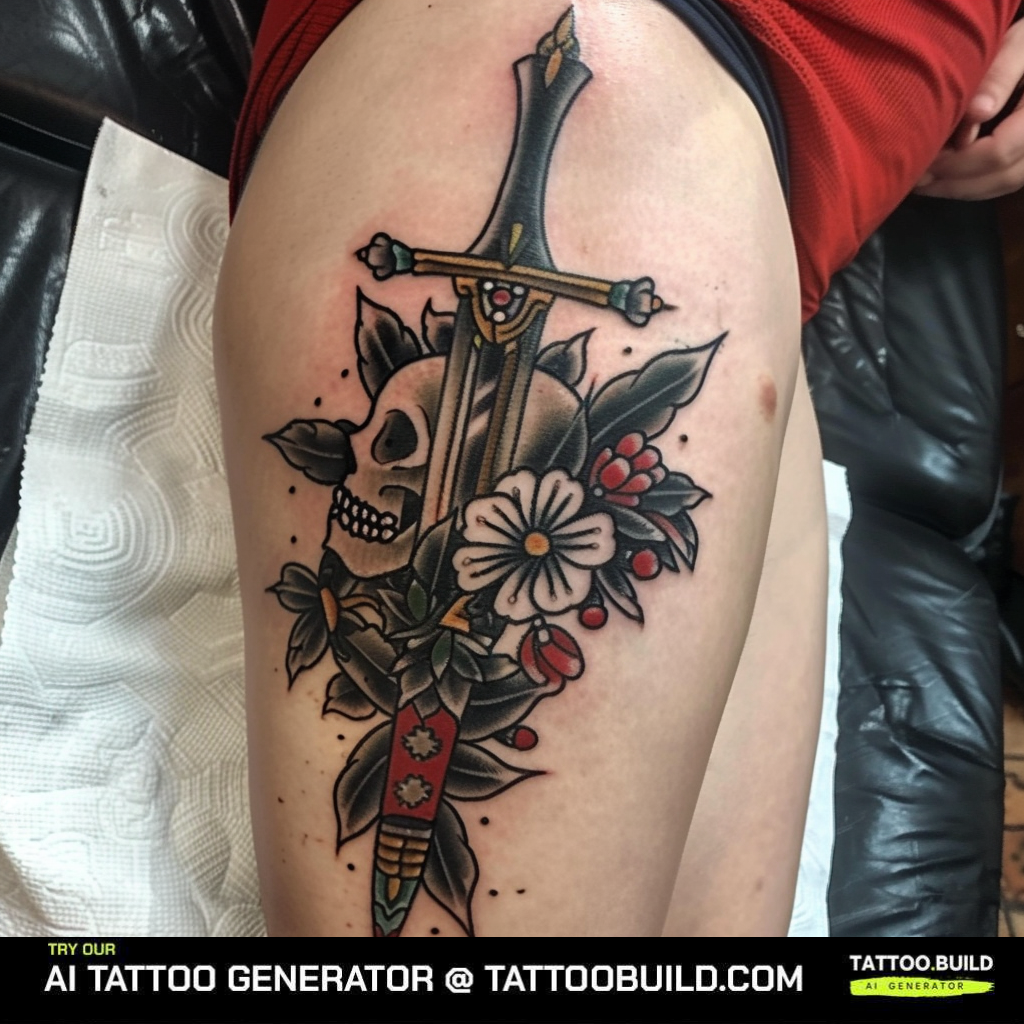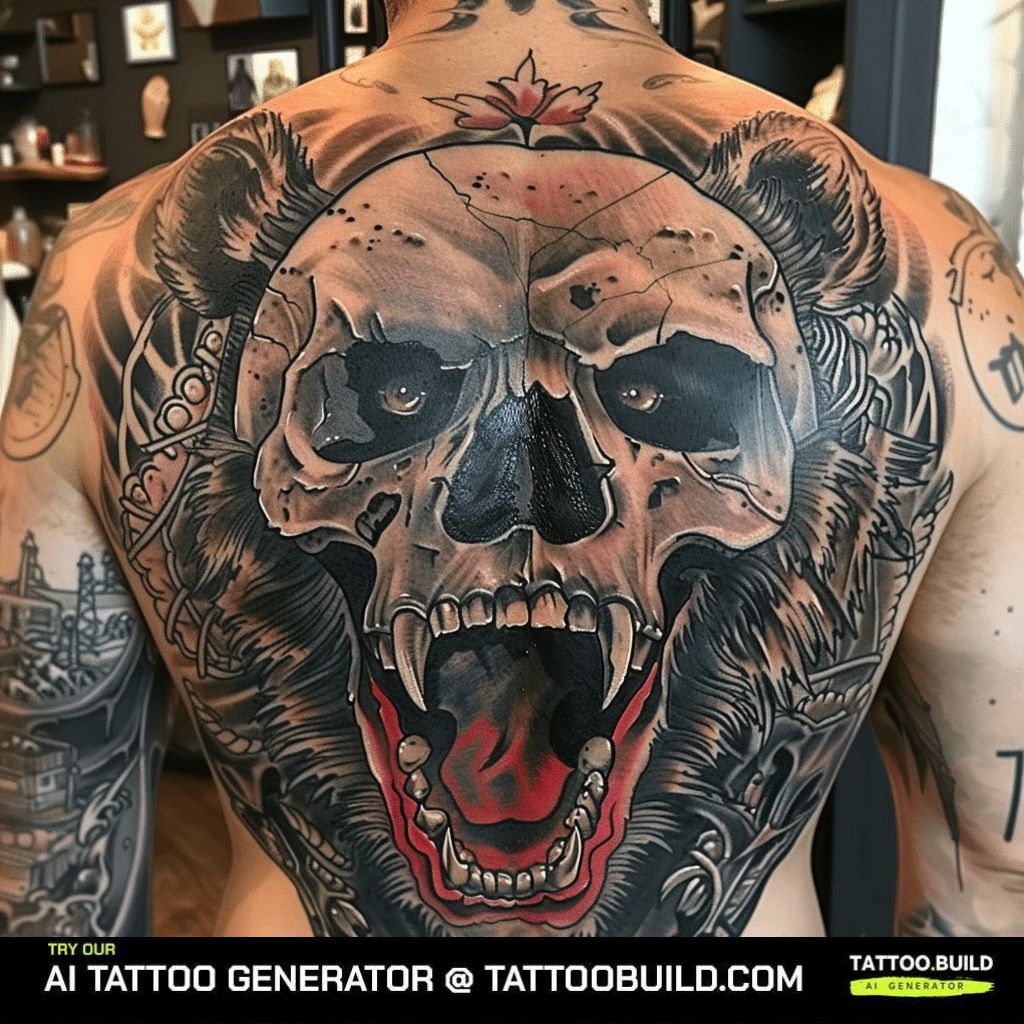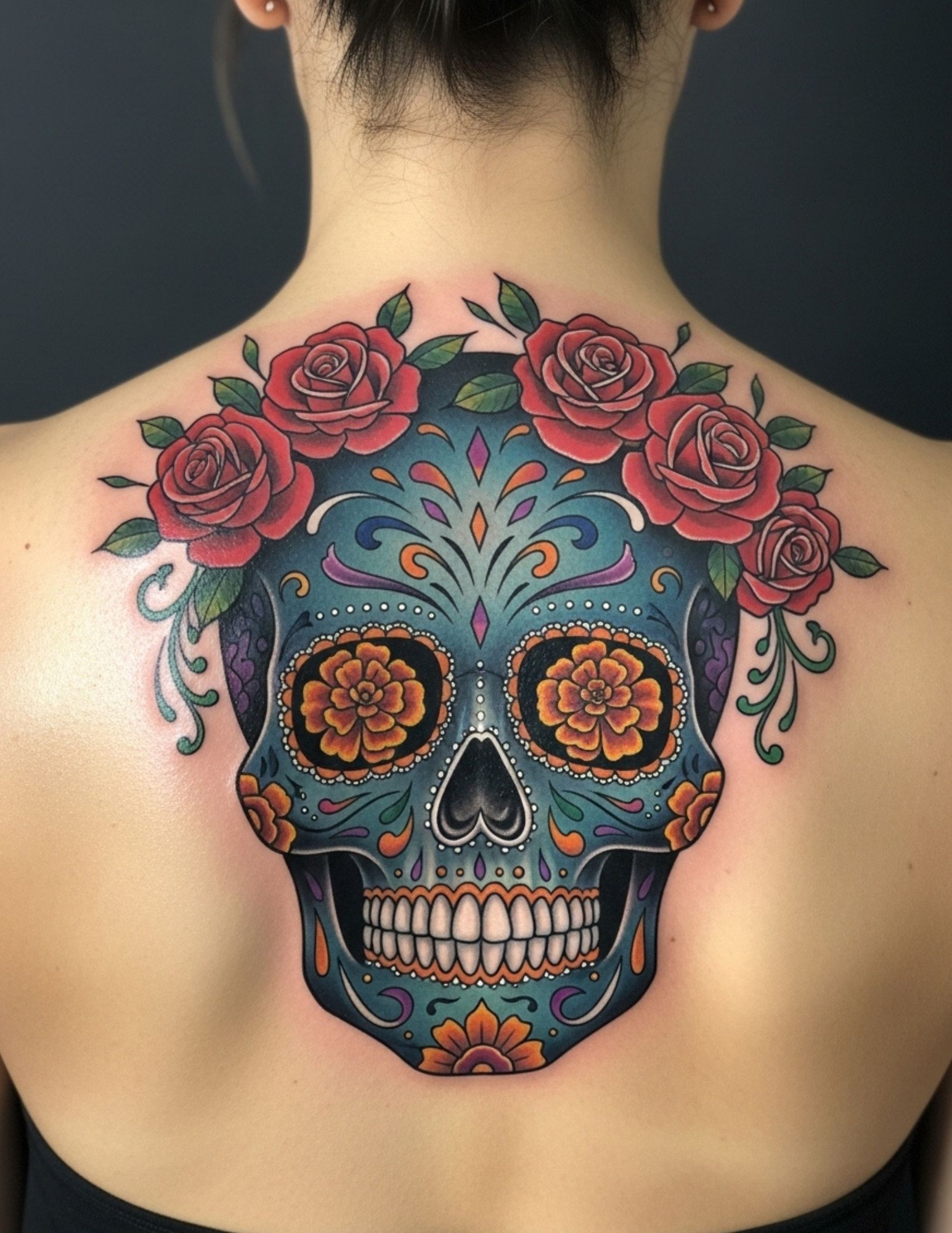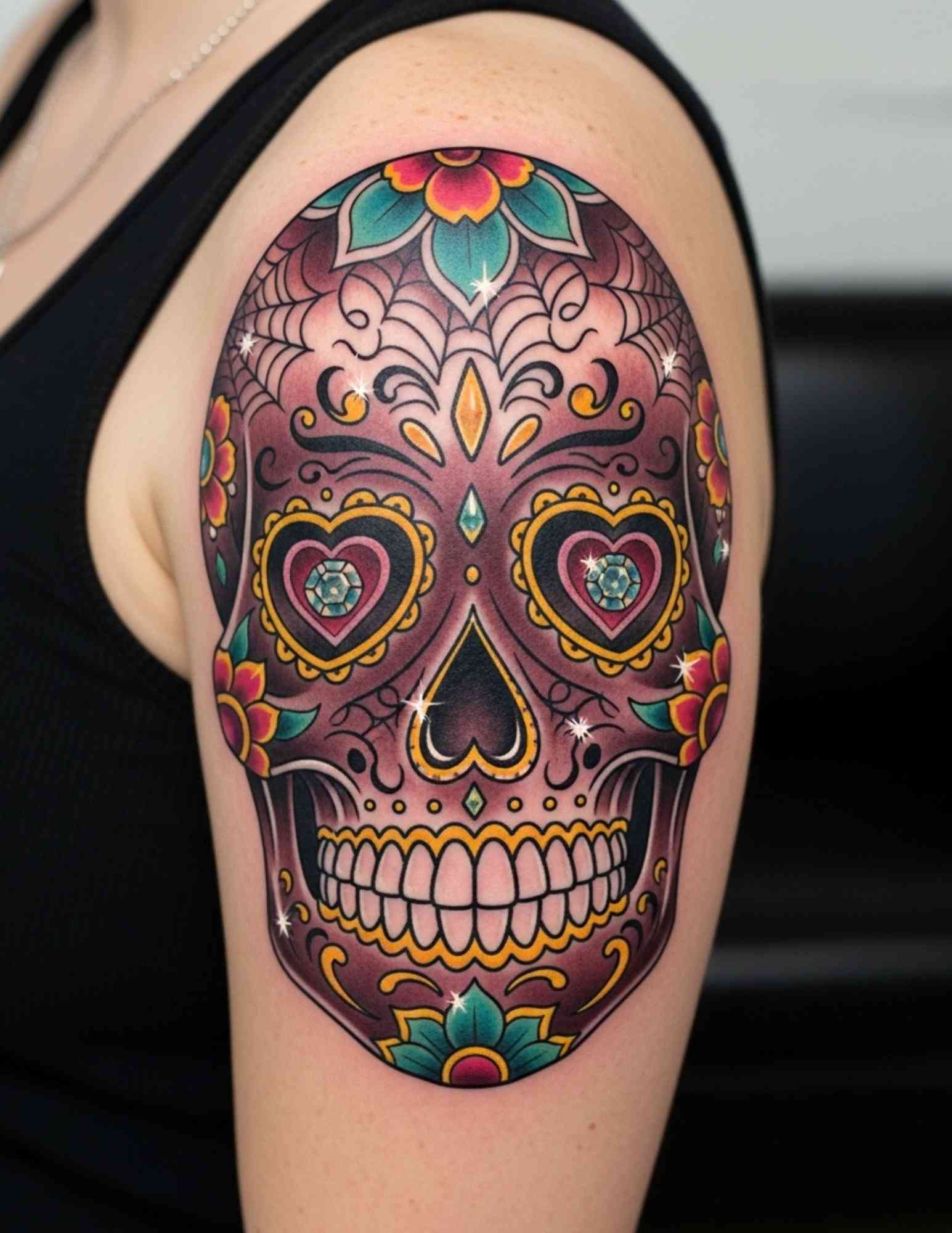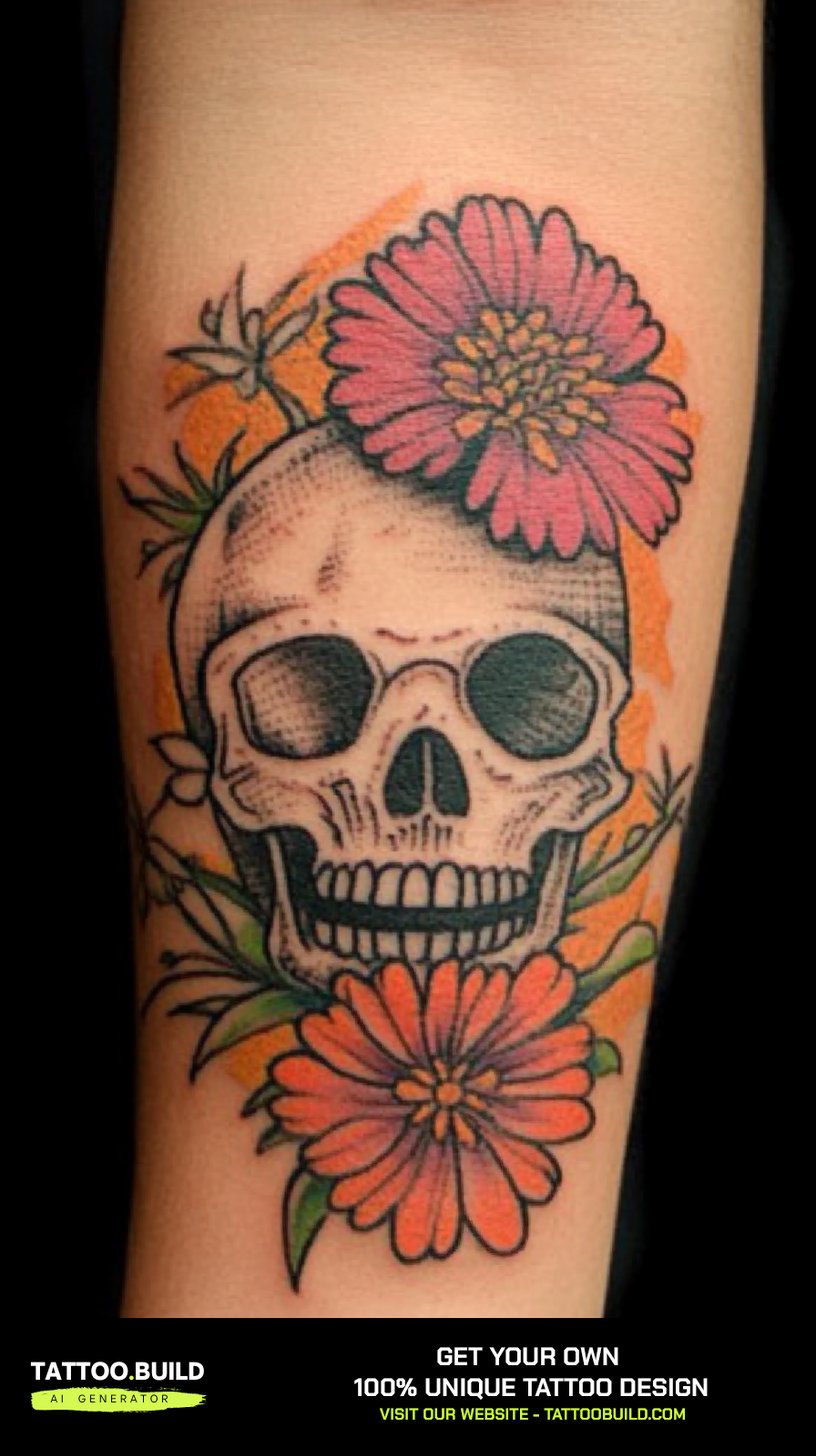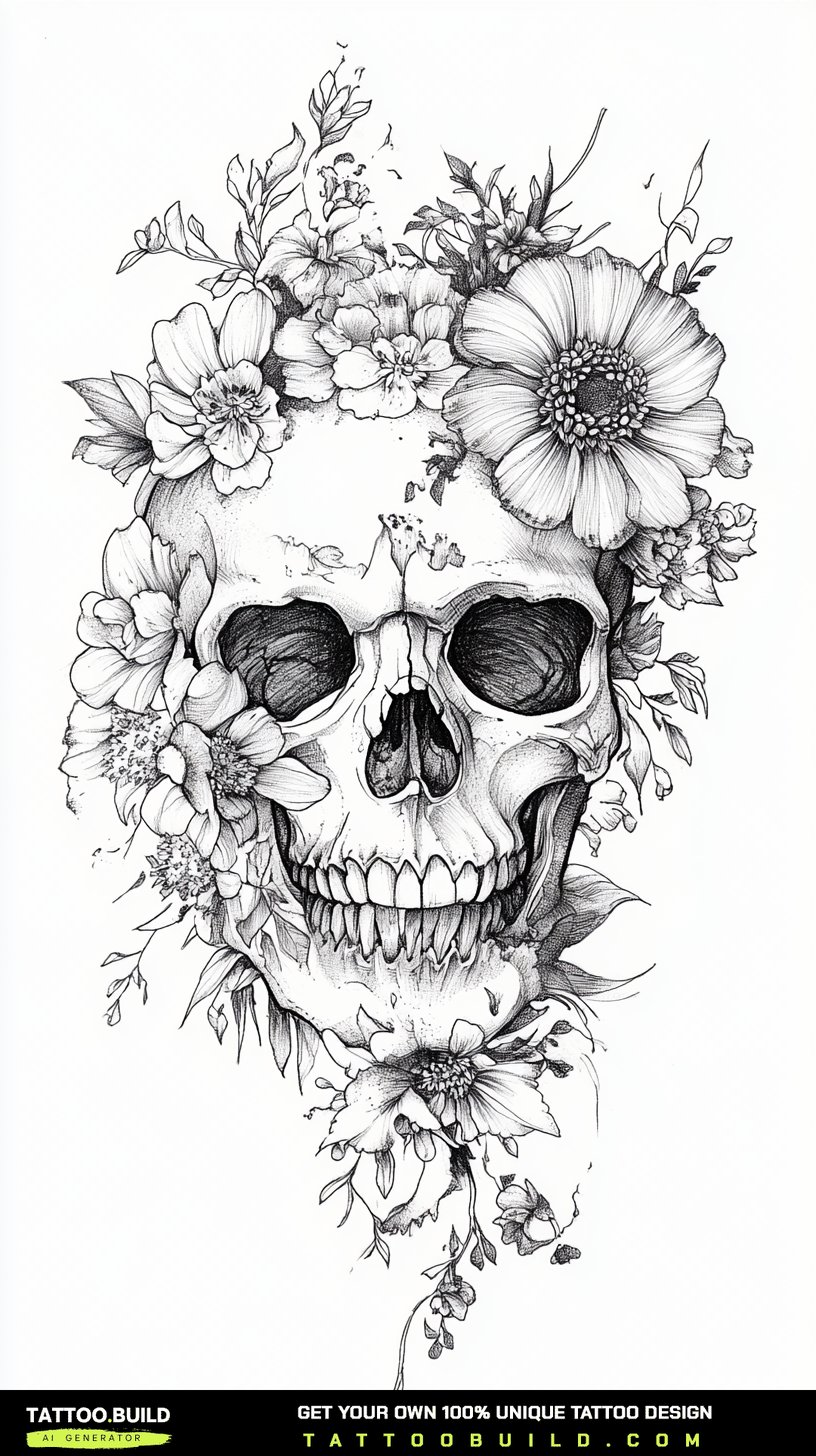
I have been collecting skull tattoo drawings for years, and the thing that surprised me most is how few of them actually work on skin. A skull drawing only becomes a good tattoo when the eye sockets, the cheekbone shadow and the jawline are strong enough to survive being shrunk, stretched and softened by ten years of healing.
Everything below is drawn art rather than healed photographs, which is exactly what you want when you walk into a consultation. A drawing shows the artist the composition you are after without dictating how they should tattoo it.
I have grouped these 31 skull tattoo drawings by theme instead of numbering them one to thirty-one, because in my experience people arrive already knowing whether they want flowers, snakes, smoke or plain bone. If flowers are where you are leaning, the wider gallery of skull and flower tattoos is a useful companion to this page.
Screenshot the ones you like, note what you like about each, and bring the whole set. Artists work far better from three references and a sentence than from one image and a request to copy it.
Which Skull Tattoo Style Is Right for You?
Style matters more than subject here. The same skull drawn in five different styles ages five different ways.
| Style | Best Placement | Smallest Size That Works | How It Ages |
|---|---|---|---|
| Fine-line botanical | Forearm, thigh, calf | About 5 in / 13 cm tall | Softens noticeably; usually wants a touch-up around year five |
| Neo-traditional | Upper arm, shoulder, thigh | About 4 in / 10 cm tall | Very well — bold outlines hold the shape as detail fades |
| Blackwork / tribal | Outer arm, calf, back | About 3 in / 8 cm tall | The most forgiving option; solid black stays readable longest |
| Black and grey realism | Forearm, chest, back | About 6 in / 15 cm tall | Grey wash lightens over time; needs an experienced artist |
| Ornamental / dotwork | Sternum, spine, forearm | About 5 in / 13 cm tall | Dots can merge if placed too tightly; spacing is everything |
| Colour (sugar skull, florals) | Thigh, upper arm, back | About 5 in / 13 cm tall | Depends heavily on sun exposure; reds and yellows fade first |
What Actually Makes a Skull Drawing Work as a Tattoo
The first thing I look at in any skull drawing is the eye sockets. If they are drawn as flat black holes, the skull tends to look like a sticker once it is on skin.
Good sockets have an inner edge, a shadow that falls away from the brow, and a small amount of reflected light at the bottom. That is what gives the skull depth from three feet away.
The second thing is the cheekbone. The zygomatic arch is the widest point of the human skull, and drawings that flatten it end up reading as a generic Halloween shape rather than anatomy.
Third is contrast range. A drawing that uses pure white paper, mid-grey and solid black will translate; a drawing built entirely from mid-greys will not. Skin has no white, so the artist has to borrow your natural tone as the highlight.
Every artist I have asked about this says the same thing in different words — leave them room. A drawing that fills every square millimetre gives the tattooer nowhere to put the negative space that makes the piece breathe.
31 Skull Tattoo Drawings, Grouped by Theme
These are the drawings themselves. Each group below covers a different direction you can take the same basic subject.
Floral Skulls and Botanical Overgrowth
Flowers growing through bone is the single most requested skull variation I come across, and it is popular for a reason — it puts two opposite ideas in one image.
The drawings in this group all handle the overlap differently. Some let the blooms sit behind the skull, some push stems through the eye sockets, and one wraps a complete ring of flowers around the outside.
When I tested these as stencils at roughly forearm size, the versions with flowers behind the skull held up best. Petals crossing over bone tend to blur the silhouette once the linework softens.
If you want to understand what this pairing is usually taken to mean before you commit, the guide to flower and skull tattoo meaning covers the symbolism properly.
Skull-and-Rose Combinations
Roses and skulls have been tattooed together since the early days of American traditional flash, and the pairing has never really gone out of rotation.
A rose gives the composition a second focal point and a natural place to put warmth if you ever want colour added later. It also fills space efficiently, which matters on a forearm.
In my experience the mistake people make is asking for too many roses. Two well-drawn blooms beat five crowded ones every time, especially under 6 inches.
There are far more of these than I could fit here — the dedicated collection of rose and skull tattoo ideas is worth a look if this is your direction.
Snake-and-Skull Drawings
A serpent threading through an eye socket is one of the few compositions that genuinely improves a skull rather than just decorating it.
The snake gives you a flowing line to follow, which solves the biggest problem with skull tattoos — a skull on its own is a static, symmetrical lump that does not wrap around a limb well.
When I have seen these done at full sleeve scale, the artist usually extends the snake body well past the drawing to follow the arm. Expect your artist to redraw the tail entirely.
If the serpent is what is drawing you in, the broader set of snake tattoo ideas shows how the same body shape gets used without a skull attached.
Fire, Smoke and Movement
Flames and smoke are the traditional answer to the same static-shape problem, and they cover a lot of skin for relatively little time in the chair.
Smoke in particular is forgiving. It has no fixed correct shape, so the artist can adjust it live to fit your anatomy without anyone being able to tell it changed.
The trade-off is that light, wispy smoke fades faster than anything else in a black and grey piece. Ask for the smoke to be built with visible edges rather than pure soft shading if you want it to last.
Mushrooms, Leaves and Woodland Decay
This is the newer direction of the group, and it has grown a lot over the past few years. Instead of flowers, the skull is being reclaimed by fungi, moss and leaf litter.
It reads quieter than a rose-and-skull piece and tends to suit people who want the memento mori idea without the classic biker-flash associations. The memento mori tradition in Western art is the same instinct, several centuries earlier.
One practical note from watching these get tattooed: mushroom caps need a solid dark underside to read correctly. A cap drawn as an outline alone tends to disappear into the skin.
Blackwork, Tribal and Heavy-Contrast Skulls
If you want a tattoo that will still be perfectly legible in twenty years, this is the group to look at. Solid black holds its edge better than any other approach.
Bold blackwork also handles small sizes far better. A tribal skull at 3 inches still reads; a realism skull at 3 inches becomes a grey smudge within a decade.
The cost is flexibility — solid black is very difficult to cover or rework later, so this is a style to be sure about. Most of the pieces in the skull tattoo ideas for men collection lean this way.
Soft and Ornamental Skulls
Bows, crowns, filigree and dotwork turn the skull into something closer to jewellery than a warning.
These sit beautifully on a sternum, a spine or the inside of a forearm, where the symmetry of the design can line up with the symmetry of the body.
In my experience ornamental skulls need the most size of any group here. The detail that makes them work is exactly the detail that closes up first when a tattoo is placed too small. The same is true of sugar skull tattoo ideas, which share the decorative approach.
Sketchbook Studies and Shading Practice
Not every drawing here is meant to be tattooed as-is. These three are studies — useful if you are learning to draw skulls yourself, or if you want to show an artist the shading depth you are after.
If you are drawing along, start with the socket and cheekbone and leave the teeth until last. Teeth are the part everyone rushes and the part that most obviously looks wrong.
Keep the light source consistent. A skull drawn with light from the upper left and shadows from the lower left is the most common tell of a beginner drawing, and it is fixable in about ten minutes of attention.
Small Flash and Sleeve Filler Skulls
These are the compact designs — the kind an artist reaches for to fill a gap between larger pieces, or the kind that works as a standalone first tattoo.
Filler skulls need to be simpler than you think. Anything under about 2.5 inches should be outline and one shadow value, nothing more.
I have watched artists redraw a customer-supplied small skull three times before tattooing it, purely to remove detail. That is normal, and it is the artist doing you a favour.
Variations Worth Considering Before You Book
The drawings above are a starting point. These are the adjustments that come up most often once someone is actually sitting in the consultation.
Swapping the Skull Species
A human skull is not the only option. Ram, bull, deer and bear skulls carry different associations and all have stronger horizontal lines, which sit better on a chest or shoulder.
Animal skulls also tend to need less internal detail, which makes them a safer choice at smaller sizes.
Adding a Second Object
A dagger, a clock, a moth or a candle gives the composition a vertical axis and stops the skull from floating. The skull with dagger tattoo meaning guide covers the most traditional of those pairings.
One added object is usually the limit under 8 inches. Two objects and a skull almost always needs a half sleeve to work.
Colour Versus Black and Grey
Every drawing on this page is black and grey, but most of them can be adapted. Flowers are the easiest element to colour; the skull itself is usually best left in greyscale so it does not compete.
If you are set on colour, know that it needs more aftercare protection from sun exposure than black and grey does, and that touch-ups are more likely down the line.
Hybrid Subjects
Butterfly wings, moth bodies and floral crowns merged into the skull shape itself are increasingly common, and they suit people who want the shape without the starkness. The butterfly skull tattoo meaning breakdown explains where that particular hybrid comes from.
Hybrids are harder to draw than they look, because both halves have to stay recognisable. Ask to see healed examples, not just fresh ones.
Turning a Drawing Into a Tattoo That Ages Well
Bring at least three references rather than one. Three images let the artist see what is consistent about your taste; one image only tells them to copy.
Ask your artist to size the stencil on your body before any needle touches skin, and look at it in a mirror from across the room. Skull tattoos are viewed from conversational distance far more often than from arm’s length.
Expect to be told your drawing needs simplifying. In my experience the single best predictor of a skull tattoo that still looks good in a decade is how much detail the artist removed before starting.
For healing, follow the aftercare your artist gives you rather than anything you read online, including this page — their instructions match their technique and their ink. If you notice spreading redness, heat, swelling that worsens after day three, or any discharge, contact your artist and see a doctor. The Mayo Clinic’s overview of tattoo risks is a reasonable plain-language summary of what can go wrong, and the FDA’s consumer guidance on tattoo inks covers reactions to pigment specifically. Nothing here is medical advice.
Common Mistakes — and What to Do If You Are Still Not Sure
The most common mistake is going too small. A skull needs enough room for the socket shadow to exist as its own shape, and that is usually more space than people expect.
The second is choosing an artist by price rather than portfolio. Black and grey shading is a specific skill, and a portfolio full of fine-line script tells you very little about how someone handles a skull.
The third is bringing a drawing and refusing to let it change. A drawing is flat paper; your arm is a cylinder. Something has to give.
If none of the drawings above have clicked yet, try widening the search rather than narrowing it. The gothic tattoo drawings collection covers the same mood with different subjects, and grim reaper tattoo ideas push further into the same territory if you want something with more narrative to it.
Frequently Asked Questions
How big does a skull tattoo need to be?
For a detailed black and grey skull, plan on roughly 5 to 6 inches (13 to 15 cm) tall as a practical minimum. Bold blackwork and simplified designs can work down to around 3 inches. Below that, the eye socket shadow and the cheekbone edge start to merge, and within a few years the piece reads as a dark blob rather than a skull. Your artist will usually tell you honestly if a design is too small for the detail you want.
Do skull tattoos hurt more than other designs?
The design itself does not change how much it hurts — placement and shading time do. Skull tattoos often involve a lot of solid black and packed grey wash, which means longer sessions and more repeated passes over the same area than a line-only design. Bony placements like the sternum, ribs, elbow and ankle are consistently reported as more painful than fleshy ones. If pain is a concern, ask about splitting the work across two shorter sessions.
Are skull tattoos considered negative or unlucky?
In most Western contexts a skull tattoo is read as a memento mori — a reminder that life is finite — rather than as something threatening. In Mexican tradition, the decorated calavera associated with Día de los Muertos is celebratory and tied to remembering the dead. Interpretations do vary by culture and by individual, so it is worth knowing what the design means in your own context. Nobody can tell you what it will mean to you.
Can a skull tattoo be covered up or reworked later?
Usually yes, but it depends on how much solid black is in the original. Line-based and grey-wash skulls are relatively straightforward to rework, often by adding flowers or smoke around the existing shape. Heavy blackwork and tribal skulls are the hardest to cover and may need laser lightening first. Ask a cover-up specialist rather than assuming — they will tell you quickly whether it is realistic.
Should I bring one of these drawings to my artist or ask for something original?
Bring them as references, not as a copy request. Most reputable artists will not tattoo another artist’s drawing line for line, and the ones who will are often the ones you want to avoid. Showing three or four drawings you like, plus a sentence about what appeals to you in each, gives your artist everything they need to draw something original that still lands where you wanted. In my experience that conversation takes about ten minutes and improves the result enormously.
Quick Summary
- Judge a skull drawing by its eye sockets, cheekbone and contrast range — not by how detailed it looks on paper.
- Bold blackwork ages best; fine-line and grey-wash realism need more size and more upkeep.
- Flowers, snakes and smoke all solve the same problem: a bare skull is static and does not wrap a limb well.
- Plan on about 5–6 inches for a detailed black and grey skull, and about 3 inches for simplified blackwork.
- Bring three or four references rather than one image, and expect your artist to simplify the design.
- Colour works best on the surrounding elements; leave the skull itself in greyscale so it stays the focal point.
- Follow your artist’s aftercare instructions, and see a doctor for any sign of infection rather than self-treating.