I have been looking at snake tattoos in shop portfolios for years, and I still think they are the single most versatile subject in the medium. A snake fits the human body better than almost any other image, because its shape is defined by the surface it wraps around rather than by a fixed outline.
That flexibility is why the same animal shows up as a delicate ankle wrap on one person and a full Japanese back panel on another. The subject scales in a way that a portrait or a landscape simply cannot.
The symbolism stretches just as far. Depending on the tradition, a snake stands for danger, healing, protection, fertility, or rebirth — and if you want the deeper history, we cover it separately in our guide to snake tattoo meaning.
Below are 20 snake tattoo ideas across every style and scale, with notes on what each one actually costs you in placement, healing, and long-term ageing. I have added the honest downsides too, because most idea lists leave those out.
Which Snake Tattoo Style Is Right for You?
Style choice affects far more than looks. It changes how long the session runs, how much the piece hurts, and how it will read in fifteen years.
This is the rough shape of the trade-offs as I have seen them play out across shops in different countries. Treat it as a starting point for a conversation with your artist, not a price list.
| Style | Typical scale | Session length | How it ages | Best for |
|---|---|---|---|---|
| American traditional | Palm to forearm | 2–4 hours | Excellent — bold lines hold | A first snake tattoo you want to keep sharp |
| Japanese (irezumi) | Thigh, back, full sleeve | Multiple full days | Excellent when done at scale | Long-term, large-format commitment |
| Fine line | Wrist, ankle, ribs | 1–2 hours | Softens; may need a touch-up | Subtle, discreet placements |
| Blackwork | Forearm to full limb | 3–6 hours | Very well — solid black is stable | High contrast with no colour fade |
| Dotwork | Forearm, calf, shoulder | 3–5 hours | Good, though dots can blur slightly | Texture without heavy solid fill |
| Watercolour | Shoulder, thigh | 2–4 hours | Weakest of the group; plan touch-ups | People who want colour movement |
| Neo-traditional | Upper arm, thigh | 4–6 hours | Strong — outlines carry the design | Detail and colour with structure |
Why the Snake Works So Well as a Tattoo Subject
The snake’s body is essentially a long curve with a head at one end. That gives an artist enormous freedom to route the design around a bicep, down a spine, or along the line of a calf muscle.
A well-designed snake follows your anatomy rather than sitting on top of it. When I look at a snake piece that feels flat, the cause is almost always that the flow was drawn on paper and then transferred without adjusting for the body underneath.
Meaning is the second reason. Western tradition inherited the serpent as a figure of temptation and deceit, while Japanese tattooing treats the snake as a protector that wards off illness and misfortune.
Greek medicine gave us the rod of Asclepius, the single snake-wrapped staff still used as a medical emblem, and alchemy gave us the ouroboros as a symbol of cyclical renewal. Britannica’s entry on the ouroboros traces that lineage back to ancient Egypt.
Practically speaking, the snake is also forgiving. Because the body is elongated, an artist can extend or shorten it during the stencil stage to fit your limb, which is not something you can do with a face or a clock.
20 Snake Tattoo Ideas
Each of these is a different answer to the same question: what do you want the snake to be doing on your body?
1. Traditional Coiled Snake
American traditional treats the snake as a subject built for it: thick outlines, a deliberately limited palette, and a flat graphic quality that survives ageing better than almost anything else.
A coiled snake with the hood slightly raised reads as threatening without tipping into cartoon. The tension comes from the pose, not from detail.
If you want a snake tattoo you will still recognise in twenty years, this is the safest choice on the list. Bold lines and simple colour blocks do not soften into ambiguity the way fine work does.
Photo: @sonofthegarden
2. Ouroboros
A snake consuming its own tail is one of the oldest symbols we have, appearing in Egyptian funerary texts, Norse myth, and later European alchemy.
It stands for eternity and cyclical time — the notion that endings feed beginnings. People often choose it after a period of genuine change rather than as a general aesthetic pick.
As a tattoo it forms a natural circle, which makes it geometrically ideal for shoulders, thighs, and the outer upper arm. Every artist I have asked about it says the hardest part is keeping the circle true on a curved surface.
Photo: @kattystrophic
3. Japanese Snake With Cherry Blossoms
In Japanese tattooing the snake, or hebi, is a guardian figure associated with protection, recovery from illness, and good fortune. That is close to the opposite of its Western reputation.
Pairing it with cherry blossoms sets permanence against impermanence, and the contrast is the whole point of the composition.
These are large-format pieces by design. They want a thigh, an upper arm, or a back panel, because the style needs room for the scale work, the florals, and the negative space that separates them.
Photo: @juliustattoo_
4. Fine Line Minimalist Snake
Strip a snake down to one continuous line and it still reads instantly. The silhouette is distinctive enough to carry a design with no shading, fill, or interior detail.
This works beautifully on forearms, inner wrists, and ankles, where a heavier piece would feel out of proportion.
The honest caveat: fine line ages less predictably than bold work. Thin lines spread slightly as skin changes, so budget for a touch-up somewhere in the five to ten year range and choose an artist who specialises in the technique.
Photo: @gingiepop
5. Snake and Skull
A snake threaded through a skull is one of the most established combinations in Western flash, and it still works because the two shapes interlock so naturally.
The skull supplies a hard geometric anchor; the snake supplies movement around it. Without the skull, a snake alone can float on the skin with nothing to push against.
Symbolically it reads as life continuing through death rather than as pure menace. That reading is worth knowing before someone assumes it is only about danger.
Photo: @jamie_95_tattoos
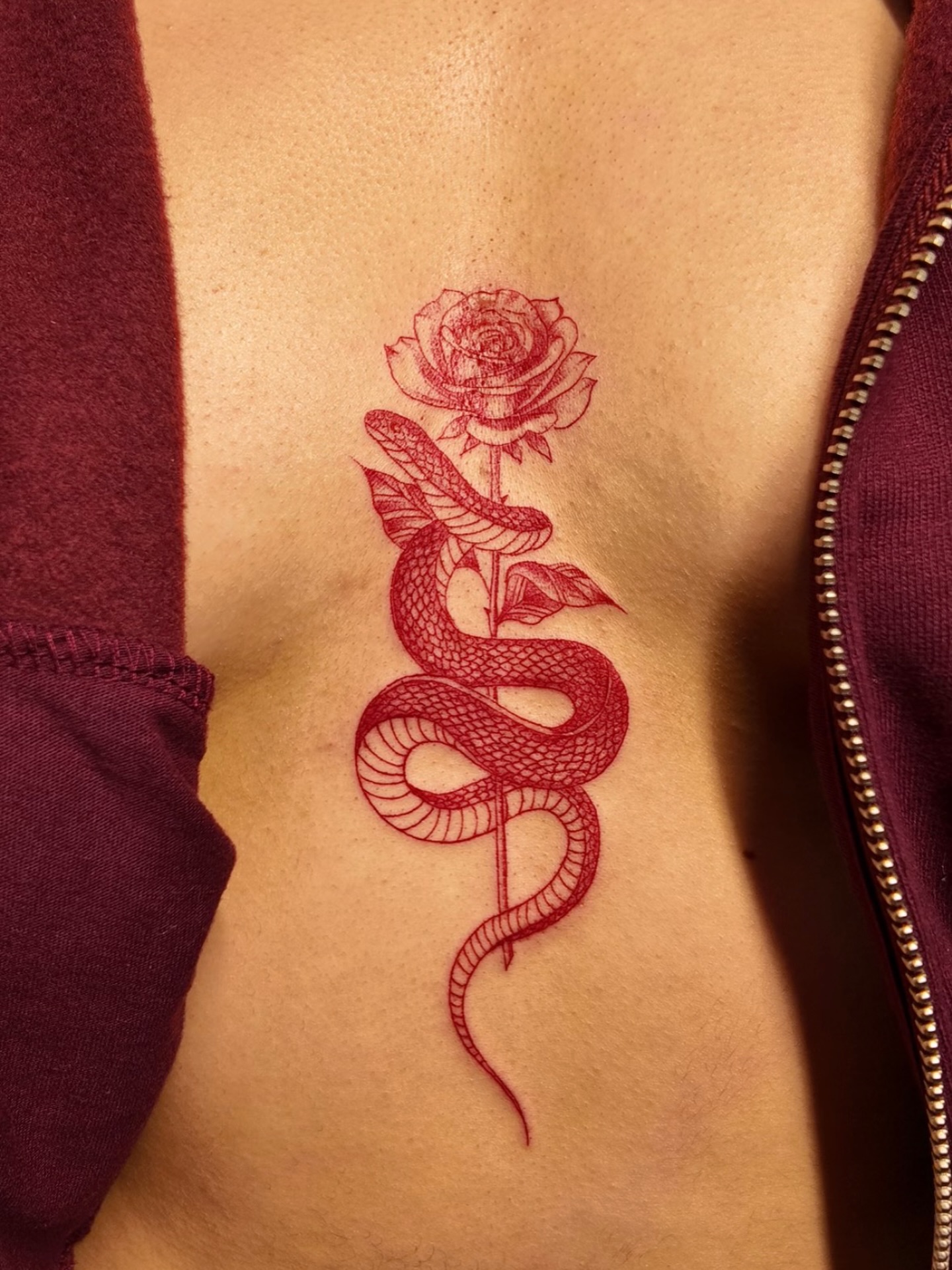
6. Snake Through a Rose
Roses give a snake something soft to move against, and the contrast between petal and scale is what makes the composition hold together.
It is a flexible pairing: one rose and a short snake fits a forearm, while three roses and a longer body will fill a thigh comfortably.
If this is the direction you are leaning, we have a dedicated collection of rose and snake tattoo ideas with more layouts than I can fit here.
Photo: @zig_tattoos
7. Medusa Snake Hair
Medusa has been reinterpreted heavily in recent years, moving from monster to a figure of survival and reclaimed power. That shift is why the design has become so common.
It is a demanding tattoo. You are asking for a portrait and a dozen small snakes in one composition, so it needs an artist comfortable with both.
Ask to see finished, healed Medusa work specifically — fresh photos hide how the fine snake detail settles once the skin recovers.
Photo: @seeshelbytattoo
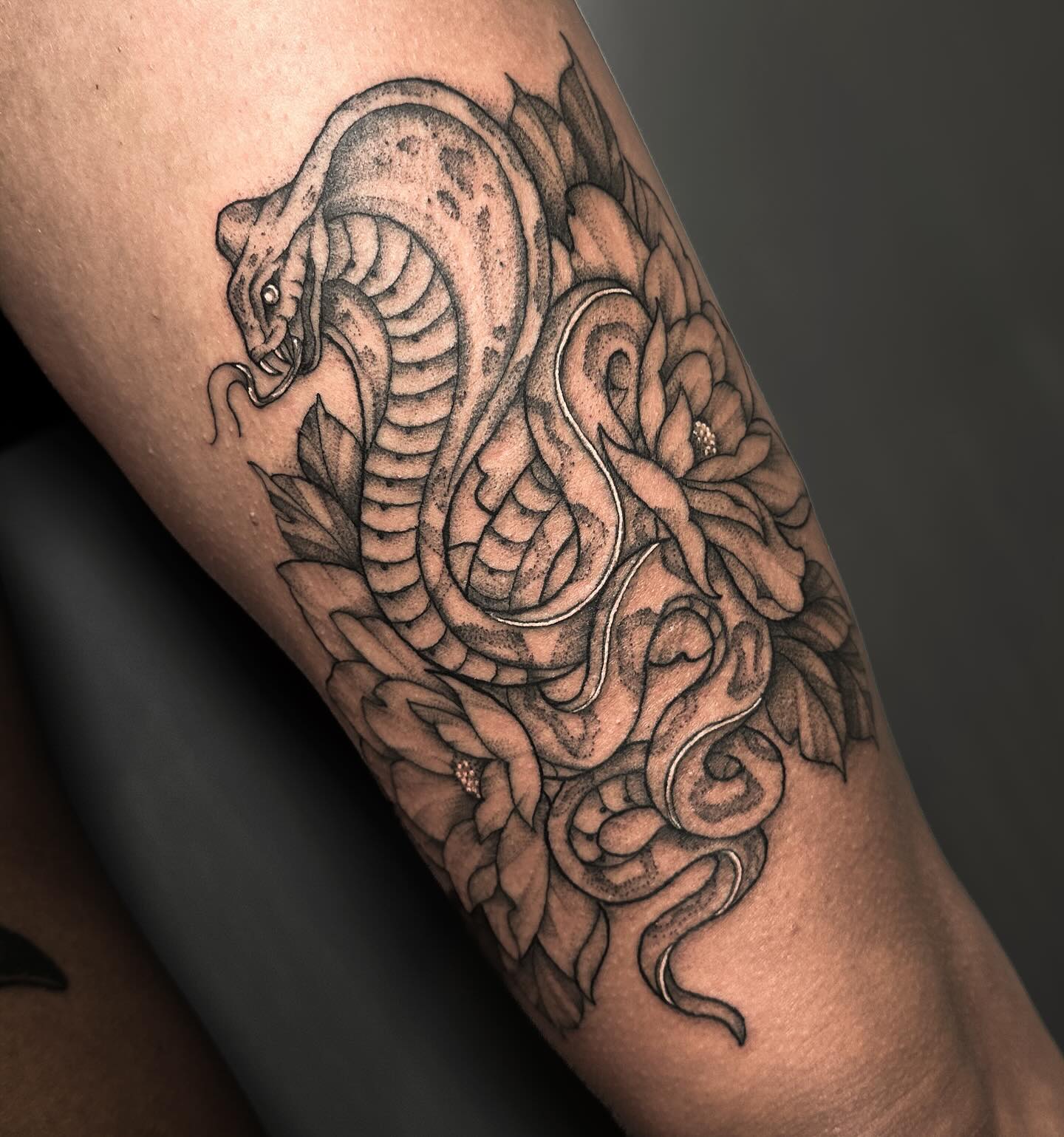
8. Dotwork Snake Coil
Dotwork builds tone from thousands of individual points instead of solid fill, which suits scales almost too well — the texture of the technique matches the texture of the subject.
Expect a longer session than a comparable blackwork piece, because stippling is slow by nature and cannot be rushed without the tone going patchy.
The style holds up reasonably over time, though dots do soften slightly. Our overview of dotwork tattoo ideas goes into the technique in more depth.
Photo: @chrisgosbeeart
9. Two-Headed Snake
Two heads on one body gives you built-in symmetry, which is why this design sits so well on a sternum, a spine, or the centre of a back.
The usual reading is internal conflict: two impulses sharing one life. People who pick it tend to have a specific version of that in mind.
Design-wise, the interesting problem is the neck. Where the two bodies separate is the visual focus, and a good artist will spend real time on that junction.
Photo: @dreamingofaliens
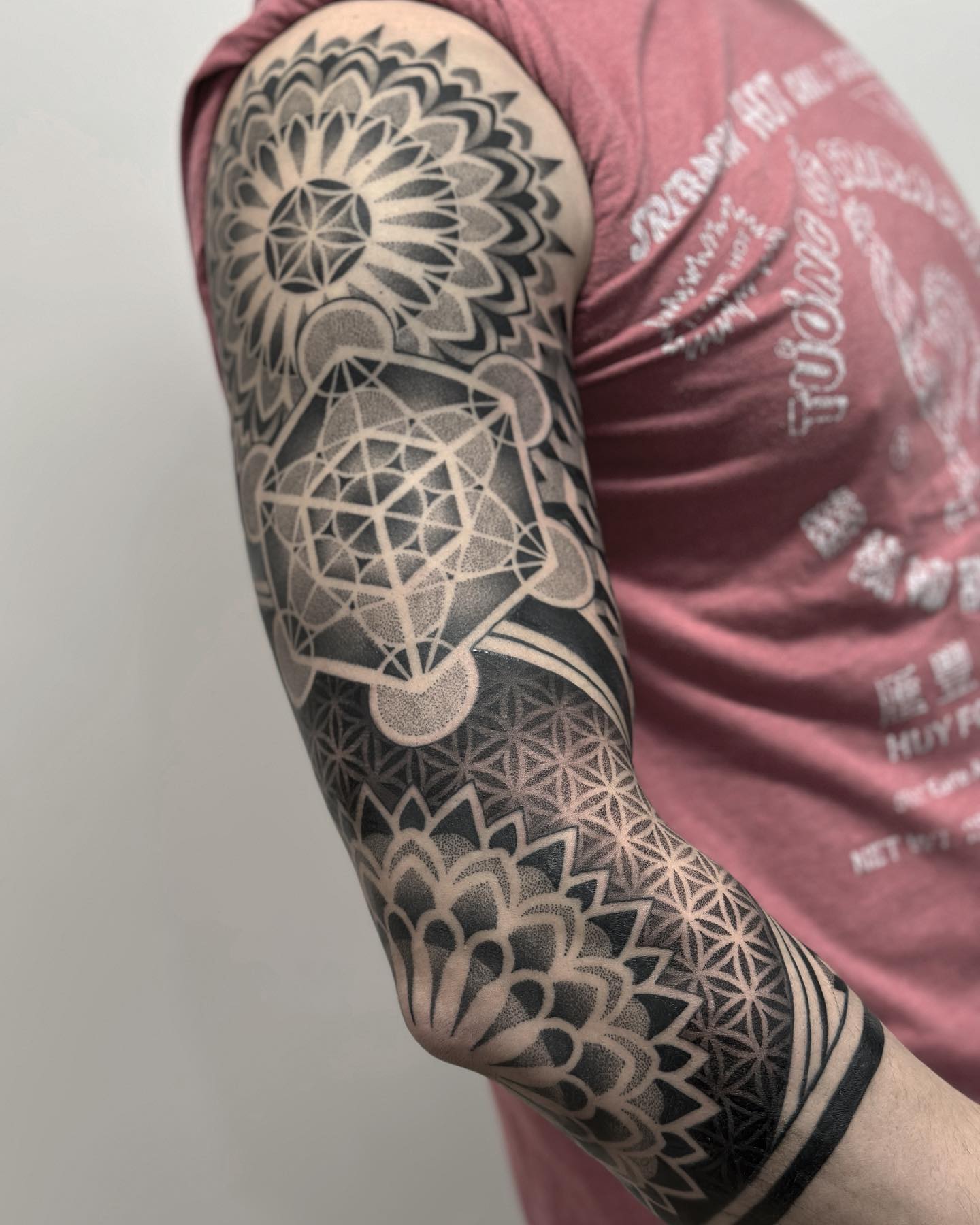
10. Geometric Snake
Setting an organic form inside hard geometry — triangles, arcs, mandala segments — creates a deliberate clash, and that clash is the design.
The precision cuts both ways. Straight lines and true circles show every wobble, so this style demands an artist with genuinely steady linework.
It sits best on flat-ish areas: outer forearm, calf, upper back. Wrapping strict geometry around a heavily curved surface tends to distort it.
Photo: @siarnthecatwitch
11. Cobra Hood Spread
A cobra with the hood fully spread is the most immediately readable snake pose there is. Nobody has to work out what they are looking at.
The hood also functions as a canvas within the tattoo — artists frequently fill it with ornamental patterning, mandala work, or an eye motif.
Because the hood is wide and the body is narrow, this design suits a chest, an upper back, or the front of a thigh better than a slim forearm.
Photo: @celebrityinktattookutabali
12. Snake Spine Tattoo
A snake running the full length of the spine is one of the best matches of subject to placement in tattooing, because the body already provides the line.
Be honest with yourself about the pain. The spine sits directly over bone with very little tissue between needle and vertebrae, and most people describe it as sharp rather than dull.
Sessions are usually broken into several sittings for that reason. Our guide to spine tattoo ideas covers what to expect from the placement itself.
Photo: @loe.tattoo
13. Snake and Dagger
A snake coiled around a blade is a piece of traditional flash that has never gone out of rotation, and the reason is proportion — the vertical dagger fits a forearm almost perfectly.
The traditional reading is protection through vigilance, or a warning about the cost of it. Both are defensible.
It works in almost any style. I have seen it as flat traditional, as heavy blackwork, and as delicate fine line, and all three hold.
Photo: @cobracustomtattoo
14. Simple Ankle Snake Wrap
A snake wrapping the ankle behaves like jewellery: visible when you want it, hidden under a sock or boot when you do not.
Keep the design simple here. There is limited surface area and the skin over the ankle bone moves constantly, so intricate interior detail rarely survives well.
Ankle skin is thin and sits close to bone, so expect it to be sharper than a forearm. The session is short, which helps.
Photo: @otautahitattooqueenstown
15. Snake and Moon
A crescent moon gives the snake a curve to echo, and the two shapes frame each other without either one competing.
The pairing leans toward cycles, intuition, and renewal rather than danger, which makes it a common pick for people who want the snake without the menace.
It is a compact design. A moon and a modest snake fit an inner forearm, a shoulder blade, or the back of a calf without needing to be scaled up.
Photo: @niaink
16. Watercolour Snake
Watercolour treats colour as though it were bleeding past the linework, and on a snake that reads as movement rather than as a mistake.
I will be straight about the trade-off: watercolour is the least durable approach here. Soft, unbounded colour fades faster than colour held inside a strong outline.
Artists who work in the style often anchor it with at least a partial black outline for exactly this reason. If yours suggests that, it is good advice rather than a compromise.
Photo: @heeyajenny
17. Blackwork Snake Sleeve Element
In a sleeve, a snake is one of the most useful shapes available because it can travel between other elements and tie them together.
Rendered in heavy blackwork, it becomes the structural spine of the composition — the thing the eye follows from wrist to shoulder.
Solid black is also the most stable ink over time, which is why so many long-term collectors build around it. See our blackwork tattoo designs for more on how the style behaves.
18. Neo-Traditional Snake Portrait
Neo-traditional keeps the bold outline of American traditional but adds depth, a wider colour range, and decorative framing.
On a snake that means visible scale texture, real dimensionality in the coils, and often an ornamental border or floral surround.
It costs more hours than flat traditional and ages nearly as well, because the outline is still doing the structural work underneath all the detail.
Photo: @inkanddaggertattoo
19. Snake Ribcage Piece
The ribs already curve, so a snake laid along them needs very little forcing. The anatomy supplies the composition for free.
It is also, by most accounts, among the more painful placements — thin skin, bone directly underneath, and the constant movement of breathing. Our list of the most painful tattoo spots puts it near the top for good reason.
Plan for shorter sittings than you would elsewhere. Very few people sit a full day on ribs comfortably, and pushing through it tends to hurt the quality of the work.
Photo: @phiawalla
20. Small Snake Behind the Ear
Tiny, specific, and semi-hidden. A small snake curving behind the ear is the kind of tattoo you show deliberately rather than by default.
Keep it simple. There is very little space, and even moderately fine lines will soften and close up over time in an area this small.
A clean bold outline with no interior detail will hold far longer and stay readable. This is one case where restraint is not an aesthetic preference but a technical necessity.
Photo: @linettearmstrong
Variations Worth Considering
If none of the twenty is quite it, these adjustments change the character of a snake tattoo without starting over.
Change the Species, Not the Style
A viper, a python, and a coral snake produce completely different silhouettes and patterns. Naming a real species gives your artist reference material and usually produces a more convincing result than a generic snake.
Add a Second Subject
Snakes are natural companions to florals, blades, moons, hands, and eyes. A second element gives the composition somewhere to resolve instead of simply trailing off.
Go Negative Space
Rather than tattooing the snake, some artists tattoo the area around it and let untouched skin form the body. It is a striking effect on a solid black background, but it is unforgiving of imprecision.
Colour the Eye Only
A single spot of colour in an otherwise black and grey snake pulls the whole design toward the head. It is a small decision with a large effect, and it adds very little time to the session.
Aftercare and Practical Advice
The most common way a good snake tattoo goes wrong is healing, not tattooing. Long, wrapping designs cross more skin types and more movement than a compact piece, so they need a bit more attention.
Follow the specific instructions your artist gives you rather than anything you read online, including this page. If you want a general picture of the timeline, our guide to the tattoo healing stages walks through what is normal week by week.
Keep it clean, keep it lightly moisturised, and keep it out of direct sun while it heals. The US Food and Drug Administration also notes that reactions to tattoo inks can appear well after healing, so it is worth knowing what to watch for.
If you develop spreading redness, increasing pain after the first few days, swelling, discharge, or a fever, that is a matter for a doctor and not for your artist or a forum. Infections are uncommon with a licensed studio, but they are treatable and treating them early matters.
Still Not Sure? Common Mistakes to Avoid
The mistake I see most often is choosing a size that does not fit the level of detail requested. A snake with individually rendered scales needs room; shrunk to two inches, those scales become a grey smudge within a few years.
The second is booking on style rather than on subject. Plenty of excellent artists have never tattooed a snake, and it shows in the way the body moves.
The third is skipping the placement conversation. Where the snake sits determines how it flows, and that is worth deciding with your artist rather than before you walk in. If you are still weighing options, our collections of snake tattoo ideas for women and snake tattoo designs for men show how the same subject shifts across placements.
And do not rush the artist search. Reviewing healed portfolio work is the single highest-value thing you can do, and our guide on how to find a tattoo artist explains what to look for.
Frequently Asked Questions
What does a snake tattoo symbolise?
It depends entirely on the tradition you draw from. In Western and Judeo-Christian imagery the snake is associated with temptation and danger, while Japanese tattooing treats it as a protective figure linked to healing and good fortune. Greek medicine gave us the snake-wrapped rod of Asclepius, and alchemy gave us the ouroboros as a symbol of renewal. In my experience most people choose the meaning first and then find a style that carries it.
Do snake tattoos hurt more than other designs?
The design does not determine the pain — the placement does. A snake on the outer forearm or calf is usually manageable for most people, while ribs, spine, sternum and the area behind the ear tend to be sharper because the skin is thin and bone sits close underneath. Because snakes are often long and wrapping, they can also cross several sensitivity zones in one sitting. Ask your artist to plan the session breaks around that.
How much does a snake tattoo cost?
Shops price by hour or by piece, and rates vary enormously by city, artist demand and experience, so any figure I gave you would be misleading. What is reliable is the relationship: a small fine line snake is usually one short session, a detailed neo-traditional or Japanese piece is several long ones. Ask for a written estimate at consultation, and expect a deposit that comes off the final total.
Which snake tattoo style ages the best?
American traditional and blackwork hold up best in most cases, because bold outlines and solid black are the most stable marks in the skin over decades. Neo-traditional does well for the same reason — the outline carries the structure even as the interior colour softens. Fine line and watercolour are the most likely to need touch-ups. None of this means you should avoid the softer styles, only that you should budget for maintenance.
Can a snake tattoo be covered up or extended later?
Snakes are one of the easier subjects to extend, because the body can simply keep going into a new section of skin. That makes them popular as the first element of a sleeve. Using a snake to cover an existing tattoo is more situational — it can work well because the winding body hides straight lines effectively, but whether it will work on your specific piece is a question for an artist who specialises in cover-ups.
Quick Summary
- A snake fits the human body better than most subjects because its shape adapts to the surface it wraps around.
- Meaning varies by tradition — danger in Western imagery, protection in Japanese tattooing, renewal in the ouroboros.
- American traditional and blackwork are the most durable styles; fine line and watercolour need touch-ups.
- Placement drives pain far more than the design does — ribs, spine and behind the ear are the sharpest here.
- Match the size to the detail you want; small snakes with fine scales blur within a few years.
- Book an artist who has tattooed snakes before, and review healed work rather than fresh photos.
- Snakes extend easily, which makes them a strong first element for a future sleeve.
- Follow your artist’s aftercare instructions, and see a doctor for spreading redness, discharge or fever.