The snake is the most symbolically loaded animal in all of tattooing, and that is exactly why so many people get stuck before they book the appointment. A snake tattoo does not carry one fixed meaning — it carries whichever meaning the design, the culture it borrows from, and the elements around it point toward.
In Western and Judeo-Christian imagery the serpent reads as temptation and danger. In Greek tradition it reads as medicine and healing. In Japanese tattooing it reads as protection and good fortune. In Hindu cosmology it holds creation and destruction at the same time.
I have spent a lot of time going through snake pieces with artists and with people wearing them, and the pattern is consistent: the ones who love their tattoo years later are the ones who decided what the snake meant to them before they decided what it should look like. The ones with regrets picked an image off a mood board and worked backwards.
This guide walks through what snake tattoos actually mean across their major forms, how the design choices change the reading, and how to land on the version that fits you. If you already know you want the tail-in-mouth version, our ouroboros tattoo ideas go deeper on that one symbol.
Which Snake Meaning Is Right for You?
Before the style conversation, it helps to see the main readings side by side. This is the table I mentally run through whenever someone says “I want a snake but I don’t know which one.”
| Design | Core meaning | Reads best at | Choose it if |
|---|---|---|---|
| Ouroboros (tail in mouth) | Eternal cycles, self-renewal, time without end | Upper arm, forearm band, ankle | You think in cycles rather than straight lines |
| Caduceus / rod of Asclepius | Healing, medicine, care work | Inner arm, inner bicep | You work in health care or came through a long illness |
| Coiled or striking snake | Warning, boundaries, self-defence | Collarbone, hand, shin | You want “do not test me” rather than “do not touch me” |
| Japanese hebi | Protection, wisdom, good fortune | Chest panel, back, full sleeve | You want scale and you respect the tradition |
| Shedding or flame-wrapped snake | Transformation, leaving a past self behind | Inner forearm, ribs, thigh | The tattoo marks a specific turning point |
| Snake with fruit, hand or rose | Temptation, desire, knowledge with a price | Calf, thigh, upper back | You like symbols that stay a little ambiguous |
| Two entwined snakes | Duality, balance, opposing forces held together | Thigh, spine, sternum | Neither half of you feels like the “real” one |
| Small fine line snake | Personal reminder, quiet version of any of the above | Inner forearm, ankle, behind the ear | You want it for you, not for an audience |
Why Snake Tattoos Carry So Many Meanings at Once
Almost every ancient culture built a story around the snake, and they did not agree with each other. That disagreement is the whole reason the symbol is so flexible now.
The biology is the source of most of it. A snake sheds its skin and emerges looking new, which reads unmistakably as rebirth. It has venom that kills and, in modern medicine, venom-derived compounds that treat. It moves without limbs, which struck ancient observers as uncanny.
The snake is one of the very few symbols that can mean a thing and its opposite without contradicting itself. Poison and cure, danger and guardianship, death and renewal — they are all downstream of the same animal.
That is a gift and a trap. The gift is that you can make it mean almost anything you need. The trap is that viewers bring their own default reading, and in most of the English-speaking world that default is the Garden of Eden — temptation and deceit.
So if you want a specific meaning to come through, you have to build it into the design. The surrounding elements do that work: clouds and waves push it Japanese, a staff and wings push it medical, flames push it transformational, an apple or a hand pushes it toward temptation. Left bare, a snake usually defaults to whatever the viewer already believes about snakes.
Snake Tattoo Meanings by Design and Tradition
Here are the eight readings that come up most often, and what each design choice actually signals.
The Ouroboros: Cycles Without End
The ouroboros is the snake swallowing its own tail to form a closed ring. It is one of the oldest symbols we have a record of, appearing in ancient Egyptian funerary texts, in Gnostic and alchemical manuscripts, and in Norse myth as Jormungandr, the serpent that encircles the world.
What is striking is how little the meaning drifts between those traditions. Everywhere it turns up, it means roughly the same thing: the cycle with no beginning and no end, the thing that sustains itself by consuming itself. Britannica’s entry on the ouroboros is a decent short primer if you want the historical version.
As a tattoo it usually reads as time as a loop rather than a line — grief that returns, recovery that is never finished, a self that keeps rebuilding from its own material. In my experience it is chosen more by people in their thirties and forties than by people in their twenties, and I do not think that is a coincidence.
Practically, it wants a curved surface. An armband, a wrist, an ankle or a calf lets the circle sit naturally. Flat placements like the middle of the back can make the ring look like a sticker.
Healing: The Caduceus and the Rod of Asclepius
Two Greek symbols get mixed up constantly, and if you are getting one inked it is worth knowing which you actually want.
The rod of Asclepius is a single snake wound around a plain staff, and it belongs to the Greek god of medicine. The caduceus is Hermes’s staff — two snakes, plus wings — and historically it belonged to commerce, messengers and negotiation, not healing. The caduceus picked up its medical association largely through later adoption, notably by the US Army Medical Corps.
Most medical professionals I have spoken to who get one still choose the caduceus, simply because it is the shape the public recognises. A few deliberately choose the single-snake rod precisely because it is the historically correct one. Neither is wrong — just know which story you are wearing.
The underlying logic is the shedding again: the snake that renews its own skin became shorthand for the body’s capacity to recover. That is why this version gets chosen so often by nurses, paramedics, veterinarians, and by people marking the end of a long illness.
Danger, Boundaries and Protection
A snake that is coiled, alert, or mid-strike reads as a warning rather than a threat — and the difference matters.
Most snakes do not hunt people. They warn, they posture, and they strike when cornered. That is why a defensive snake works so well as a boundary symbol: it says “I will not start this, but I will finish it.”
Placement does a lot of the talking here. A small serpent following the collarbone or curling up the side of the neck sits in a visible, vulnerable spot, which reads as quiet confidence. The same design buried on a back panel loses that edge entirely.
Rattlesnakes carry this reading most directly, which is why they are a staple of American traditional animal tattoos — usually paired with a banner and a warning phrase, and drawn coiled rather than stretched out.
The Japanese Snake (Hebi)
In Japanese tattooing the snake is a protector, not a villain. That single fact flips almost everything a Western viewer assumes.
The hebi is associated with guarding against illness and misfortune, with wisdom, and with good luck — white snakes in particular are linked to Benzaiten and to prosperity. It is one of the standard subjects in traditional Japanese body suits alongside dragons, koi and tigers.
This is the version that most rewards scale. Japanese work is built around background — clouds, wind bars, waves — and that background is what makes the piece read as one object rather than a floating sticker. A hebi on a chest panel, back or full sleeve has room to do that. A three-inch one usually does not.
If you are going this route, find an artist who actually works in the style rather than one who will draw a snake and add clouds. The conventions are specific, and they are the point. Our guide to Japanese tattoo designs covers how the elements are meant to fit together.
Shedding Skin: Transformation and Rebirth
This is the meaning people most often arrive with, and it is the most literal one. A snake outgrows its skin, sheds it, and continues as a version of itself that could not have existed inside the old covering.
As a tattoo, it usually marks something specific: getting out of something, coming through something, becoming someone the earlier version could not have been.
The honest caveat is that this meaning is invisible unless the design carries it. A plain snake does not say “transformation” to anyone but you. Artists build it in with the shed skin itself trailing behind the body, with flames or smoke, with a colour split between old and new, or with a contrast in linework density along the length of the snake.
The red-linework approach below is a good example — black snake, red flame, one colour doing all the symbolic lifting. It is also a design that ages well, because the contrast survives even as fine lines soften over the years.
Temptation, Desire and Forbidden Knowledge
This is the default Western reading, and some people choose it deliberately rather than fighting it.
In the Eden story the serpent offers knowledge that comes at a cost. Read generously, that is not really about evil — it is about wanting to know something badly enough to accept the consequences of knowing it.
Designs in this lane almost always include a second element: an apple, an open hand, a rose, a woman’s figure, an eye. The snake alone is ambiguous; the snake plus a reaching hand is not. If you want the reading to land, the companion element is doing most of the work.
Snake-and-rose is the most common pairing, and it stacks two symbols that already argue with themselves — beauty with thorns, danger with allure. Our breakdown of the meaning of a rose tattoo is worth reading before you commit to that combination, because the rose brings its own baggage.
Duality: Two Snakes, Two Forces
Two entwined snakes is a distinct symbol from one snake doubled. It is about tension held in balance rather than about snakes at all.
The pairing shows up across traditions — the twin serpents of the caduceus, the coiled kundalini channels in yogic tradition, the two-headed serpent in Mesoamerican art. The consistent idea is that opposing forces are not a problem to be solved but a structure to be maintained.
People choose it for the parts of themselves that do not reconcile: discipline and appetite, softness and hardness, the public version and the private one. It is a more honest symbol than most, because it does not pretend the conflict resolves.
Compositionally it wants a long, roughly symmetrical surface — thigh, spine, sternum, outer forearm. The interlace is the whole design, so it needs enough room that the two bodies stay readable where they cross.
Medusa and the Reclaimed Serpent
Medusa deserves her own mention because her snakes mean something different again, and because the reading has genuinely shifted in the last decade.
In the classical telling she is a monster. In the version that has taken hold more recently, she is someone punished for what was done to her, and the serpents become armour rather than a curse.
Every artist I have asked about Medusa requests says the same thing: they get asked why far less often than they used to. The symbol has become common enough that it no longer prompts the question, which is arguably the point of a reclaimed symbol.
If that reading is what draws you, our collection of Medusa tattoo ideas covers the design decisions that push it toward strength rather than horror — mainly the expression, and whether the snakes are rendered as hair or as a separate crown.
Small and Fine Line Snakes
A small single-needle snake can carry any of the meanings above. It just carries them quietly.
These are usually first tattoos or private ones — inner forearm, ankle, ribs, behind the ear. The appeal is that the symbol is fully legible to the wearer and mostly decorative to everyone else.
The trade-off is longevity, and it is worth being honest about it. Very fine lines spread slightly as they settle into the skin, and they generally soften faster than bolder work — more so on high-friction spots like hands, feet and inner wrists. Most artists I have asked expect fine line pieces to need a touch-up sooner than traditional or blackwork ones.
That is not a reason to avoid the style. It is a reason to keep the snake simple, to skip tiny internal scale detail that will blur into a grey mass, and to place it somewhere that does not rub against clothing all day.
Variations Worth Considering Before You Book
Once you know the meaning you want, the style decision changes how it will look in ten years more than it changes how it looks next week.
Solid Blackwork
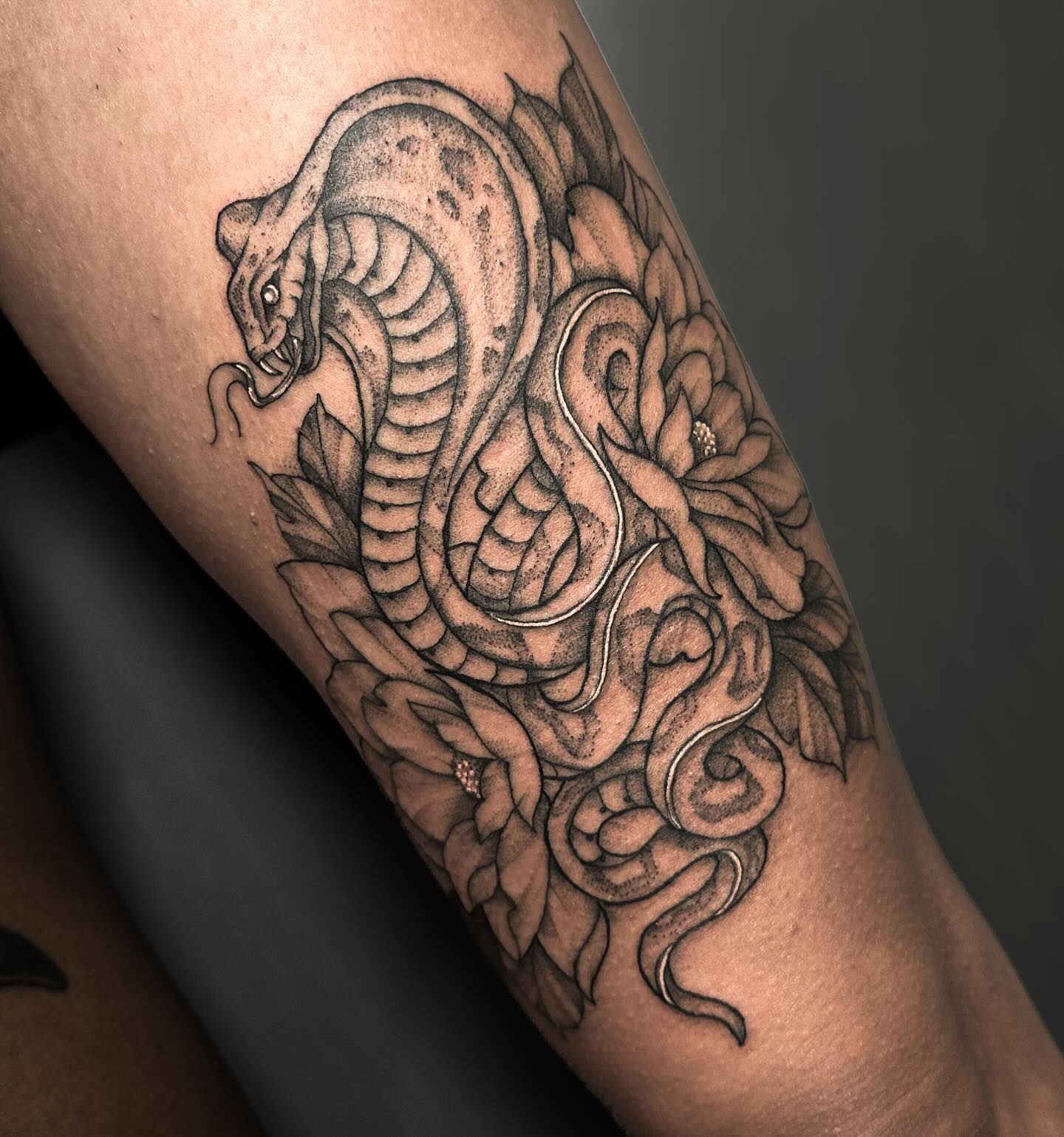
Heavy black fills and bold outlines age better than almost anything else, because there is no fine detail to lose. A blackwork serpent wrapping a limb reads clearly from across a room and will still read clearly decades in.
The cost is flexibility — solid black is difficult to cover or rework later. If you are confident, that permanence is a feature. Our overview of blackwork tattoo designs covers what the style does and does not suit.
American Traditional
Bold outline, limited palette, coiled rattlesnake, often with a banner. The style was built to stay legible as skin ages, and it does.
It also carries a specific tone — defiant, a little old-school, not subtle. That tone comes with the style whether you want it or not.
Snake Plus a Second Symbol
Pairings are the most reliable way to pin down meaning. Snake and dagger reads as danger met head-on — see our dagger tattoo ideas for how that composition is usually built. Snake and compass reads as guidance through risk, covered in our snake and compass tattoo guide.
Snake and skull leans toward mortality; snake and flower leans toward beauty with a cost. Pick the second element for what it says, not for how it fills the space.
Placement, Flow and Healing
Snakes are one of the few subjects that actively benefit from a curved placement, because a long sinuous body wants to follow a limb rather than sit flat on it. Forearms, calves, thighs, spines and ribs all give the design somewhere to go — our forearm tattoo ideas show how much difference the wrap makes.
Ask your artist to draw directly onto your skin or to fit the stencil with you standing in a natural position. A snake that looks perfect on paper can lose its flow the moment the arm bends, and the fix is free before the needle starts.
On healing: most tattoos surface-heal in roughly two to three weeks, with the deeper skin settling over a couple of months. Keep it clean, keep it moisturised lightly rather than smothered, keep it out of direct sun, and do not soak it — no pools, baths or hot tubs until it has closed. Your artist’s written aftercare beats generic advice, including this, because they know what they put in your skin.
Anything that looks like spreading redness, increasing pain after the first few days, heat, pus or fever is a doctor’s job, not a forum’s. Allergic reactions to pigment — most commonly reported with red inks — can also appear well after healing. The FDA’s fact sheet on tattoos and permanent makeup is a reasonable starting point on the risks. Nothing here is medical advice; see a licensed professional if something is wrong, and never attempt to treat or remove a tattoo yourself.
Common Mistakes — and What to Do If You Are Still Not Sure
The most common mistake is choosing the image before the meaning. A snake you saved because it looked cool will usually end up meaning “I saw this on the internet in 2026.”
The second is going too small for the level of detail. Scales, fangs and eye detail need room; crammed into two inches they merge into a dark smudge within a few years.
The third is borrowing a tradition without the tradition. A Japanese hebi drawn by someone who does not work in the style tends to look like a snake with clouds behind it, and that is visible to anyone who knows the style.
If you are still undecided, the useful question is not “what does a snake mean” but “which of these meanings would I still want on my body in fifteen years.” Cycles, healing, boundaries, protection, transformation, temptation, duality — one of those will sit differently than the rest. Start there, then let the artist solve the picture.
Frequently Asked Questions
Is a snake tattoo bad luck or a negative symbol?
Not inherently, though it depends entirely on whose tradition you ask. In Japanese culture the snake is a protective and lucky symbol, and in Greek tradition it is tied to healing. The “negative” reading comes mainly from Judeo-Christian imagery, where the serpent is associated with temptation and deceit. If you are worried about how it will be read in your own community, the surrounding elements and the style will shape that far more than the snake itself.
Do snake tattoos mean something different for women and men?
The symbol does not change, but the conventions around it have. Historically the snake-as-temptress reading was projected onto women’s snake tattoos more often, which is part of why the reclaimed Medusa reading resonates the way it does. In practice the design choices — scale, placement, style — communicate more than the wearer’s gender does. Choose the meaning you want and build the design around it.
Where does a snake tattoo look best?
Anywhere the body gives the snake a curve to follow. Forearms, calves, thighs, the spine and the ribcage are the most common because a long body wraps them naturally. Ouroboros designs specifically suit armbands, wrists and ankles, where the circle closes on itself. Large Japanese pieces need chest, back or full-sleeve real estate to include the background elements the style depends on.
How much does a snake tattoo hurt?
Pain depends on placement far more than on subject matter. Outer forearm, outer thigh and calf are generally among the more tolerable spots; ribs, sternum, spine, hands, feet and the inner arm are usually reported as sharper. A long snake also means a long session, so the total experience is often about endurance rather than peak intensity. Tell your artist if you need to break — every reputable one expects it.
Can a snake tattoo cover an existing tattoo?
Often yes, and snakes are one of the better cover-up subjects. A long winding body can be routed around or over an existing piece, and heavy scalework and dark shading hide old linework well. Whether it will work in your case depends on how dark and how large the original is — bring photos to a consultation rather than assuming, and expect a specialist to sometimes recommend fading sessions first.
Quick Summary
- Snake tattoos have no single meaning — the design, the tradition it borrows from, and the surrounding elements decide the reading.
- The ouroboros means cycles and self-renewal, and it wants a curved placement so the loop can close.
- The caduceus and the rod of Asclepius both signal healing, but only the single-snake rod is the historically medical one.
- A coiled or striking snake reads as boundaries and self-defence rather than aggression.
- In Japanese tattooing the hebi is protective and lucky, and it needs scale and proper background to work.
- Transformation only reads if the design carries it — shed skin, flames, or a deliberate contrast along the body.
- Fine line snakes suit private, personal meaning but soften faster; keep them simple and off high-friction spots.
- Decide the meaning first, then let the artist solve the picture — and take healing problems to a doctor, not a forum.