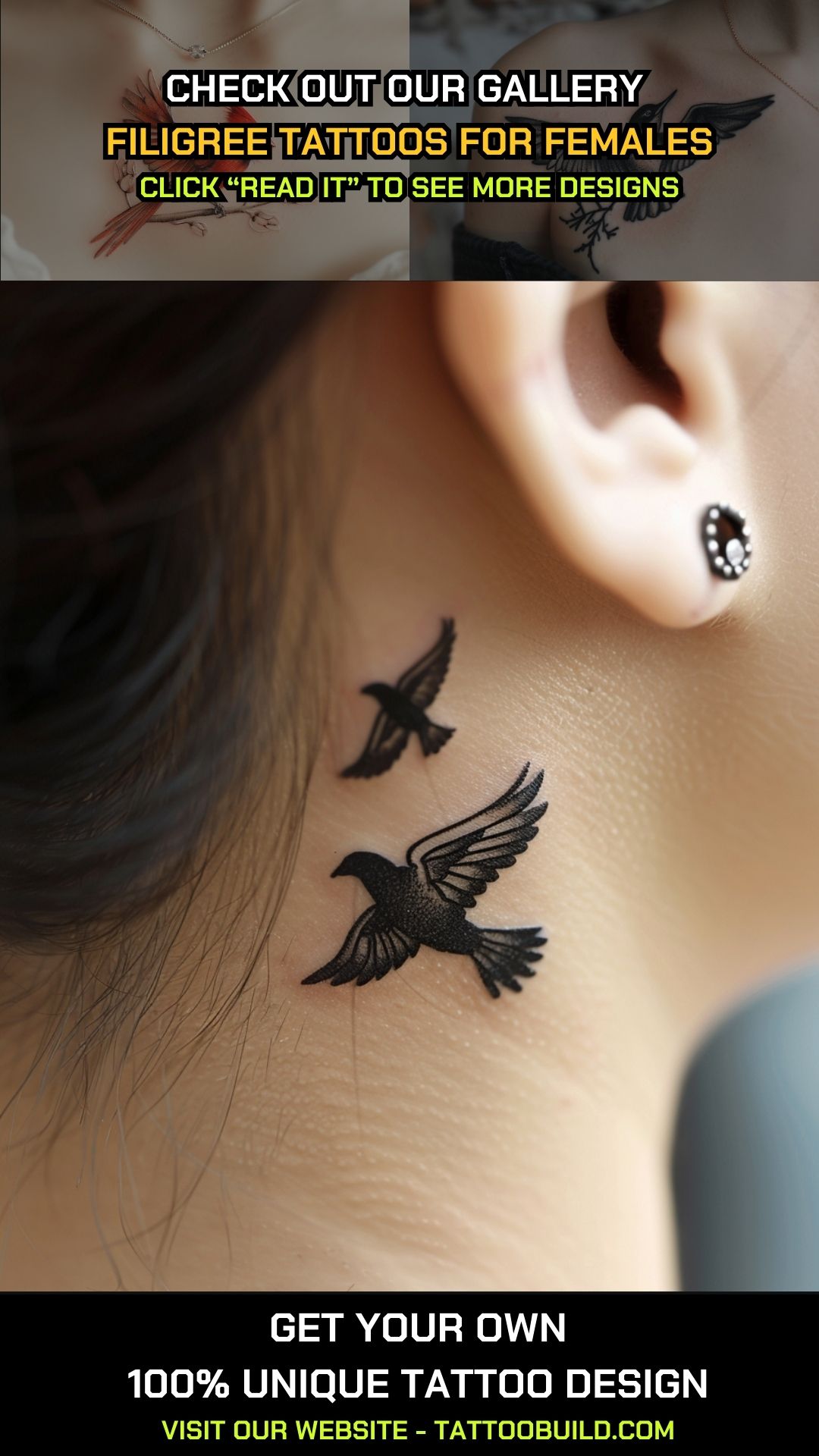
A bird tattoo is one of the most personal symbols you can wear, because the same silhouette can mean freedom to one person and grief to the next. I have spent years designing and researching bird tattoos, and the question I hear most is never “which bird looks best” — it is “which bird actually means what I feel.”
In my experience, the people who still love their bird tattoo ten years later are the ones who chose the species for its story first and its shape second.
This guide walks through 15 different bird tattoos and their meanings, from the hawk to the puffin, with honest notes on where a meaning is widely agreed on and where it is really yours to decide. Every design below was made with our AI tattoo generator, and you can read how to use TattooBuild AI to sketch your own before you ever sit in the chair.
Bird symbolism shifts across cultures and centuries, so I will flag the places where a meaning is contested rather than pretend there is one universal answer.
Which Bird Tattoo Is Right for You?
Before the full breakdown, here is the shortlist I usually sketch out with clients on a first consultation.
| Bird | Core Meaning | Works Well On | Suits This Style |
|---|---|---|---|
| Hawk | Focus, vision, decisiveness | Forearm or outer bicep | Fine-line or black-and-gray |
| Albatross | Endurance, long journeys | Back, ribs, upper arm | Traditional or blackwork |
| Kingfisher | Patience, precision, calm | Inner forearm, calf | Watercolor or colour realism |
| Penguin | Family, devotion, resilience | Ankle, shoulder blade | Small illustrative |
| Magpie | Intelligence, curiosity | Forearm, thigh | Black-and-gray or neo-traditional |
| Blackbird | Transformation, voice, grief | Wrist, sternum, spine | Fine-line silhouette |
| Flamingo | Grace, balance, standing out | Thigh, upper arm | Bold colour or watercolor |
| Heron | Patience, stillness, solitude | Spine, ribs, forearm | Long fine-line or Japanese |
| Rooster | Courage, pride, new beginnings | Chest, calf, upper arm | American traditional |
Treat the placements as starting points, not rules. A long-necked bird like a heron simply has more room to breathe on a spine or a forearm than on a wrist.
Why Bird Tattoos Carry Such Deep Meaning
Birds sit in almost every mythology humans have written down, which is why they carry more symbolic weight than most animals people tattoo.
They move between ground and sky, so cultures across the world have used them as messengers, souls, omens and escapes. That crossover is exactly why a bird can hold two opposite meanings at once.
A blackbird can be a song and a funeral in the same image. A seagull can be freedom or the memory of a specific stretch of coastline.
In my experience, this ambiguity is a feature rather than a problem. It lets a wearer keep a private meaning while the tattoo still reads as beautiful to everyone else.
The practical upshot: pick a bird whose real-world behaviour matches what you want to remember. Symbolism you can point to in nature tends to outlast symbolism you read once on a list.
If you want to see how a species actually behaves before you commit, the Audubon bird guide is a far better reference than a Pinterest board.
15 Different Bird Tattoos and Their Meanings
Each entry below covers what the bird usually symbolises, where that meaning comes from, and how the design tends to behave as a tattoo.
1. Hawk Tattoo
The hawk is the bird of focus. It hunts by seeing detail from a distance and committing without hesitation, which is why it reads as clarity and decisiveness.
Many people choose a hawk to mark a period when they finally stopped drifting and picked a direction.
In several Indigenous North American traditions hawks are understood as messengers, though the specifics differ sharply between nations — if that layer matters to you, research the particular culture rather than a generic summary.
As a design, hawks are forgiving. The wide wing shape holds up at small sizes and the head profile is instantly readable even in a simple silhouette.
Every artist I have asked prefers a hawk in flight over a perched one for forearms, because the spread wings follow the taper of the arm. If you want a heavier raptor with more traditional weight behind it, the eagle tattoo covers a close cousin with its own symbolic history.
2. Albatross Tattoo
The albatross is endurance made visible. It can stay at sea for years at a time and covers enormous distances on almost no wing movement.
Sailors historically treated it as a good omen, and Coleridge’s Rime of the Ancient Mariner then flipped it into a symbol of guilt carried around your neck.
Both meanings are live today, so an albatross can read as freedom or as burden depending on how you present it.
I usually suggest an albatross for someone marking a long haul — recovery, a degree, years of caregiving — rather than a single triumphant moment.
Design-wise it needs space. The wingspan is the whole point, so a cramped albatross loses the thing that makes it an albatross.
3. Kingfisher Tattoo
The kingfisher waits motionless, then strikes in a fraction of a second. That combination of patience and precision is its core meaning.
Greek myth gave us the halcyon, a kingfisher said to calm the seas while it nested — the origin of the phrase “halcyon days.”
It has become a favourite for people who work slowly and carefully and want that recognised rather than mistaken for hesitation.
The kingfisher is also one of the few birds where colour genuinely earns its cost. The blue-orange contrast is the identifying feature.
When I tested a fine-line kingfisher against a colour one at the same size, the colour version was recognisable from across a room and the line version was not.
4. Toucan Tattoo
The toucan is the most openly cheerful bird on this list. It symbolises expressiveness, sociability and refusing to shrink yourself.
That oversized bill is a real thermoregulation organ, not decoration, which I like as a quiet metaphor: the loud thing about you is often the functional thing.
It suits people who have been told they are “too much” and decided that was fine.
As a tattoo, a toucan is essentially a colour piece. In black and gray it tends to read as a generic bird with a big beak.
Expect to book a longer session than the size suggests, because saturated colour blocks take time to pack evenly.
5. Penguin Tattoo
Penguins symbolise community, devotion and getting through cold stretches by huddling together.
Emperor penguins famously take turns on the outside of the huddle so no individual freezes, which is about as clean a symbol of shared burden as nature offers.
Several penguin species pair for a full breeding season and many return to the same partner, so they have become a common choice for couples and family pieces — just be aware the “penguins mate for life” line is an oversimplification.
Small penguins work beautifully. The silhouette is unmistakable even at a couple of inches.
I have inked more matching penguins for siblings than for couples, which tells you something about how people actually read the symbol.
6. Magpie Tattoo
Magpies represent intelligence, curiosity and a certain amount of mischief.
They are among the few animals that have shown signs of recognising themselves in a mirror, and they solve problems that defeat most birds.
British folklore attaches them to the counting rhyme — one for sorrow, two for joy — so a single magpie carries a superstitious edge that a pair does not.
If that bothers you, tattoo two. Plenty of people do exactly that for precisely that reason.
The black-and-white plumage makes magpies ideal for black-and-gray work, where the iridescent blue-green in the tail can be suggested with negative space instead of colour.
7. Pelican Tattoo
The pelican is the nurturing bird. It symbolises provision, sacrifice and protecting the people who depend on you.
Medieval European Christian art used the pelican as an emblem of self-sacrifice, based on a mistaken belief that it wounded itself to feed its young.
The biology was wrong, but the symbol stuck, and it still appears in heraldry today.
In practice I see pelicans chosen by parents, nurses and anyone whose role is to absorb strain on someone else’s behalf.
Visually the pouch and the heavy bill give you a strong, unusual profile — a nice alternative for someone who wants a seabird but finds seagulls too common.
8. Blue Jay Tattoo
Blue jays stand for communication, boldness and loyalty to their own.
They are loud, territorial and known for mimicking hawk calls, which is either clever or obnoxious depending on your point of view.
That double edge is useful. A blue jay can mean “I speak up” without pretending that speaking up is always graceful.
They are also strongly associated with family groups, so jays show up in pieces about protecting siblings or close friends.
The blue is structural rather than pigmented, which is a nice detail but changes nothing technically — you still need a skilled colour artist to keep the crest from turning muddy.
9. Seagull Tattoo
Seagulls mean freedom, adaptability and resourcefulness, and for a lot of people they mean home.
If you grew up near a coast, gulls are less a symbol than a soundtrack, and that personal association usually beats anything on a symbolism list.
They are also genuinely adaptable birds that have learned to live alongside humans, so they work as a marker of surviving on your wits.
The simple flying-gull shape is the classic filler tattoo — two curved strokes, instantly readable, easy to scatter across a larger composition.
In my experience this is the bird people most often add to an existing piece rather than plan as a standalone.
10. Blackbird Tattoo
The blackbird sits between mystery and transformation, and it carries a strong association with song and voice.
Its meaning depends heavily on culture — in parts of Europe it is a good omen and elsewhere it is linked to mourning.
Many people choose it specifically as a grief tattoo, and the ambiguity is the point: it reads as beautiful to strangers and as a memorial to you.
A solid black silhouette is one of the most reliable tattoos you can get. There is nothing to fade unevenly and nothing to blur into a neighbouring line.
If you want the darker, heavier version of this idea, the raven tattoo goes further into corvid symbolism.
11. Flamingo Tattoo
Flamingos symbolise grace, balance and being conspicuous without apology.
Their pink comes from carotenoid pigments in what they eat, which makes them a fairly literal symbol of becoming what you take in.
They also stand on one leg for long periods, which has made “balance” the most common reading among wearers I have spoken to.
This is a bold-colour tattoo. Pink is a lighter ink and will need refreshing sooner than black, especially on sun-exposed skin.
The long neck and legs give you a naturally vertical composition, which is why flamingos sit well on thighs and outer arms.
12. Heron Tattoo
The heron is stillness. It stands motionless in shallow water for long stretches and moves only when moving is worth it.
It reads as patience, self-containment and comfort with solitude — not loneliness, which is a distinction most heron wearers care about.
Herons and cranes appear widely in Japanese art, and traditional Japanese tattooing has its own established conventions for them, so an artist trained in that style will approach the design very differently than a Western illustrative artist.
The long body is a gift for spine, ribs and forearm placements where a vertical subject fits the anatomy.
Every artist I have asked says the neck curve is the make-or-break line. Get that wrong and the whole bird looks stiff.
13. Ostrich Tattoo
The ostrich is the grounded one. It cannot fly, and it is faster on land than any other bird.
That makes it a symbol of resilience through a different route — not escape, but outrunning the thing in front of you.
The “head in the sand” idea is a myth; ostriches lower their heads to turn eggs and to graze. Plenty of wearers like reclaiming a symbol that was misread for centuries.
It is an unusual choice, which is most of its appeal. I have designed far more hawks than ostriches.
Long legs and a small head mean the composition needs planning. An ostrich squeezed into a square panel loses its proportions and stops reading as an ostrich.
14. Rooster Tattoo
The rooster means courage, pride and the start of something. It announces dawn, and that association runs through most cultures that keep chickens.
It is one of the twelve animals in the Chinese zodiac, so it doubles as a birth-year tattoo for anyone born in a Rooster year.
In American traditional tattooing the rooster also has a sailor-era history as a luck charm, usually paired with a pig.
Roosters are made for bold traditional work. Heavy black outlines, a limited palette and that unmistakable comb and tail.
For the full symbolic background and more design directions, see our guide to rooster tattoo meaning.
15. Puffin Tattoo
Puffins carry whimsy, adaptability and a quieter kind of devotion.
They spend most of the year out on open ocean and come to land only to breed, often returning to the same burrow and the same partner.
That mix — long solitary stretches, then reliable return — makes them a favourite for long-distance relationships and for people who need a lot of space without loving anyone less.
The colouring is striking enough that a small puffin still reads clearly, which is rare for a colour piece at that size.
In my experience puffins are the design people show friends most, because almost nobody expects a puffin.
Popular Bird Tattoo Styles and Variations
The species decides the meaning. The style decides how the tattoo ages and how it reads from three metres away.
Fine-Line and Minimalist
Fine-line birds are the most requested version right now, and for good reason: they are quick, they sit well on wrists and ribs, and they suit silhouettes.
The trade-off is longevity. Very thin lines spread slightly over the years, so a fine-line bird with a lot of internal detail can lose that detail in a way a bold silhouette never will.
Keep the linework open and the detail count low and a fine-line bird holds up well. Our fine-line spine tattoo guide shows how the same principle plays out on a long vertical placement.
Traditional and Black-and-Gray
American traditional is the safest bet for a bird you want to still read clearly in twenty years. Heavy outlines, solid blacks, limited palette.
Black-and-gray gives you more realism without the fade risk of colour, and it is especially strong for magpies, herons and any bird whose plumage is already monochrome.
If you want to see this handled well across several species, our black-and-gray traditional bird gallery is worth a look.
Watercolor and Colour-Rich
Watercolor birds are beautiful fresh and are the highest-maintenance option on this list. Soft edges and pale washes fade faster than anything anchored by black.
Most artists I have worked with will push for at least some black structure underneath — a line, a shadow, a solid wing — so the piece still has a skeleton once the soft colour softens further.
Silhouette Flocks and Filler Birds
A scatter of small flying birds is the most common bird tattoo in the world, and it is usually chosen for movement rather than species.
They work best with uneven spacing and varied sizes. A perfectly even row of identical birds reads as a border, not a flock.
Related Birds Worth Considering
These did not make the main list, but they come up in almost every consultation I have about bird tattoos.
Hummingbird
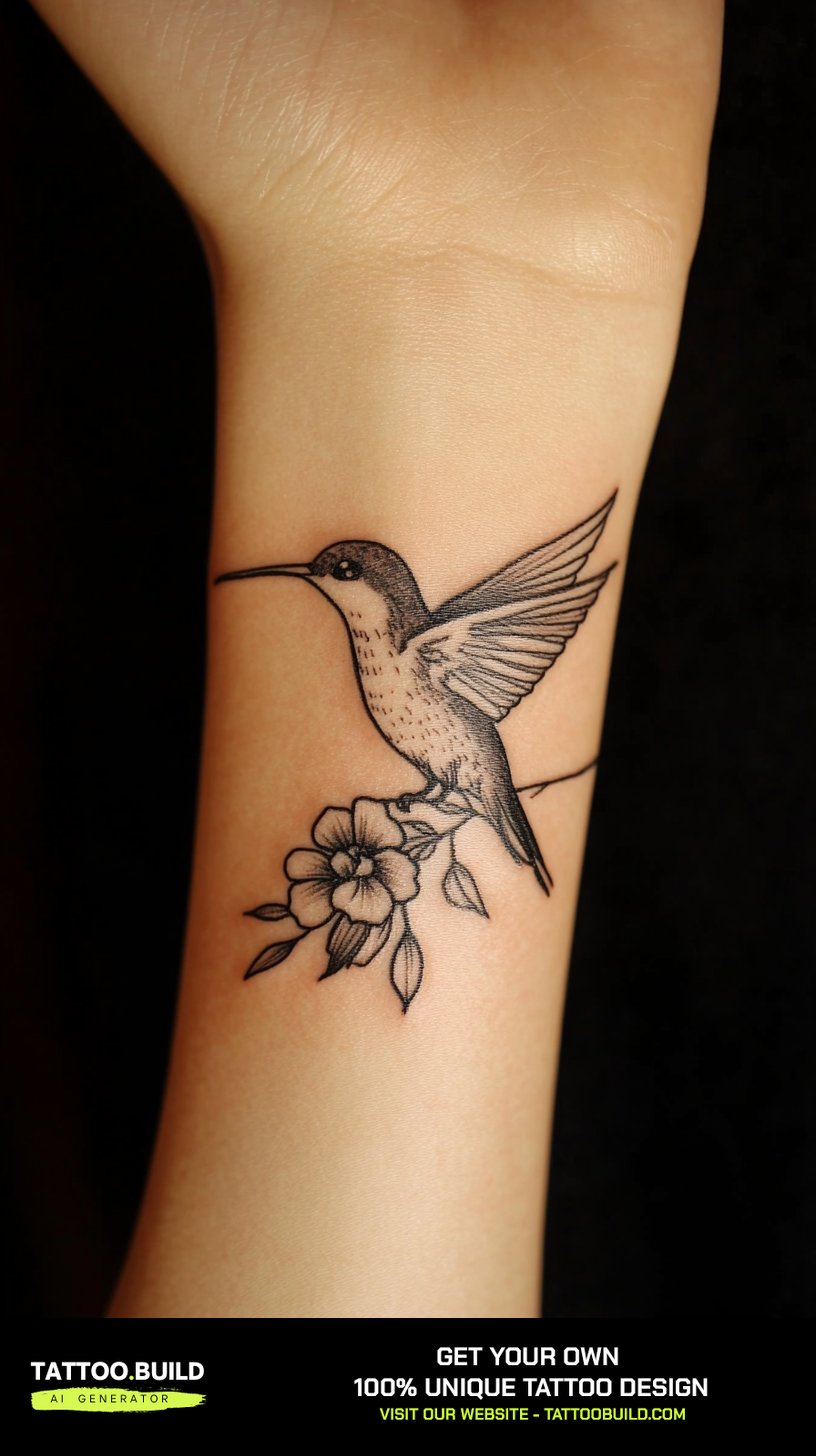
Joy, resilience and living at full speed. It is the most popular small colour bird by a wide margin, and our hummingbird tattoo guide covers the design side in detail.
Swallow
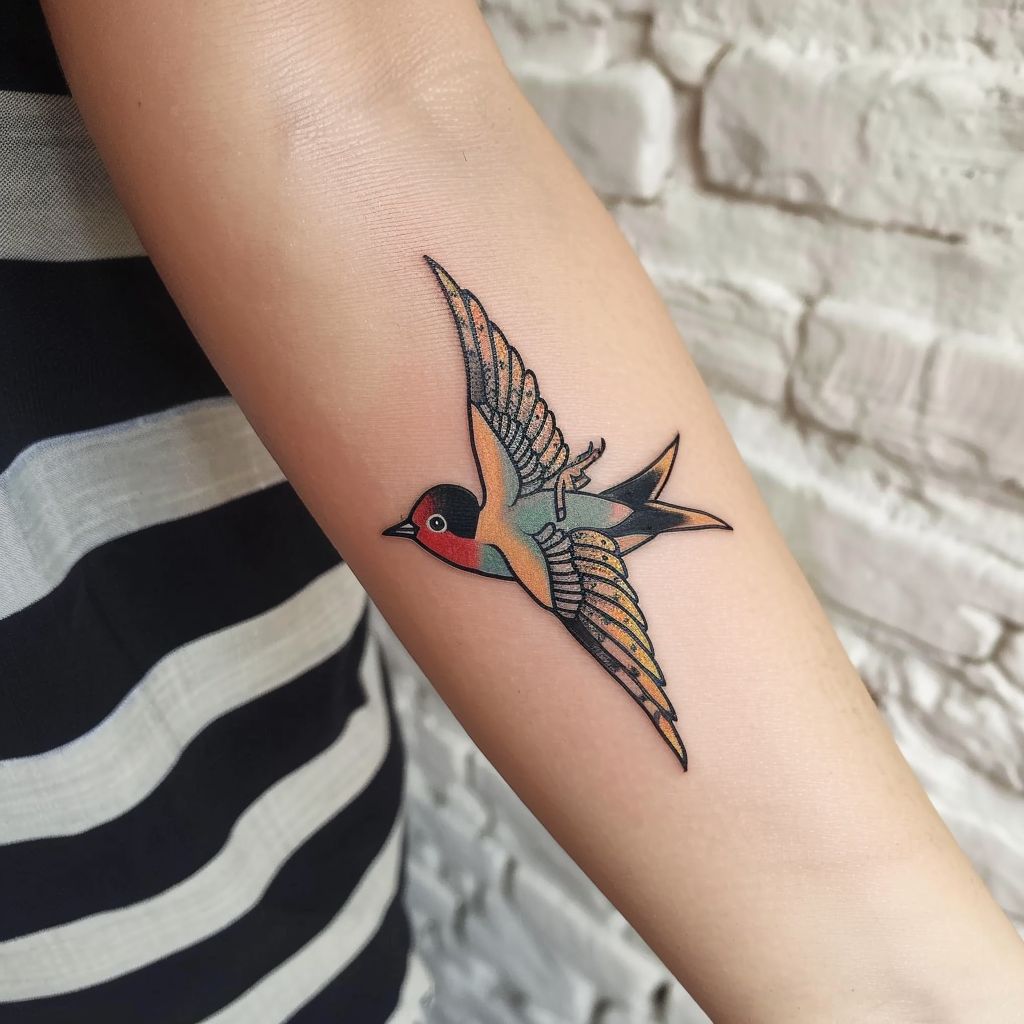
Traditionally a sailor’s tattoo for distance travelled and safe return home. Read the swallow tattoo meaning if you want the full history.
Owl
Wisdom in most of Europe, an omen of death in several other traditions. Worth checking what it means to your own family before committing.
Phoenix
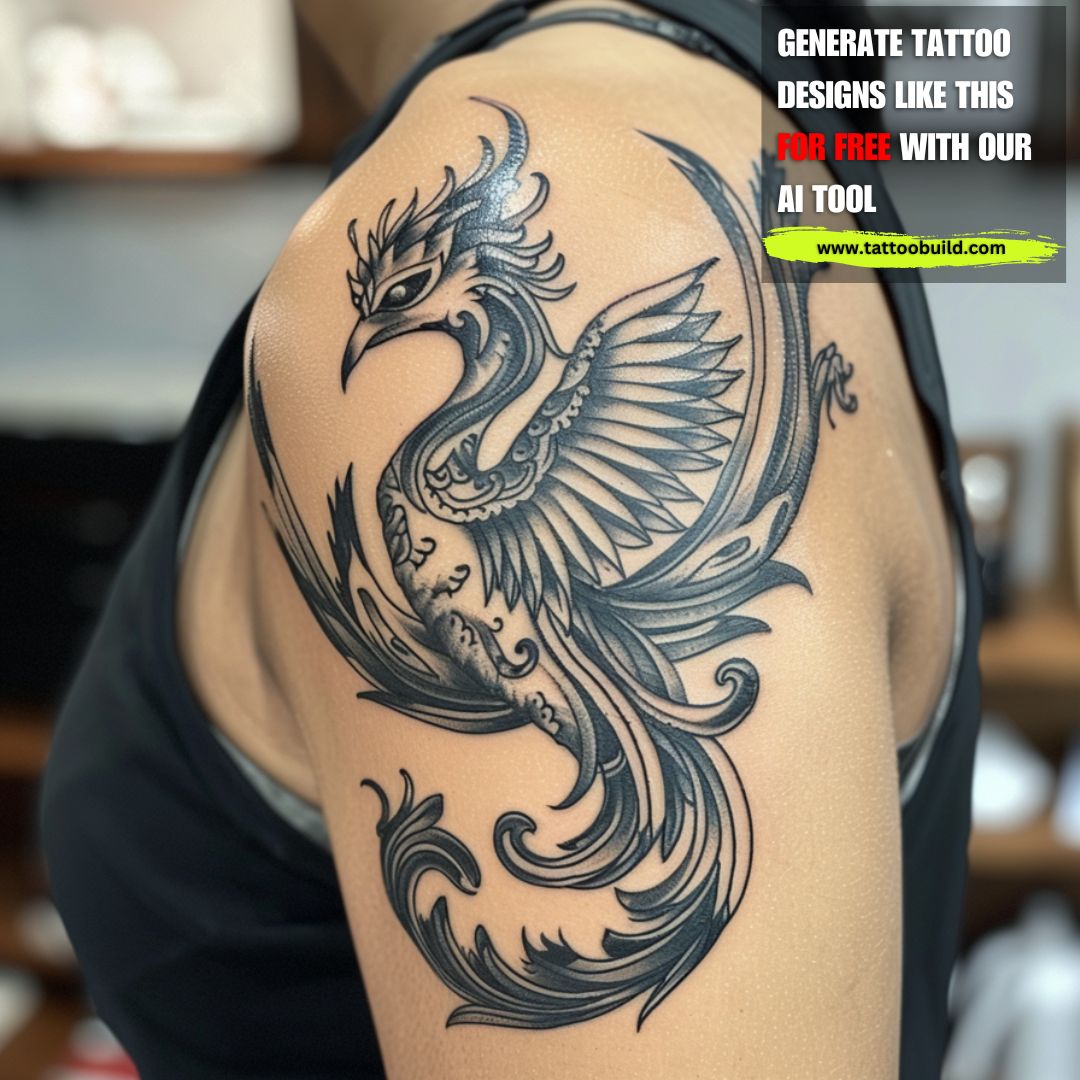
Not a real bird, but the strongest rebirth symbol available and a common choice after a hard chapter. Our phoenix tattoo gallery collects design directions.
Placement, Aftercare, and Practical Tips
Match the bird’s shape to the body part. Long birds — herons, flamingos, albatrosses — want long placements like the spine, ribs or forearm. Compact birds like puffins and penguins work almost anywhere.
Ribs, sternum and the inner arm are consistently reported as more painful than outer arm, thigh and calf. If this is a first tattoo, start somewhere forgiving.
Sun is the main enemy of a coloured bird. Daily sunscreen on an exposed tattoo makes a visible difference over a decade, and it is the single easiest thing you can do to protect the work. For chest placements specifically, our guide to bird chest tattoos covers how the ribcage curve affects composition.
Follow the aftercare instructions your artist gives you, since they know their inks and their technique. The American Academy of Dermatology’s tattoo care guidance is a solid general reference, and anything that looks like spreading redness, increasing pain after day three, or fever needs a doctor rather than an internet search.
This article is design and symbolism advice, not medical advice. Allergic reactions to tattoo ink are uncommon but real, red pigments most often, and a licensed professional artist doing a patch discussion beforehand is worth the extra conversation.
Still Not Sure Which Bird to Choose?
The mistake I see most often is choosing a bird from a symbolism list without ever having watched the animal do anything.
The second most common is scale. People pick a detailed species and then ask for it at two inches, and the detail that made them choose it disappears within a few years.
The third is copying an existing tattoo exactly. Bring references, then let your artist redraw it for your body.
If you are stuck between two species, sketch both at the intended size and placement before booking. Seeing a design on your own arm settles the question faster than any list, including this one.
Frequently Asked Questions
What does a bird tattoo symbolize?
Most bird tattoos symbolize freedom, transformation, or a connection between the everyday and something larger. The specific meaning depends almost entirely on the species: a hawk reads as focus, a heron as patience, a rooster as courage. Culture matters too, since the same bird can be a good omen in one tradition and a warning in another. In my experience the meaning that lasts is the personal one — the bird you associate with a place, a person, or a period of your life.
Which bird tattoo is best for a first tattoo?
A simple silhouette on the forearm, outer bicep or calf is the easiest first bird tattoo. Blackbirds, swallows and small flying-bird shapes are all forgiving because they rely on a clean outline rather than fine internal detail. Avoid ribs and sternum for a first piece if you can, since those areas are consistently reported as more painful. Starting small also lets you find out how your skin holds ink before committing to a larger piece.
Do bird tattoos have different meanings in different cultures?
Yes, and sometimes they are direct opposites. Owls mean wisdom across much of Europe but appear as omens of death in several other traditions, and magpies carry a superstitious weight in British folklore that they do not have elsewhere. Herons and cranes have long-established meanings in Japanese art that differ from Western readings. If a bird has significance in your own background, that reading should outweigh any general list.
Where is the best place for a bird tattoo?
Match the placement to the bird’s proportions. Long-necked or long-winged birds like herons, flamingos and albatrosses suit the spine, ribs and forearm, where there is room for a vertical or sweeping shape. Compact birds such as puffins, penguins and small silhouettes work almost anywhere, including wrists and ankles. Also consider sun exposure: a coloured bird on a forearm will need more protection than one on an upper back.
Do colorful bird tattoos fade faster than black ones?
Generally yes. Black ink is the most stable over time, while lighter colours — particularly pinks, yellows and pale blues — tend to soften sooner, especially on skin that gets regular sun. This is why watercolor-style birds usually need touch-ups earlier than black-and-gray work. Keeping the tattoo covered or under sunscreen is the most effective way to slow it down, and many artists build in some black structure so the design holds its shape as colour fades.
Quick Summary
- Choose the species for its story first. Shape and placement are easier to solve than a meaning you do not believe in.
- Hawk, kingfisher and heron cover focus, precision and patience — the three most requested “mindset” birds.
- Albatross, penguin and ostrich are endurance birds, better suited to marking a long stretch than a single moment.
- Magpie, blue jay and blackbird carry double meanings; decide which side you want to emphasise before you design.
- Flamingo, toucan and puffin are colour-dependent. Budget for longer sessions and earlier touch-ups.
- Match the bird’s proportions to the placement: long birds on spines, ribs and forearms; compact birds anywhere.
- Bold outlines and solid blacks age best. Very fine internal detail at small sizes rarely survives a decade.
- For healing questions, infection signs or ink reactions, talk to your artist and a doctor — not a symbolism guide.