A hummingbird tattoo is one of the few small designs that still looks like something ten years later — provided the wings are drawn open and the linework is not pushed thinner than the skin can hold.
I have watched a lot of these heal. The ones that hold up share a pattern, and the ones that blur into a grey smudge share a different one.
This guide covers what the bird actually symbolises, which styles survive aging, where on the body they work, and the mistakes I keep seeing people make on their first piece. If you are still deciding on a shape, our hummingbird tattoo drawing gallery is a good place to gather reference before you book.
Everything below comes from watching designs age on real people, plus what artists tell me when I ask them why they pushed back on a client’s idea.
Which Hummingbird Tattoo Style Is Right for You?
Style choice matters more than size. Here is how the main options compare on the things people actually care about after the appointment is over.
| Style | Smallest size that works | How it ages | Best for |
|---|---|---|---|
| Realistic | 5–6 in | Softens gradually; detail merges | Thigh, back, upper arm |
| Fine line / minimalist | 1.5–2 in | Thickens and lightens fastest | Forearm, ribs, shoulder |
| Watercolor | 3–4 in | Colour softens; needs a line layer | Upper arm, shoulder blade |
| Geometric | 3 in | Holds well if angles are clean | Forearm, calf |
| Black and grey | 2.5 in | Most predictable of the group | Almost anywhere |
| Silhouette | 1 in | Best long-term legibility | Wrist, ankle, behind ear |
If you want one rule from that table: the smaller you go, the bolder the style needs to be.
What a Hummingbird Tattoo Actually Symbolises
The short answer is that it depends heavily on which tradition you are drawing from, and most people choose a meaning that is personal rather than inherited.
In several Indigenous cultures of the Americas the hummingbird carries specific significance — in Aztec tradition it was connected to Huitzilopochtli, and warriors were sometimes associated with the bird after death. That is a real cultural context, not a decorative detail, and it is worth knowing before you claim it as your meaning.
The more common modern reading is simpler: resilience, lightness, and the ability to keep moving. The bird is tiny, migrates absurd distances, and hovers by beating its wings faster than the eye can follow.
In my experience the most common personal reason people give me is memorial. A grandmother who fed them, a parent who kept a feeder on the porch. That association is strong enough that a lot of artists now expect it when someone books one.
You do not owe anyone an explanation for your tattoo. But knowing why you want it usually produces a better design brief, and artists notice the difference. Broader bird tattoo meanings are worth skimming if you are choosing between species.
Hummingbird Tattoo Styles Worth Considering
Each of these is a genuinely different commitment in terms of cost, session length, and how it will look in a decade.
Realistic Hummingbird Tattoos
Realism is the most expensive option here and the least forgiving of a small canvas.
The detail that sells a realistic hummingbird — individual feather separation, the iridescent throat patch, the blur of the wings — all needs physical room. Every artist I have asked puts the practical floor around five inches, and most prefer six or more.
Iridescence is worth understanding, because clients ask for it constantly. There is no ink that shimmers. What artists do is exaggerate contrast between adjacent colour patches so the eye reads it as metallic. It works well fresh and it softens over time.
Budget realistically for realism: it is usually a multi-hour session, sometimes two, and the price reflects that. Ask to see healed photos of the artist’s realism work specifically, not just fresh ones.
Fine Line and Minimalist Hummingbird Tattoos
This is the most requested version right now and the one I would think hardest about.
Minimalist hummingbirds are beautiful the week they are done. The problem is that very thin lines spread as ink settles into the dermis, and a design that relied on hairline separation between wing strokes can close up into a solid shape.
The fix is not to avoid the style. It is to keep the line weight consistent and slightly heavier than looks necessary, and to leave more negative space between elements than the design seems to need.
When I have compared fine line pieces at the fresh stage and again several years later, the ones that held up were the ones the artist deliberately drew “too open.” Our fine line tattoo ideas and minimalist tattoo ideas collections show that spacing well.
Watercolor Hummingbird Tattoos
Watercolor suits hummingbirds better than almost any other subject, because the bird is already associated with a blur of colour.
The persistent argument about watercolor is whether it lasts. In my experience the honest answer is: colour-only watercolor fades unevenly, and watercolor built over a light black line structure holds its shape indefinitely even as the colour softens.
Ask your artist which of the two they are doing. A hidden line layer is the difference between a piece that softens and a piece that dissolves. More examples sit in our watercolor tattoo ideas gallery.
Geometric Hummingbird Tattoos
Geometric designs break the bird into facets, triangles, or dotwork gradients, and they age surprisingly well.
The catch is that geometry is unforgiving of a shaky hand. A slightly wobbly straight line reads as a mistake in a way that a slightly wobbly feather never does.
This is the style where artist selection matters most. I would rather wait four months for someone whose linework is genuinely straight than book next week with someone whose portfolio is mostly script.
Dotwork shading is a good compromise if you want depth without colour — see our geometric tattoo designs for how the two combine.
Hummingbird and Flower Tattoos
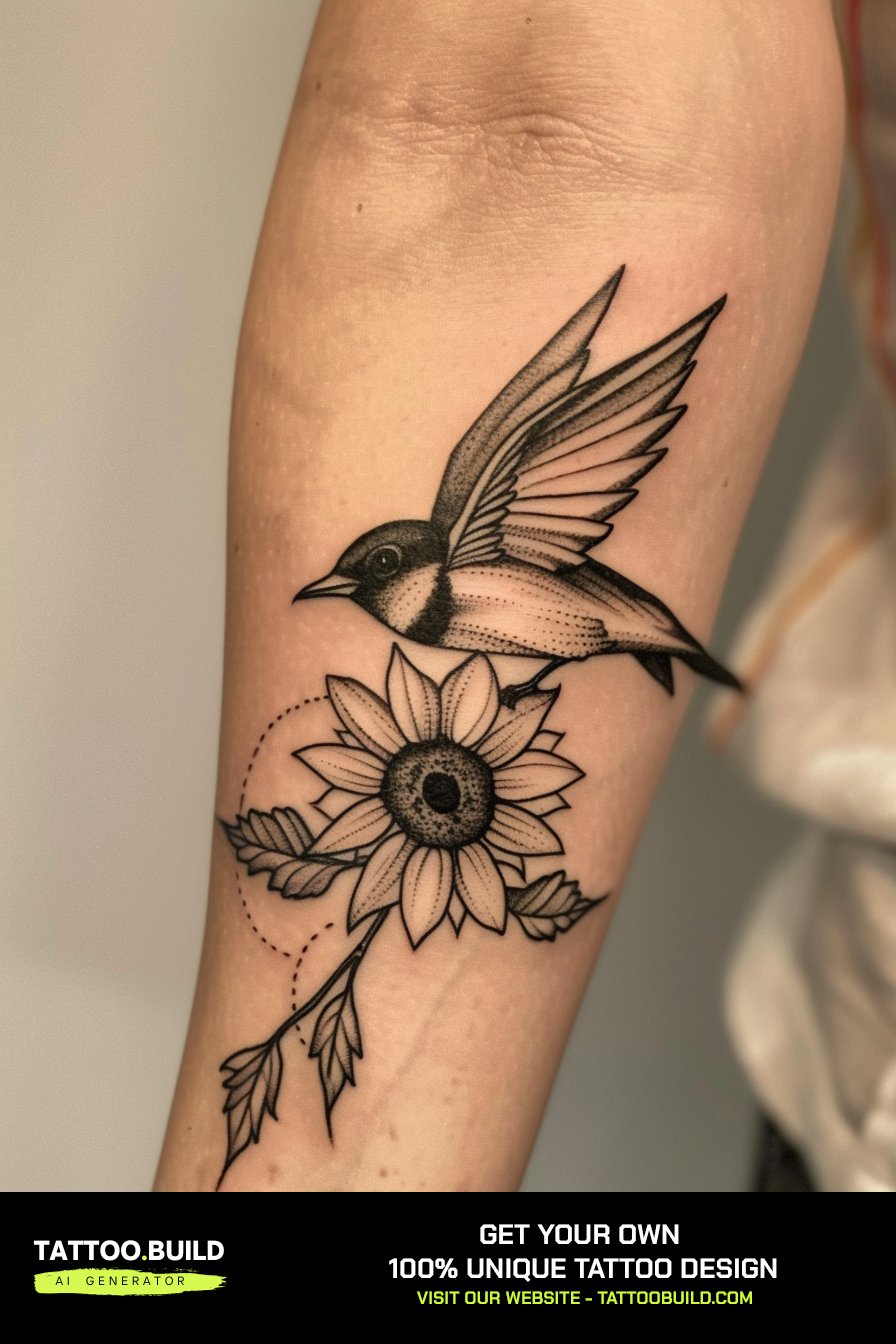
Pairing the bird with a flower is the single easiest way to make a common design specific to you.
The composition also solves a practical problem: a hummingbird alone floats awkwardly on skin, while a bird with a flower has an obvious reason to be hovering and an obvious direction to face.
Birth month flowers are the most popular route, and they let you fold a second person into the piece without adding a name. Our birth flower tattoo ideas guide lists the standard month associations.
Trumpet-shaped flowers — honeysuckle, salvia, trumpet vine — are the botanically accurate choices, since those are what hummingbirds actually feed from. Most artists will appreciate you knowing that.
Black and Grey Hummingbird Tattoos
If you want the most predictable long-term result, this is it.
Black and grey work ages more consistently than colour across the widest range of skin tones, and it is easier to touch up or build onto later if you decide to expand into a larger piece.
The thing that keeps grey wash from flattening is contrast. A piece with genuine blacks and genuine highlights still reads at a distance after a decade; one shaded entirely in mid-greys tends to go soft.
Ask for a full tonal range rather than a uniformly soft look. It will seem harsher on day one and better every year after.
Hummingbird Silhouette Tattoos
The silhouette is the most underrated option on this list.
A solid black hummingbird shape has the best legibility-per-square-inch of anything here. It survives at sizes where fine line work would blur, it needs the fewest touch-ups, and it costs the least.
The trade-off is that there is no detail to enjoy up close. If the appeal of the bird for you is the feather work, this is not your style.
For small placements though — wrist, ankle, behind the ear — I would take a clean silhouette over a detailed miniature nearly every time.
Tribal and Neo-Traditional Hummingbird Tattoos
Bold black patterning trades anatomical accuracy for shapes that hold their form for a very long time.
Neo-traditional is the version I see more of now: heavier outlines, limited saturated palette, stylised feathers rather than realistic ones. It sits between traditional boldness and modern detail.
If you are drawn to a specific cultural tribal style rather than a generic one, it is worth researching whose tradition it belongs to first. Some artists will decline the work, and that is a reasonable position rather than an obstacle.
Small and Micro Hummingbird Tattoos
Small works, but only if the design is simplified rather than shrunk.
The failure mode I see most often is a detailed design scaled down until the details are technically present and visually illegible. A two-inch bird needs roughly a third of the elements of a six-inch one.
Anything under about an inch and a half should be a silhouette or an outline with two or three internal lines, no more.
Also plan for a touch-up. Small, fine work on high-friction skin commonly needs one within a few years, and most artists price that reasonably or include it.
Placement Ideas and What Each One Costs You
Placement affects pain, longevity, and how often you will be asked about it. Those are three separate decisions people tend to collapse into one.
Wrist
The most requested spot and one of the fastest to fade, because of constant sun exposure and sleeve friction.
Sitting the design just above the wrist bone rather than directly over it avoids the worst of the skin stretch. Pain is moderate — thin skin, bone close underneath. See our wrist tattoo ideas for sizing references.
Ankle and Foot
Visually excellent, practically demanding. Footwear rubs the area during healing and swelling is common in the first few days.
I would only pick this if you can genuinely wear open shoes for two weeks.
Shoulder, Collarbone and Chest
The shoulder is one of the most forgiving spots on the body: low friction, minimal stretch, moderate pain, easy to cover or show.
The collarbone looks striking and hurts considerably more — bone directly under thin skin.
Back and Spine
The upper back and shoulder blade give a hummingbird enough room for real detail without the sun exposure that fades arm pieces.
Spine placements are among the more painful on the body. They are also difficult to keep clean during healing without help.
Thigh, Forearm and Behind the Ear
The thigh is the most comfortable large canvas most people have — fleshy, low friction, easy to keep covered while it heals.
The forearm is flat, ages well, and is the easiest placement to actually look at yourself, which matters more than people expect.
Behind the ear is a high-pain, high-friction spot suited only to very small designs. Check a tattoo pain map before committing to it.
Aftercare That Actually Protects the Design
Follow the aftercare instructions your artist gives you over anything written here — they know what they used and how you healed in the chair.
The general pattern most studios recommend is: keep it clean with unscented soap, keep it lightly moisturised rather than saturated, and leave it alone. Picking flakes is what pulls pigment out.
Sunscreen is the single biggest factor in how a hummingbird tattoo looks in ten years. UV breaks down pigment, and fine line and colour work suffer most. Once healed, high SPF on any exposed placement is not optional if you care about the linework.
Signs that need a doctor rather than a forum: spreading redness beyond the tattooed area, heat, pus, or fever. Allergic reactions to red pigment in particular are uncommon but real. Seek medical advice promptly rather than waiting it out — the American Academy of Dermatology has plain guidance on this, and the FDA’s tattoo safety page covers ink-related risks.
Still Not Sure? Common Mistakes to Avoid
Choosing the size before the design. Decide what the bird needs to show, then let that determine the size — not the other way round.
Booking on portfolio breadth rather than depth. An artist with forty excellent fine line pieces is a better bet for a fine line hummingbird than one with four of everything.
Ignoring healed photos. Fresh work looks good almost universally. Healed work is the only honest evidence.
Rushing the placement decision in the studio. If you are unsure, ask for the stencil to be placed and then walk around for ten minutes before you sit down. Every artist I have asked prefers that to a regret conversation later.
Frequently Asked Questions
What does a hummingbird tattoo mean?
Most commonly it represents resilience, lightness, and joy, and it is very often chosen as a memorial for someone who loved the birds. There are also specific cultural meanings, including in Aztec tradition where the hummingbird was linked to the god Huitzilopochtli. Ultimately the meaning is whatever you attach to it. Artists generally do not need a reason, but having one usually leads to a stronger design.
How much does a hummingbird tattoo cost?
It depends far more on style and artist than on the bird itself. A small silhouette is typically a shop-minimum job, while a detailed realistic piece can run several hours at an hourly rate. Get a quote in writing before booking, and ask whether a touch-up is included. Prices vary widely by city, so treat any figure you read online as a rough starting point rather than a benchmark.
Do small hummingbird tattoos blur over time?
Simplified small designs hold up well; detailed designs shrunk down do not. The issue is line separation — as ink settles, thin lines spread slightly, and details drawn close together can merge. Keeping the design open and the line weight consistent is what prevents it. Expect that very small fine line work may want a touch-up within a few years.
Where does a hummingbird tattoo hurt least?
Fleshy, low-friction areas are generally the most comfortable — outer thigh, upper arm, and shoulder are the usual answers. Ribs, spine, collarbone, ankle, and behind the ear are on the sharper end because bone sits close to the skin. Pain is individual though, and being rested and fed matters more than most people expect.
Is watercolor a bad choice for a hummingbird tattoo?
Not inherently, but it needs to be built correctly. Watercolor applied over a light black line structure keeps its shape as the colour softens, while colour-only watercolor tends to fade unevenly. Ask your artist which approach they use before booking. If long-term crispness is your priority, black and grey remains the more predictable option.
Quick Summary
- Pick the style first — it determines minimum size, cost, and how the piece ages.
- Realism needs roughly five inches or more; anything under an inch and a half should be a silhouette.
- Fine line looks best fresh and needs deliberately open spacing to survive.
- Watercolor lasts when it sits over a hidden black line layer.
- Black and grey with real contrast is the most predictable long-term choice.
- Pairing the bird with a meaningful flower personalises a very common design.
- Shoulder, outer thigh and forearm are the most forgiving placements; wrist and ankle fade fastest.
- Sunscreen after healing does more for longevity than anything else you control.