Wings are one of the few tattoo subjects that work at almost any size, on almost any body, in almost any style. The design decision that matters most is not which kind of wing you pick, but whether the wing shape follows the muscle underneath it.
I have watched a lot of wing tattoos heal, and the ones that still look good five years later share a pattern: the artist mapped the wing to the client’s shoulder blade, spine, or ribcage before the stencil ever went on.
The ones that age badly are usually the opposite story — a flat wing copied off a screen and dropped onto a curved back, where it buckles the moment the person moves.
This guide walks through seven wing styles, what each one actually costs you in sitting time and touch-ups, and where on the body each tends to sit best. If you are still deciding on your subject, it is worth reading about bird tattoos and their meanings first, since a lot of wing designs start there.
Which Wing Style Is Right for You?
Here is how the seven main wing families compare on the things people actually ask me about — detail level, how well they hold up, and roughly how long they take.
| Wing Style | Best Placement | Detail Level | Typical Sitting Time | Ages Well? |
|---|---|---|---|---|
| Bird wings | Upper back, shoulder blade | High | 4–10 hours | Yes, if feathers stay separated |
| Butterfly wings | Spine, shoulder, forearm | Medium to high | 2–6 hours | Fine line versions need touch-ups |
| Dragon wings | Shoulder, upper arm, back | Medium | 4–8 hours | Very well — bold shapes |
| Fairy wings | Shoulder, upper back, ankle | Low to medium | 1–4 hours | Weakest — relies on thin lines |
| Phoenix wings | Full back, ribs, thigh | Very high | 8–20+ hours | Depends heavily on the artist |
| Bat wings | Upper back, behind shoulders | Low | 2–5 hours | Excellent — solid black |
| Tribal wings | Back, chest, upper arm | Low | 3–7 hours | Excellent — thick line weight |
Those sitting times are ranges I have seen quoted by artists for mid-sized pieces, not fixed prices. Your own quote will move with size, placement and the shop’s hourly rate.
What Actually Makes a Wing Tattoo Work
A wing is a shape with a built-in direction. It sweeps from a thick anchor point out to a thin tip, and your eye follows that sweep whether you want it to or not.
That is why placement decides so much. Put the anchor point at the shoulder blade and the wing reads as though it is growing out of the body. Put it in the middle of a flat forearm and it reads as a sticker.
The second thing that decides whether a wing works is feather separation. Feathers that touch each other on day one will blur into a single grey mass as the ink settles and spreads over the years.
Every artist I have asked about this says the same thing in different words: leave more space between elements than looks right on paper, because skin closes that gap for you over time.
The third factor is symmetry. A single wing is far more forgiving than a matched pair, because a pair puts every millimetre of difference on display right next to itself. If you want a symmetrical piece, budget for an artist who works in large symbolic back tattoos regularly.
Seven Wing Tattoo Styles Worth Considering
1. Bird Wings
Bird wings are the default for a reason. They are the shape most people picture when they hear “wing,” and they carry the freedom and independence symbolism without needing any explanation.
The design work here is all in the feather layering. A real bird wing has three visible tiers — short covert feathers near the body, longer secondaries in the middle, and the long primaries at the tip — and a design that respects that structure looks convincing even when it is heavily stylised.
Eagles, ravens and swallows are the most requested birds, and each brings a different silhouette. Eagle wings are broad and blunt, raven wings taper with splayed tips, swallow wings are short and sharply pointed.
My honest take: a single bird wing on one shoulder blade is usually a stronger piece than a matched pair. It costs half as much, it heals easier, and it leaves you room to expand later. If you want the full bird rather than just the wings, eagle tattoo designs are a good place to look at proportion.
2. Butterfly Wings
Butterfly wings have taken over the spine placement almost completely in the last few years, and it makes sense — the vertical body of a butterfly maps naturally onto the vertebrae.
The appeal is transformation. A butterfly wing carries the metamorphosis idea more directly than any other wing shape, which is why so many of these are memorial or milestone pieces.
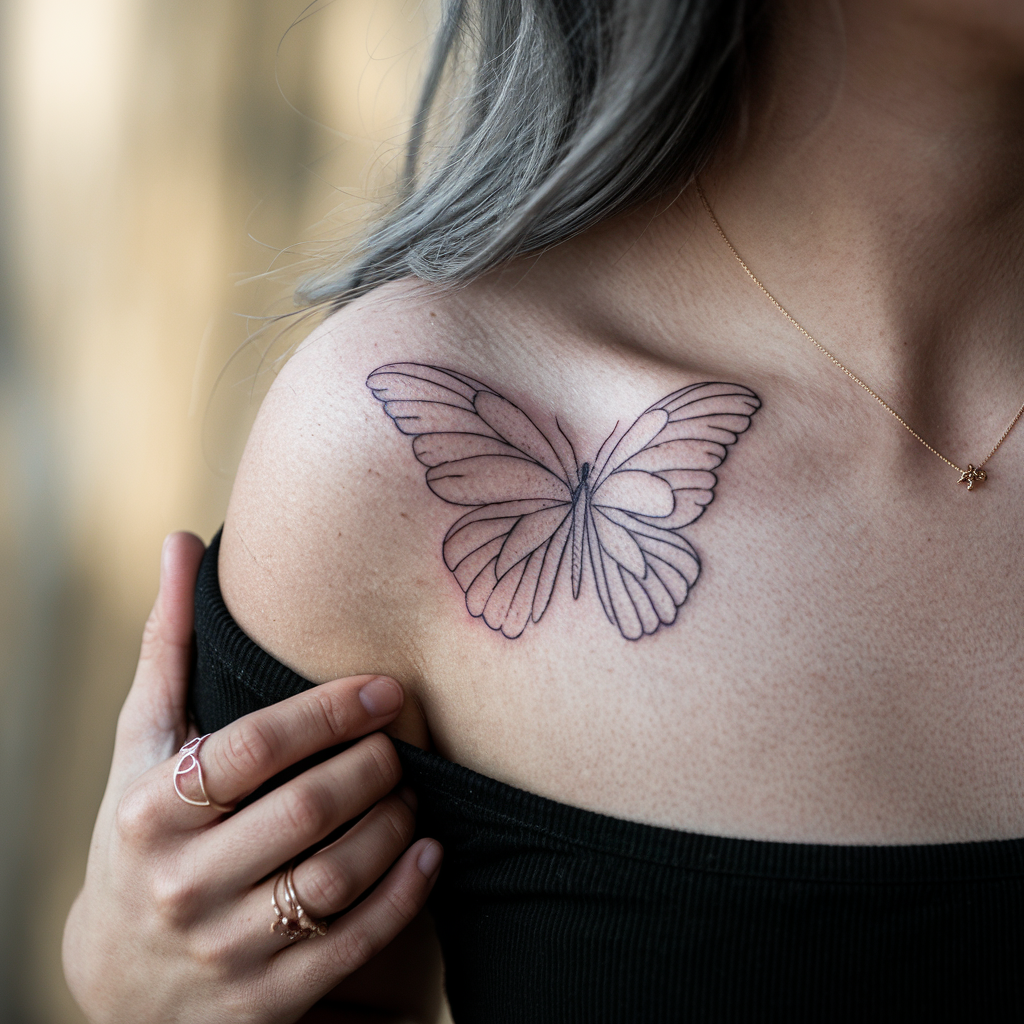
Design-wise, you have two directions. Realistic butterfly wings with full pattern detail, or a fine line outline that suggests the shape and leaves the rest to negative space.
Be aware that fine line butterfly wings are the most touch-up-prone piece in this entire list. Thin lines on the spine sit over bone with very little fat underneath, and in my experience those lines soften faster than the same work on a fleshier area. If you like the delicate insect look, moth tattoo designs use heavier line weight and hold up better.
3. Dragon Wings
Dragon wings swap feathers for membrane, and that single change makes them dramatically easier to age well.
Instead of dozens of small overlapping shapes that can blur together, you get a handful of large panels separated by heavy bone struts. That is a structure that survives ink spread.
The detail that sells a dragon wing is the finger bones — the long ribs radiating from the shoulder joint out to the wing tips. Get those spacing and taper right and the wing looks anatomical rather than decorative.
Dragon wings also scale up better than almost anything else here. They work at forearm size and they work as a full back piece, which is not true of fairy wings or fine line butterflies. Eastern styling is a different look entirely, closer to Chinese dragon spine tattoo designs, where the body does the work and the wings are secondary.
4. Fairy Wings
Fairy wings are the most delicate option on this list, and the trade-offs come with that.
The whole effect depends on suggesting transparency — thin outlines, sparse dotwork, a lot of untouched skin standing in for translucent membrane. It is beautiful fresh and it is genuinely fragile over time.
If you want this look to last, two things help. Keep the piece large enough that the internal spaces stay open, and keep it off high-friction, high-sun areas like the outer forearm and the tops of the shoulders.
I would also push back gently on the very tiny versions. A fairy wing at two inches has no room for the negative space that makes it read as a wing at all. For the full character rather than just the wings, fairy tattoo ideas covers more ground.
5. Phoenix Wings
Phoenix wings are the most ambitious piece here and the one most likely to go wrong in the wrong hands.
They are not really feathers. They are flame shapes arranged in a feather pattern, which means the artist has to sell two things at once — the sweep of a wing and the movement of fire.
That takes hours. A full-back phoenix is a multi-session project, and colour versions add sessions on top of that because the reds and oranges usually need a second pass to reach full saturation.
If you are considering one, look at healed photos of the artist’s work, not fresh photos. Fresh phoenix wings look spectacular on almost anyone; healed ones separate the artists who understood spacing from the ones who did not. Phoenix tattoo designs shows how much variation there is in how the wings get handled.
6. Bat Wings
Bat wings are the most practical choice on this list, and I think they are underrated for it.
Solid black, clean membrane edges, no fine detail to lose. This is the wing style that will look closest to its original state in twenty years.
The look leans gothic, but it does not have to. Stripped back to just the silhouette, a small pair of bat wings behind the shoulders is quite subtle and sits under most clothing.
One practical note — large areas of solid black take longer to heal than line work and tend to be more tender for the first few days. Plan for that. If you like the aesthetic, bat tattoo designs shows how the wings look attached to the full animal.
7. Tribal Wings
Tribal wings abstract the shape down to bold curves and sharp points, and the result is a piece that reads from across a room.
The strength here is line weight. Thick black strokes with clear gaps between them are about as durable as tattooing gets, which is why genuine tribal work from decades ago still looks sharp.
The weakness is that tribal is a style with real cultural roots, and a lot of what gets sold as “tribal” is a generic pattern with no connection to any of them. If a specific tradition matters to you, say so at the consultation and find an artist who works in it.
Otherwise, treat it as a graphic style rather than a cultural one and be honest about that. Tribal tattoo designs covers the range of what is out there.
Variations Worth Considering Before You Commit
Not every wing idea has to be a full pair of wings on a back. A few alternatives come up often enough in consultations that they are worth naming.
Single wing instead of a pair
One wing on one shoulder blade. Half the cost, half the sitting time, and no symmetry problem to solve.
It also reads as intentional rather than incomplete when the anchor point is placed properly against the spine.
Wing-tipped lettering or dates
A short line of text with small wings on either end. Common as a memorial piece and much less demanding than a full wing design.
Keep the wings simple here — detailed feathers competing with letterforms usually makes both harder to read.
Wings built from another subject
Feathers made of flowers, book pages, musical notes, or geometric shapes. This is where wing tattoos get genuinely personal.
The rule is the same as always: whatever the feathers are made of, they still need visible gaps between them.
Wings as part of a larger scene
Angel wings behind a figure, a bird mid-flight, a phoenix rising out of flames. The wings stop being the subject and become part of the composition.
This is usually the better route if you want a large piece, because the surrounding elements give the artist somewhere to put the negative space.
Practical Advice Before and After You Get Inked
Bring reference images of healed tattoos to your consultation, not just fresh ones. Fresh photos hide exactly the spacing problems you are trying to avoid.
Ask the artist to place the stencil and then move — roll your shoulders, raise your arms, twist. A wing that looks right standing still and folds awkwardly when you move is a stencil problem, not a tattoo you have to live with.
For healing, follow the aftercare your artist gives you rather than advice from the internet, including this article. They know what ink and technique they used on you. General guidance from the American Academy of Dermatology is a reasonable baseline, but it does not replace shop-specific instructions.
Sun is the single biggest long-term threat to a wing tattoo, especially on the shoulders and upper back where most of these sit. Once healed, sunscreen on the piece is the cheapest touch-up prevention there is.
If you notice spreading redness, swelling that worsens after the first few days, discharge, or fever, that is not normal healing — contact your artist and see a doctor. The Mayo Clinic overview of tattoo risks covers the warning signs. Never attempt to treat a suspected infection or remove a tattoo yourself.
Still Not Sure? Common Mistakes to Avoid
The most common mistake I see is going too small. Wings are a shape defined by the space inside them, and below a certain size that space disappears.
The second is choosing a placement for how it looks in a mirror rather than how it sits on the body. The upper back and shoulder blade suit wings for anatomical reasons — flat, broad, and shaped like the thing you are drawing.
The third is booking on a deposit before seeing the artist’s healed work. Ask directly. Any artist worth your money will have healed photos and will be happy to show them.
And the fourth is treating symmetry as free. It is not — matched pairs cost more time and more skill. If budget is tight, a single wing is a better use of it than a rushed pair. If you are weighing placement more broadly, shoulder tattoo ideas is useful for seeing how these shapes sit on real bodies.
Frequently Asked Questions
How painful is a wing tattoo?
It depends almost entirely on placement rather than the design. The fleshy part of the upper back and outer shoulder is generally considered one of the more tolerable areas, while ribs, spine and anywhere directly over bone tend to be significantly sharper. Most people describe the shoulder blade as manageable in two to three hour stretches. If you are worried, ask your artist to break the work into shorter sessions rather than pushing through one long one.
How much does a wing tattoo cost?
There is no fixed answer, because shops price by hour or by piece and rates vary widely by city and by artist reputation. What you can control is the scope: a single wing costs roughly half what a matched pair does, and bold styles like tribal or bat wings take fewer hours than detailed feather work. Ask for a written quote at the consultation that specifies whether touch-ups are included. Most shops include one free touch-up within a few months, but confirm rather than assume.
Do wing tattoos blur over time?
All tattoos soften with age as ink spreads slightly in the skin, and wing tattoos show it more than most because they rely on gaps between feathers. Designs with heavy line weight and generous spacing — bat wings, tribal wings, bold dragon wings — hold their shape best. Fine line fairy and butterfly wings tend to need touch-ups soonest. Sun protection makes a real difference either way.
Where is the best place on the body for wings?
The upper back and shoulder blades are the most common answer, because the anatomy matches the design and the flat broad surface lets a wing sit without distorting. The spine works well for vertical designs like butterfly wings. Forearms and calves can work for single wings, though the curved surface means the artist has to plan for how the shape wraps. Talk placement through with your artist before you settle on a size.
Can a small wing tattoo work, or does it have to be large?
Small wings can absolutely work, but only in styles built for it. A simple silhouette, a pair of small bat wings, or a minimal outline all read clearly at a few inches. What does not work small is anything depending on internal detail — layered feathers, phoenix flame patterns, translucent fairy wings — because that detail closes up as the tattoo heals and ages. Pick the style to suit the size rather than shrinking a detailed design.
Quick Summary
- Placement beats style. A wing anchored to the shoulder blade or spine will always read better than the same design dropped on a flat surface.
- Leave more space between feathers than looks right on paper — skin closes that gap over the years.
- A single wing is usually a stronger and cheaper choice than a matched pair, and it leaves room to expand later.
- Bat wings and tribal wings age best; fine line fairy and butterfly wings need the most touch-ups.
- Phoenix wings are the biggest commitment here — expect multiple sessions and vet the artist on healed work.
- Dragon wings scale from forearm to full back better than any other style on this list.
- Ask for healed reference photos, not fresh ones, before paying a deposit.
- Follow your artist’s aftercare, use sunscreen once healed, and see a doctor for any sign of infection.