I have been collecting raven reference photos for years, and the thing that keeps surprising me is how differently the same bird reads depending on how it is drawn. A raven tattoo is one of the few designs that can look scholarly, mournful, protective or genuinely menacing without changing a single element of the anatomy.
The silhouette does most of the work. A hooked beak, a wedge tail and a heavy shoulder line are enough for anyone to recognise the bird, which is why ravens survive being shrunk down to a two-inch wrist piece.
That range is also what makes the design hard to commission. When I have talked to artists about it, the first question is almost always about tone rather than style, in much the same way that crow tattoo ideas split along a completely different mood line.
Below are 46 designs I have pulled together, grouped by the approach that actually determines how the piece ages, plus the practical notes I wish someone had given me the first time.
Which Raven Tattoo Style Is Right for You?
This is the comparison I sketch out for anyone who asks me where to start. Sizes are the smallest I have seen artists agree to without losing detail.
| Style | Mood It Reads As | Smallest Practical Size | How It Ages |
|---|---|---|---|
| Black and grey realism | Sombre, cinematic | 5–6 in | Soft shading blurs first; needs size to survive |
| Blackwork / solid black | Bold, graphic, slightly ominous | 3 in | Best long-term hold of any option here |
| Fine line / minimalist | Quiet, personal, modern | 1.5–2 in | Thin lines widen; expect a touch-up eventually |
| Geometric | Clean, abstract, contemporary | 3–4 in | Holds well if the facets are not too fine |
| Celtic / Norse knotwork | Ancestral, mythic | 4 in | Knot gaps close up if drawn too tightly |
| Tribal | Powerful, decorative | 4 in | Very durable, but hardest to cover later |
What the Raven Actually Means
Ravens carry more cultural weight than almost any other bird, and the meanings genuinely contradict each other depending on which tradition you are drawing from.
In Norse myth, Odin keeps two ravens, Huginn and Muninn — thought and memory — who fly out each day and report back. That is the source of the “wisdom” reading, and it is why the bird sits so naturally alongside Norse mythology tattoo ideas.
In Celtic tradition the association is darker and more martial, tied to the Morrígan and to battlefields. If that is the version you want, Celtic knot tattoo designs give you the visual language to signal it without a caption.
Then there is the literary raven — Poe’s 1845 poem did more to fix the bird as a symbol of grief and obsession in English than any myth did. Most people getting a raven today are somewhere between the Norse reading and the Poe reading, and the design should tell you which.
Worth knowing that the real animal earns the reputation. Common ravens are among the more cognitively capable birds studied, with documented tool use and play behaviour, as the Cornell Lab of Ornithology outlines. The symbolism is not purely invented.
Raven Tattoo Ideas by Style
These are grouped by approach rather than by body part, because the style is what you and your artist actually have to agree on first.
1. Realistic Raven Tattoos
Realism is the most requested version and the one I see go wrong most often, almost always because it was made too small.
A raven has a huge amount of feather structure around the throat and shoulder. Rendered properly that detail is what sells the piece; rendered at three inches it turns into a grey smudge within a few years.
If you want realism, budget for size before you budget for detail. Every artist I have asked about this has said the same thing — they would rather do a simpler bird large than a complex one small.
The strongest realistic pieces I have seen also give the bird something to stand on or fly against: a branch, a moon, a treeline. It gives the shading somewhere to go.
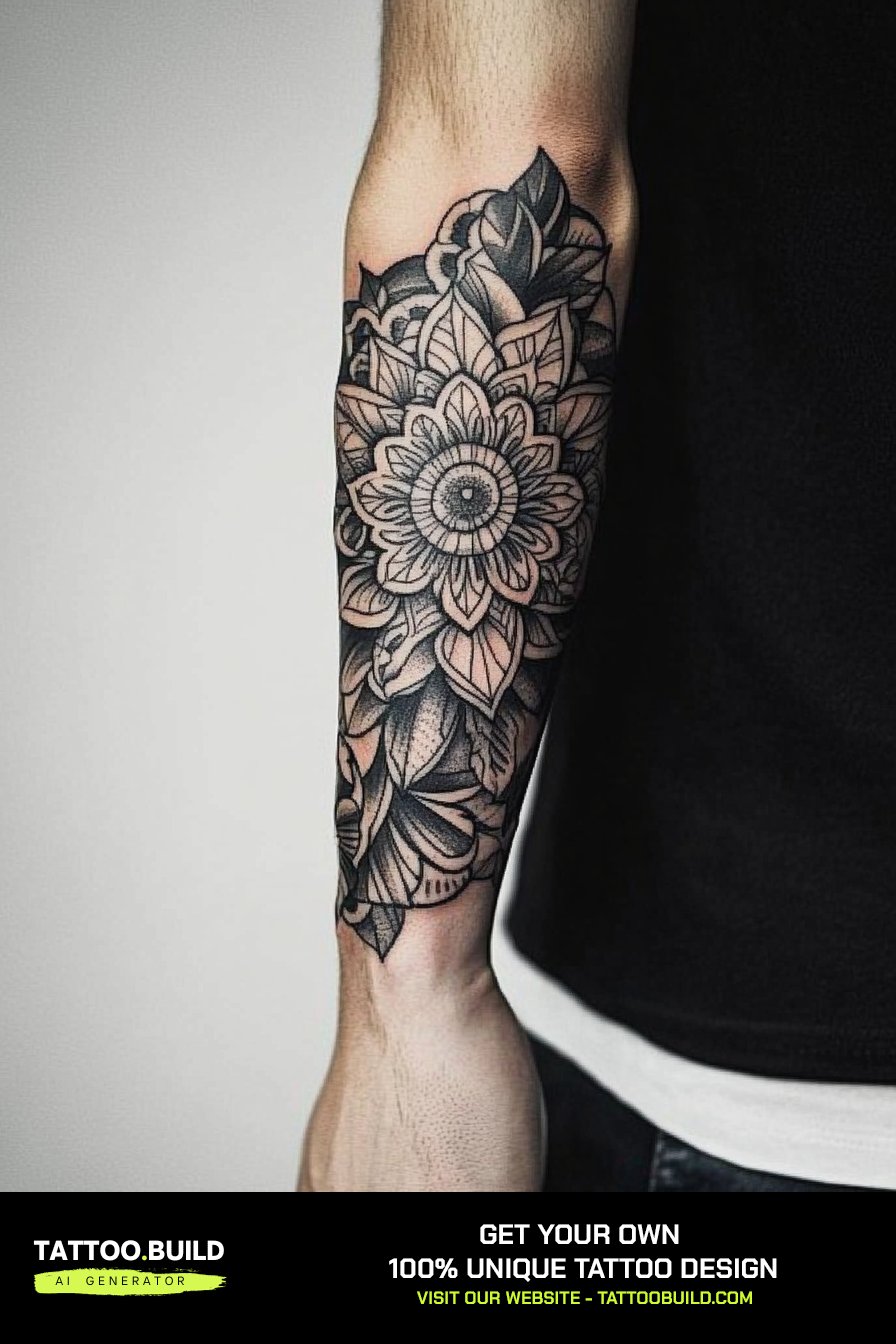
2. Geometric Raven Tattoos
Geometric treatments break the bird into facets, triangles or line bundles, and they read as modern in a way realism never does.
The trade-off is legibility. Push the abstraction too far and the raven stops being a raven — I have seen pieces that could just as easily be an eagle or a hawk.
The versions that work keep the beak and tail wedge intact and abstract everything else. That is the same discipline that makes geometric tattoo designs readable in general.
Dotwork shading inside the facets adds depth without adding colour, and in my experience it holds up better than fine grey wash at the same size.
3. Raven and Skull Tattoos
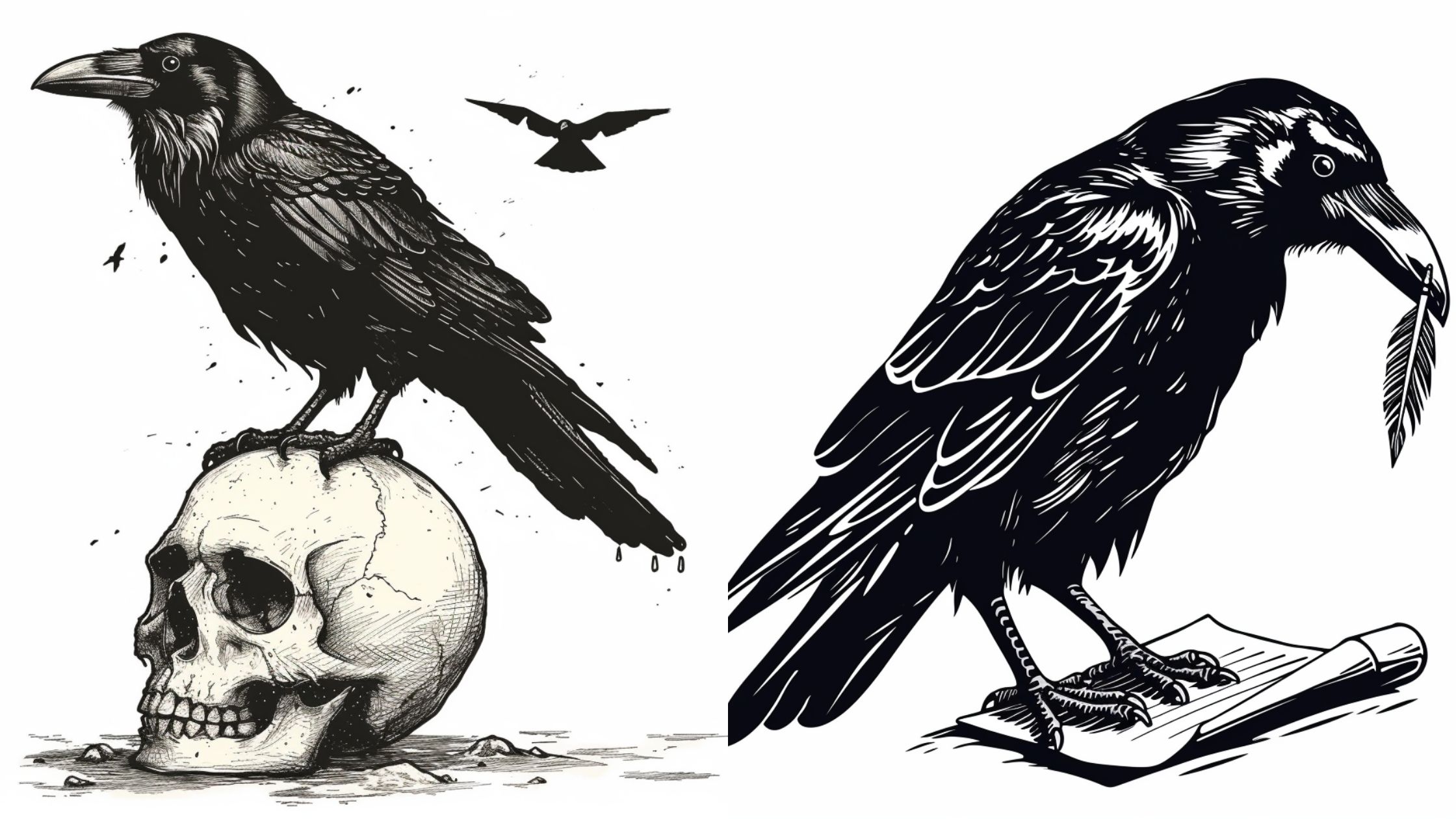
The raven-and-skull pairing is old, direct and completely unsubtle — which is exactly why people choose it.
The symbolism is the bird as a carrion animal and a psychopomp, present at the boundary between life and death.
Compositionally, the skull gives you a solid mass to balance the bird’s open shapes. It is the same structural logic behind most strong skull tattoo designs.
Have your artist decide early whether the skull or the bird is the focal point, because when both compete the piece reads as busy rather than dramatic.
4. Celtic and Norse Raven Tattoos
Knotwork ravens are a different discipline entirely. You are not drawing a bird so much as designing a pattern that resolves into one.
The critical detail is the gap between the interlaced bands. Tattoo ink spreads slightly over decades, and knotwork drawn too tight will close into a solid black blob.
I have been told by artists who do a lot of this work that they deliberately open the gaps wider than looks right on paper, specifically to account for that spread.
If you want the Odin reading rather than the Morrígan reading, two birds instead of one is the clearest signal you can give.
5. Raven and Moon Tattoos
The moon is the most common companion element, and it earns its place: a circle behind a bird is a genuinely good composition.
A full moon gives you a bright field to silhouette against. A crescent gives you a shape to fly through.
Stippled or dotwork moons age better than smooth grey-wash ones in my experience, which is worth knowing if you are browsing moon tattoo ideas for reference.
Ask for the moon to be slightly off-centre behind the bird — perfectly concentric versions look like a logo.
6. Minimalist and Fine Line Raven Tattoos
This is where the raven silhouette pays off. Almost no other bird stays recognisable at two inches with only a handful of lines.
Single-needle work like this is the most fashionable option right now and also the least permanent-looking.
Thin lines widen as they settle, so a hairline raven will read heavier in ten years than it does at the healed check-up. That is not a flaw, but it is the honest trade-off with all fine line tattoo work.
If you want minimal but durable, ask for a solid black silhouette rather than an outline — it holds its shape far better at small sizes.
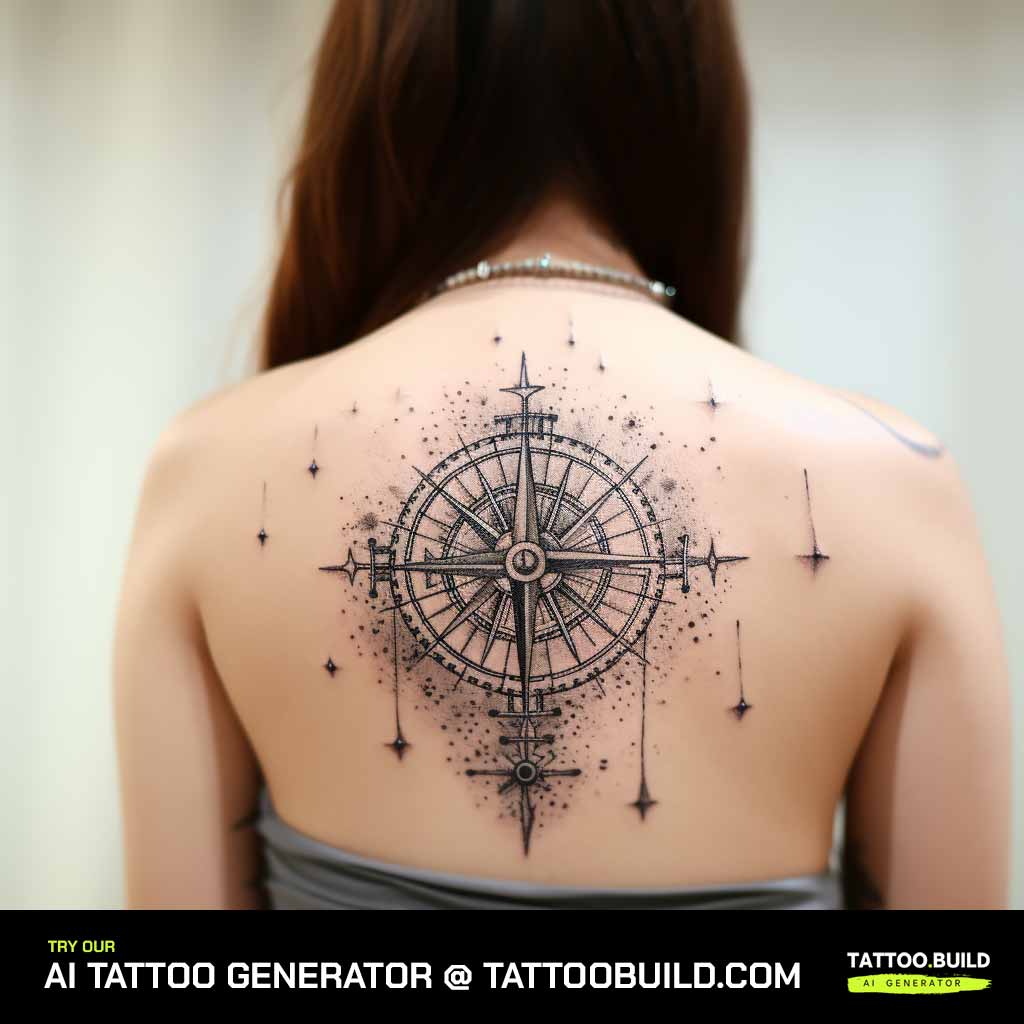
7. Raven and Compass Tattoos
The compass pairing turns the bird into a guide rather than an omen, which is a meaningful shift in tone.
It is a popular choice for travel and direction-related pieces, and it sits well on the forearm because the compass fills the width the bird leaves empty.
Map linework in the background is common and, done lightly, adds texture without competing. There are more layouts worth studying in these compass tattoo designs.
Keep the compass rose points crisp — soft points are the first thing that makes this combination look dated.
8. Raven, Books and the Literary Raven
This is the Poe branch, and it is quietly one of my favourites because it is so specific.
Books, newsprint, a quill, a candle — the props do the work, and the bird just has to be well drawn.
It also reads as personal rather than intimidating, which matters if you work somewhere that a skull-and-raven piece would not land well.
I have seen this done as a small forearm piece and as a full back panel, and it scales unusually well in both directions.
9. Tribal Raven Tattoos
Tribal treatments strip the bird to bold black shapes and negative-space cuts, and they are the most physically durable option on this page.
They also flow with the limb better than most styles, because the shapes can be stretched to follow muscle rather than sitting on top of it.
Two honest caveats. First, solid black is the hardest thing to cover or remove later. Second, some tribal vocabularies are culturally specific — if you are borrowing Polynesian or Haida forms, it is worth understanding what you are wearing, the same care that applies across blackwork tattoo designs.
Commit to tribal only if you are confident about the placement, because it is the least reversible choice here.
Placement Variations Worth Considering
Style decides the mood; placement decides how often you see it and how much it hurts.
Wrist and Ankle
Small, visible and the most common entry point for a first raven. Expect a shorter session and a faster heal.
Both areas move constantly, so silhouettes hold up better here than delicate outlines.
Back and Shoulder
The back is where a raven gets to be its actual size, with a full wingspan across the shoulder blades.
It is also the placement people regret least, in my experience, because you choose when it is visible.
Raven and Rose
A softer pairing that offsets the bird’s severity with something organic.
It is the version I would suggest to someone who likes the raven symbolism but does not want the piece to read as grim.
Practical Tips Before You Book
Bring reference photos of real ravens, not just other tattoos. Artists consistently produce better birds when they can see actual feather structure and posture.
Ask to see the stencil on your skin and move the limb before anyone starts. A raven that looks balanced flat can sit awkwardly once the arm bends.
Plan for a healed check-up at four to six weeks. Small gaps in blackwork and fine line work are normal and are usually touched up free, but only if you go back.
For aftercare, follow the specific instructions your artist gives you rather than anything you read online — including this page. If you see spreading redness, heat, swelling that increases after day three, or any discharge, that is a question for a doctor, not for a tattoo forum. Allergic reactions to pigment are uncommon but real, and they need a professional opinion.
Still Not Sure? Common Mistakes to Avoid
The most common one is picking a style from a photo of a fresh tattoo. Fresh work always looks sharper than healed work — ask your artist for healed photos of the same style.
The second is going too small for the level of detail requested. This accounts for most of the disappointing raven tattoos I have seen.
The third is choosing the bird before choosing the meaning. If you are still deciding, it is worth reading around bird tattoo meanings first — some of what people want from a raven is actually closer to an owl or a phoenix.
And if the darker symbolism is the whole appeal, the sister designs in this space are worth a look too before you commit.
Frequently Asked Questions
What does a raven tattoo symbolise?
It depends heavily on the tradition you are drawing from. In Norse myth the raven represents thought and memory through Odin’s birds Huginn and Muninn, which gives it a wisdom reading. In Celtic tradition it is tied to the Morrígan and to battle, which is considerably darker. Since Poe, it has also carried strong associations with grief and memory in English-language culture. Most modern raven tattoos sit somewhere between the wisdom and the mourning readings.
Is there a difference between a raven and a crow tattoo?
Visually, yes — ravens are larger, with a heavier hooked beak, shaggy throat feathers and a wedge-shaped tail, while crows are sleeker with a fan tail. Symbolically the two overlap a lot, though ravens tend to be read as more solemn and mythic and crows as more clever and mischievous. In practice many tattoos labelled as one are anatomically the other. If the distinction matters to you, bring reference photos and say so explicitly.
How much does a raven tattoo usually cost?
It varies enormously by artist, region and size, so any specific number would be misleading. What I can say is that the style you choose changes the hours more than the subject does — a small blackwork silhouette might be a single short session, while a realistic back piece is typically multiple full days. Most artists quote by hour or by day rate rather than by design. Ask for a quote range at the consultation rather than assuming.
Where is the best placement for a raven tattoo?
The forearm and upper arm suit the bird’s vertical shape well and are the most commonly chosen. The back gives you the space for a full wingspan and is the only placement where a large realistic piece really works. Wrist and ankle are fine for silhouettes but not for detail. Consider how visible you want it at work before you decide, since that is harder to change than the design.
Do raven tattoos age well?
Solid blackwork and bold tribal versions hold up best over decades. Fine line and single-needle ravens look excellent for the first few years but the lines widen as ink settles, so plan on a touch-up eventually. Black and grey realism ages well if it was done large enough and poorly if it was not. Sun exposure is the biggest controllable factor for all of them — sunscreen on a healed tattoo genuinely makes a difference.
Quick Summary
- Decide the tone first — Norse wisdom, Celtic battle, or Poe-style mourning — because it drives every other choice.
- Realism needs size. Under about five inches, ask for a simpler design instead.
- Blackwork and bold tribal are the most durable options over decades.
- Fine line ravens look best for the first few years and will need a touch-up eventually.
- The raven silhouette survives shrinking better than almost any other bird, so minimalist works genuinely well.
- Companion elements — moon, skull, compass, books — change the meaning more than the style does.
- Bring photos of real ravens, not just other tattoos, to your consultation.
- Book a healed check-up at four to six weeks, and take anything that looks infected to a doctor rather than a forum.