A daisy tattoo is one of the few floral designs that still looks like itself at half an inch and at half a forearm — and that is the whole reason it keeps showing up in artists’ portfolios year after year.
I have watched this design get requested more than almost any other flower except the rose. The daisy sits in a useful middle ground: recognisable enough to read instantly, simple enough that a good artist can shrink it without turning it into a smudge.
Below are the daisy tattoo directions I keep coming back to, from single fine-line blooms to full bouquets, along with the honest trade-offs for each. I have included what tends to age well and what does not, because that is the part most inspiration posts skip.
If you like the look of loose, unfussy florals in general, the same logic applies to wildflower tattoo ideas — daisies just happen to be the most forgiving flower in that family.
Which Daisy Tattoo Style Is Right for You?
Before scrolling through designs, it helps to know roughly what you are choosing between. Here is how the main daisy approaches compare on the things that actually matter.
| Style | Best Size | Typical Sitting | How It Ages | Best For |
|---|---|---|---|---|
| Minimalist fine line | 1–2 inches | Under an hour | Softens; may want a touch-up in time | First tattoos, discreet placements |
| Bold traditional | 3–5 inches | One to two hours | Very well — thick lines hold longest | Arms, calves, anyone wanting longevity |
| Black and grey realism | 4 inches and up | Two to four hours | Good if real contrast was built in | Forearm, thigh, upper arm |
| Watercolour | 3 inches and up | One to three hours | Fades fastest without a line anchor | Covered placements, colour lovers |
| Daisy chain / band | Wraps the limb | One to three hours | Well, if gaps were left between blooms | Wrist, ankle, upper arm bands |
| Bouquet or cluster | 5 inches and up | Three hours or more | Good when the silhouette is strong | Thigh, back, upper arm |
What a Daisy Tattoo Actually Means
The daisy has carried the same handful of associations for a very long time: innocence, purity, and new beginnings. Those readings come from folklore and the Victorian language of flowers rather than from any single fixed authority, so treat them as tradition, not doctrine.
The common lawn daisy’s English name comes from the Old English dæges éage, or “day’s eye,” because the flower opens at dawn and closes at dusk — a detail recorded in the Bellis perennis entry, and one I mention constantly because it gives the tattoo a second layer.
In my experience, the meaning someone brings to the flower matters far more than the historical one. Most people I have talked to chose a daisy for a person, a date, or a period they came out the other side of.
That is worth knowing before you commit, because meaning changes what the tattoo should look like. A daisy standing in for a childhood memory usually wants to be small and quiet. A daisy marking a hard year usually wants weight and size.
There is a practical layer too. The daisy is the birth flower for April, which is why it appears so often in family birth-flower pieces alongside the sweet pea.
Daisy Tattoo Ideas Worth Considering
Nine directions, roughly ordered from smallest and simplest to largest and most involved.
1. Minimalist Daisy Tattoo
A single bloom drawn in one consistent weight of line, no shading, no fill. This is the design I see requested more than any other floral.
It works because the daisy silhouette is already simple. Strip a rose down to line only and it turns into a scribble; strip a daisy down and it still reads as a daisy from across a room.
The catch is that fine line at very small sizes is the least permanent thing you can get. Lines placed close together will spread slightly as the ink settles, so ask your artist to leave visible gaps between petals rather than crowding them.
Placements that work: inner wrist, behind the ear, ankle, the side of a finger. Fingers look incredible on day one and then need honest maintenance — worth reading minimalist tattoo ideas before committing to a high-wear spot.
2. Daisy Chain Tattoo
A run of daisies linked stem to stem, wrapping the wrist, ankle, or upper arm like a bracelet. It is the design that most directly references the thing everybody actually did as a kid.
The chain is the most placement-sensitive design on this list. A band that wraps a limb has to account for how the skin moves, and a bloom sitting directly on the wrist or ankle bone will distort.
Every artist I have asked about wrap-around work says the same thing: leave a deliberate gap where the ends meet rather than forcing a perfect closed circle. A visible break looks intentional; a bad join looks like a mistake forever.
Sizing matters as much. Daisies much smaller than half an inch across tend to blur into a dotted line over the years, so scale up slightly if you want the chain to stay readable as a chain.
3. Realistic Daisy Tattoo
Black and grey realism, or full colour, with petal curl and centre texture rendered properly. This is the most technically demanding daisy here and the one where artist choice matters most.
A daisy is harder to render realistically than people assume. The petals are thin and pale, which means the illusion depends almost entirely on the shadows between and beneath them rather than on the petals themselves.
When I have compared realism florals that held up against ones that went muddy, the difference was almost always contrast. Pieces built with genuinely dark darks still read years on; pieces built entirely in mid-greys go flat.
Give it size. Under about four inches, realism detail has nowhere to live. Forearm, upper arm, and thigh are the placements that earn the sitting time.
4. Daisy and Butterfly Tattoo
The most requested daisy pairing, and one with an obvious thematic fit — the flower for new beginnings beside the insect for transformation.
The design risk is competition. A butterfly and a daisy are both busy, symmetrical, radiating shapes, and placed side by side at equal weight they fight each other for attention.
The fix is hierarchy: make one element solid and one open, or make one clearly larger. The versions I have liked best have a bold butterfly against an open daisy outline, or a fine-line butterfly resting on the bloom rather than floating next to it. The same balance problem shows up in rose and butterfly tattoo ideas, and the solution is identical.
Ribs, forearm, and shoulder all suit this pairing because they give the two shapes room to sit at different visual depths.
5. Daisy Bouquet Tattoo
Several stems gathered into one arrangement, sometimes daisies alone, more often daisies mixed with other florals. This is where a daisy tattoo becomes a real piece rather than an accent.
The single thing separating a good bouquet from a cluttered one is silhouette. Squint at the design on paper — if it reads as one coherent shape rather than a pile of flowers, it will read on skin.
Vary the bloom sizes deliberately. Bouquets where every daisy is identical look flat; one dominant bloom, two mid-size, and a few small buds gives depth without any shading trickery.
Expect three hours or more, and expect a second session for anything wrapping a thigh or covering the upper back. Sitting through a long floral piece in one go is possible, but it rarely produces the artist’s best work at the end of it.
6. Daisy and Name Tattoo
A daisy paired with a name — a child, a parent, someone lost. Of every design in this article, this is the one people are most certain about before they walk in.
Script is the weak point, not the flower. Thin, high-contrast lettering with delicate connecting strokes is exactly the kind of line that thickens and closes up as it settles.
Ask for slightly heavier lettering than looks right on the stencil, and keep it short. The longer version of this trade-off lives in our name tattoo ideas guide, but the short version is: fewer letters, thicker strokes.
Composition-wise, wrapping the name around the stem or curving it under the bloom looks more considered than parking the text beside the flower. It also half-hides the lettering, which a lot of people prefer.
7. Daisy and Quote Tattoo
A short line of text anchored by one or more daisies. Done well it looks like a page from a notebook; done badly it looks like a poster.
Length is the whole game. I have never seen a long quote tattoo that still read cleanly years later — the letters close in on each other and the line turns into a grey smear.
Three to six words is the range that survives. If the sentence matters more than the look, put it somewhere with room, like the inner forearm or ribcage. Our quote tattoo ideas guide covers the phrasing side in more depth.
Using a row of small daisies as an underline, rather than as decoration scattered around the text, is the composition I have consistently liked most. It gives the eye a clear line to follow.
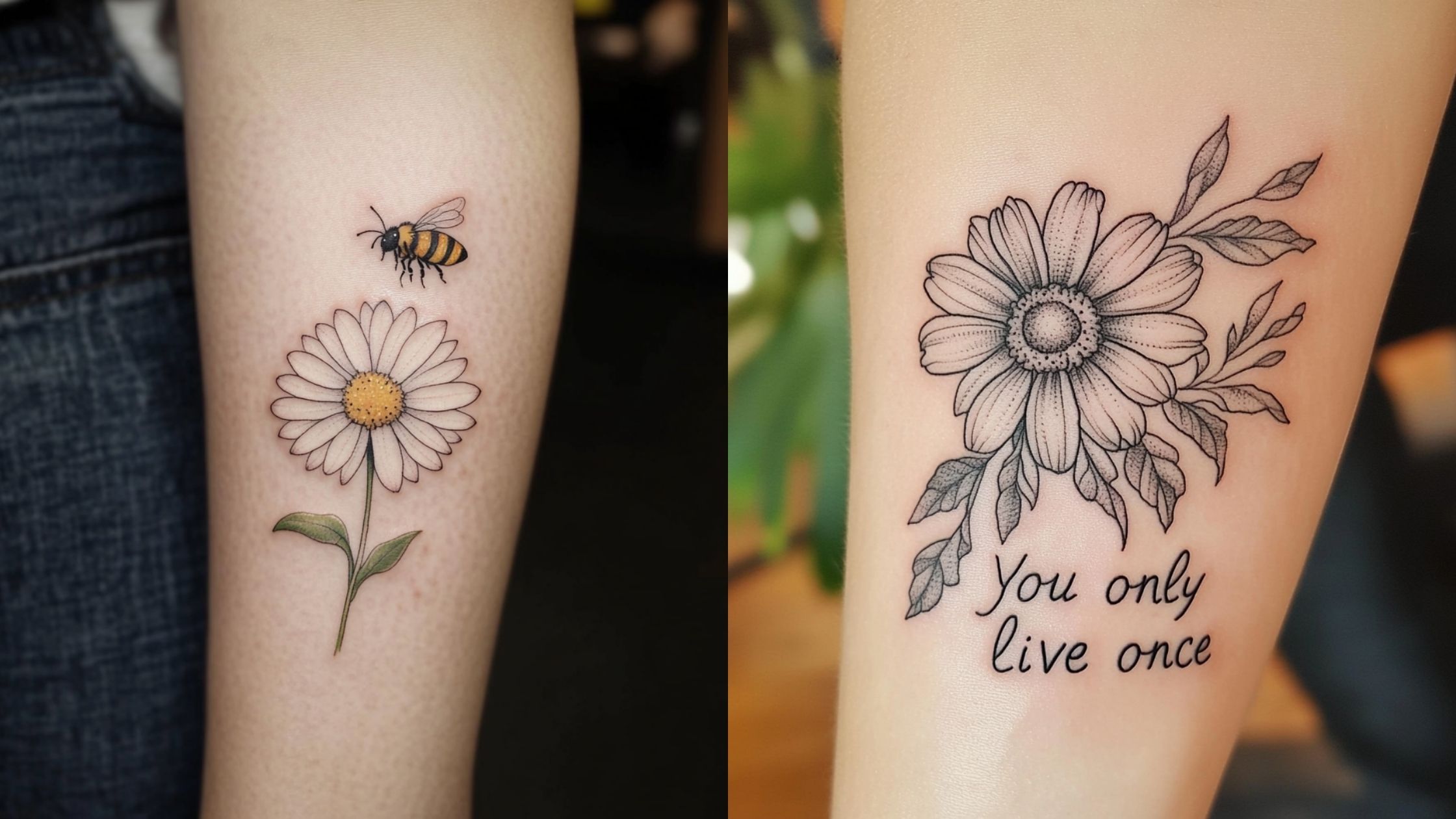
8. Daisy and Bee Tattoo
A bee approaching or landing on the bloom. It is a natural pairing, and unlike the butterfly, the bee is usually small enough that it never competes with the flower.
The detail that decides this one is the bee’s stripes. At very small sizes the stripes merge into a solid dark body and the bee stops reading as a bee at all.
My rule of thumb from looking at healed work: if the bee body is under about half an inch, ask for fewer, thicker stripes rather than accurate ones. Legibility beats accuracy every time. There are more variations in our bee tattoo design ideas.
Inner arm, shoulder, and forearm all work. The pairing also scales up nicely if you later want to build it into a larger nature piece.
9. Daisy and Sun Tattoo
A sun behind or around the daisy head, playing on the flower’s “day’s eye” origin. Of all the pairings here, this is the one with the tightest conceptual fit.
It is also the most graphic. Both shapes radiate from a centre, so the design lives or dies on whether the two sets of rays are clearly differentiated.
The versions I have liked best keep the sun as a bold, simple outline and let the daisy carry the detail — or the exact reverse. Never both. If you want to lean further into the celestial side, sun tattoo designs has more options.
Shoulder and upper back suit it best, because a radiating design needs a reasonably flat area to sit on without warping.
Daisy Tattoo Variations Worth Knowing About
If none of the nine above is quite it, these four adjustments cover most of what is left.
Watercolour Daisies
Loose colour washes with soft or absent outlines. Beautiful fresh, and the fastest-fading style on this page.
If you want it anyway, ask for a light line anchor underneath the colour so there is still a drawing when the wash softens. Watercolor tattoo ideas goes further into which versions survive.
Geometric and Blackwork Daisies
The daisy reduced to a circle and a set of even petal shapes, sometimes framed inside a ring or triangle.
This ages better than almost anything else here because it relies on solid shapes rather than fine detail. It also suits people who want a flower without a soft or delicate feel to it.
The Daisy as a Birth Flower
The daisy represents April, so it turns up constantly in family birth-flower pieces where each bloom stands for a different person.
The design question there is scale — a daisy next to a much larger chrysanthemum needs deliberate sizing to avoid disappearing. See birth flower tattoo ideas for how these get composed.
Colour Choices Beyond White
Gerbera and African daisies come in pink, orange, and deep red, so a coloured daisy is botanically honest rather than a stylisation.
Worth knowing: white ink is among the least reliable pigments in tattooing and often reads as scar tissue once healed. Most artists render white petals by leaving bare skin and shading around them instead.
Placement, Healing, and Aftercare
Daisies are usually small, which tempts people into high-movement placements — fingers, feet, inner wrist. Those spots take the most friction and hold ink the worst, so go in expecting maintenance.
Follow whatever aftercare your artist gives you over anything you read online, including this article. Broadly, the Mayo Clinic advises washing the tattooed area twice a day with soap and water, applying a mild moisturiser, and keeping it out of the sun until it heals.
Surface healing generally takes a couple of weeks; the deeper skin keeps settling for a month or two after that. Judging your fine-line daisy at day ten is judging it far too early.
If you develop spreading redness, swelling that increases rather than decreases, discharge, or a fever, contact a doctor — that is a medical issue, not a tattoo question. Pigment reactions are also possible, and the FDA notes that tattoo inks can cause allergic responses that sometimes appear well after the session.
Sunscreen once healed is the single highest-return habit for keeping a small black daisy crisp. UV exposure is what turns fine black line grey.
Common Mistakes — and What to Do If You Are Still Unsure
The mistake I see most is going too small. People pick a size based on how discreet they want the tattoo rather than on how much detail the design actually needs, and the design loses.
Second is bringing a reference photo of a fresh tattoo and expecting that result permanently. Fresh tattoos always look sharper than healed ones. Ask your artist for healed photos of their own work instead.
Third is over-filling. A daisy with every petal shaded and a fully packed centre has no breathing room, and blank skin inside a design is exactly what keeps it legible over time.
Still undecided on style? Fine line tattoo ideas covers the delicate end of the spectrum properly, including how those designs hold up once they have settled.
And if you cannot decide between a daisy and something else entirely, that is a good sign to wait. A design you are still thinking about in three months is a design worth getting.
Frequently Asked Questions
What does a daisy tattoo symbolise?
Daisies are traditionally associated with innocence, purity, and new beginnings, meanings that come largely from folklore and the Victorian language of flowers. They are also the birth flower for April, which is why they turn up in family birth-flower designs. In practice, most people I have spoken to attach a personal meaning — a person, a date, a fresh start — that matters more to them than the traditional reading. There is no single official meaning you have to adopt.
How small can a daisy tattoo be?
Around an inch across is where a simple outline daisy still reads clearly once healed. You can go smaller, and plenty of people do, but below that the petal gaps start closing as the ink settles and the flower gradually turns into a dot with a ring around it. If you want something under an inch, ask your artist to reduce the petal count rather than shrinking every detail proportionally. That keeps the shape readable for much longer.
Do daisy tattoos age well?
Bold-lined and blackwork daisies age very well because they rely on solid shapes rather than fine detail. Fine-line and watercolour versions soften noticeably faster, especially on hands, fingers, and feet. Sun exposure is the biggest single factor, so daily sunscreen on a healed tattoo makes a real difference. Most fine-line florals benefit from a touch-up at some point, and that is normal rather than a sign anything went wrong.
Where is the best place for a daisy tattoo?
Inner wrist, ankle, behind the ear, and the forearm are the most common placements, and all of them suit the daisy’s compact shape. For larger bouquets or realism work, the thigh, upper arm, and upper back give the design the space it needs. Avoid fingers and the sides of the feet if you want low maintenance, since friction there wears fine lines faster than anywhere else. Your artist can usually tell within a minute whether a placement suits the specific design you have brought in.
How much does a daisy tattoo cost?
Cost varies enormously by artist, city, and studio, so any specific figure here would be misleading. What is reliable is the structure: most studios have a minimum charge that covers small pieces, and larger work is priced by the hour or as a flat rate for the whole design. A simple fine-line daisy usually falls at or near the shop minimum, while a realism piece or a full bouquet is priced by session. Ask for a quote before booking — every reputable studio will give you one.
Quick Summary
- Daisies work at almost any size, which is why they suit both first tattoos and large floral pieces.
- Fine line is the most requested style and the least permanent — leave visible gaps between petals so it stays readable.
- Daisy chains need planning, with a deliberate gap where the band meets and no bloom sitting directly on a bone.
- Realism needs size and contrast — four inches and up, with genuinely dark shadows rather than all mid-grey.
- Pairings need a hierarchy: make the butterfly, bee, or sun either bolder or lighter than the flower, never equal.
- Keep script short and slightly heavier than looks right on the stencil, whether it is a name or a quote.
- White ink petals rarely work; most artists leave bare skin and shade around it instead.
- Sunscreen once healed is the single best thing you can do to keep a black daisy crisp.