I have lost count of how many people have walked into a studio with a phone full of One Piece screenshots and no idea which one to commit to. The One Piece tattoos that age well are almost never the ones that try to fit the whole crew into one piece — they are the ones built around a single symbol that means something specific to you.
Eiichiro Oda’s series has been running in Weekly Shōnen Jump since 1997, which means a lot of readers have grown up alongside Luffy. That length of attachment is exactly why the tattoos land differently from most anime work.
Below are 60+ design directions I keep coming back to, grouped by what they actually ask of an artist and of your skin. If you are still weighing anime work in general, our wider guide to anime tattoo ideas is a useful companion read.
I have tried to be honest about which of these are easy wins and which ones need a specialist. Not every idea here is a good first tattoo.
Which One Piece Tattoo Style Is Right for You?
Most of the decision comes down to three things: how much space you have, how much detail survives at that size, and how many sittings you are willing to book.
| Design Type | Best Placement | Rough Sitting Time | Ages Well? |
|---|---|---|---|
| Straw hat symbol | Inner forearm, ankle, ribs | 1–2 hours | Yes — simple shape, bold lines |
| Jolly Roger flag | Upper arm, shoulder, calf | 2–3 hours | Yes — high contrast holds up |
| Character portrait | Outer thigh, back, upper arm | 5–10 hours, often multiple sessions | Only with a portrait specialist |
| Ship and wave scene | Half sleeve, back, thigh | 8–20 hours across sessions | Yes if the composition is open |
| Devil Fruit | Forearm, shin, shoulder blade | 2–4 hours | Yes — colour needs occasional touch-ups |
| Fine line / minimalist | Wrist, behind ear, finger | Under 1 hour | Fades faster; expect a refresh |
Those sitting times are what I have seen quoted by artists for mid-sized work, not a guarantee. Your artist’s estimate beats any table on the internet.
Why One Piece Tattoos Carry More Weight Than Most Fan Art
The series has been serialised for well over two decades, and Oda built its emotional core around chosen family rather than power levels. That is the part people tattoo.
Almost every long-running arc ends with someone choosing loyalty at a real cost. When a client tells me why they want Ace’s mark or Nami’s pinwheel, the reason is usually a person, not a plot point.
That specificity is what separates a One Piece tattoo that still means something in ten years from a screenshot on skin. The design does not have to be complicated to do that job.
There is also a practical reason the series suits tattooing well. Oda’s character designs are built on strong silhouettes and flat colour, which is close to how traditional tattoo flash already works.
You can read the series legally through VIZ Media or Shueisha’s MANGA Plus if you want to go back and find the exact panel before you commit.
Popular One Piece Tattoo Designs
These are the design families I see most often, ordered roughly from easiest to hardest to execute well.
1. Luffy’s Straw Hat
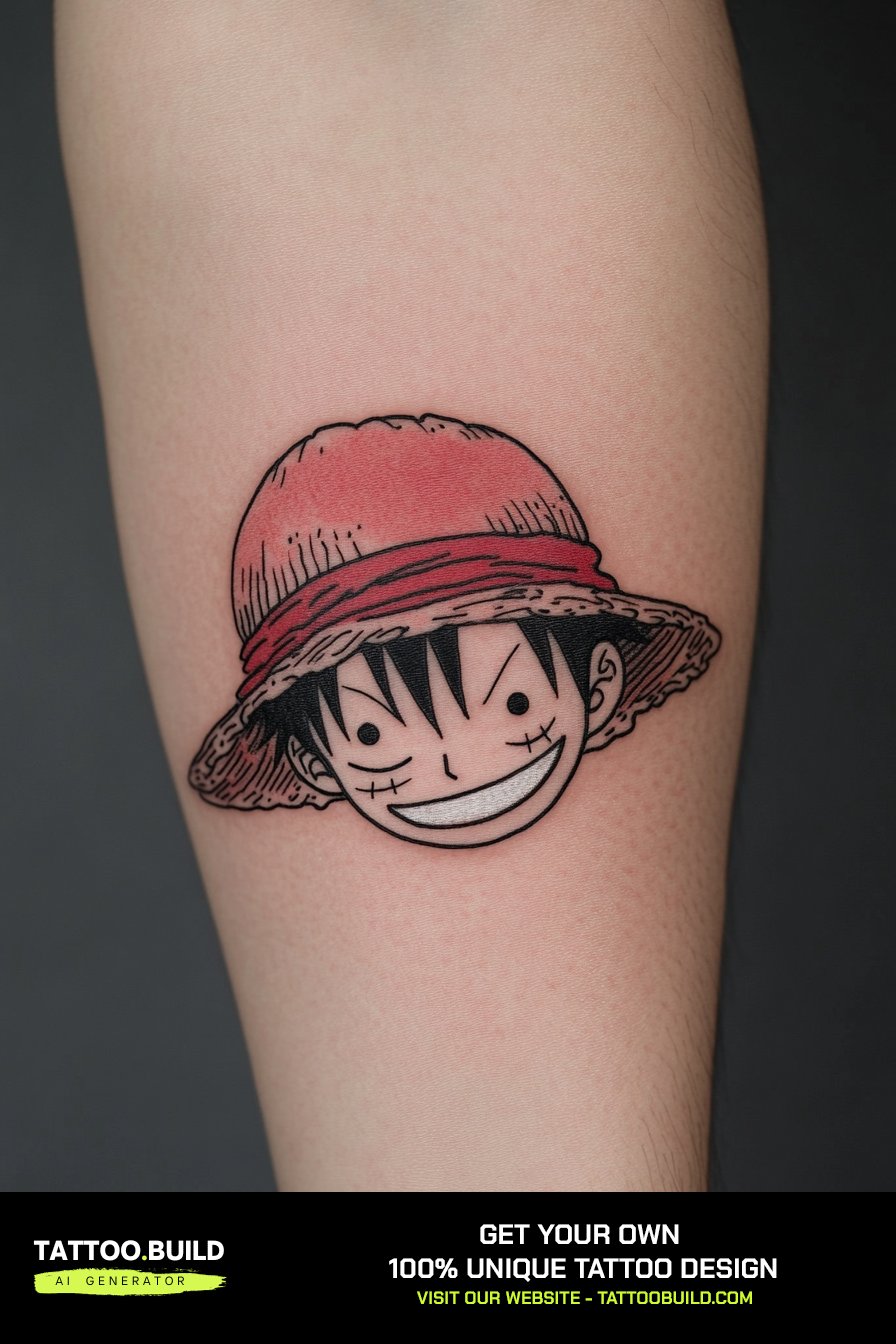
The straw hat is the single most requested One Piece tattoo, and for good reason: it is one shape, it reads at two inches or twelve, and it carries Shanks’ promise without needing a face attached to it.
In my experience the cleanest version is the hat alone in solid black with the red band as the only colour. Artists who try to render every strand of straw usually end up with a piece that blurs into a grey mass after a few years.
If you only want one One Piece tattoo, this is the safest bet. It sits well on the inner forearm, the ankle, and the ribs, and it pairs easily with script if you want a line of dialogue underneath.
A variation worth considering: the hat resting on a wooden post or hung on a hook, which nods to the moments in the story when Luffy hands it over rather than wears it.
2. The Straw Hat Jolly Roger and Crew Flags
Every crew in the series has its own Jolly Roger, and that gives you a whole catalogue of high-contrast, tattoo-ready designs before you even reach the characters.
The Straw Hats’ skull with the straw hat and crossbones is the obvious pick. Whitebeard’s crossed-bones crescent, the Heart Pirates’ smiling skull and Red-Haired Shanks’ three-scar flag all work just as well and are far less common.
When I tested placement options with a friend last year, the flag looked strongest on the outer upper arm where the curve of the muscle does not distort the skull’s symmetry. Forearms work too, but the design wants to be centred.
Solid black with a single spot colour is the version that holds up. If you like this kind of bold, graphic work, our skull tattoo ideas guide covers the same principles outside the One Piece universe.
3. Ace’s Back Tattoo and the Whitebeard Mark
Portgas D. Ace’s back piece is one of the few tattoos in the story that is itself a tattoo, which makes recreating it feel less like fan art and more like joining something.
The detail people miss: the ‘S’ in ASCE is deliberately crossed out, a tribute to Sabo. Get that wrong and every reader who sees it will notice.
Whitebeard’s purple bisected crescent is the other half of this pairing. I have seen it done small on a shoulder blade and large across the upper back, and both read cleanly because the shape is so simple.
Be aware that a full back piece is a serious commitment in both time and pain. Upper back sits high on most tattoo pain charts, and the lower back and spine are worse again.
4. Zoro and the Three-Sword Style
Zoro gives an artist something most anime subjects do not: strong diagonals. Three crossed katana build a composition on their own, with or without the character attached.
The swords-only version is underrated. Wado Ichimonji, Sandai Kitetsu and Enma stacked or crossed makes a clean vertical piece that fits a forearm or a calf without needing a portrait’s detail budget.
If you want Zoro himself, the classic pose with a blade held in his teeth is the recognisable one — but it needs a face, and faces need a specialist. I would rather see a good sword design than a mediocre likeness.
Black and grey suits this subject better than colour. The green hair is tempting, but green ink over a dark linework portrait rarely stays as vivid as clients expect.
5. The Going Merry and the Thousand Sunny
The ships are where One Piece overlaps most naturally with traditional tattooing. Nautical work has centuries of tattoo history behind it, and the Merry’s ram figurehead slots straight into that vocabulary.
Pairing either ship with Japanese-style wave work is the move I recommend most often. It gives the piece movement, fills negative space honestly, and lets the design scale up into a half sleeve later.
The Going Merry’s departure is the emotional peak of that arc for a lot of readers, and the burning-ship version of this tattoo carries that. It is heavy imagery — make sure you want to see it every day.
For the wave and background side of this, our Japanese tattoo designs guide and our ocean tattoo ideas collection are both worth a look before you brief an artist.
6. Devil Fruit Designs
Devil Fruits are the most tattoo-friendly object in the whole series. That swirl pattern is distinctive, compact, and abstract enough that it does not look like a screenshot.
The Gomu Gomu no Mi is the obvious choice, but almost any fruit from the story works, and a lot of people pick one whose power matches something about them rather than a favourite character.
This is the design I most often suggest to people who want a One Piece tattoo that non-fans will simply read as a stylised fruit. That discretion matters more to some clients than they expect.
Colour is worth the money here. A saturated purple or blue swirl with a clean black outline holds its shape far better than a soft watercolour version, in my experience.
7. Character Portraits: Nami, Robin, Sanji and the Rest
Portrait work is where budgets and expectations most often collide. A good anime portrait is a specialist skill, and the artists who do it well are booked out and priced accordingly.
Nami’s own tattoo — the pinwheel and tangerines she had inked over the Arlong Pirates’ sun mark — is a lovely piece of storytelling and much easier to execute than her face.
Every artist I have asked about anime portraits says the same thing: bring the highest-resolution reference you can find, and let them redraw it rather than copy it. A direct trace of a manga panel usually does not survive the transition to skin.
If you are building toward a larger composition of several crew members, treat it as a sleeve project from the start rather than adding characters one at a time. Retrofitting a sleeve almost always shows.
8. Chopper and the Lighter Side of the Grand Line
Not every One Piece tattoo has to be heavy. Chopper, the mini-Merry, or a simple Den Den Mushi snail all give you the series in a register that is warm rather than dramatic.
Chopper in particular is forgiving to tattoo. The design is already simplified, the colours are flat, and it looks right at small sizes where a human character would not.
These are also the designs that work best as matching pieces. I have seen siblings take a Chopper and a Luffy, and it worked far better than two halves of the same image would have.
If that is the direction you are heading, our matching tattoo ideas guide covers how to make two separate designs still read as a pair.
Alternatives and Variations Worth Considering
If none of the standard designs fit, these variations give you the same reference without the same commitment.
Minimalist Line Work
A single-line straw hat, a small Jolly Roger outline, or the crew’s X mark on the forearm — the one they drew on in Alabasta — all work at wrist or ankle scale.
Fine line work does fade faster than bold work, especially on hands and fingers. Plan on a touch-up every few years and it is a fine trade.
Script and Quote Tattoos
Lines from the series carry well on their own, particularly for people who want the reference to stay private. Keep the font simple and the line short.
If you use Japanese text, have a native speaker check it before the needle touches skin. I have seen more than one tattoo that did not say what its owner believed it said.
Blackwork and Negative Space
A solid black band with the straw hat cut out in negative space is a striking, modern take that avoids the fan-art look entirely.
This ages extremely well because there is no fine detail to lose. It is also difficult to cover or remove later, so be certain.
Practical Tips and Aftercare
Choose the artist before you finalise the design. A neo-traditional artist and an anime specialist will take the same brief in completely different directions, and both can be right.
Bring reference for the style as well as the subject. Showing three tattoos you like the finish of tells an artist far more than showing three screenshots of Luffy.
Follow whatever aftercare instructions your artist gives you over anything you read online, including this page. They know their ink, their machine and your skin. General guidance from the American Academy of Dermatology is a reasonable baseline, but it is not a substitute for their advice.
Colour work needs sun protection more than black and grey does. Once healed, high-SPF sunscreen on the piece is the cheapest thing you can do to keep it sharp.
If a healing tattoo becomes hot, increasingly painful, swollen after the first few days, or starts weeping pus, stop researching and see a doctor. Infection and allergic reactions to pigment are both real and both treatable early. Never attempt to treat or remove a tattoo yourself.
Common Mistakes and What to Do Instead
Cramming the whole crew into a forearm is the mistake I see most. Nine characters at that scale become nine grey blobs within five years.
Copying a manga panel line for line is the second. Print resolution and skin behave differently; a good artist will redraw the reference to work as a tattoo.
Picking a character because they are popular rather than because they mean something is the third, and it is the only one you cannot fix with a better artist.
Still not sure this is your subject? It is worth browsing wider before committing — our anime tattoo and Japanese style collections cover adjacent territory, and there is no deadline on this decision.
Frequently Asked Questions
How much does a One Piece tattoo cost?
It depends almost entirely on size, detail and your artist’s hourly rate, which varies enormously by city. A small straw hat symbol is usually a shop-minimum or single-hour job, while a multi-character portrait piece runs across several sessions. The honest answer is to send your reference to two or three local artists and compare quotes. Anyone who quotes a detailed portrait suspiciously cheap is worth a second look.
Do I need to be a fan of the series to get one?
No, though most people who get them are. Several of these designs — the Devil Fruit swirl, the ship-and-waves compositions, the nautical flags — stand on their own as artwork. That said, the tattoos that hold up emotionally are the ones tied to a specific reason, and the series is usually where that reason comes from.
Which One Piece tattoo hurts the least?
Placement matters far more than the design itself. Outer forearm, outer thigh and calf are generally reported as the more tolerable spots, while ribs, spine, sternum and inner arm are consistently ranked among the worst. A small straw hat on the outer forearm is about as gentle an introduction as this subject offers. Pain tolerance is individual, so treat any chart as a rough guide.
Will a colourful One Piece tattoo fade quickly?
Colour fades faster than black and grey in most cases, particularly reds, yellows and lighter tones. Sun exposure is the biggest factor you actually control. With consistent sunscreen and an occasional touch-up, a well-applied colour piece stays vivid for many years. Ask your artist how their specific inks have aged on past clients.
Can I add to a One Piece tattoo later?
Yes, but it is much easier if you plan for it from the beginning. Tell your artist at the first session that this may grow into a sleeve or a larger back piece, and they will leave the composition open. Adding pieces to a design that was drawn as a finished standalone almost always looks bolted-on.
Quick Summary
- Pick one symbol that means something specific to you rather than trying to fit the whole crew into one piece.
- The straw hat, the Jolly Roger and Devil Fruit designs are the most forgiving and the best value for a first One Piece tattoo.
- Ace’s ASCE back piece needs the crossed-out S to be correct — check your reference.
- Ship designs pair naturally with Japanese wave work and scale up into half sleeves cleanly.
- Character portraits need a genuine anime portrait specialist; budget for multiple sessions.
- Bold black with one spot colour ages better than heavy fine detail at any size.
- Plan for a sleeve from the first session if you think you will add to it later.
- Follow your artist’s aftercare instructions, and see a doctor for any sign of infection.