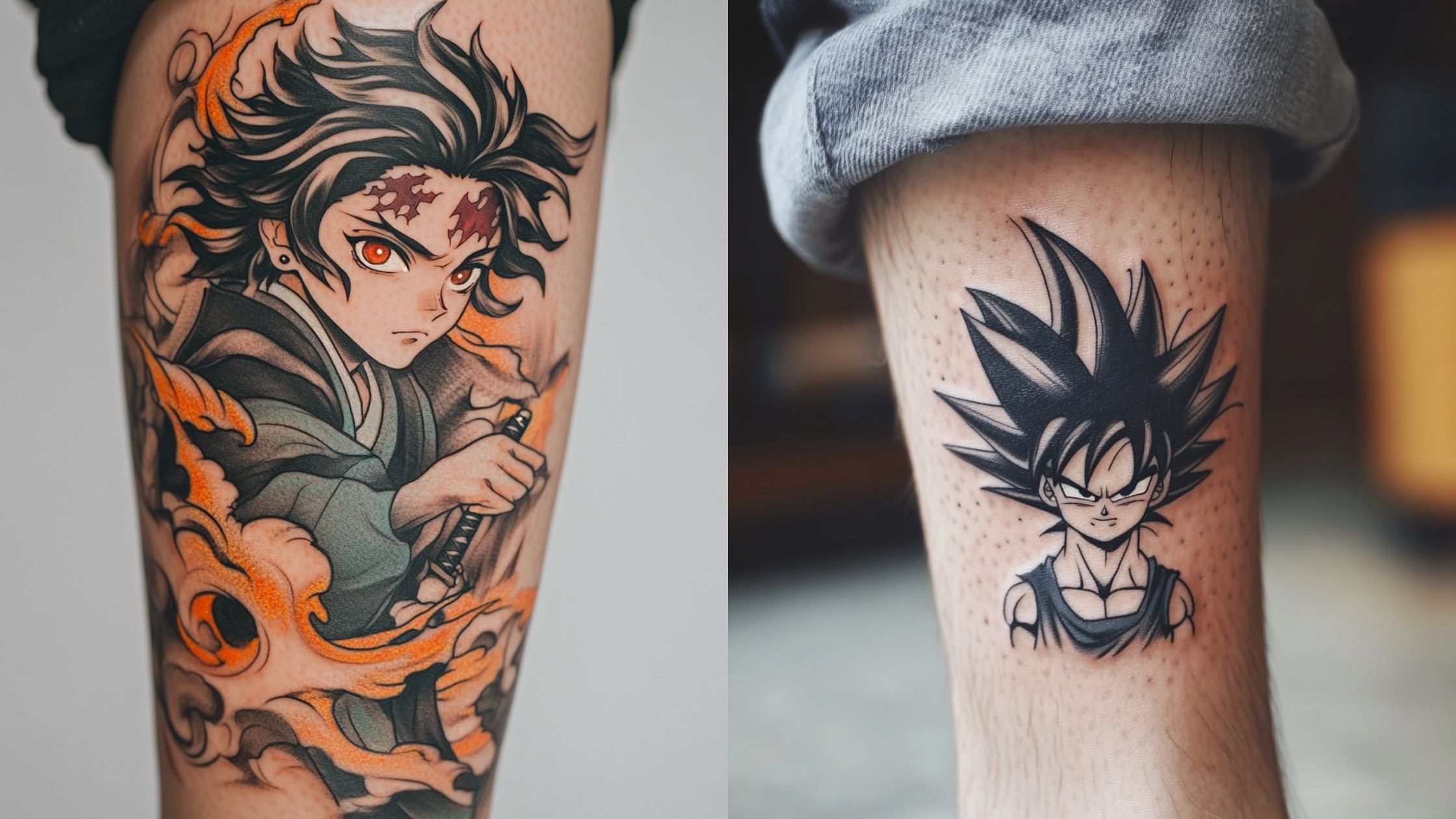
Anime tattoos look easy until you sit down and try to pick one. The designs that still look good five years later are almost never the most detailed ones — they are the ones with clean linework, real contrast and enough breathing room to age.
I have spent a lot of time in shops watching artists rework anime pieces that were packed too tightly, and the pattern is always the same. Too many characters, too little space, colour laid over colour.
This guide walks through the anime tattoo ideas that consistently hold up, the styles that suit different pain thresholds and budgets, and the questions I would ask an artist before booking. If you like bold Japanese-influenced work in general, the samurai tattoo ideas collection pairs well with anything here.
Everything below comes from designs I have seen healed in person, not from renders that only look good on day one.
Which Anime Tattoo Style Is Right for You?
Style matters more than subject. The same character can be a tiny wrist piece or a full colour thigh panel, and the two age completely differently.
| Style | Best For | Typical Session Length | How It Ages |
|---|---|---|---|
| Full colour anime | Character portraits, signature palettes | Several sessions for anything sleeve-sized | Needs the most sun protection; brights soften first |
| Black and grey anime | Dramatic scenes, faces, shading-led work | One to three sessions for a mid-size piece | Very forgiving if the contrast is strong |
| Manga panel / halftone | Recreating a specific page or frame | Usually one longer session | Dot shading can blur if placed too small |
| Minimalist / fine line | Symbols, silhouettes, subtle references | Often under two hours | Fine lines widen over time; keep gaps generous |
| Neo-traditional anime | Bold outlines with a painterly feel | Two or more sessions | Among the most durable options |
If you are torn, I would push you toward bold-line work almost every time. Contrast is what keeps a tattoo readable, not detail.
What Actually Makes an Anime Tattoo Age Well
Anime art is built for a screen or a printed page, where a hairline can be one pixel wide. Skin does not work that way.
Ink spreads slightly as it settles, so lines that sit too close together will eventually merge into a single dark mass. Most experienced artists I have talked to open up the spacing on a reference image before they even start drawing.
Size is the other half of it. A face that works at 12 cm across the forearm can turn into an unreadable smudge at 5 cm, no matter how skilled the artist is.
Then there is placement. Areas that get constant friction or heavy sun — hands, feet, outer forearms — fade faster than the inner arm, thigh or upper back.
If your artist suggests going bigger or simplifying the reference, that is usually them protecting the tattoo from your future self. In my experience the people who argue that point are the ones back for a rework in a few years.
Anime Tattoo Ideas That Consistently Work
These are the subjects I see healed well most often, and why they hold up.
1. Goku and Dragon Ball Z Tattoos
Goku is probably the most requested anime tattoo subject there is, and there is a practical reason it works so well.
The Super Saiyan silhouette is instantly recognisable even in pure black — the spiked hair does the identifying work, so the piece survives even when fine facial detail softens.
The strongest versions I have seen keep the aura as negative space rather than filling it with yellow, because untouched skin will always stay brighter than yellow pigment. Full colour Dragon Ball pieces can be stunning, but they ask more of you in sun protection.
Placement-wise, the outer forearm and upper arm both suit the vertical composition. A single Goku portrait usually fits comfortably in a session or two depending on size and shading.
2. Naruto Uzumaki Tattoos
Naruto pieces have a built-in advantage: the whisker marks, headband and swirl motif are strong graphic shapes that survive shrinking better than most.
That is why a Naruto tattoo can work small in a way that, say, a detailed mecha design cannot. The Konoha leaf symbol alone is a clean, readable option if you want something subtle.
When I have seen these go wrong it is almost always the eyes. Sharingan and Rinnegan patterns pack a lot of concentric detail into a small circle, and that is exactly the kind of geometry that blurs first.
Ask for the iris to be drawn slightly larger than the reference. It looks odd on paper and correct on skin.
3. Sailor Moon Tattoos
Sailor Moon designs pull in a different direction: soft palettes, crescent moons, stars and flowing hair.
The pastel look is genuinely beautiful, but pale pinks and light blues are the first pigments to lose punch, especially on sun-exposed skin. A thin black or dark violet line around the shapes keeps the design readable long after the pastels soften.
I like these on the thigh and outer shoulder, where there is room for the flowing composition and less daily sun. If you want the celestial elements without a character portrait, our moon tattoo ideas post covers a lot of that ground.
Pastel work is a maintenance choice, not just an aesthetic one. Be honest with yourself about sunscreen habits before you commit.
4. Crossover and Face-Off Tattoos
Putting two characters in one piece — Naruto against Goku being the classic — is the request I would think hardest about.
Two portraits mean two focal points competing for attention, and unless the composition gives one of them clear dominance the eye does not know where to land.
The versions that work usually stage it as a scene: one figure forward, one receding, with real depth between them. That takes space, which usually means a half sleeve or a thigh panel rather than a forearm.
If you like the idea but not the scale, a split design — two symbols rather than two faces — gets the same message across in a fraction of the real estate.
5. Demon Slayer Tattoos
Demon Slayer has become one of the most tattooed series of the last few years, and the visual language is unusually tattoo-friendly.
The checkered haori pattern, the water and flame breathing effects, the hanafuda earrings — these are all bold repeating shapes that read well at almost any size.
Breathing-technique wave and flame motifs are the standout to me, because they behave like traditional Japanese wave and flame work that has been proven on skin for centuries. They flow around a limb naturally rather than fighting it.
If you want to go deeper on this one series specifically, we have a dedicated Demon Slayer tattoo ideas guide.
6. Rick and Morty and Western-Animation Crossovers
Strictly speaking Rick and Morty is not anime, but the requests overlap constantly and the design logic is close enough to include.
New school and western-animation styles lean on thick outlines and flat colour blocks, which is about as durable as tattooing gets.
The portal green is the one thing I would flag. Bright greens can shift slightly as they heal, so ask to see healed photos of that specific ink rather than fresh ones.
These suit the forearm and calf well — both give a good flat canvas for bold graphic work.
7. Minimalist Anime Tattoos
Minimalist anime work is where I send most people getting their first piece.
A single symbol, a silhouette, a line-art profile — these are quick to sit through, cheaper, easier to place discreetly, and far less likely to disappoint you in a decade.
The catch is that fine lines widen as they settle. A design with 2 mm gaps between lines today may have noticeably tighter gaps years from now, so build in more space than looks necessary.
If this direction appeals, our minimalist tattoo ideas post go into placement and longevity in more depth.
8. Inuyasha and Classic Series Tattoos
Older series like Inuyasha bring a softer, more painterly art style, and that translates beautifully into black and grey or muted colour.
There is also a real advantage in the supporting imagery. Feudal-era backgrounds, the Tessaiga sword, sacred beads and cherry blossom framing all give an artist material to build a full composition around rather than a floating portrait.
A character with an environment around them almost always looks more finished than the same character on bare skin. That is the single biggest upgrade I would suggest to anyone planning a large anime piece.
These scale naturally into half sleeves. If that is the direction you are heading, the sleeve tattoo ideas collection is worth a look for layout inspiration.
Beyond Character Portraits
Not every anime tattoo needs a face in it. Some of the best ones I have seen contain no character at all.
Symbols and Emblems
Clan crests, guild marks and series logos are clean, graphic and endlessly scalable. They also read as abstract design to anyone who does not know the source, which some people prefer.
Quotes and Japanese Text
If you want Japanese script, have it checked by a fluent reader before the needle touches skin — not by a translation app. Mistranslated kanji is one of the most common tattoo regrets there is, and it is entirely avoidable.
Landscape and Scene Panels
A recognisable location from a series, rendered as a landscape, carries the same emotional weight as a character but ages far better. Wide shapes and open sky give the piece natural breathing room.
Objects and Weapons
Swords, keys, masks and talismans work extremely well as vertical forearm or spine pieces, and they sit comfortably next to traditional Japanese motifs like koi fish designs if you plan to expand later.
Aftercare That Actually Protects the Colour
Anime tattoos live or die on colour saturation, and aftercare is where most of that is won or lost.
Follow the specific instructions your artist gives you — they know what ink and technique they used. In general that means keeping it clean, keeping it lightly moisturised, and not picking at anything that flakes.
Sun is the long game. Once healed, daily sunscreen on exposed placements does more for colour retention than any product marketed as tattoo balm. The American Academy of Dermatology has straightforward guidance on caring for tattooed skin.
If you see spreading redness, swelling that worsens after the first few days, discharge, or a fever, that is not normal healing — see a doctor rather than asking online. The Mayo Clinic outlines the infection and allergic reaction risks worth knowing about, and the FDA publishes consumer guidance on tattoo ink safety. Nothing in this article is medical advice.
For a step-by-step walkthrough, our tattoo aftercare guide covers the first month in detail.
Common Mistakes and What to Do Instead
The mistake I see most often is bringing a screenshot and asking for it exactly as-is. A screenshot is a flat image; a tattoo wraps a curved, moving surface.
The second is going too small on a detailed subject to save money. That is the most expensive decision in the whole process, because reworking a blurred piece costs far more than sizing it properly the first time.
The third is choosing an artist by price rather than portfolio. Look specifically for healed anime or illustrative work in their gallery, not fresh photos. Fresh work always looks sharp; healed work tells you the truth.
If you are still weighing it up, it helps to know what you are signing up for physically and financially. Our most painful tattoo spots guide and the first tattoo guide are the two I would read next, and sleeve tattoo costs gives realistic expectations if you are thinking big.
Frequently Asked Questions
Do anime tattoos fade faster than other tattoos?
Not because they are anime, but because of how they are usually made. Bright colours and very fine linework are the two things that soften fastest on skin, and anime designs tend to feature both. A black and grey anime piece with strong contrast ages about as well as any other tattoo. Sun exposure and placement matter far more than subject matter.
How much does an anime tattoo cost?
It depends almost entirely on size, detail and your artist’s hourly rate, which varies enormously by city and by reputation. A small minimalist symbol may be a shop minimum, while a full colour half sleeve is a multi-session commitment. Ask for a quote based on a rough sketch rather than a screenshot. Most reputable artists will give you an honest session estimate up front.
Can I get an anime tattoo of a copyrighted character?
Getting one tattooed on yourself is very common and generally not something individuals run into problems over. The situation is different for commercial use, such as a shop using your tattoo in paid advertising. Some artists prefer to add their own interpretation rather than copy official art exactly, partly for this reason and partly for artistic ones. If it concerns you, ask your artist how they usually handle it.
What is the best placement for a first anime tattoo?
The inner or outer forearm, upper arm and outer thigh are the usual recommendations. They are relatively tolerable pain-wise for most people, they hold detail well, and they are easy to cover if you need to. Ribs, hands, feet and the sternum are generally reported as more painful and tend to age less predictably. Your artist can tell you which of your placements suits the specific design.
Should I go colour or black and grey?
Black and grey is the more forgiving choice and looks striking with anime’s dramatic lighting. Colour is worth it when the palette is genuinely part of the character’s identity, like Sailor Moon’s or Naruto’s orange. If you are unlikely to be diligent with sunscreen, black and grey will probably make you happier in ten years. There is no wrong answer, only different maintenance.
Quick Summary
- Pick contrast over detail — bold linework is what keeps an anime tattoo readable for years.
- Size up rather than down; shrinking a detailed reference is the most common regret.
- Black and grey ages more forgivingly than pastel or bright colour.
- Goku, Naruto and Demon Slayer motifs work well because their silhouettes are strong.
- Crossover pieces need space and a clear focal point, so plan for a half sleeve or thigh.
- Minimalist symbols are the safest starting point for a first tattoo.
- Have any Japanese text checked by a fluent reader, never a translation app.
- Daily sunscreen after healing protects colour better than any specialty balm.