A koi fish tattoo is one of the few designs that works at almost any size, in almost any style, and still carries the same meaning: you kept swimming when it would have been easier to drift.
I have been collecting, commissioning and writing about Japanese-influenced tattoos for years, and koi come up in more consultations than any other single animal.
Part of that is how well the shape fits the body. A koi is a long, curving comma, and the human arm, thigh and back are all long, curving surfaces.
This guide walks through the designs that actually hold up on skin, the styles worth comparing, placement notes I have picked up the hard way, and the questions artists get asked in every koi consultation. If you want to sketch before you book, our collection of koi fish tattoo drawings is a good place to gather reference.
Which Koi Fish Tattoo Style Is Right for You?
Before you talk placement, decide on style. It changes the price, the number of sessions and how the piece ages.
| Style | Best For | Ages Like | Commitment |
|---|---|---|---|
| Traditional Japanese (irezumi) | Large arm, back or leg pieces with wave and blossom background | Excellent — bold line and heavy black hold shape for decades | High: usually multiple sessions |
| Black and grey realism | Dramatic, smoky koi with soft water | Good, though soft grey washes lighten over time | Medium to high |
| Fine line / minimal | Forearm, ankle, ribs, first tattoos | Fair — thin lines can soften and blur | Low: often a single short sitting |
| Watercolour | Soft, painterly koi with bleeding colour | Weakest of the four unless anchored with line work | Low to medium |
| Neo-traditional colour | Punchy stylised koi with floral framing | Very good — strong outlines plus saturated colour | Medium |
What a Koi Fish Tattoo Actually Means
The core story is the Dragon Gate legend: koi swim up a river against the current, and the one that clears the waterfall at the top is transformed into a dragon.
That is where perseverance, transformation and earned reward all come from. It is a story about the climb, not the arrival.
Koi are also, in plain biological terms, ornamental carp bred in Japan for colour — you can read the background on koi as a species if you want the non-mythological version.
You will see a lot of confident claims online that a koi swimming up means one thing and a koi swimming down means the opposite. In my experience, artists treat direction as a compositional choice far more often than a coded message.
The same goes for colour meanings. Some collectors care deeply that a red koi reads as love or a black koi as overcoming hardship; plenty of others simply picked what looked best against their skin tone, and that is a legitimate answer too.
If the symbolism matters to you, say so at the consultation. If it does not, say that too — a good artist will design differently depending on the answer. The wider vocabulary of Japanese tattoo designs is worth reading through before you commit.
Koi Fish Tattoo Designs Worth Considering
1. Traditional Japanese Irezumi Koi
This is the reference point every other koi design is measured against, and for good reason.
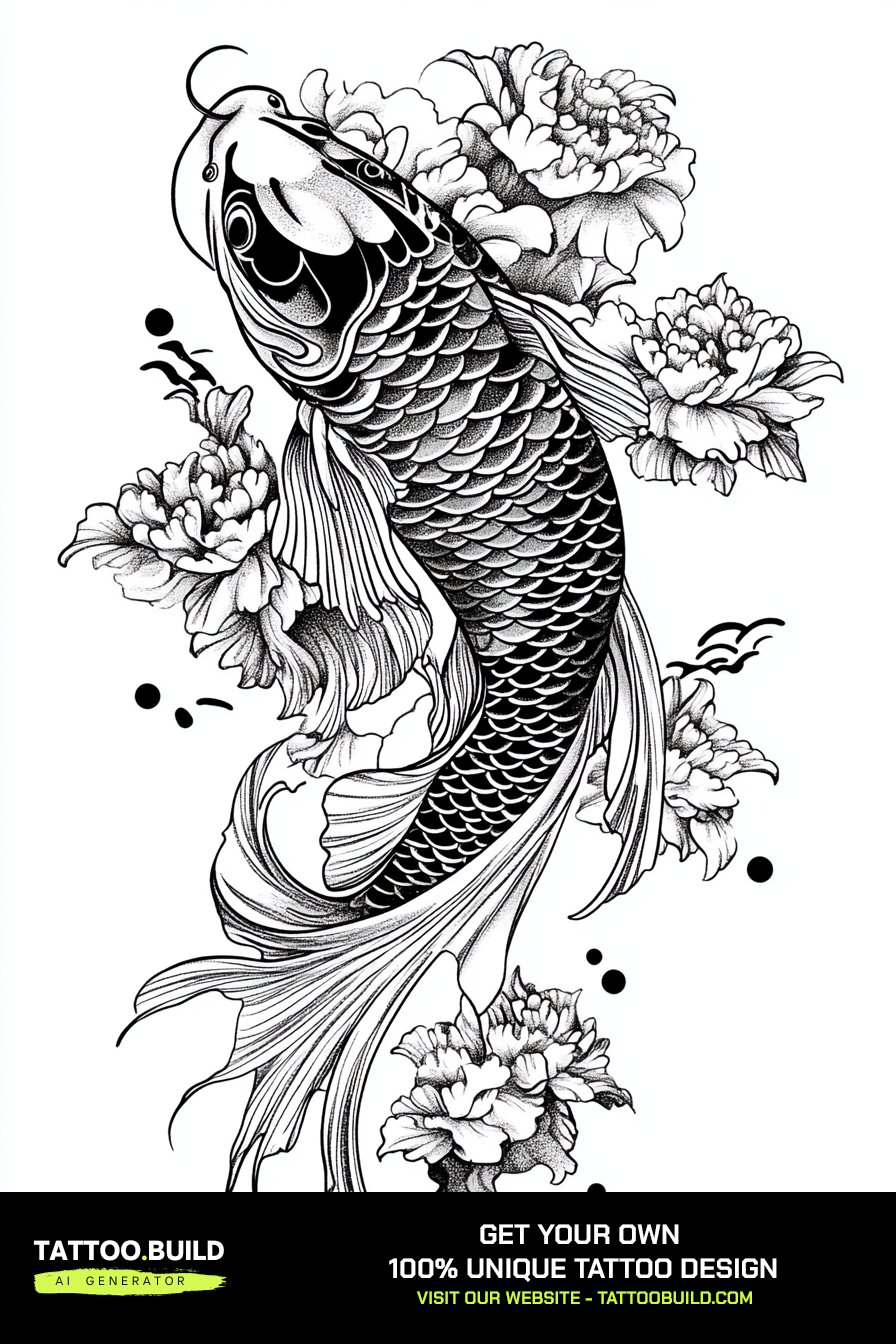
A traditional koi is drawn with a bold outline, individually rendered scales, and a background of stylised finger waves, wind bars or cherry blossom. The background is not filler — it is what makes the fish read as moving.
The single biggest quality difference I notice between a good irezumi koi and a mediocre one is whether the water was designed at the same time as the fish, rather than added afterwards to fill space.
These pieces are usually planned as a body-suit fragment — a back panel, a full sleeve, a hip-to-knee. Expect several sittings, and expect your artist to want to see the whole area rather than a rectangle of it. The tradition itself has a long and complicated history, summarised well in this overview of Japanese irezumi.
2. Black and Grey Koi
Dropping the colour does not weaken a koi tattoo. It changes what the piece is about.
Black and grey pushes the emphasis onto movement, water texture and the fish’s silhouette rather than its markings.
It is also the version I most often recommend to people with darker skin tones, because contrast comes from value rather than from pigment fighting the skin underneath — though a good artist working in colour can absolutely make it work, so ask to see healed photos on skin like yours.
The honest limitation: very soft grey washes fade lighter than people expect over ten or fifteen years. Ask your artist to keep some genuinely solid black in the composition as an anchor.
3. Koi and Floral Combinations
Pairing a koi with flowers is the most common way to soften an otherwise heavy design.
Lotus is the traditional partner — it grows out of muddy water, which rhymes neatly with the koi’s upstream struggle.
Cherry blossom is the other classic, and it changes the tone entirely: blossoms fall, so the piece starts speaking about impermanence rather than endurance. Both work; they just say different things.
The mistake I see most often here is equal weighting — koi and flowers competing for attention until neither wins. Pick a hero. Browse lotus flower tattoo designs and cherry blossom tattoos to see how the supporting element should sit back.
4. Fine Line and Minimal Koi
Not everyone wants a back piece. A small koi on the forearm, ankle or ribs is a perfectly serious tattoo.
The design problem is that a koi is defined by its scales, fins and whiskers, and all three disappear when you shrink the fish too far.
The fix that works: stylise rather than miniaturise. Suggest scales with a few marks, exaggerate the tail, and let negative space do the rest.
Be realistic about longevity. Very thin lines placed on high-friction spots — inner wrist, fingers, feet — soften faster than the same lines on a forearm. Every artist I have asked says the same thing: go a little bigger and a little bolder than feels necessary.
5. Koi Sleeves and Half Sleeves
The sleeve is where koi designs get to breathe.
A half sleeve — shoulder to elbow — is enough room for one koi at full size plus a proper water background, and it stops at a natural break in the body.
A full sleeve lets you run the fish diagonally so the head sits near the elbow and the tail wraps the shoulder, which is how the piece reads as a single image from every angle instead of a picture stuck on an arm.
Plan the whole sleeve before the first needle touches you, even if you pay for it in stages. Retrofitting a background around an isolated koi is the most common repair job I hear artists complain about.
Budget accordingly — our breakdown of how much a sleeve tattoo costs is a more useful starting point than guessing, and half sleeve tattoos for men shows how the composition is usually staged.
6. The Koi-to-Dragon Transformation
This is the design that tells the whole legend in one image: a fish whose head, whiskers or forelimbs have already begun turning draconic.
Done well, it is the most narrative koi tattoo you can get. Done badly, it looks like an artist could not decide which animal they were drawing.
The trick is committing to a single point of transition — usually the head — and keeping the body unmistakably koi.
This design needs an artist who draws dragons regularly, not just fish. Look through their portfolio for dragon tattoo work before you book, because the dragon half is where these pieces usually fail.
7. Placement Ideas for Women
Hip, thigh and outer arm are the placements I see requested most often, and all three suit the koi’s curve.
The thigh in particular is a genuinely good canvas: large, flat-ish, low friction, easy to cover, and it holds detail well over time.
The hip gives you a natural S-curve to follow, which means the fish can look like it is turning without the artist forcing the pose. It is also, in most people’s experience, a noticeably more tender area to sit through.
Whatever the placement, ask how the design will look when the limb is relaxed, not just stretched flat on the bench. That single question has saved more than one piece I have watched get designed.
8. Wrapped Arm and Forearm Koi
If you want one koi and nothing else, the forearm is hard to beat.
It is a flat enough surface to keep the fish undistorted, visible enough to enjoy, and easy to cover with a sleeve when you need to.
A wrapped bicep design is more ambitious: the fish disappears around the arm and reappears, which is genuinely striking but means part of the tattoo is never visible at once.
Ask for the stencil to be placed and then walk around a mirror before you commit. Wrapped designs look different in every direction, and the bench is the wrong place to find that out.
Variations Worth Asking Your Artist About
Two Koi Together
A pair of koi circling each other is a natural fit for round surfaces — shoulder cap, chest, back of the hand’s larger cousin the outer forearm.
People often read it as a yin-yang or a relationship piece. Just be aware that it doubles the detail you are asking the artist to fit into the same space.
Koi and Waterfall
Adding the waterfall makes the Dragon Gate story explicit rather than implied.
It needs vertical space, so it lands best on a back, a thigh or a full leg — anywhere the composition can actually go up.
Non-Traditional Colour
Blue, purple and deep green koi are increasingly common and look excellent when the water is kept desaturated around them.
If painterly colour appeals to you, look through watercolor tattoo ideas — but ask specifically for line work underneath, because unanchored watercolour is the style that disappoints people most a decade later.
Koi as a Cover-Up
Koi are one of the better cover-up subjects, because scales, waves and heavy black give an artist a lot of places to hide an old design.
Expect the new piece to be substantially larger and darker than what is underneath. That is not upselling; it is how cover-ups work.
Booking, Sitting and Aftercare
Choose the artist before the design. A koi drawn by someone who works in Japanese style every week will beat a better idea drawn by someone who does not — every time.
Ask to see healed photos, not fresh ones. Fresh tattoos all look sharp; healed work is where line quality and colour packing show themselves.
Eat properly beforehand and book long sittings earlier in the day. The main thing that ends a session early is the client running out of energy, not the artist.
For healing, follow the written aftercare your studio gives you rather than advice from the internet, because it is matched to the products they used on you. Keep it clean, keep it out of direct sun, do not soak it, and do not pick at flaking skin.
Some redness and swelling in the first days is normal. Spreading redness, heat, pus, a fever or a rash is not — see a doctor rather than waiting it out, and tell your artist as well. The FDA’s overview of tattoo safety and possible reactions is a reasonable plain-language starting point. Nothing in this article is medical advice.
Long-term, sunscreen is the single cheapest thing you can do to keep a colour koi looking like it did in year one.
Common Mistakes — and What to Do Instead
Going too small is the mistake I see most. A koi that fits on a business card loses the scales and fins that make it a koi.
Skipping the background is the second. An isolated fish on bare skin rarely looks finished, and adding water later is harder than designing it in.
Bringing a reference photo and asking for an exact copy is the third. Bring three or four references, explain what you like about each, and let the artist compose.
Still not sure a koi is your design? It is worth looking sideways at related subjects before you commit — flying fish tattoo meaning covers another water symbol entirely, and full sleeve tattoo ideas for women is useful if the scale is what appeals to you more than the fish.
Frequently Asked Questions
Does the direction a koi swims change its meaning?
You will find plenty of sources claiming that upstream means still striving and downstream means goals achieved. It is a popular reading, but it is not a fixed rule in traditional Japanese tattooing, and artists mostly choose direction to suit the body. If the interpretation matters to you personally, tell your artist which way you want it to swim and why. That intention is what makes it meaningful, not a universal code.
How big does a koi tattoo need to be?
Big enough that individual scales, fins and whiskers still read from arm’s length. In practice that usually means a forearm-length piece at minimum for a detailed koi. Smaller is possible, but only if the design is deliberately stylised rather than a shrunken version of a large one. Ask your artist to show you the stencil at the size you are considering before you decide.
How many sessions will a koi sleeve take?
It depends entirely on the artist’s speed, the amount of colour, and how long you can sit. A colour half sleeve is commonly staged across several sittings spaced a few weeks apart to allow healing between them. Your artist can give you a realistic estimate once the design is drawn, and that estimate is worth asking for at the consultation. Treat any promise of a full colour sleeve in one sitting with suspicion.
Do colour koi tattoos fade faster than black and grey?
Colour generally needs more protection than solid black, and lighter pigments tend to show fading sooner than dark ones. Sun exposure is the biggest single factor you actually control. Keeping the area covered or sunscreened makes a visible difference over years. A well-packed colour koi by a strong artist can still look excellent decades on.
Is a koi tattoo culturally inappropriate for non-Japanese people?
Opinions genuinely differ, and it is worth hearing them rather than dismissing the question. Many Japanese-style artists worldwide, including Japanese artists, tattoo koi on clients of every background and treat it as a shared visual tradition. Others feel the imagery deserves more context than a walk-in gets. The respectful path is to learn what the motifs mean, choose an artist who knows the tradition, and be able to explain your piece.
Quick Summary
- Koi symbolise perseverance and transformation, drawn from the Dragon Gate legend.
- Pick your style first — traditional, black and grey, fine line, watercolour or neo-traditional — because it drives cost, sessions and how the piece ages.
- Traditional irezumi koi need a designed water background, not one added afterwards.
- Black and grey emphasises movement and silhouette, and keeps strong contrast on any skin tone.
- Small koi should be stylised, never shrunk; thin lines on high-friction areas soften fastest.
- Plan a full sleeve as one composition even if you pay for it in stages.
- Thigh, hip and outer arm are the most forgiving placements for a curving design.
- Choose an artist by their healed Japanese-style work, follow studio aftercare, and see a doctor for anything beyond normal early redness.