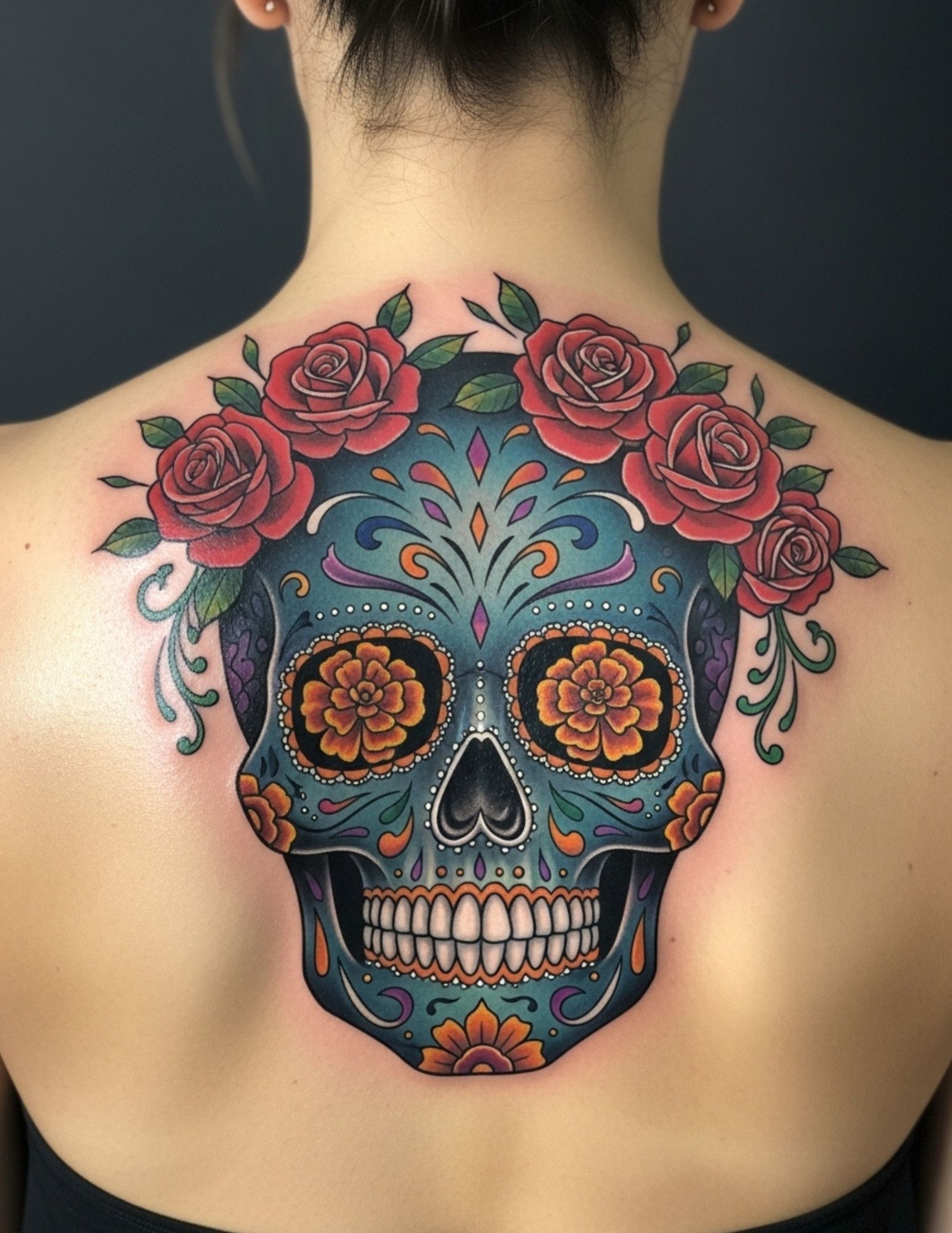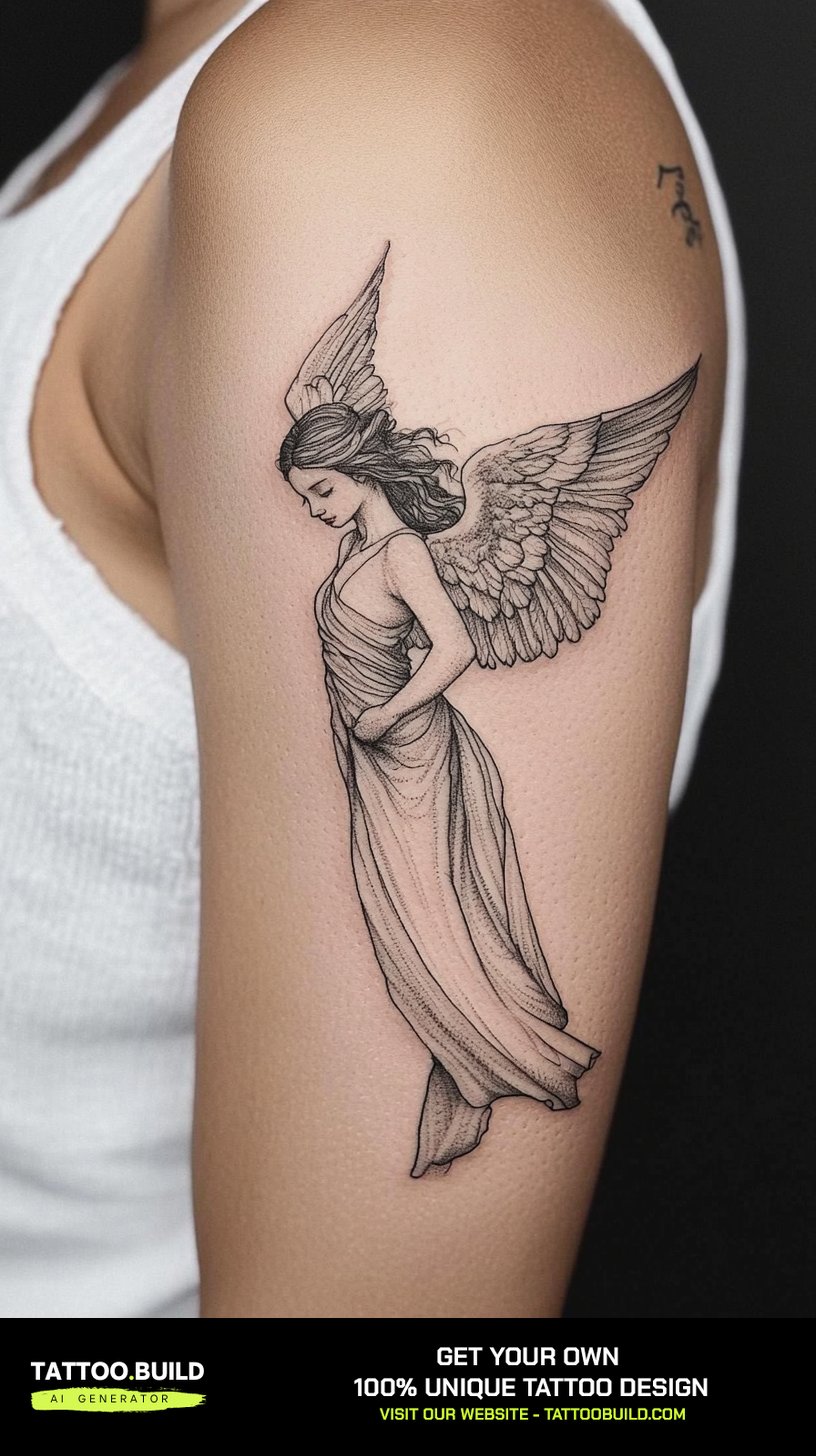
An angel tattoo works best when you decide what it is standing for before you decide what it looks like. The style, the size and the placement all fall into place much faster once that part is settled.
I have sat with a lot of women planning this exact piece, and the conversation almost always starts in the same place: a reference photo of a beautiful, heavily shaded angel saved from somewhere online.
That photo is a fine starting point. It is rarely the finished plan, because the thing that makes an angel tattoo age well is not the reference — it is the scale, the contrast and the artist you hand it to.
This guide walks through the styles worth considering, what each one costs you in healing time and touch-ups, and where these designs actually sit well on the body. If you want to sketch first, our collection of angel tattoo drawings is a good place to gather shapes before you commit.
Which Angel Tattoo Style Is Right for You?
Every style below can produce a stunning angel tattoo. They simply ask for different things from you — different budgets, different sitting times, different maintenance.
| Style | Best Minimum Size | Typical Sitting | How It Ages | Best For |
|---|---|---|---|---|
| Black & grey realism | 6–8 inches | 4–8 hours, often split | Softens gradually; fine detail blurs first | Portrait and guardian angel pieces |
| Fine line / single needle | 2–4 inches | 1–3 hours | Lightens fastest; expect touch-ups | Delicate, private, first tattoos |
| Neo-traditional | 4–6 inches | 3–5 hours | Very well — bold outlines hold shape | Colour, decoration, long-term clarity |
| Blackwork / illustrative | 4–7 inches | 3–6 hours | Strongly; solid black is durable | Graphic, high-contrast designs |
| Wings only (no figure) | 5 inches upward | 2–6 hours by scale | Well, if feathers are not overcrowded | Back, shoulder blades, ribs |
If you are torn between two rows of that table, the tiebreaker is usually placement. A design that has to live on a wrist and a design that can take up a shoulder blade are not the same design.
What Angel Tattoos Actually Mean
Angels appear as messengers and protectors across Judaism, Christianity and Islam, and that shared role is exactly why the imagery travels so well onto skin. Britannica has a clear overview if you want the religious background before you commit to a symbol.
In the studio, though, meaning tends to be personal rather than doctrinal. The most common reason women give me for an angel tattoo is memory — someone they lost, or someone they are trying to keep close.
Others choose it as protection. The guardian angel reading is old, uncomplicated and does not require you to explain yourself to anyone who asks.
A third group is not religious at all. They like the shape: wings, drapery, soft shading, a figure that fills a space beautifully without needing to be anything more than that.
All three are legitimate reasons. It only matters because it changes the design — a memorial angel usually wants a date or an object in it, while a purely decorative one is free to be abstract.
Angel Tattoo Designs Women Ask For Most
These are the versions I see requested again and again, with the practical notes that usually come up once we start planning them properly.
Guardian Angel Tattoos
A standing or kneeling figure, often with a hand extended or a child beside it, rendered in black and grey. This is the archetype most people picture.
It is also the most demanding. Faces carry the whole piece, and a face that is too small will soften into an ambiguous smudge within a decade.
When I have watched these age well, they were almost always at least six inches tall and placed somewhere with low friction — outer arm, thigh, upper back. When I have watched them age badly, they were three inches on a wrist.
If you want the guardian angel reading without the technical risk, ask your artist about the figure turned away or the head bowed. Both keep the story and remove the hardest detail.
Angel Wings Without the Figure
Wings on their own are the most flexible option in this whole category. They scale up and down, they follow the body naturally, and there is no face to worry about.
The classic placement is a matching pair across the shoulder blades, but I have seen far more interesting versions running down a single side of the spine or curled around a forearm.
The mistake with wings is packing in too many feathers. Feather tips that sit closer than a couple of millimetres apart will eventually read as a solid grey mass.
Our wider gallery of wing tattoo ideas shows how differently this reads at small versus large scale.
Cherub and Baby Angel Tattoos
Cherubs come out of Renaissance painting rather than scripture, which is part of why they feel softer and less solemn than a full guardian angel.
They suit smaller placements better than adult figures do, because the proportions are already simplified — big head, round cheeks, short wings.
Every artist I have asked about cherubs says the same thing: keep the face light. Over-shading a cherub ages it by twenty years and loses the whole point of the design.
Fallen Angel Tattoos
Darker, moodier, usually built on heavy black and dramatic negative space. Broken or downward wings, sometimes a chained or seated figure.
These hold up unusually well over time because solid black is the most durable thing you can put in skin.
One honest caution: strong black work over a large area is a longer, more uncomfortable sitting than the same area in light grey. Plan for it to be split across sessions.
Praying and Statue-Style Angels
Statue angels — the cemetery-monument look, with stone texture instead of skin — have become one of the most requested variations of the last few years.
The texture does a lot of work for you. Weathered stone reads convincingly even when the underlying detail is loose, which is more forgiving than photographic realism.
It also pairs cleanly with faith imagery if you are building toward a larger piece. Take a look at faith tattoo ideas if that is the direction you are heading.
In my experience these look best in the six-to-ten inch range, where the carved shadows have room to actually behave like shadows.
Memorial Angel Tattoos
When the tattoo is for someone you have lost, the design brief changes. It stops being about the angel and starts being about the detail attached to it.
Dates, initials, a birth flower, a small object that meant something. The angel becomes the frame around that detail rather than the subject.
Give yourself permission to leave room. More than one client has come back a few years later wanting to add to a memorial piece, and a design with breathing space makes that possible.
There are more ideas along these lines in our guide to memorial tattoo ideas.
Fine-Line and Minimalist Angels
Single-needle angels are gorgeous fresh out of the machine. That is genuinely half the appeal, and it is worth saying plainly.
The trade-off is longevity. Very fine lines placed in thin skin usually need a touch-up sooner than bolder work — how much sooner depends on placement, sun exposure and your own skin.
If you love the look, the way to protect it is placement. Inner forearm, upper arm and back hold fine line work better than hands, fingers and feet.
Angels With Clouds, Light and Florals
Background elements are underrated. Clouds, light rays and roses give the figure somewhere to exist instead of floating in empty skin.
They also solve a real problem: they let an artist shade around a figure to create contrast without over-working the figure itself.
Florals in particular soften a subject that can otherwise feel heavy, which is why so many of the pieces below combine the two.
Alternatives and Variations Worth Considering
If the classic angel figure is not quite right, these adjacent options carry a similar meaning with a different visual weight.
A Cross or Faith Symbol Instead
Simpler, faster to heal and far cheaper to maintain. Our collection of cross tattoos for women covers the delicate and the bold ends of that range.
Feathers as Shorthand
A single falling feather implies the wing without committing to it, and it fits placements that a full angel never could. See women’s feather tattoo ideas for how varied this gets.
Broader Spiritual Imagery
Halos, hands, doves and light motifs all sit in the same emotional territory. There is a wider survey in our spiritual tattoo ideas for women guide.
Scaling Up to a Sleeve
If you already know you want more than one piece, planning an angel as the centrepiece of a half sleeve is smarter than adding to it later. Composition planned in advance always beats composition negotiated afterwards.
Placement, Sizing and Aftercare
Placement decides more about the finished result than most people expect. The upper back, outer thigh and outer upper arm are the friendliest areas: flat, low-friction, easy to keep out of the sun.
Ribs and the spine suit tall vertical designs but hurt more and swell more, so budget a longer, more broken-up session. Our guides to rib tattoos for women and forearm tattoo ideas for females go deeper on what each area asks of you.
On aftercare, follow whatever your artist gives you rather than anything you read online, including this. Practice varies by studio and by the wrap they use, and they know what they put in your skin.
The general shape of it is consistent though: keep it clean, keep it lightly moisturised, do not pick, and keep it out of direct sun and out of pools and baths while it is healing. Sun exposure is the single biggest long-term threat to shaded grey work.
If you see spreading redness, heat, swelling that increases after a few days, pus or a fever, that is a doctor visit, not a studio visit. The Mayo Clinic has a plain-language rundown of tattoo risks, and the FDA covers ink safety and reactions. Nothing here is medical advice.
Common Mistakes — and What to Do If You’re Still Not Sure
The most common one is going too small. An angel is a figure with a face, drapery and feathers; shrink it far enough and all three merge.
The second is choosing an artist by price rather than portfolio. For black and grey figure work you want to see healed photos, not fresh ones — healed work is the only honest evidence of how someone shades.
The third is bringing a single reference image and asking for it exactly. Good artists will redraw it to fit your body, and that redraw is the part you are actually paying for.
Still undecided? Browse angel and devil tattoo ideas if you like contrast and want to see the same figure treated a different way. Sitting with options for a few weeks costs nothing and has talked more than one person out of a design they would have regretted.
Frequently Asked Questions
Do angel tattoos have to be religious?
No. Plenty of the angel tattoos I have seen planned have nothing to do with faith at all — they are chosen for protection, memory or simply because the imagery is beautiful. The symbolism is broad enough that it carries whatever meaning you attach to it. If someone asks, you are under no obligation to explain. What matters more for the finished tattoo is that you know your own reason, because it shapes the details you include.
How big does an angel tattoo need to be?
For a full figure with a visible face, most artists I have spoken to want at least five to six inches of height, and more if you want realistic shading. Wings alone or a simplified silhouette can work smaller. Below about three inches, faces and feathers tend to merge as the tattoo settles. Your artist will tell you the honest minimum for their style — listen to that number rather than negotiating it down.
Where do angel tattoos hurt the least?
Generally the outer upper arm, outer thigh and upper back are the more tolerable areas, since they have more padding and fewer nerve endings close to the surface. Ribs, spine, sternum, feet and the inner arm tend to be sharper. Pain is genuinely individual though, and a long session anywhere becomes uncomfortable eventually. If you are worried, book a shorter first session and see how you handle it.
How long does an angel tattoo take to heal?
The surface usually looks settled within two to three weeks, while the deeper layers typically take a couple of months to fully recover. Large, heavily shaded pieces sit at the longer end of that range. Follow your artist’s specific instructions rather than a generic timeline. If anything looks infected — spreading redness, heat, pus, fever — see a doctor rather than waiting it out.
Will a fine-line angel tattoo fade?
All tattoos soften over time, and very fine lines show it earlier than bold work because there is less ink holding the shape. How fast depends heavily on placement, sun exposure and your skin. In my experience, fine-line pieces on the inner forearm or upper back hold up considerably better than the same design on a hand or foot. Sunscreen once healed, and an occasional touch-up, keep them looking sharp.
Quick Summary
- Decide what the tattoo is for — memory, protection or pure aesthetics — before choosing a style.
- Full angel figures need size: five to six inches minimum, more for realistic faces.
- Wings without a figure are the most flexible and forgiving option in the category.
- Neo-traditional and blackwork age best; fine line looks the most delicate but needs touch-ups.
- Outer arm, outer thigh and upper back are the friendliest placements for shaded work.
- Memorial pieces should leave space so you can add to them later.
- Judge an artist on healed black-and-grey work, not fresh photos.
- Sun protection after healing does more for longevity than anything else you can control.