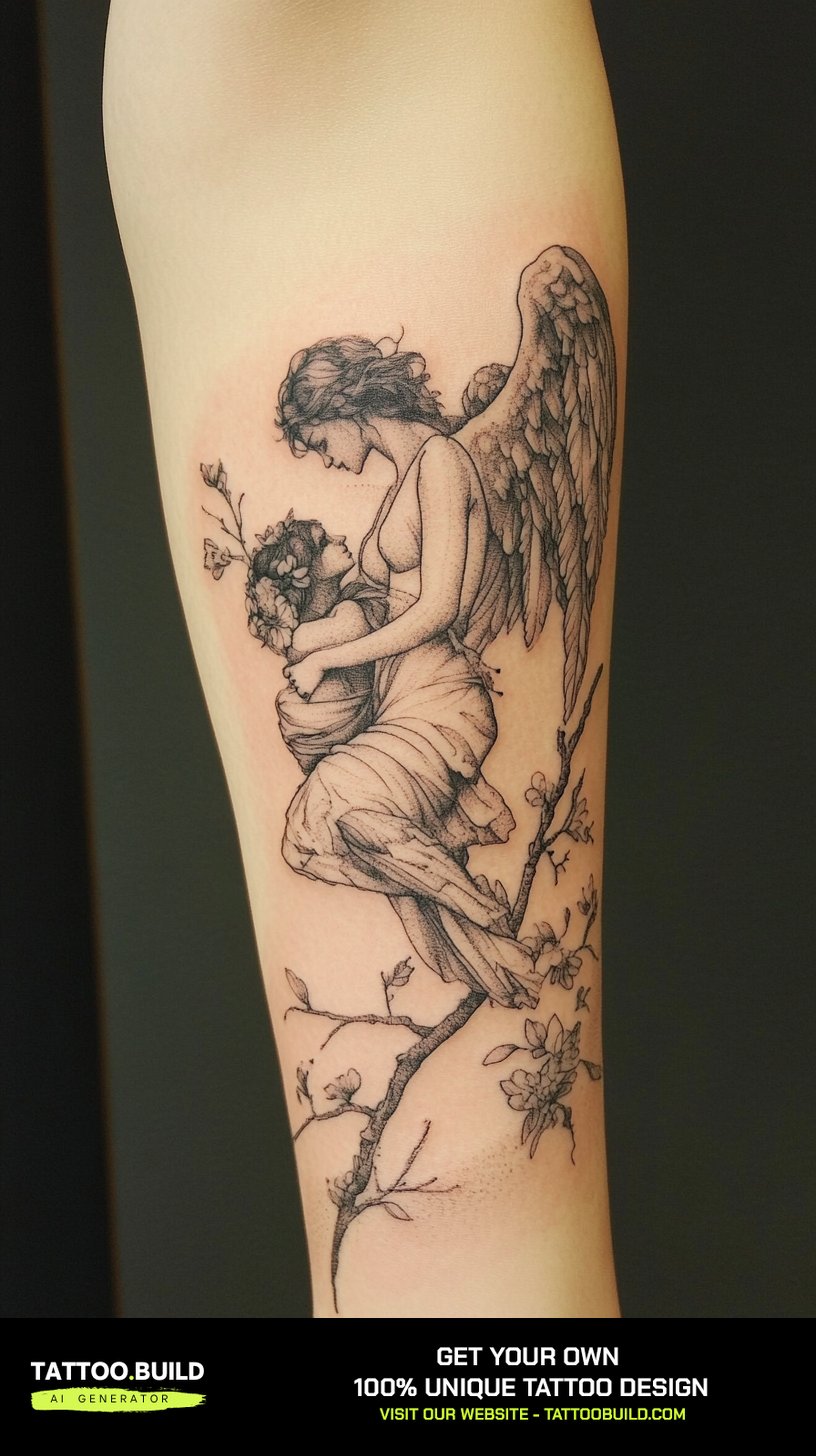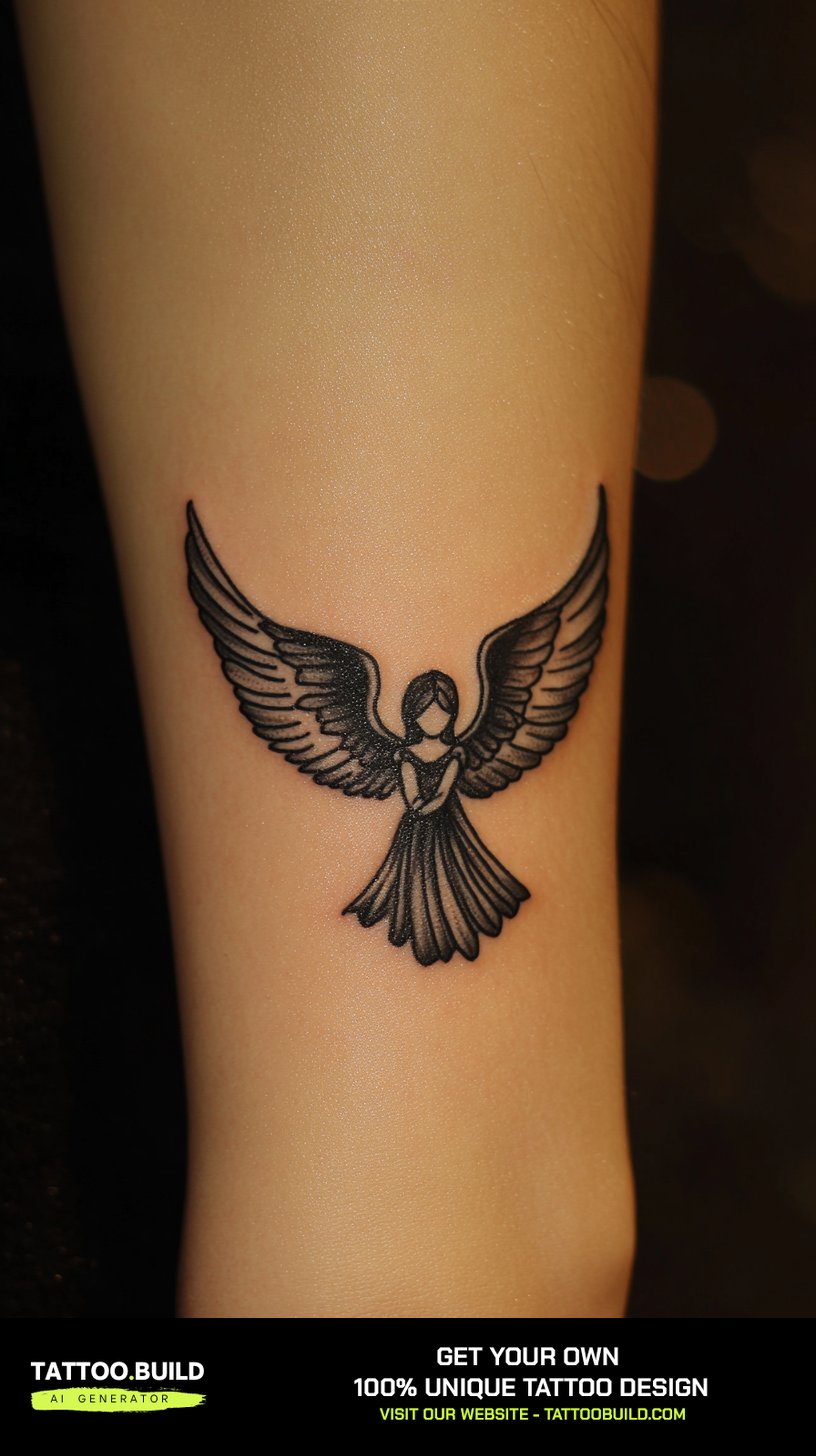
An angel tattoo drawing only works on skin if it was designed for skin in the first place — and that is where most of the pretty sketches people bring in fall apart.
I have spent a lot of hours going through artist portfolios for this site, and the pattern is consistent: the angel designs that still look good after five years are the ones with fewer feathers, not more.
This guide covers the drawings that actually translate — guardian figures, single wings, cherubs, memorial pieces — plus placement, sizing and the questions worth asking before you book. If you are narrowing down by gender-leaning styles, the angel tattoos for women collection is a useful companion piece.
Everything below is drawn from artist conversations and portfolio study, not from a medical background. Anything touching healing or skin reactions belongs to your artist and your doctor, not to a blog post.
Which Angel Tattoo Style Is Right for You?
Style choice decides more about the final result than the subject does. Here is how the four most common approaches compare in practice.
| Style | Best For | Typical Size | How It Ages | Watch Out For |
|---|---|---|---|---|
| Black & grey realism | Portrait angels, statue looks, memorial pieces | Half sleeve and up | Softens gradually; grey wash fades first | Needs a specialist — generalists struggle with faces |
| Traditional / neo-traditional | Bold guardian angels, cherubs, banners | Palm-sized to full forearm | Best of the four — heavy outlines hold shape | Less anatomical detail; not a portrait style |
| Fine line | Small wings, minimal halos, subtle scripts | Coin-sized to forearm strip | Thin lines can blur or lighten over years | Cramped detail closes up — keep gaps generous |
| Watercolor | Wings with colour bleed, celestial backgrounds | Shoulder, ribs, thigh | Fades fastest; often needs a refresh | Ask for a black underline to anchor the shape |
If you lean bold and masculine in your reference folder, the angel tattoo ideas for men gallery leans heavily on that second row.
What Actually Makes an Angel Tattoo Drawing Work
The difference between a drawing and a tattoo design is negative space. Paper tolerates density; skin does not.
Every artist I have asked says the same thing about wings: reduce the feather count. A wing drawn with forty individual feathers becomes a grey blur once the ink settles and spreads slightly under the skin.
Faces are the second failure point. An angel face smaller than roughly a playing card rarely holds its expression, because the features sit too close together for the lines to stay separate.
Then there is flow. A wing drawn flat on a page has to be re-drawn to wrap a shoulder or follow the curve of a ribcage, which is why good artists redraw your reference rather than tracing it.
None of this means your Pinterest folder is useless. It means the folder is a brief, not a stencil.
Angel Tattoo Drawing Ideas That Translate to Skin
These are the design directions I keep seeing survive the jump from sketchbook to skin, roughly in order of how often they come up.
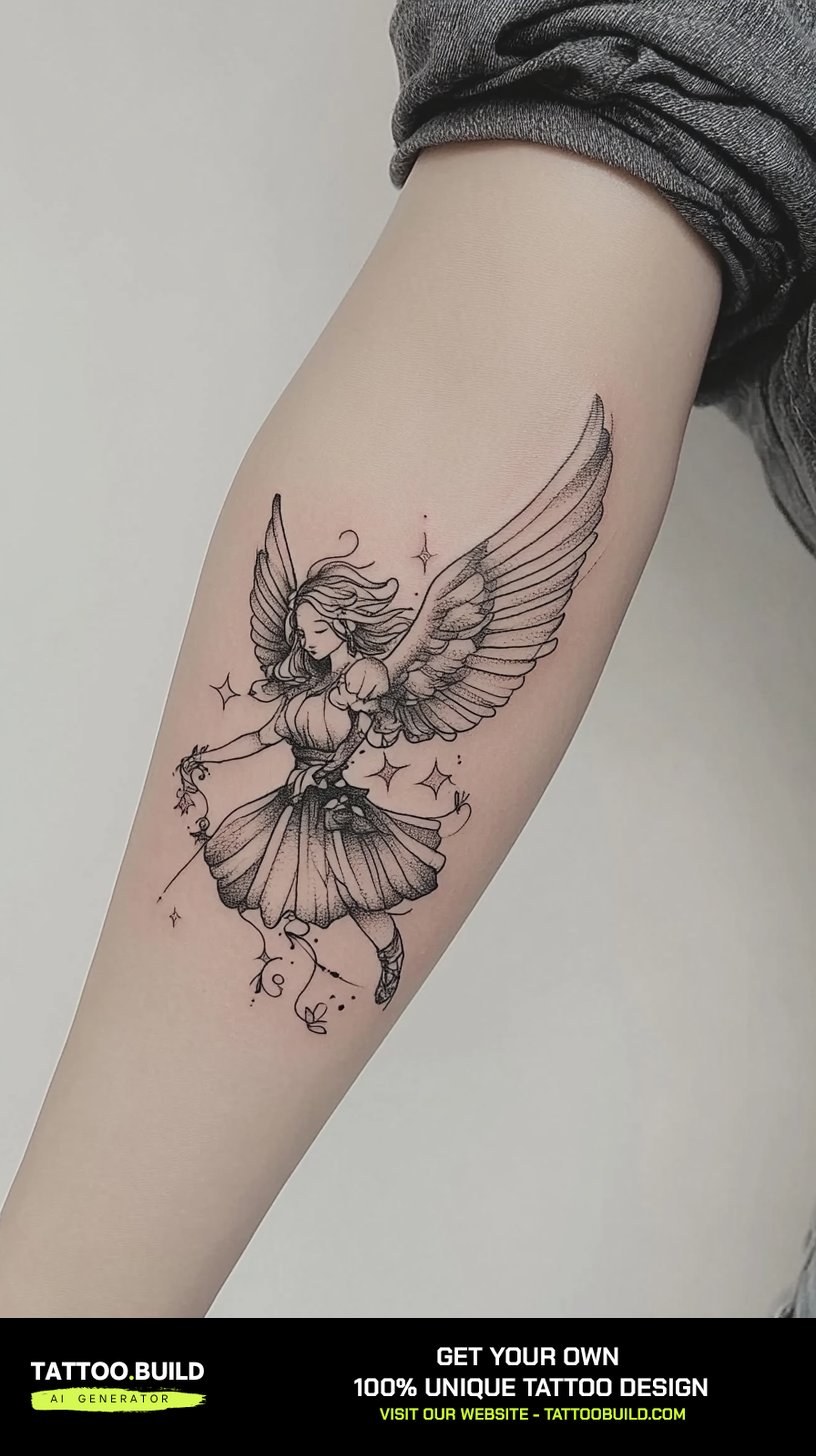
1. The Guardian Angel Over the Shoulder
This is the most requested angel design and the one with the widest range of quality. The good versions place the figure so the wings follow the deltoid rather than cutting across it.
When I have compared portfolio shots side by side, the ones that read clearly at arm’s length all share a trait: one wing is foreshortened, and only one is fully open. Two symmetrical open wings on a shoulder almost always look pasted on.
Sizing tends to start around the width of your hand and grows from there. Below that, the figure loses its face and becomes a shape.
A guardian angel also carries the most flexible meaning of any version — protection, watchfulness, a person you lost, or simply a reminder to keep your own standards. That flexibility is part of why it dates so well.
2. Single Wings and Half-Wing Designs
A single wing is the most underrated angel drawing on this list. It says the same thing with a fraction of the healing time and a much lower failure rate.
It also solves a real problem: a full pair of wings needs a back, a chest or a pair of shoulder blades. One wing fits a forearm, a calf or a ribcage. The wider wing tattoo ideas collection has variations well beyond the angelic ones.
Ask for feather groups rather than individual feathers — three or four tiers of shape, each shaded as a unit. That is the single change that keeps a wing legible after a decade.
Half-wings paired across two people, or one wing on each forearm, are a common matching-tattoo approach and generally hold up better than matching script.
3. Cherubs and Baby Angel Drawings
Cherubs went from Renaissance ceilings to Chicano-style tattooing to mainstream requests, and the tattoo version borrows from all three.
They are harder than they look. A cherub face is a small round area with very soft transitions, and heavy outlining turns a child’s face into something unsettling almost instantly.
In my experience the successful ones are done in smooth black and grey by someone who does portrait work, and sized at least as large as a fist.
Cherubs are also a common memorial choice for a child or a pregnancy loss. If that is the intention, tell the artist directly — it changes how they draw the expression.
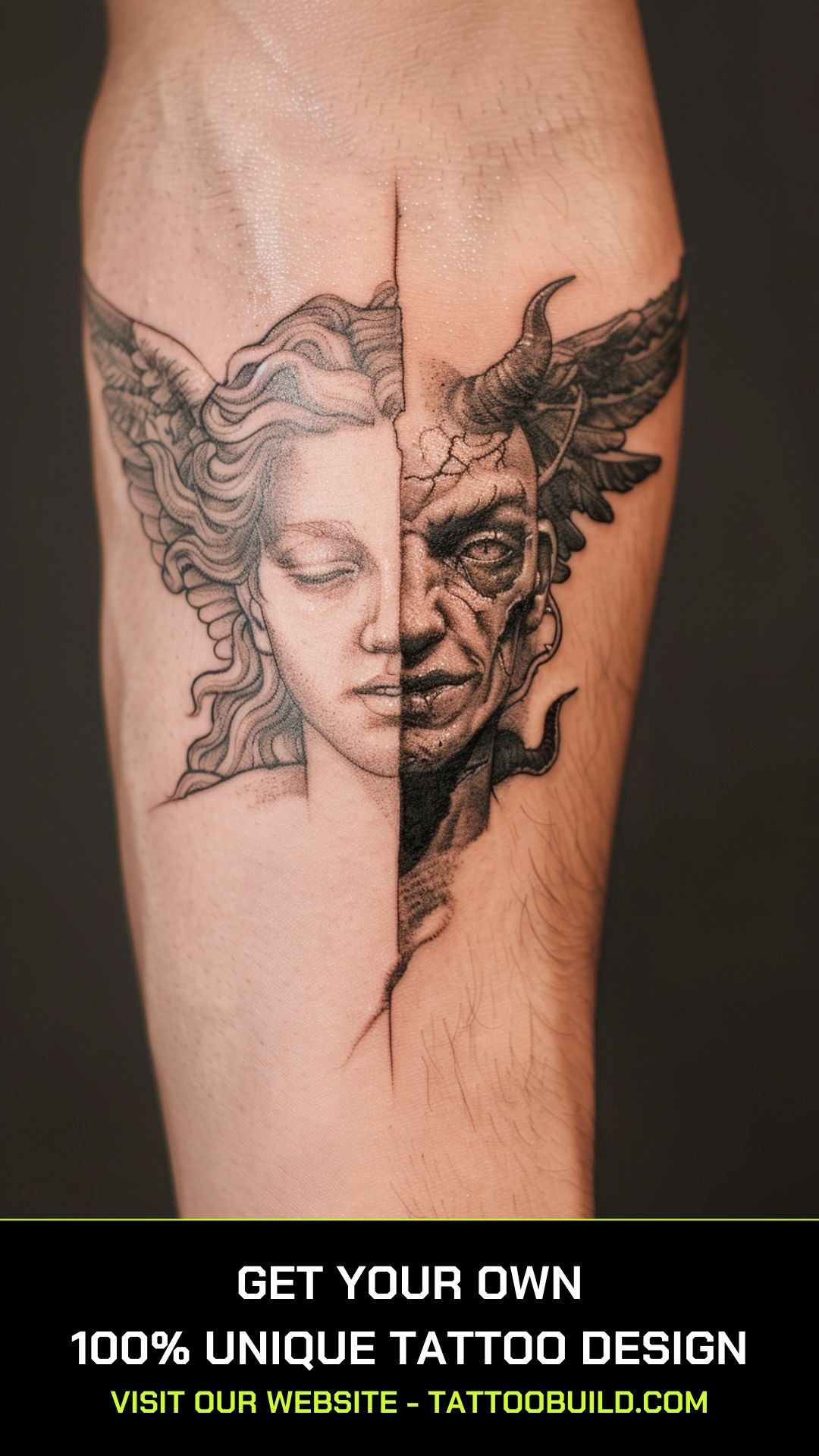
4. Fallen Angels and Angel vs. Devil Designs
The fallen angel is the darker branch of the family: broken or downturned wings, heavy shadow, sometimes a cracked halo.
These lean on contrast rather than detail, which makes them a reasonable choice for larger areas like the back or the outer thigh where you have room for solid black.
The split composition — angel on one side, devil on the other — is its own subgenre, and the angel and devil tattoo ideas gallery covers the pairing properly.
One honest warning: the duality concept is common enough that a generic version looks generic. The interesting ones make the two halves share a single face or a single body line.
5. Praying and Kneeling Angel Figures
A kneeling angel compresses into a roughly square area, which makes it one of the easiest angel drawings to place well.
It suits the shoulder blade, the calf, the chest panel and the outer thigh, and it does not demand the width that a spread-wing design does.
The praying pose overlaps heavily with religious imagery, and it is frequently combined with clasped hands or a rosary — the praying hands tattoo ideas collection shows how those elements are usually arranged.
Kneeling poses are also the most forgiving for a first large piece, because the outline does most of the work and the shading can be built up in a second session if you need a break.
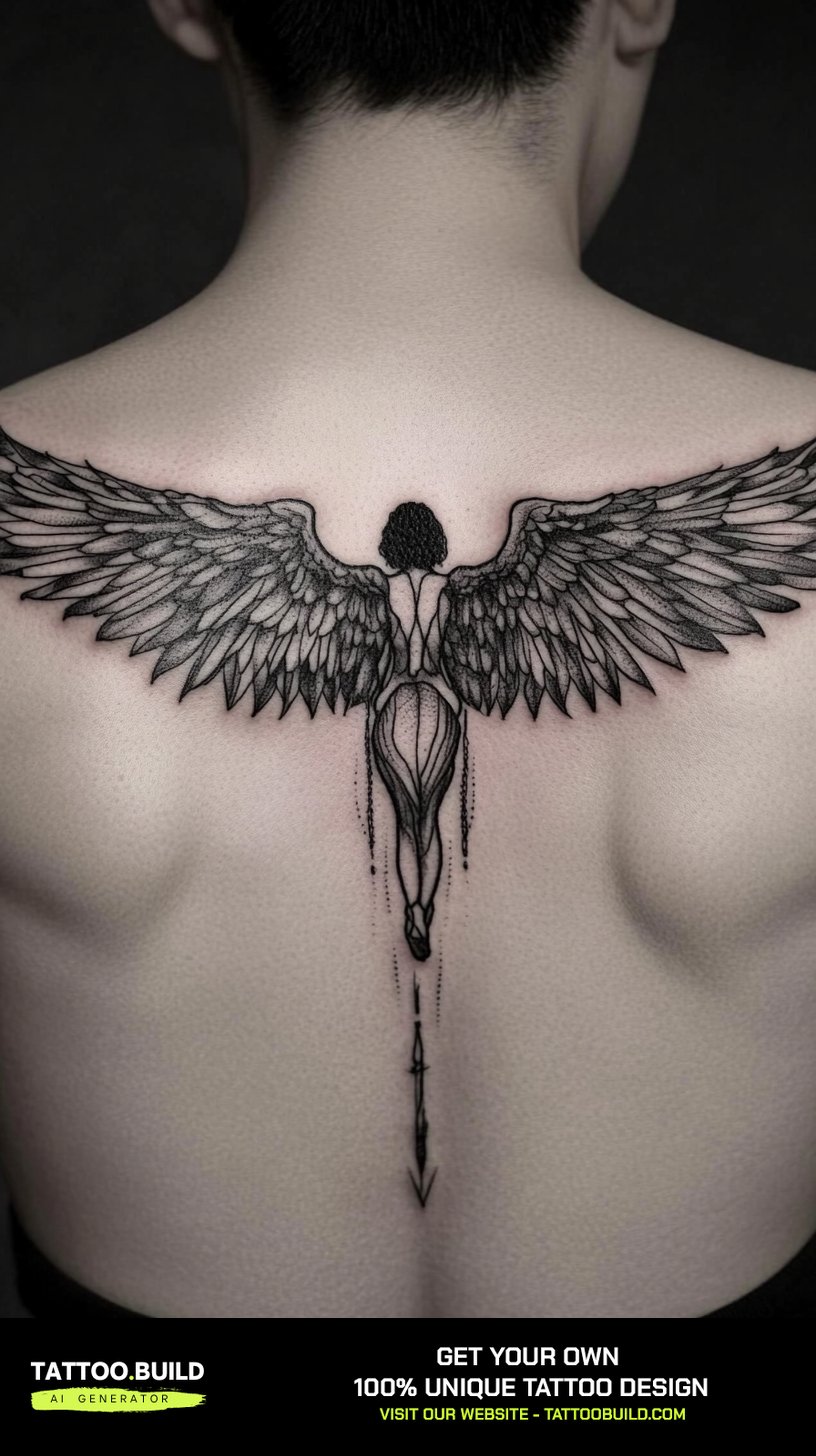
6. Full Angel Wings Across the Back
This is the big one, and it deserves a realistic description. A full back wing piece is not a single appointment.
Based on what artists quote publicly, a detailed pair of back wings is usually broken into multiple sessions of several hours each, spaced weeks apart to let the skin recover between them.
The design decision that matters most is where the wings end. Wings that stop abruptly at the waistband look cut off; wings that fade into shading or feather scatter look intentional.
Symmetry is the other trap. Perfectly mirrored wings expose every asymmetry in your own back, so most experienced artists introduce a slight difference on purpose.
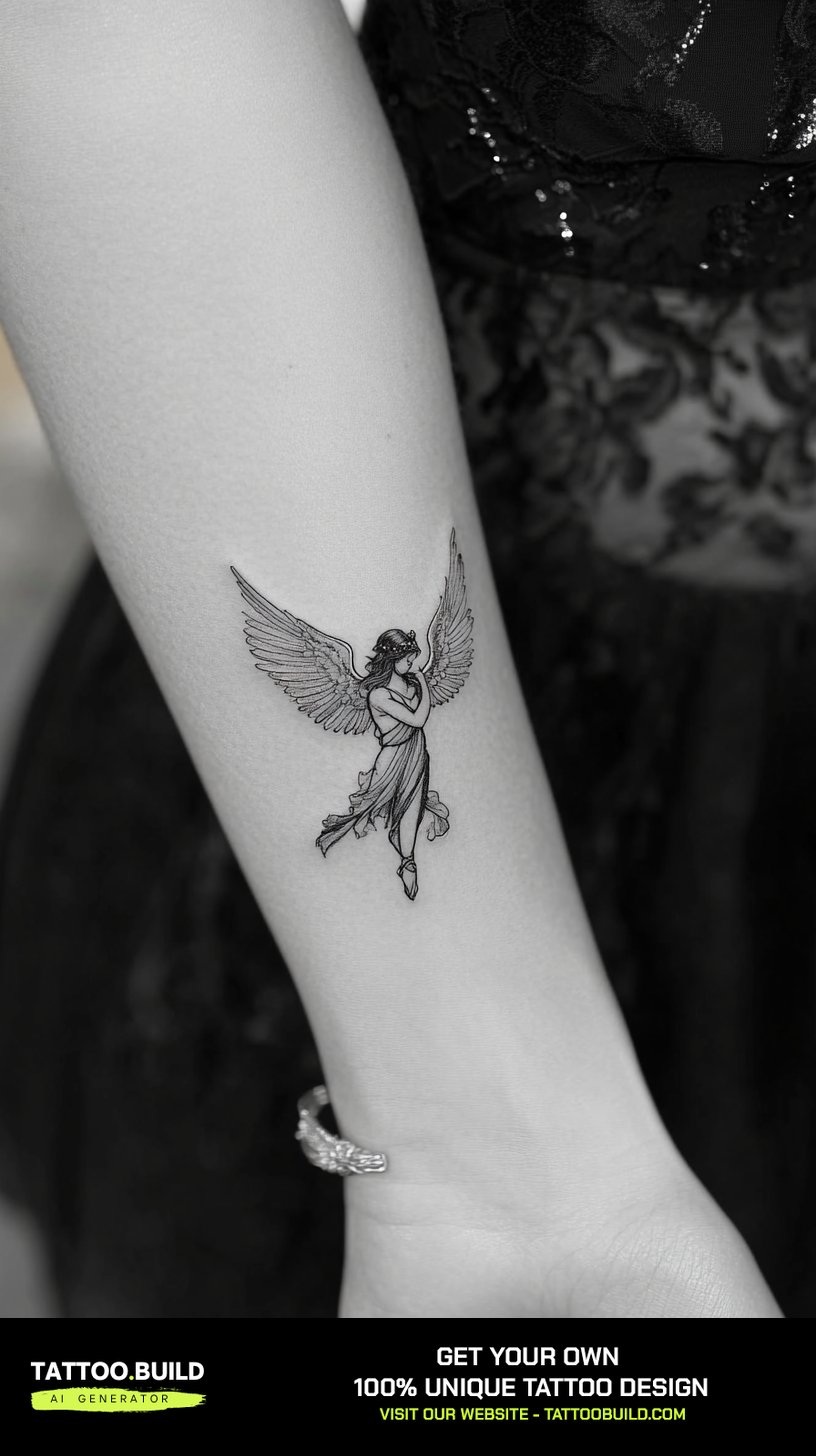
7. Fine Line and Micro Angel Drawings
Small angel tattoos are popular for a good reason — they are quick, subtle and easy to place on a forearm, an inner bicep or behind the ear.
The honest trade-off is longevity. Thin lines placed close together tend to soften over the years, and very small designs have the least room to spare.
What helps: keep the gaps between lines wider than feels necessary, skip interior feather detail entirely, and accept that the design will be a silhouette rather than a portrait.
I would rather see a clean minimal wing at coin size than a full angel figure crammed into the same space. The second one becomes a smudge.
8. Memorial Angels with Names and Dates
A large share of angel tattoos are memorial pieces, and they carry a specific design requirement: the text has to be readable in ten years, not just on day one.
That means bolder lettering than most people expect, generous spacing, and a banner or ribbon rather than free-floating script. The memorial tattoo ideas collection has a wider range of layouts if the angel is only one element.
Get every name, date and spelling checked by someone other than yourself before the stencil goes on. Corrections to healed lettering are difficult and sometimes impossible to make invisible.
Some people leave deliberate space for a second name later. If that is a possibility, say so during the design stage rather than after.
Placement: Where Angel Drawings Sit Best
Placement is not decoration — it decides how large the drawing can be and how well it will hold.
Shoulder and Upper Arm
The most forgiving spot for angel work. It offers a curved surface that suits wings, heals reliably in most people, and can be covered with a t-shirt.
Back and Shoulder Blades
The only area with enough room for full spread wings at true scale. The downside is obvious: you will rarely see it yourself, and it takes the longest to complete.
Forearm
Good for vertical compositions — a standing angel, a single wing, a column of feathers. Highly visible, which is worth thinking about if your workplace has a policy.
Ribs and Side
Visually excellent for a wing that follows the body’s curve, and widely reported by artists and clients as one of the more painful areas. Plan for shorter sessions.
Chest
Suits symmetrical designs and memorial pieces, with the sentimental advantage of sitting over the heart. Chest skin moves a lot, so flow matters more here than almost anywhere else.
Variations Worth Considering
If the standard guardian angel feels too familiar, these are the directions people usually move toward.
Archangels with Swords or Scales
Michael with a sword is the most common. It shifts the tone from comfort to defiance, and it needs a larger canvas because of the added props.
Stone and Statue Angels
Rendered as carved marble rather than living figures, often based on cemetery statuary. Grey wash does most of the work, and the cracked-stone texture ages more gracefully than skin texture does.
Angel Numbers and Symbolic Shorthand
Numbers like 111 or 444, small wing glyphs, or a simple halo over an initial. Minimal, quick, and easy to place — and they sit comfortably alongside the celestial tattoo ideas people often pair them with.
Angels Combined with Florals or Clouds
Roses, peonies and cloud banks are the usual partners. They give the artist a way to fade the composition out at the edges instead of ending on a hard line.
Aftercare for a Large Angel Piece
Follow the written instructions your artist gives you, not the ones you read online — including these. Studios differ, and yours knows what they put in your skin.
The general shape of it is consistent though: keep it clean, keep it lightly moisturised, do not pick at it, and keep it out of the sun while it heals. The Mayo Clinic guidance on tattoo risks and care is a reasonable neutral reference.
Large wing pieces cover a lot of skin at once, which makes hygiene and sleep position more of an issue than with a small tattoo. Ink ingredients and reactions are also a real topic — the FDA consumer page on tattoo safety covers what is known and what is not.
If you see spreading redness, increasing pain after the first few days, heat, or discharge, that is a doctor question, not a forum question. Do not wait it out, and do not self-treat a suspected infection.
Common Mistakes — and What to Do Instead
Bringing a photorealistic render and expecting it traced. Bring three references and let the artist build something that fits your body.
Going too small for the detail level. If the drawing has a face, give it room; if it does not have room, drop the face.
Booking on price. An angel face is a portrait, and a cheap portrait is the most expensive tattoo you will ever get, because cover-ups cost more than originals.
Skipping the stencil walk. Ask to see it placed, then move around, sit down, raise your arm — the position that looks right standing still is not always the one that looks right in motion.
Still undecided? Browse the broader spiritual tattoo ideas collection, or the cross tattoos for women gallery if the religious element matters more to you than the figure itself.
Frequently Asked Questions
What do angel tattoos usually mean?
Most commonly protection, guidance, faith, or remembrance of someone who has died. The specific design shifts the meaning — a guardian angel reads as watchfulness, a cherub as innocence, a fallen angel as struggle or defiance. There is no fixed dictionary here, and the meaning that matters is the one you assign it. If you want it read a particular way by other people, keep the symbolism simple and recognisable.
How much does an angel tattoo drawing cost?
It depends almost entirely on size, detail and your artist’s hourly or day rate, which varies enormously by city and reputation. A small fine-line wing is typically a short single sitting; a detailed back piece is a multi-session project quoted by the day. Ask for a written estimate that includes the number of expected sessions, not just an hourly figure. Any artist worth booking will give you that before you pay a deposit.
How long does a full back angel wing tattoo take?
Realistically it is spread over several sessions of a few hours each, with healing time in between. Artists generally cap sessions for comfort and skin condition rather than pushing through in one marathon sitting. Expect the whole project to run over weeks or months depending on scheduling. Anyone promising a full detailed back piece in one appointment is a warning sign.
Do angel tattoos age well?
Bold traditional and neo-traditional work ages best, because heavy outlines hold their shape as ink spreads slightly over the years. Fine line and watercolour angels are the most likely to need touch-ups. Sun exposure is the biggest accelerant regardless of style, so sunscreen on a healed tattoo genuinely matters. Ask your artist how their own older work has held up — most will happily show you.
Can an angel tattoo cover an old tattoo?
Often yes, because wings and drapery provide large areas of shading that can absorb existing linework. It depends on how dark and how large the original is, and a cover-up specialist should assess it in person before you commit to a design. In some cases a few laser sessions to lighten the old piece first gives a much better result. Do not plan the cover-up design before that assessment — the old tattoo dictates what is possible.
Quick Summary
- Simplify the wings. Feather groups, not individual feathers — this is the single biggest factor in how the tattoo looks in ten years.
- Give faces room. An angel face below roughly playing-card size loses its expression as the ink settles.
- Pick the style before the pose. Bold traditional ages best; fine line and watercolour need touch-ups.
- Match the design to the placement. Spread wings need a back or chest; single wings and kneeling figures fit arms and calves.
- Plan back pieces as a project. Multiple sessions over weeks, quoted by the day, not by the hour.
- Triple-check memorial text. Names, dates and spelling verified by a second person before the stencil goes on.
- Book the right specialist. Portrait-level angels need a black-and-grey realism artist, not a generalist.
- Treat healing seriously. Follow your studio’s written aftercare, and see a doctor — not a forum — for anything that looks like an infection.