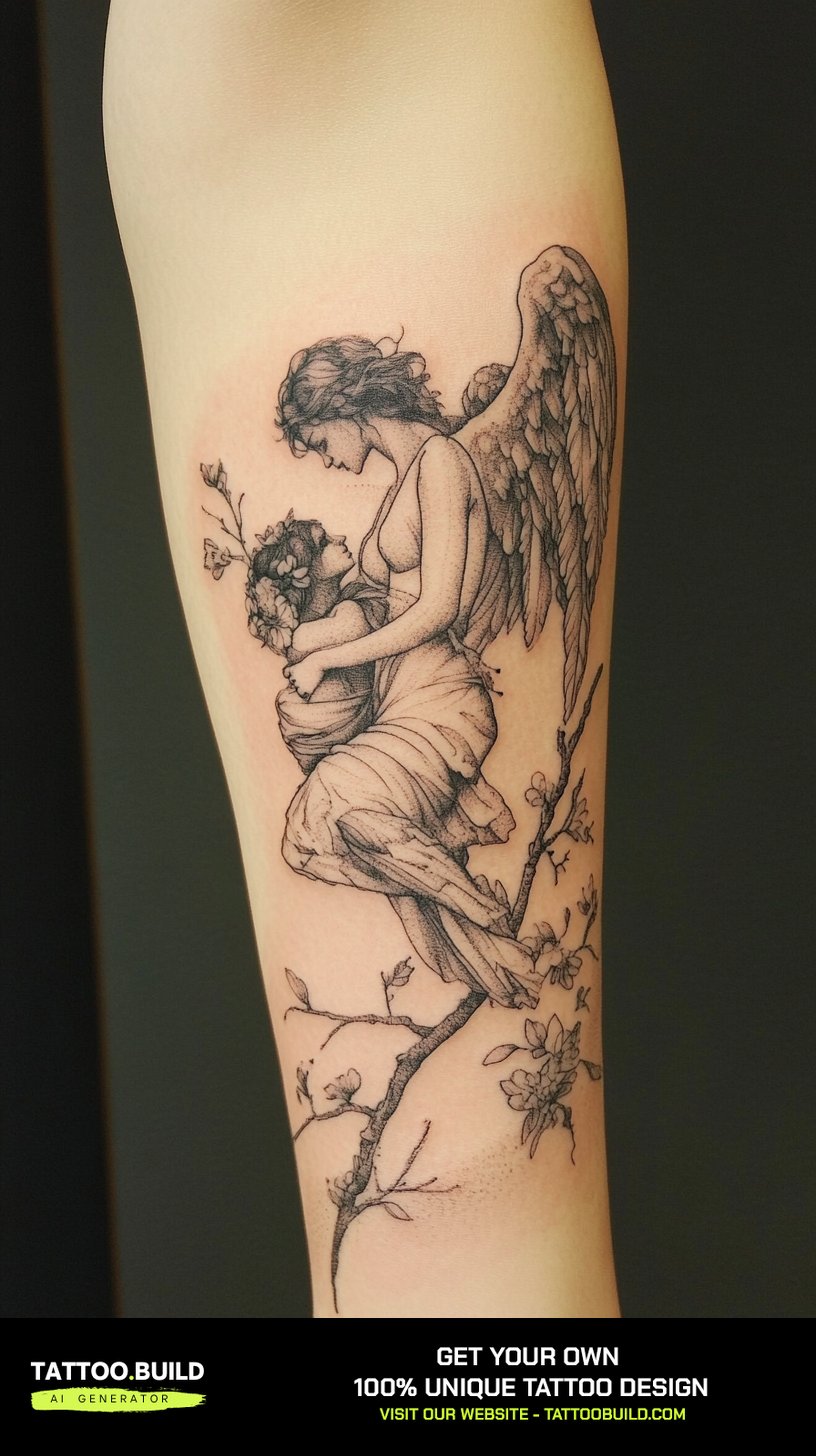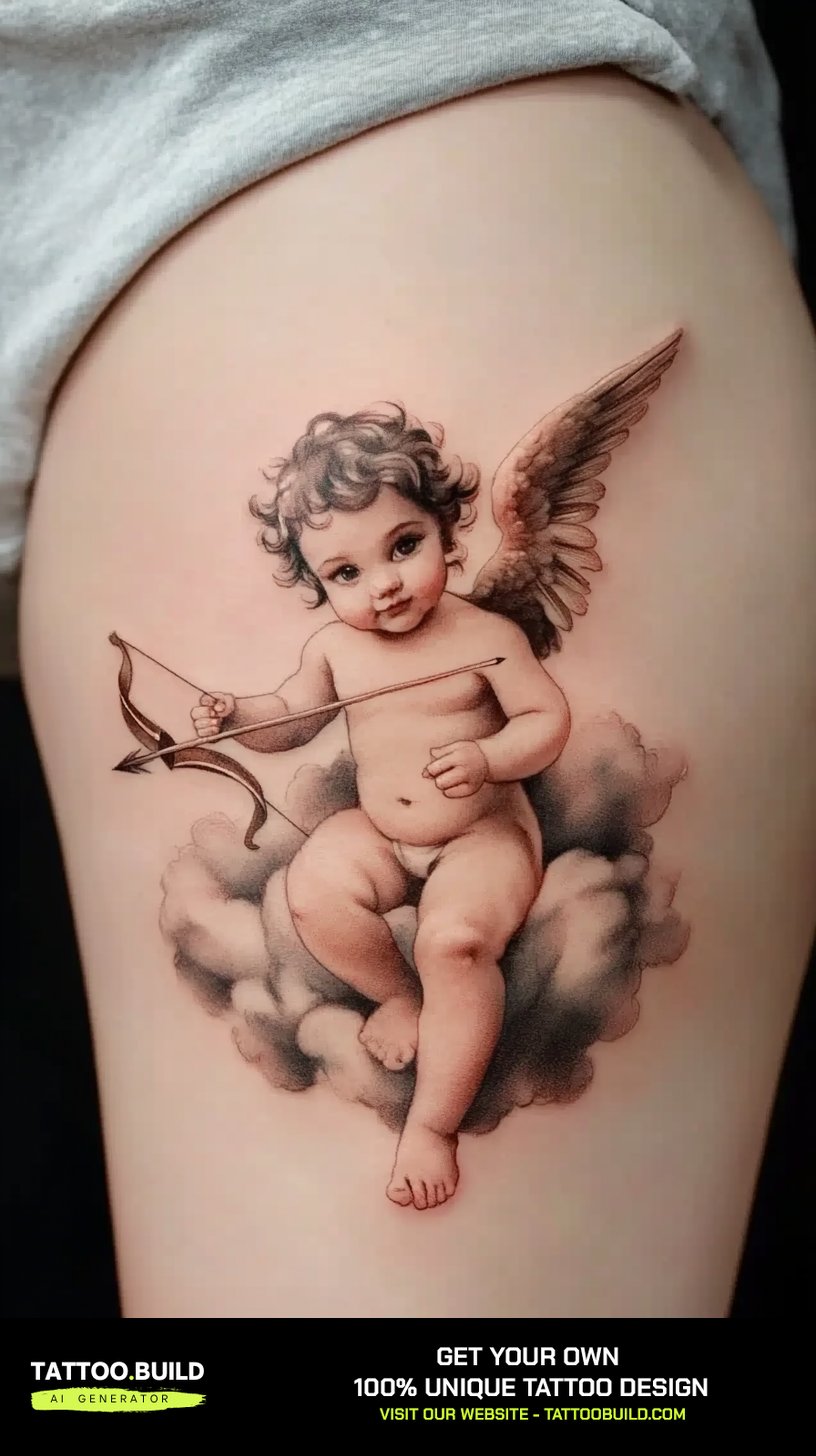
I have lost count of how many angel reference photos I have pulled up for friends who walked into a shop knowing only that they wanted “something with wings.” An angel tattoo is one of the few designs that reads as beautiful, protective and personal all at once, which is exactly why it survives trends that swallow other styles whole.
The word “angel” covers an enormous range on skin. A pair of feathered wings across the shoulder blades and a two-inch cherub behind the ear are both angel tattoos, and they ask completely different things from an artist.
What follows is the working guide I wish more people had before their consultation: seventeen directions broken down by what each actually costs you in placement, session time and long-term legibility. If you are still deciding on direction, our wider gallery of angel tattoos for women is a good place to browse first.
I have deliberately kept the fluff out. Every section below tells you who the design suits, where it sits well, and where I have watched it go wrong.
Which Angel Tattoo Style Is Right for You?
Before scrolling the designs, it helps to know roughly what each family of angel tattoo asks for. These are working ranges based on the sessions I have sat through and the quotes artists have given me — your shop will vary.
| Style | Typical size | Best placements | Session time | Ages well? |
|---|---|---|---|---|
| Minimalist line angel | 1–3 inches | Inner wrist, behind ear, collarbone, ankle | Under an hour | Only if lines are not hair-thin |
| Fine-line figure | 4–7 inches | Forearm, inner arm, calf | 2–4 hours | Good with light grey wash |
| Black and grey realism | 6–12 inches | Upper arm, thigh, ribs | 5–10 hours, often split | Very good in skilled hands |
| Wing backpiece | 10–18 inches | Upper back, shoulder blades | Multiple sessions | Excellent — low-friction area |
| Cherub | 3–6 inches | Shoulder, upper arm, thigh | 2–5 hours | Good; faces need a specialist |
| Angel and florals | 5–10 inches | Forearm, calf, upper back | 4–8 hours | Good if the two elements are spaced |
What an Angel Tattoo Actually Means to the Person Wearing It
Angels carry meaning across Christianity, Islam and Judaism, and they also live outside religion entirely as a shorthand for protection and grief.
In my experience the single most common reason women get one is memorial. Someone died, and a winged figure was the least literal way to keep them close.
The second most common reason is protection — a guardian figure placed where the wearer cannot easily see it, on the back or the outside of the shoulder, so it sits behind rather than in front of them.
The third is simply aesthetic, and there is nothing wrong with that. Renaissance drapery and feather work are gorgeous subjects, and plenty of people want the art without the theology. You do not owe anyone an explanation for your tattoo.
If the spiritual angle is what draws you, it is worth browsing broader spiritual tattoo ideas for women before you commit, because an angel is one option among many for the same feeling.
Ten Angel Tattoo Designs, Broken Down
These ten come from real pieces rather than digital mockups, which matters — a design that only works as a flat drawing tends to disappoint on curved skin.
1. The Meditative Angel
This one shows a standing angel with her eyes closed and her arms folded across her chest. The wings are detailed but held close to the body, so the silhouette stays narrow.
That narrow silhouette is the whole reason it works on an upper arm. Wide-winged designs fight the curve of the bicep; a closed posture wraps cleanly.
I recommend this one most often to people getting their first medium-sized piece, because the composition forgives a lot. If the shading softens over ten years, the shape still reads.
Expect three to four hours. Ask your artist to keep the face slightly abstracted rather than photoreal — small tattooed faces are where most angel pieces go wrong.
2. The Angelic Backpiece
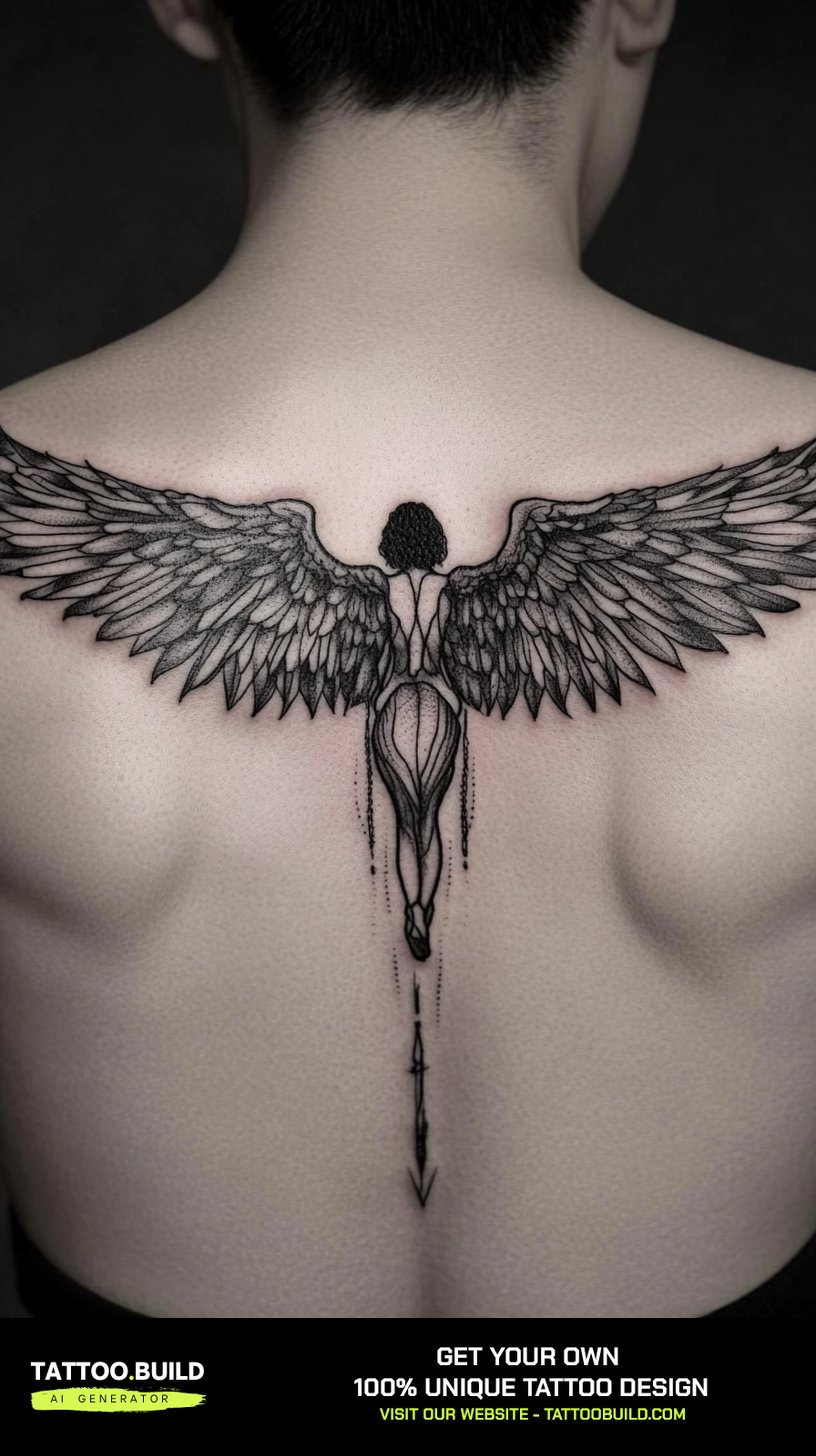
Here the wings stretch across the upper back and the figure between them is barely suggested. The wings carry the entire piece.
This is the design I have seen age the best out of everything on this list. The upper back gets almost no friction, limited sun if you are reasonably careful, and the skin stays taut for decades.
It is also the biggest commitment here. Every artist I have asked quotes this across at least two sessions, and the outline session alone is long.
Worth knowing: shoulder blades move. Ask to be stencilled standing up rather than lying down, or the wings can end up asymmetric when you are upright. If you like the scale, our guide to back piece tattoo ideas for women covers the layout question in more depth.
3. Guardian Angel With Flowers
A standing angel holding a loose bouquet, with fine shading through the gown and the feathers. The flowers soften what can otherwise be a very solemn image.
The forearm suits it because you see it in your own eye line all day. People who choose a guardian figure usually want to see it, not hide it.
This is a common memorial choice, and the flowers are often the memorial part — a birth flower, or whatever was in the hospital room.
If that is your reason for getting it, it is worth reading through memorial tattoo ideas first, because there are quieter ways to carry the same thing.
4. The Flowing Angel
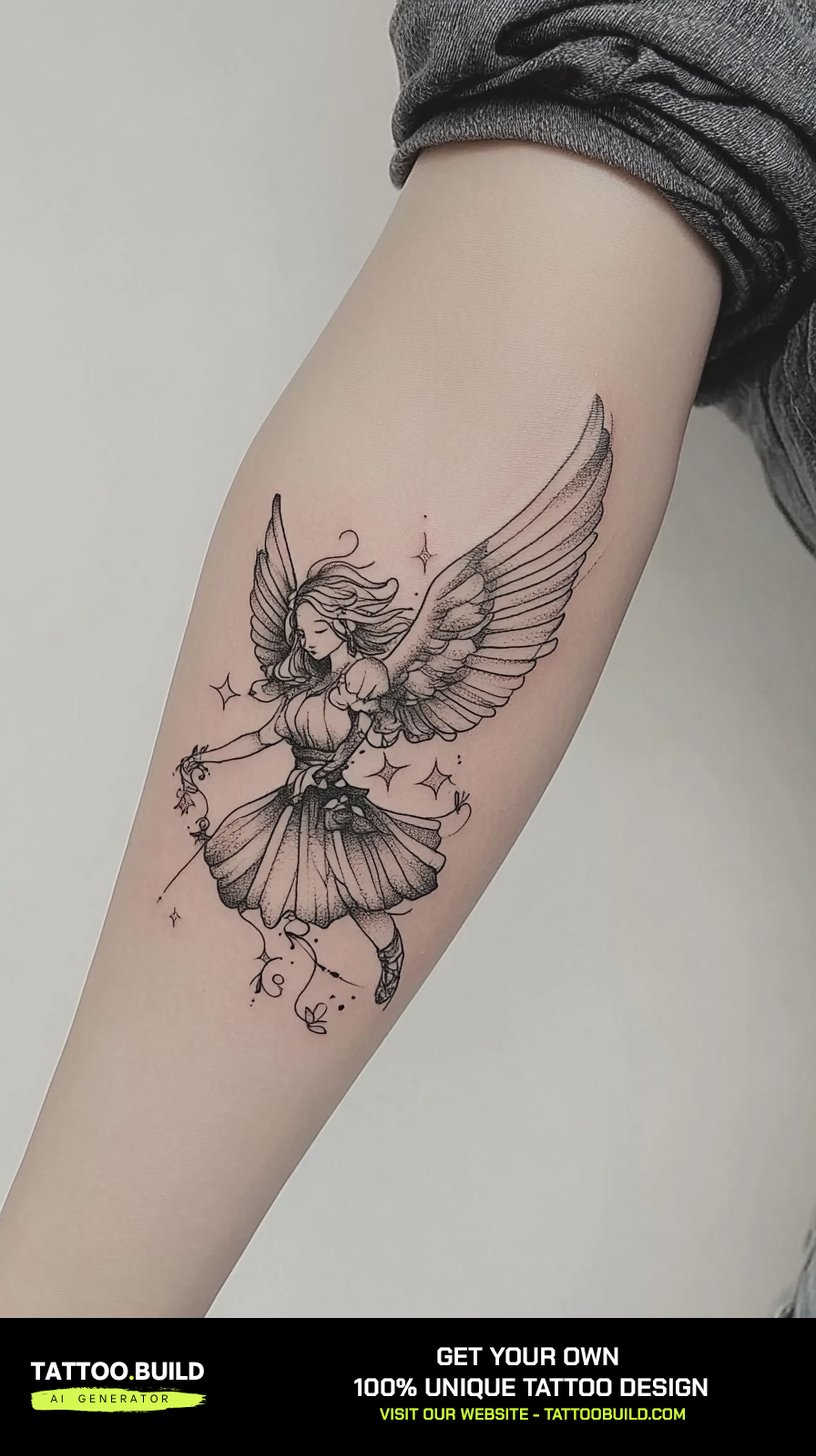
An angel caught mid-flight, robes and wings trailing. The movement is the point, and it demands an artist who is genuinely comfortable with drapery.
The inner arm is a good home for it because the surface is relatively flat and the design gets to run vertically without wrapping.
It is also one of the more painful spots on this list. The inner arm is thin-skinned and nerve-dense, and most people find it noticeably sharper than the outer arm.
Ask to see healed photos of drapery specifically, not fresh ones. Flowing fabric relies on soft grey transitions, and those are what fade first with a heavy hand.
5. Angel on the Shoulder
A leaning figure with open wings and one arm reaching outward, sitting over the shoulder cap.
The symbolism is almost too neat, but that is why people love it — the angel literally sits on your shoulder.
The shoulder cap is a forgiving spot for a first larger tattoo. It heals quickly for most people, it is easy to cover for work, and the skin does not stretch much over time.
The catch is that the shoulder is a dome. The design has to be planned to be seen from one angle, usually from the front-side. Our roundup of shoulder blade tattoo ideas for women shows how differently pieces read a few inches further back.
6. The Minimalist Angel
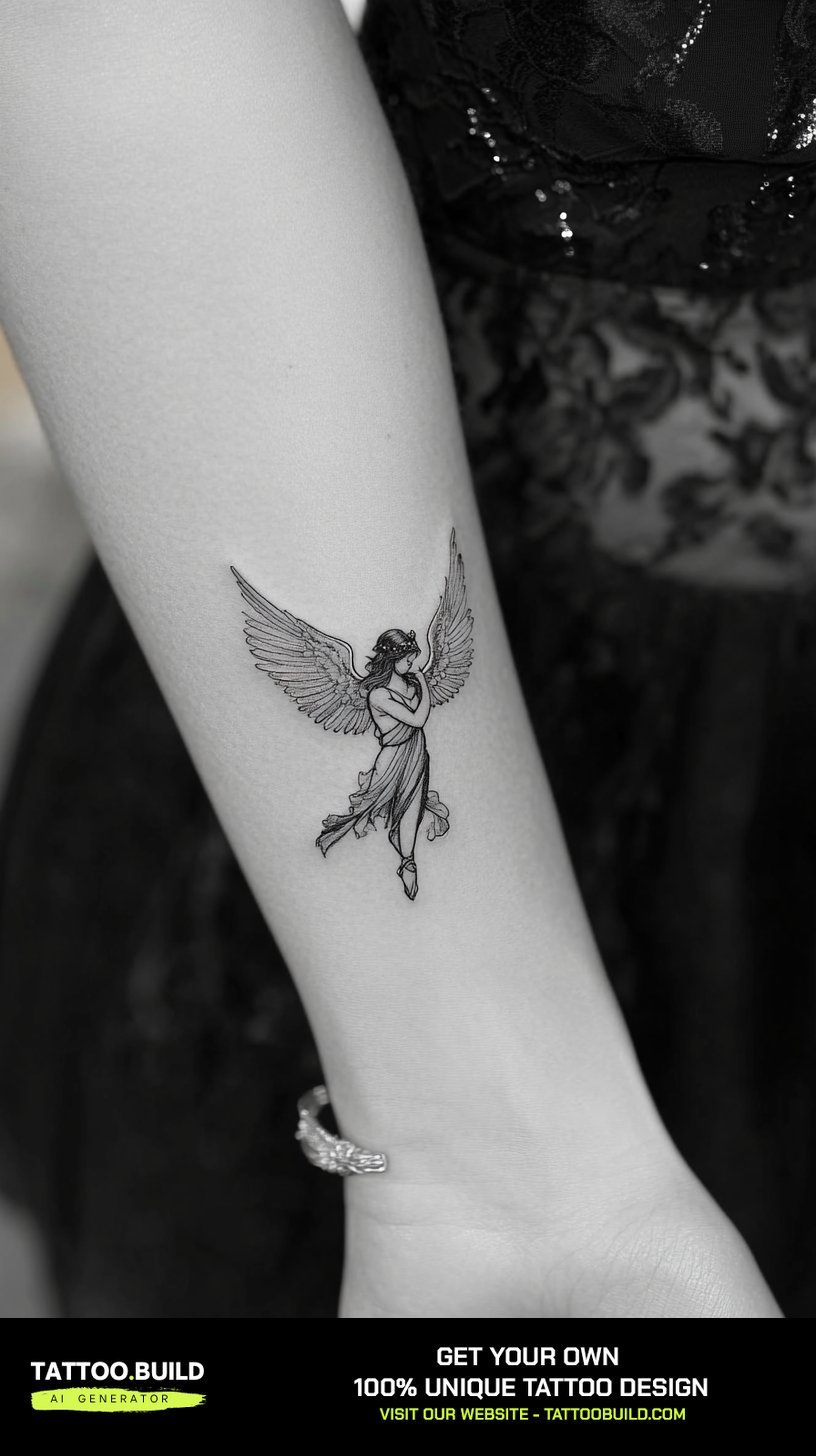
Stripped to outline. No shading, no feather detail, just the shape of a winged figure.
I like these more than most people expect me to, but with one condition: the lines cannot be hair-thin. Very fine single-needle work spreads slightly as it settles into the skin, and a design with no shading has nothing to hide behind.
Ask for a slightly heavier line than the sketch suggests. It will look a touch bolder on day one and considerably better on year eight.
This style suits people who want the meaning without the visual weight. If that is you, minimalist tattoo ideas is a useful companion read.
7. Praying Angel With Floral Accents
A kneeling or bowed figure with hands together, framed by small florals that fill the negative space around the wings.
The florals are doing structural work here, not just decoration. They give the composition an outer edge so it does not float on the arm.
This one photographs beautifully and is genuinely popular as a first religious piece.
One honest limitation: praying hands and a bowed face are two of the hardest small elements in black and grey. If your artist’s portfolio is mostly bold traditional, this is not the piece to ask them to stretch on.
8. The Cherub
Small wings, round face, soft shading — the Renaissance putto that has been on tattoo flash for over a century.
Cherubs read as warm rather than solemn, which makes them a good fit for people who want an angel without the funeral association.
They are deceptively difficult. The whole charm sits in a face maybe an inch across, and a face that is even slightly off looks unsettling rather than sweet.
Go bigger than you think you need to. A four-inch cherub is legible in ten years; a two-inch one often is not.
9. Dancing Angels
Two figures with wings arched toward one another, composed as a pair.
Paired angels usually mean something specific — siblings, a friendship, two people being remembered together.
Composition is the risk. Two figures need genuine space between them or they merge into one dark mass as the ink settles.
I would give this at least six inches of run, and I would ask the artist to leave more negative space between the wings than looks right on paper.
10. The Solitary Angel
A seated figure with her head bowed, rendered in soft shading with very little linework holding it together.
This is the quietest design here and, to my eye, the most affecting. It does not perform anything.
The leg suits it. Calves and thighs hold black and grey well and give you a large flat-ish canvas, and the placement means you choose who sees it.
Shading-led pieces like this need a careful artist and honest aftercare. Peeling one of these early will cost you the softest transitions permanently.
Variations Worth Considering Before You Book
If none of the ten above is quite it, these are the directions I would push you toward next.
Wings Without a Figure
Dropping the angel and keeping only the wings is the single most flexible option on this page. Wings scale from a two-inch pair behind the ear to a full back.
They also sidestep the hardest technical problem in the whole category, which is a small tattooed face.
The trade is that wings alone are far more common, so the design work has to come from the feather structure rather than the concept.
Delicate Feathered Linework
Soft shading, fine lines, individual feathers picked out rather than blocked in.
This suits smaller placements — wrist, ankle, behind the shoulder — where a heavy black wing would look like a smudge.
Ask specifically about how the artist plans to keep the feather gaps open. Detail that is too tight closes up over the years.
The Full Guardian Figure
A complete angel in a protective posture, wings out, robes rendered, usually placed on the back or the outer arm so it faces outward.
This is the most expensive direction here and the one that most rewards saving up for a specialist.
It is also the version people are least likely to regret, in my experience — the ones that get covered up are almost always the rushed small ones.
Halos, Hearts and Symbols Only
Sometimes the strongest version is a halo alone, or a tiny outline with a single wing.
These take under an hour and cost accordingly, which makes them a reasonable way to test whether you actually like having a tattoo there.
Keep them somewhere with low friction. Fingers and the outer edge of the hand chew through small delicate work faster than anywhere else on the body.
Motion-Led Compositions
An angel mid-descent, robes streaming, sometimes with the wings cropped off the edge of the design.
Cropping is an underused trick. Letting a wing run off the edge of the composition makes a medium tattoo feel much larger.
It needs a bigger canvas — thigh, ribs, upper arm — and it needs an artist who thinks about the body as a shape rather than a sheet of paper.
Classical Cherub Groupings
Cherubs with clouds, drawn straight out of Renaissance painting. Baroque, warm, unmistakably art-historical.
These work best when the artist leans into the reference rather than modernising it. Half-classical, half-fine-line rarely lands.
Bring the actual painting to your consultation. Artists are much happier working from a clear reference than from a vague description.
Angels Blended With Florals
Roses, lilies and cherry blossom all sit naturally alongside angel imagery, and they let you add personal meaning without adding text.
The mistake I see is packing them too tightly against the figure. Give the two elements room or they read as one busy patch from across a room.
Forearms take this well, and it is one of the more popular directions in current forearm tattoo ideas for females.
Placement, Pain and Aftercare: The Practical Part
Angel tattoos tend to be shading-heavy, and shading-heavy work is more sensitive to how you heal it than bold linework is.
On pain: the ribs, inner arm, sternum and the back of the knee are the spots people flinch at most. Outer thigh, calf and outer shoulder are the gentlest. Our guide to the most painful tattoo spots maps this properly if you are choosing between placements.
On healing: most artists will tell you the surface closes in roughly two to three weeks, while the deeper skin keeps settling for a couple of months. The tattoo you judge at week three is not the tattoo you will have at month three, and soft grey work in particular looks patchy before it evens out.
Follow the aftercare your artist gives you rather than anything you read online, including here — they know their inks and their machines. As a general rule, keep it clean, keep it lightly moisturised, and do not pick the flaking.
If you see spreading redness, heat, swelling that increases after day three, or any discharge, that is a doctor’s visit, not a shop visit. The Mayo Clinic’s overview of tattoo risks covers the warning signs plainly, and the American Academy of Dermatology has sound general guidance. Nothing in this article is medical advice.
Long term, sunscreen does more for a black and grey angel than any product marketed at tattoos. UV is what turns crisp grey wash into a soft blur.
Common Mistakes I See With Angel Tattoos
Going too small is the big one. Angels are detailed subjects, and detail packed into three inches closes up over time.
Choosing an artist by price rather than portfolio is the second. Black and grey figure work is a specialism, and a great traditional artist is not automatically a great realism artist.
The third is picking the design before the placement. Bodies are curved; a composition that looks perfect flat can distort badly on a bicep or a ribcage.
And the fourth is rushing a memorial piece. Grief is a bad deadline. The design will still be there in six months, and it will usually be better.
Still weighing it up? It is worth looking at faith tattoo ideas for adjacent symbolism, and at angel tattoo drawings if you want line art to take to a consultation.
Frequently Asked Questions
How much does an angel tattoo cost?
It depends far more on hours than on the subject. A small minimalist angel is usually a shop-minimum job, while a detailed black and grey figure runs several hours and a wing backpiece runs multiple sessions. Ask for an hourly rate and an honest session estimate rather than a flat quote, and expect a deposit. Prices vary widely by city and by artist reputation.
Where do angel tattoos hurt the least?
The outer thigh, calf and outer shoulder are generally the most tolerable spots for larger angel work. The ribs, sternum and inner arm are the ones people struggle with most. Pain is genuinely individual, though, so treat any chart as a rough guide rather than a promise. Tell your artist if you need a break — they would much rather pause than have you tense up for an hour.
Do angel tattoos have to be religious?
No. Plenty of people choose them purely for the imagery, or as a memorial with no faith attached. Angels function as a general symbol of protection and remembrance across a lot of cultures. Your reasons are yours, and no artist worth booking will interrogate them.
How long does an angel tattoo take to heal?
The surface usually closes within about two to three weeks, and the deeper layers keep settling for roughly two to three months. Shading-heavy angel pieces can look patchy or dull during that middle stretch, which is normal. Follow your artist’s aftercare instructions, keep it out of the sun, and do not pick at flaking skin. If you see spreading redness, heat or discharge, see a doctor.
Should I get a full angel or just the wings?
If you want something under about four inches, wings alone are almost always the better choice — small faces are the hardest thing to get right and the first thing to blur. If you have room for six inches or more and you have found an artist whose figure work you trust, the full angel gives you far more to look at. In my experience the regret sits overwhelmingly with the too-small figures.
Quick Summary
- Decide on meaning first — memorial, protection or purely aesthetic. It changes the design more than the style does.
- Match the scale to the detail. Under four inches, drop the face and keep the wings.
- Pick the placement before the composition, because bodies are curved and drawings are flat.
- Back and shoulder placements hold detail longest; hands and fingers hold it worst.
- Choose the artist on healed black and grey work in their portfolio, not on price.
- Ask for slightly heavier linework than the sketch shows — fine lines spread as they settle.
- Follow your artist’s aftercare, keep it out of the sun, and never pick the flaking.
- If anything looks infected, see a doctor rather than the shop.