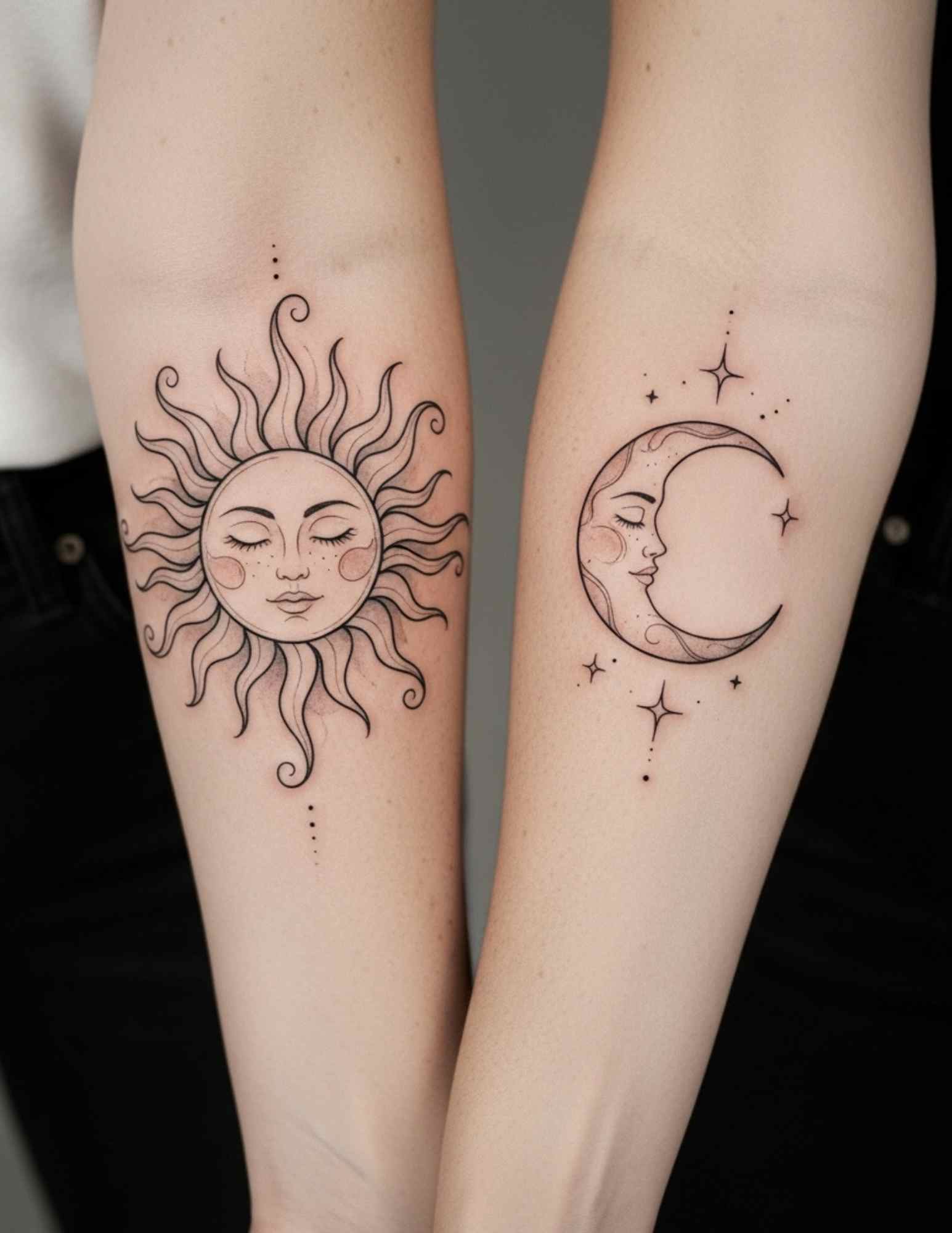
I have sat in on a lot of consultations, and spiritual tattoos are the only category where the client almost never opens with a picture. They open with a story.
That changes everything about how the design gets built. You are not matching a reference — you are translating a belief into line weight, scale and placement.
This guide covers 18 spiritual tattoo ideas for women, drawn from Buddhist, Hindu, Jewish, Islamic, Christian, Celtic, Egyptian and earth-based traditions, plus the symbols that belong to nobody but you. If you want the mixed-audience version, I keep a broader guide to spiritual tattoo ideas as well.
I have grouped them by tradition rather than by body part, because in my experience the tradition is what people actually decide first. Placement is a conversation you have afterwards, with an artist, in front of a mirror.
Which Spiritual Symbol Is Right for You?
This is the shortlist I sketch out for people who know what they believe but not what to get. Pick the row where the tradition column is honest for you, then worry about style.
| Symbol | Tradition | Best Style | Placement That Works | Ages Well? |
|---|---|---|---|---|
| Lotus | Buddhist, Hindu, Egyptian | Fine line or colour realism | Forearm, sternum, thigh | Yes, if petals are not hair-thin |
| Hamsa | Jewish, Islamic, Middle Eastern | Ornamental blackwork | Inner wrist, collarbone | Yes at medium size and up |
| Mandala | Hindu, Buddhist | Geometric fine line | Shoulder, upper back | Only if scaled generously |
| Evil eye (nazar) | Mediterranean, South Asian | Small colour or minimal line | Ankle, inner arm | Blue may need a touch-up |
| Om | Hindu, Buddhist | Clean single-weight line | Nape, inner forearm | Very well |
| Tree of life | Celtic, Norse, Kabbalistic | Illustrative or knotwork | Upper arm, ribs, back | Yes with spaced branches |
| Sacred Heart | Catholic | Traditional bold | Forearm, upper arm | Best of any on this list |
| Seed of Life | Sacred geometry | Precise fine line, no fill | Sternum, spine, forearm | Demands a geometry specialist |
| Moon phases | Earth-based, divine feminine | Fine line with solid fills | Forearm, spine, under bust | Yes |
The “ages well” column is the one people skip and later regret. A symbol you plan to carry for forty years should be drawn at a size that survives forty years of skin.
What Makes a Spiritual Tattoo Different
A spiritual tattoo carries a second job that a decorative one does not: it has to still mean something on a bad day.
That is why I push people away from trend-driven interpretations here. A style you chose because it was everywhere this year will read differently once it is not.
There is also the borrowing question, and I think it deserves a straight answer rather than a hedge. Symbols like the lotus, the om, the hamsa and the nazar are living parts of active religious practice for millions of people.
Wearing one you have no relationship with is not illegal and nobody is going to stop you — but in my experience it is also the category of tattoo that people most often come back to cover. Borrowed meaning fades faster than ink does.
Every artist I have asked about this says the same thing in different words: the clients who are happiest years later are the ones who could explain their symbol without using the word “aesthetic”.
Eastern Symbols and Contemplative Practice
1. Lotus Flower
The lotus is the single most requested spiritual tattoo among women, and the reason is the image itself: a flower rooted in mud that opens above the water.
In Buddhist and Hindu iconography it stands for spiritual growth and the emergence of clarity from difficulty. Egyptian art used the blue lotus for rebirth and the sun.
It works in fine line botanical detail, in soft colour realism, or folded into a mandala-influenced geometric frame. If you want the full range of interpretations, the lotus flower tattoo designs guide goes deeper on style choices.
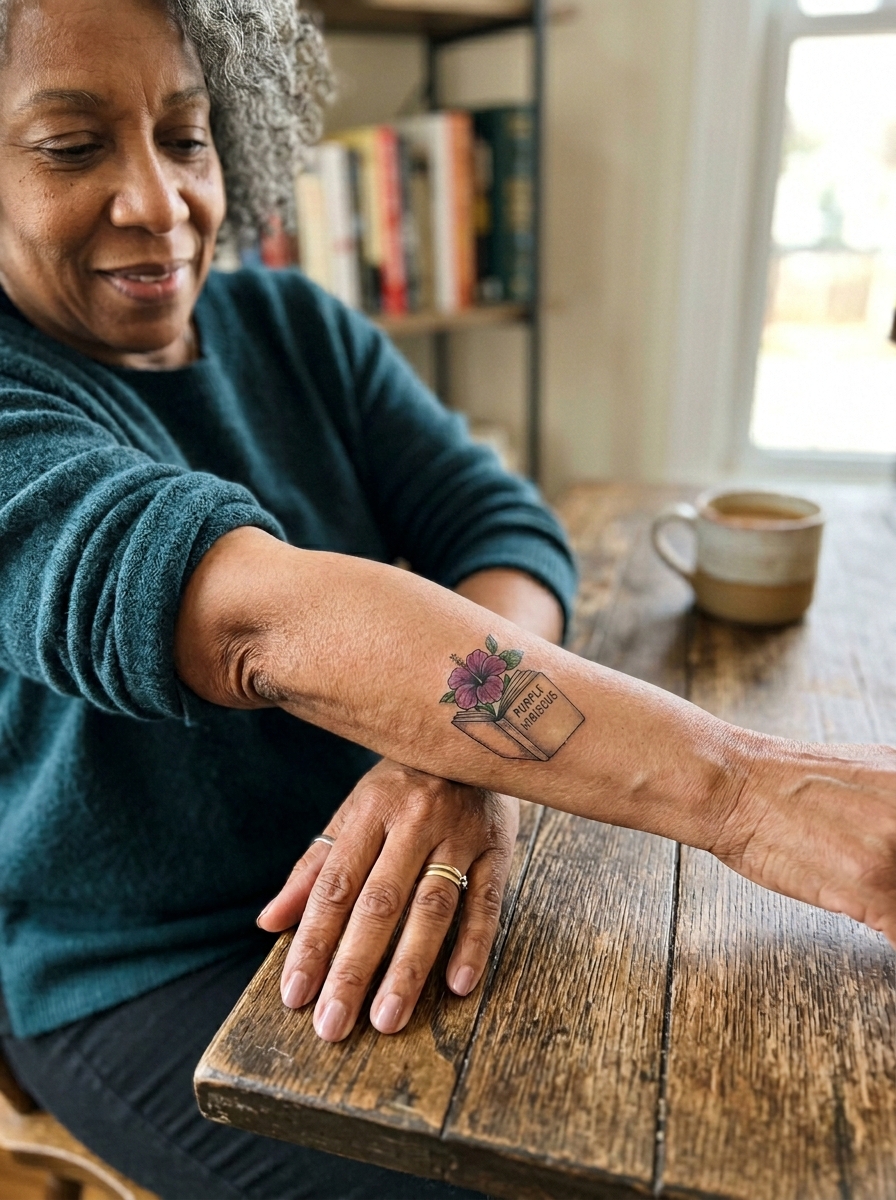
The one technical warning I give: petals drawn as single hair-thin strokes tend to soften. Ask for slightly heavier outer petals so the silhouette survives. The lotus pictured at the top of this guide is a good example of that balance.
2. Om Symbol
Om (aum) is the sacred syllable of Hindu and Buddhist practice — the sound treated as the underlying vibration of everything.
As a tattoo it is deceptively difficult. The whole design is one continuous shape, so any wobble in the line is the entire tattoo.
When I tested a few small placements on stencil, the nape and the inner forearm held the proportions best; the wrist crease distorted the lower curve.
Keep it clean and single-weight rather than ornamental unless you are going large. A simple om at three inches beats a decorated one at one inch every time.
3. Mandala
A mandala is a radially symmetric diagram used as a meditative tool and a map of the cosmos in Hindu and Buddhist traditions — Britannica has a good plain-language overview of its ritual use.
For tattooing it is a geometry problem before it is an art problem. The centre point has to sit exactly where the body curves least, or the symmetry visibly falls apart.
Shoulder caps, upper backs and outer thighs are the placements I see hold symmetry well. Forearms work if the mandala is a half-form rather than a full circle.
I would not go below palm-sized. Below that the inner rings fill in within a few years. There is a fuller breakdown in the mandala tattoo ideas for women collection.
4. Chakra Column
The seven chakras stacked from root to crown make one of the most specific spiritual tattoos available, because each symbol carries its own petal count and Sanskrit seed syllable.
Run vertically along the spine it becomes a single design with seven readable parts. That is rare and worth taking advantage of.
Colour coding each centre is traditional but it is also seven different pigments healing at once on one of the more sensitive areas of the body.
In my experience most women end up preferring it in plain black line, with the colour reserved for the crown or the heart. Sessions get split across two or three appointments either way.
5. Unalome
The unalome is a Buddhist symbol of the path to enlightenment: a spiral at the base for the confusion of early life, a straight line for progress, dots at the top for the final moment.
It is the most information-dense minimal tattoo I know of — a design that is essentially one stroke but says something specific.
Sternum, inner wrist and the back of the arm all suit it. The sternum version tends to be the one people describe as feeling most private.
Because it is so small, it is often a first tattoo. That is fine, but do not let a small design talk you into a cheap artist — a shaky straight line has nowhere to hide.
Protective Symbols
6. Hamsa Hand
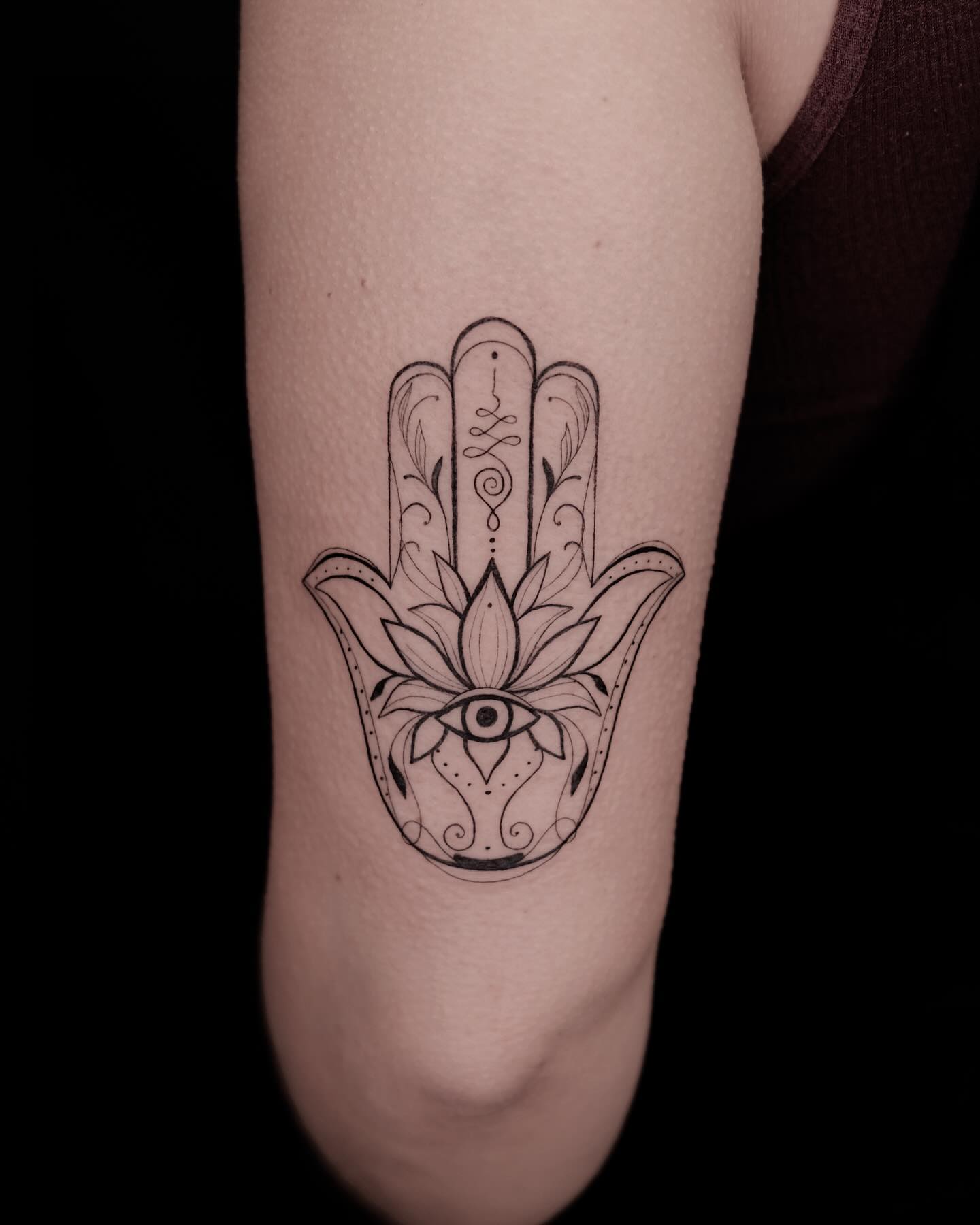
The hamsa is the open-palm amulet found across Jewish, Islamic and wider Middle Eastern tradition, worn to turn away the evil eye.
Most versions set an eye into the palm, and the fingers are where ornamental detail naturally goes — which makes it one of the most decorative options on this list.
Inner wrist, forearm and collarbone are the classic placements. Pointing downward is the more common protective orientation, though both appear historically.
If you want the ornate version, give it room. Detail packed into a two-inch hamsa is detail you will lose. The hamsa tattoo ideas guide covers orientation and styling in more depth.
7. Evil Eye (Nazar)
The nazar is the concentric blue disc used across the Mediterranean, the Middle East and South Asia to deflect the envious glance.
It is one of the few spiritual symbols that genuinely wants colour. The deep blue, pale blue and white rings are the meaning, not decoration.
Small and simple suits it — ankle, inner arm, behind the ear. It reads instantly at an inch, which almost nothing else here does.
Be realistic about the blue: saturated mid-blues on lighter areas usually want a touch-up at some point. Budget for that rather than being surprised by it.
Sacred Geometry and Cosmic Order
8. Seed of Life
The Seed of Life is seven overlapping circles in flower formation — the innermost unit of the Flower of Life, read as the pattern creation begins from.
Tattooed properly it is beautiful and almost mathematical. Tattooed by someone who is not a geometry specialist it is obvious immediately, because the eye finds an off-centre circle without being told to.
Ask to see healed geometry work before you book. Fresh photos hide a lot. This is the one symbol where I would travel for the right artist.
Sternum, spine and centre forearm all give it the symmetry it needs. More options in the sacred geometry tattoo ideas collection.
9. Tree of Life
The tree whose roots reach down and branches reach up appears in Norse, Celtic and Kabbalistic thought as the axis connecting the realms.
What makes it work as a tattoo is that it has a built-in composition: the trunk gives you a spine, the canopy gives you a shape.
I always ask for the roots to be given as much line work as the branches. Root-light trees look like a plant; root-heavy ones look like a symbol.
Upper arm, ribs and the centre back all suit it. Celtic knotwork versions are the most durable at smaller sizes.
10. Moon Phases
The cycle from new to full and back is the shorthand for cyclical time and the feminine divine, and it turns up in almost every tradition that recognises a female principle.
As a design it is the easiest on this list to place, because it is a band — it will follow a forearm, a spine or an underbust line without redrawing.
Get the sequence astronomically correct and get the waxing side on the correct side. Artists get this backwards more often than you would expect, so check the stencil yourself.
Solid black fills hold up better than stippled shading here. See the moon phase tattoo ideas guide for layout variations.
Devotional Christian Symbols
11. Sacred Heart
The Sacred Heart — the heart of Jesus crowned with thorns and radiating light — is the most immediately legible Catholic symbol there is.
It is also, in my experience, the best-ageing tattoo on this entire list, because it comes from the traditional American bold vocabulary: heavy outlines, limited palette, strong internal contrast.
If you want something that will look deliberate in thirty years rather than faded, this is the template to copy even if you change the subject.
Forearm and upper arm are the natural placements. Bold does not mean big — a three-inch traditional Sacred Heart is a complete tattoo.
12. Praying Hands
Praying hands cross traditions almost completely — Christian, Islamic and Buddhist devotional contexts all recognise the gesture.
In black and grey realism the whole tattoo is shading. There are barely any outlines, which means the artist’s gradient control is the design.
That makes it a poor choice for a first-timer at a walk-in shop and an excellent choice for a black and grey specialist with a portfolio of healed hands.
Inner forearm is the standard placement. It also works as one element inside a larger devotional composition rather than alone.
Ancestral and Earth-Based Symbols
13. Celtic Knotwork
Celtic interlace — the triquetra, the Celtic cross, a continuous knotwork band — represents eternal connection and the cycle of life, death and return.
The rule with knotwork is that the negative space has to be planned before the line, or the weave stops reading and becomes a dark blob.
Every good knotwork artist I have watched draws the gaps first. If your artist is drawing the strands first, ask why.
Bands around the arm, wrist or ankle use it best, since interlace is naturally continuous. The Celtic knot tattoo ideas guide has more pattern options.
14. Ankh
The ankh is the Egyptian hieroglyph for life — a looped cross, and one of the oldest continuously recognised spiritual symbols we have.
Its strength as a tattoo is instant legibility. The loop and crossbar read at small size and from across a room.
I would resist over-decorating it. Hieroglyphic detailing looks good on paper and closes up in skin faster than people expect.
Nape, inner forearm and the back of the upper arm all work. Simple, medium-sized and centred is the version that lasts.
15. Feather
In many Native American traditions a feather signals connection to the divine and the freedom of the spirit — and the specific bird changes the reading, with eagle for strength and owl for wisdom.
This is a symbol worth being careful with. If you have no relationship to the tradition you are quoting, consider choosing a bird that means something to you personally instead of a tribal-style feather.
Technically, feathers age best when the barbs are broken into separate strokes rather than drawn as a solid mass — the gaps stop it going grey.
Forearm, ribs and the back of the shoulder are the placements where the long shape has room to sit naturally.
The Divine Feminine
16. Goddess Figure
Kali, Lakshmi, Isis, Hecate, or an unnamed feminine divine figure — this is the most explicitly gendered spiritual choice on the list.
It is also the one that most needs size. A face carries the whole design, and faces do not survive being shrunk.
When I have seen small goddess tattoos five years on, the features are the first thing to go soft. Thigh, upper back and outer arm give you the room.
If a named deity is involved, spend an extra consultation on iconographic accuracy. Getting the number of arms or the attributes wrong is a permanent, specific mistake.
17. Meditating Figure
A seated cross-legged silhouette marks the practice rather than the belief, which makes it the most quietly personal option here.
As a silhouette it is forgiving — solid black shapes heal predictably and hold their edges. It is one of the few designs on this list I would happily see done small.
It also composes well. Ringed with a mandala, a moon, or botanical line work it becomes a centrepiece without needing internal detail.
Between the shoulder blades and the centre forearm are the placements that suit the symmetry of the pose.
18. Your Own Personal Symbol
The strongest spiritual tattoos I have seen were not on any list. A shape from a dream, a line of text in a grandmother’s handwriting, a diagram someone drew during the worst year of their life.
These are harder to commission because there is no reference — you are asking an artist to design rather than interpret, and that costs more time and money.
It is worth it. A symbol nobody else can read is the only one that cannot be mistaken for a trend.
Bring words, not pictures, to that consultation. Describe what it has to feel like and let the artist propose the form.
Variations Worth Considering
Sacred Text Instead of Symbol
A line of scripture, a mantra in Devanagari, a Quranic phrase in calligraphy — text carries specificity that no symbol can.
The risk is transcription. Have any non-Latin script checked by someone who reads the language, not by the artist and not by a translation app.
A Composition Rather Than One Symbol
Instead of choosing between the lotus and the moon, some of the best spiritual pieces combine three or four elements into one framed composition.
This costs more and takes longer, but it solves the “I want all of them” problem without covering your arm in unrelated small tattoos.
Negative Space and Blackwork
Ornamental blackwork treats the symbol as a window in a solid field rather than a drawing on blank skin.
It ages extremely well and it is genuinely striking, but it is close to permanent — large solid black is the hardest thing to cover or remove later.
Placement, Sizing and Healing
Placement is where most spiritual tattoos go wrong, and it is almost always a scale problem rather than a location problem.
The rule I keep coming back to: every symbol has a minimum size below which its internal detail stops being detail. Ask your artist what that size is for your specific design, and then do not negotiate below it.
Ribs, sternum and spine are the classic spiritual placements and also three of the more painful ones — bone-close, thin-skinned, and long sittings. If you are choosing a sternum placement, plan for a break rather than pushing through.
For healing, follow your artist’s written instructions over anything you read online, including this. Keep it clean, keep it moisturised lightly, keep it out of the sun and out of pools while it closes — usually two to three weeks for the surface, longer underneath. Our tattoo aftercare guide walks through the timeline in detail.
One honest safety note. Tattoos are punctures, and Mayo Clinic lists infection, allergic reaction and scarring among the real risks — the US FDA says the same about ink reactions. If a healing tattoo is hot, swelling, weeping or you develop a fever, that is a doctor’s question, not a forum’s. No spiritual meaning is worth a delayed infection.
Common Mistakes, and What To Do If You Are Still Not Sure
The most common mistake is choosing the symbol from an image search and the meaning afterwards. That order is backwards and it is the one that leads to cover-ups.
The second is going too small for the symbol’s detail level — a one-inch mandala, a two-inch goddess, a hair-thin Seed of Life.
The third is not asking the artist whether this is their kind of work. A brilliant colour realism artist is not automatically a geometry artist, and most will tell you so if you ask directly.
If you are still undecided, the useful move is not more scrolling. Write down the sentence you want the tattoo to say, in plain words, and see which symbol survives the sentence.
If the answer is Christian or broadly devotional rather than tradition-specific, our faith tattoo ideas covers that ground more directly than this list does.
Frequently Asked Questions
Is it disrespectful to get a spiritual tattoo from a tradition I was not raised in?
It depends on the symbol and on your relationship to it, and reasonable people disagree. Symbols from living religious practice — om, hamsa, specific deities — are the ones most likely to read as appropriation if you have no connection to them. In my experience the most reliable test is whether you can explain the symbol’s meaning without referring to how it looks. If you are unsure, ask someone who practises the tradition rather than asking an artist.
What is the best placement for a first spiritual tattoo?
Outer forearm and outer upper arm are the easiest first placements: moderate pain, flat surface, straightforward healing and easy to keep clean. Ribs, sternum and spine are more meaningful placements for many people but they hurt more and sit still for longer. If your design is small and simple, the inner forearm is a good compromise. Avoid hands, feet and fingers for a first piece, since they fade fastest.
How much does a spiritual tattoo usually cost?
Price tracks time and detail rather than meaning, so a small unalome and a full chakra column are at opposite ends of the range. Most shops have a minimum charge that covers a small fine line symbol, and hourly rates vary widely by city and by artist reputation. Geometry and black and grey realism generally cost more per square inch because they take longer. Get a written quote at consultation, and be suspicious of a price far below local norms.
Do fine line spiritual tattoos fade faster than bold ones?
Usually yes. Thin single-pass lines have less pigment in them, so the same amount of natural fading shows sooner than it does in a heavy traditional outline. That does not mean fine line is a bad choice — it means you should expect a touch-up at some point and choose a size that leaves the lines room to soften. Sun exposure is the single biggest accelerator, so sunscreen matters more than any aftercare product.
Can I combine symbols from different traditions in one tattoo?
Technically yes, and plenty of people do. Design-wise it works best when one symbol is clearly the main element and the others are supporting, rather than three equal symbols competing for attention. Meaning-wise, be aware that some combinations will read as contradictory to people inside those traditions. If the combination is genuinely personal to your own practice, that is a strong reason to do it.
Quick Summary
- Choose the meaning first and the image second — reversing that order is the most common regret.
- The lotus, om, mandala, hamsa and nazar come from living religious practice; be honest about your relationship to them.
- Every symbol has a minimum size below which its detail collapses. Ask your artist what it is and do not go under it.
- Traditional bold styles like the Sacred Heart age best; fine line geometry ages worst without a specialist.
- Sacred geometry and black and grey realism need portfolio proof of healed work, not fresh photos.
- Sternum, ribs and spine are the most meaningful placements and the most painful — plan the session accordingly.
- Check stencils yourself for moon phase order, script transcription and deity attributes before the needle starts.
- Treat healing as medical: follow your artist’s instructions, and see a doctor for heat, fever or spreading redness.