A spiritual tattoo is different from a decorative one in the same way a prayer is different from a poem. The form can look identical. The intent is what separates them, and intent is the only part of a spiritual tattoo that cannot be copied from a reference photo.
I have spent years looking at these pieces in portfolios, in studios and on the arms of people who were willing to explain them to me. The ones that hold up are almost never the most technically complex.
They are the ones where the wearer can tell you, without hesitating, what the symbol asks of them. That is a much harder brief than picking a design you like the look of, and it is worth taking seriously before you book anything. If you want a version of this list weighted toward placements and styles more commonly requested by women, we cover that separately in our guide to spiritual tattoo ideas for women.
The 20 ideas below are drawn from several living traditions. Where cultural sensitivity genuinely applies, I have said so in the entry rather than burying it in a disclaimer at the bottom.
Which Spiritual Symbol Fits You?
This is the comparison I find myself sketching out for people most often. It is a starting point, not a verdict.
| Symbol Family | Best If You Want | Typical Size | Cultural Care Needed |
|---|---|---|---|
| Dharmic (Om, lotus, unalome) | A symbol tied to practice rather than belief in a deity | 2–6 inches | High — placement rules matter |
| Protective (hamsa, nazar) | A daily reminder rather than a statement of faith | 1.5–5 inches | Moderate |
| Ancient (ankh, Eye of Horus, vegvisir) | Clean linework with historical depth | 2–5 inches | Low to moderate |
| Abrahamic (cross, sacred heart, Star of David) | An open declaration of faith | 2–8 inches | High if not your own tradition |
| Personal or abstract | Meaning nobody else can read off your skin | Any | None |
Why Spiritual Tattoos Ask More of You Than Other Tattoos
Most tattoos only have to answer to you. A spiritual tattoo often has to answer to strangers as well, because the symbols were public property long before they were tattoo flash.
That is the practical difference: someone who practises the tradition may recognise your tattoo and ask about it. Being able to answer that question honestly is worth more than any amount of shading.
There is also the matter of permanence meeting belief. Beliefs shift over a lifetime in a way that a favourite band or a pet’s name usually does not. I have met people who love a piece they got at 22 for what it meant then, and I have met people who quietly cover theirs.
Neither outcome is a failure. But it is worth asking whether the symbol you are drawn to represents where you are now or where you hope to be, because those are different tattoos.
One more thing artists mention constantly: sacred symbols reproduced badly read as careless rather than reverent. Geometry-heavy pieces in particular punish a rushed hand, so this is not the category in which to chase the cheapest quote.
Dharmic Symbols: Hindu, Buddhist and Jain Traditions
1. Om (Aum)
The sacred syllable shared by Hinduism, Buddhism and Jainism represents the sound from which the universe is understood to arise, and the unity underneath apparent separateness. It is probably the single most widely worn spiritual symbol in the tattoo world.
That ubiquity cuts both ways. It reads instantly to almost anyone, which is exactly why it needs genuine personal connection to rise above the generic. Britannica’s entry on Om is a reasonable place to start if you want the tradition rather than the aesthetic.
Practically: most artists I have asked prefer it small and clean, two to three inches, on the inner forearm or behind the ear. One caution worth knowing is that in Hindu and Buddhist contexts the feet and lower legs are considered impure, so a sacred syllable placed on the ankle can read as disrespectful to practitioners even when no offence was meant.
2. Lotus Flower
In Buddhist and Hindu traditions the lotus stands for awakening, because the flower roots in mud and opens above the water clean. The symbolism is embedded in the plant’s actual biology, which is a large part of why it has lasted.
It is also one of the most forgiving spiritual designs to execute. Petals give an artist natural places to build gradient and depth, so it ages better than designs that rely on very fine isolated lines.
In my experience it is the piece people regret least, partly because its meaning is broad enough to keep pace with a changing life. If you want to see the range of interpretations, from single-line minimal to full ornamental, our lotus flower tattoo designs collection covers it in more depth.
3. Unalome
A Theravada Buddhist symbol representing the path toward enlightenment, drawn as a single continuous line. The spiralling base is the confusion and wandering of early life.
The line then straightens as the path becomes clearer, and terminates in a point or a small flourish representing the moment of realisation. It is one of the few symbols that tells its own story without any explanation.
Because it is a single fine line, it is more vulnerable to blur over the years than a shaded piece. Every artist I have asked about it says the same thing: go slightly larger than feels necessary, and keep it off high-friction areas such as the side of the finger. Our unalome tattoo ideas guide covers the directional conventions, which do carry meaning.
4. Dharma Wheel (Dharmachakra)
The eight-spoked wheel represents the Noble Eightfold Path and the turning of the Buddha’s teaching. It is a specifically religious symbol rather than a general spiritual one.
That distinction matters more here than almost anywhere else on this list. Worn without any relationship to Buddhist practice, it tends to read to practitioners as ornament rather than commitment.
Technically it is unforgiving. Perfect radial symmetry means any imprecision is instantly visible, so this is a piece for an artist with a demonstrated geometric portfolio, not a general-practice tattooist having a go.
5. Buddhist Hand Mudra
Mudras are ritual hand gestures, each with a defined meaning. The dhyana mudra signals meditation, the abhaya mudra signals fearlessness and protection, the vitarka mudra signals teaching and discussion.
As a tattoo, the appeal is that the meaning sits in the gesture rather than in a written symbol, so it is quieter and less immediately legible to passers-by.
The obvious pitfall is picking a gesture for how it looks and discovering later that it means something you did not intend. Confirm the specific mudra with a source you trust before the stencil goes on, because they are not interchangeable.
6. Chakra Symbols
The seven chakras of tantric and yogic tradition each have their own geometric symbol, and they are often tattooed as a vertical column along the spine in the order they are traditionally placed in the body.
It is one of the few spiritual concepts whose layout has a natural home on the body. The spine placement is not a stylistic choice so much as an anatomical one.
Be realistic about the commitment. A full seven-symbol column is a long session in a sensitive area, and spine work hurts more than most people expect. Many people I have spoken to started with a single chakra and added over a couple of years, which is a sensible approach.
Protective Symbols and Sacred Geometry
7. Hamsa Hand
The hamsa, also known as the hand of Fatima or the hand of Miriam, appears in Jewish, Islamic and broader Middle Eastern traditions as protection against the evil eye. It is one of the oldest protective amulets still in continuous use.
The five-fingered hand, usually with an eye set in the palm, is worn by people from a wide range of backgrounds. Of everything on this list it may be the most genuinely cross-cultural, which softens some of the appropriation questions without removing them.
Direction carries meaning: fingers down is generally read as inviting abundance, fingers up as warding off harm. Decide which you want before the stencil, because it is not a detail you can flip afterwards. Our hamsa tattoo ideas page has more on ornamentation styles.
8. Evil Eye (Nazar)
The nazar, the concentric blue and white eye, is a protective charm across Mediterranean, Middle Eastern and South Asian cultures. As a tattoo it functions as an amulet you cannot lose.
The symbolism is unusually consistent across all those traditions: it reflects ill intent back toward its source rather than absorbing it.
This is one of the few spiritual pieces that genuinely benefits from colour, since the blue is doing real symbolic work. Ask to see healed colour photos rather than fresh ones, because blues can shift as they settle. There is a wider range of treatments in our evil eye tattoo ideas collection.
9. Mandala
A mandala is a concentric geometric composition used in Hindu and Buddhist practice as a meditation aid, with the eye drawn steadily inward toward the centre.
It is the most demanding piece on this list to execute well. Every ring has to be genuinely concentric and every repeat genuinely even, and the human eye catches errors in radial symmetry with uncomfortable accuracy.
Expect several hours for anything larger than a palm, and expect to pay for a specialist. If you like the visual language but not the religious weight, the broader field of sacred geometry tattoo ideas gives you the same precision without the same cultural obligations.
Ancient and Ancestral Symbols
10. Ankh
The Egyptian hieroglyph for life, a looped cross carried by gods in tomb painting and temple relief. It is among the oldest symbols still in regular use as a tattoo.
Because ancient Egyptian religion has no significant living practitioner community, the appropriation question is far lighter here than with Dharmic or Abrahamic symbols. That is a real practical advantage if the concern is weighing on you.
Visually it is simple enough to sit at two inches on a wrist and still read clearly, which is unusual for a symbol with this much history behind it.
11. Eye of Horus
The wedjat, or Eye of Horus, represents protection, royal power and restored health in ancient Egyptian belief. The myth behind it involves the eye being injured and made whole again, which is where the healing association comes from.
The distinctive markings below the eye, the falcon-derived teardrop and curl, are the parts that get simplified or misdrawn most often. Bring a reference from a museum source rather than from a Pinterest board.
It suits medium sizes, roughly three to five inches, better than very small ones. Below that the internal detail closes up as the ink spreads over the years.
12. Vegvisir
The vegvisir is an Icelandic magical stave, eight arms radiating from a centre, described as helping the bearer find their way through bad weather. Honesty matters here.
It is often marketed as a Viking symbol, but it is documented in Icelandic manuscripts from the 1800s, centuries after the Viking Age. It belongs to Icelandic folk magic rather than Norse paganism.
That does not make it a lesser tattoo, and plenty of people wear it knowing exactly this. It just means the story you tell about it should match the record. If genuine Viking Age symbolism is what you are after, our Norse mythology tattoo ideas guide is the better starting point.
13. Triquetra
Three interlaced arcs forming a continuous knot, found in early Insular Celtic manuscript art and later adopted by Christians for the Trinity and by modern pagans for the triple goddess.
The reading depends entirely on who is looking, which some people find appealing and others find frustrating. It is a genuinely ambiguous symbol.
The interlacing is where the craft shows. Over-and-under weaves need consistent line weight and clean gaps, or the whole thing flattens into a blob after a decade. Related interlace work is covered in our Celtic knot tattoo ideas collection.
14. Tree of Life
A tree with roots and branches drawn in equal proportion appears in Celtic, Norse, Kabbalistic and numerous other traditions as an image of connection between worlds, above and below, past and future.
Its independent appearance across so many unrelated cultures suggests it points at something close to universal, which is also why it carries almost no appropriation risk.
It scales well. A two-inch version on a wrist and a full back piece both work, because the composition is symmetrical either way. Our tree of life tattoo gallery shows both ends of that range.
Abrahamic Faith Symbols
15. Cross
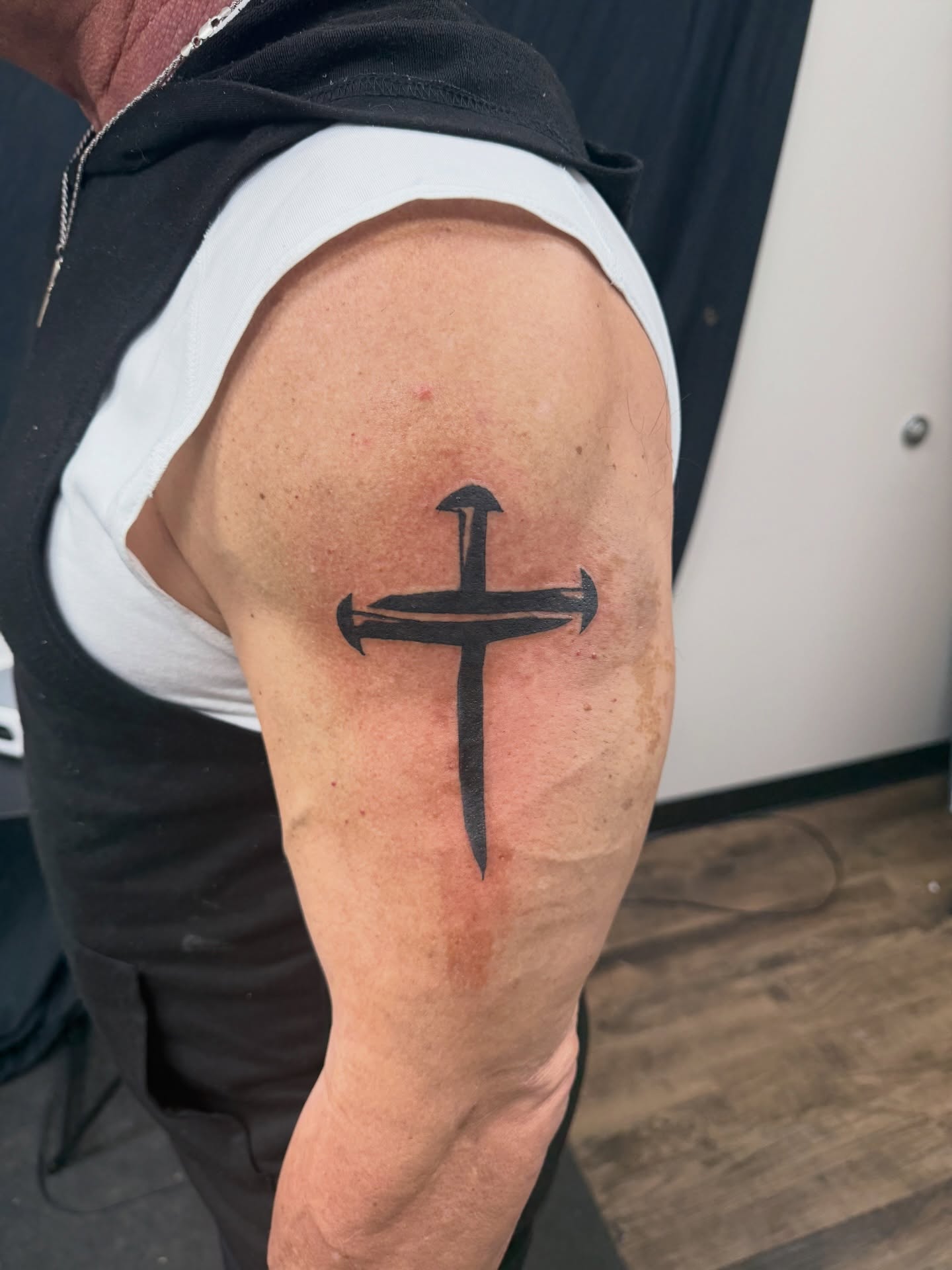
The most recognisable religious symbol in the Western world, and the one most likely on this list to be worn by someone who actively practises the faith it belongs to.
Treatments range from a bare two-inch line cross to a full ornate crucifix with rays and drapery. In my experience the simple versions age far better, because there is less fine detail to soften.
Placement conventions are looser than with Dharmic symbols, though many people still avoid anywhere that would put it below the waist. Worth a conversation with your artist if your community has expectations about that.
16. Sacred Heart
The Sacred Heart of Jesus, a flaming heart wrapped in thorns and often pierced or crowned, is a specifically Catholic devotional image with a long history in tattoo art.
It sits comfortably in traditional American tattoo style, which means there is a deep well of well-tested flash to draw on. The bold outlines that style uses are also, conveniently, the ones that survive longest.
The individual elements are not decorative. The thorns, flames and rays each mean something specific in Catholic devotion, so dropping one for aesthetic balance changes the image rather than simplifying it.
17. Star of David
The six-pointed star carries both religious and cultural weight in Judaism, standing for faith, peoplehood and identity across a wide spectrum of observance.
It is worth knowing that traditional halakhic interpretation prohibits tattoos, so this is a symbol many observant Jews would not wear. Plenty of secular and less observant Jews do, and the meaning is real for them.
The twentieth-century history attached to this symbol gives it particular weight, and that history is a large part of why some people choose it. If it is not your tradition, this is one to leave alone.
18. Crescent and Star
The crescent moon paired with a star is widely associated with Islam and appears on the flags of many Muslim-majority countries, though it predates Islam as an emblem and is not doctrinally required.
As with the Star of David, there is a significant caveat: most mainstream Islamic scholarship regards permanent tattooing as impermissible. Many Muslims who want the symbol choose jewellery instead.
Where it is worn as a tattoo it tends to be small and clean, which suits the form. The two elements need enough separation to stay distinct as the lines soften over the decades.
Open-Ended and Personal Approaches
19. Feather
The feather is the most open-ended entry here. Depending on tradition it can mean truth, ascent, freedom, or a connection to those who have died.
That flexibility is the point. It carries spiritual weight without committing you to a specific doctrine, which suits people whose beliefs do not map onto an organised tradition.
One genuine caution: feathers styled after Native American regalia are a different matter entirely and are widely considered inappropriate outside those communities. A plain feather is not the same thing as an eagle feather rendered in a specific tribal style.
20. Personal Symbol
The most genuinely spiritual tattoo might be one with no cultural precedent at all. A mark you designed, meaningful only inside your own interior life.
It requires no tradition to validate it and no research to defend it, which sidesteps every cultural question on this page at once.
The practical advice is to live with the design for a while first. Draw it, sit with it for a few months, see whether it still holds. Symbols that survive that wait tend to be the ones people are still glad of twenty years on.
Getting It Made: Practical Advice
Vet the portfolio for the specific thing you want, not for general skill. An artist who is brilliant at realism may have never drawn a true concentric mandala, and geometry is a distinct discipline.
Ask to see healed work, ideally two or more years old. Fresh photos flatter everything, and the question that matters is how a piece looks after the lines have settled.
On aftercare, follow the instructions your artist gives you rather than a generic routine from the internet, since they know their ink and their technique. The American Academy of Dermatology has straightforward general guidance if you want a second reference.
If a healing tattoo shows spreading redness, increasing pain after the first few days, swelling, pus or fever, see a doctor rather than posting a photo in a forum. Allergic reactions to pigment are uncommon but real, and red inks are the ones most often implicated. The FDA’s fact sheet on tattoos and permanent makeup is a reasonable plain-language overview. Nothing on this page is medical advice.
Still Not Sure? Common Mistakes Worth Avoiding
Choosing the symbol before choosing the artist. With sacred geometry especially, the artist determines the outcome far more than the design does.
Going too small for the detail level. A dharma wheel at one inch becomes an indistinct disc within a decade, and no amount of touch-up work fully recovers it.
Skipping the origin research and finding out afterwards. This is the one people report regretting most, and it takes an afternoon to avoid.
Treating a sacred symbol as a placeholder while you decide what you actually want. If you are still exploring, our faith tattoo ideas guide is a useful place to keep looking before committing.
Frequently Asked Questions
Is it disrespectful to get a spiritual tattoo from a tradition I do not practise?
It depends heavily on the symbol and on how you carry it. Symbols from ancient traditions with no living practitioner community, such as the ankh, raise very few objections. Symbols central to a living faith, such as the dharma wheel or the Star of David, are a different matter, and practitioners are far more likely to read them as appropriation. The reliable test is whether you could explain your connection to someone from that tradition without embarrassment.
Where should I avoid placing a sacred symbol?
In Hindu and Buddhist contexts the feet and lower legs are traditionally considered impure, so sacred syllables and religious imagery placed there can cause genuine offence even when none was intended. Many people also avoid placements that would put a religious symbol below the waist generally. Your artist may not know these conventions, so it is worth raising the question yourself rather than assuming it will come up.
How much does a spiritual tattoo usually cost?
It varies enormously by region, artist and complexity, so treat any figure you read online as a rough anchor rather than a quote. A simple two-inch symbol is typically a shop-minimum job, while a detailed mandala or a full chakra column runs to multiple sessions with a specialist. Get quotes from two or three artists whose portfolios show the specific style you want, and be sceptical of anyone dramatically cheaper than the rest.
Do fine-line spiritual tattoos hold up over time?
Less well than bolder work, as a general rule. Very fine single lines soften and spread as ink settles into the skin, and a unalome or a delicate crescent will look noticeably less crisp after ten years than it did at ten days. Sun exposure accelerates this considerably, so daily sunscreen on the area makes a real difference. Going slightly larger than feels necessary is the single most useful hedge.
What if my beliefs change after I get the tattoo?
This happens, and it is worth planning for rather than fearing. Many people come to regard an old spiritual tattoo as a record of who they were at that point, which is its own kind of meaning. Others cover or rework it, and a good cover-up artist has more options than most people expect. Choosing a symbol that reflects where you are now, rather than an aspiration you have not yet reached, tends to age better.
Quick Summary
- Intent, not design, is what makes a spiritual tattoo different from a decorative one.
- Research the origin before you book. It takes an afternoon and prevents the most commonly reported regret.
- Symbols from living traditions carry more obligation than those from ancient ones like the ankh or Eye of Horus.
- Placement conventions matter in Dharmic traditions: keep sacred symbols off the feet and lower legs.
- Geometry-heavy pieces such as mandalas and dharma wheels need a specialist, not a generalist.
- Fine single lines soften over the years, so size up slightly and use sunscreen.
- The vegvisir is Icelandic folk magic from the 1800s, not a Viking Age symbol.
- A personal symbol you designed yourself sidesteps every cultural question on this list.