I have watched the unalome go from a niche request to something artists in my city sketch out several times a week, and the single biggest reason people regret theirs is that they chose the shape before they understood what it was saying.
The unalome comes out of Buddhist and Hindu iconography, where it is read as a map of a life: the spiral is the wandering, the straight line is the clarity that follows, and the dot at the tip is the point of release.
That gives you a design with a genuine narrative structure, which is rarer than it sounds. Most symbols are static. This one has a direction, and it matters which way you point it.
Below are the unalome variations I keep seeing done well, along with the placement, sizing and healing realities that come with each. If you want a broader look at symbolic linework first, our guide to tree of life tattoos covers similar ground.
Which Unalome Style Is Right for You?
This is the comparison I sketch out for friends who ask me where to start. Sizes are the smallest I have seen hold up long term, not the smallest an artist will technically agree to.
| Style | Smallest size that ages well | Typical sitting | Best suited to |
|---|---|---|---|
| Minimalist line | About 4 cm tall | 30–45 minutes | First tattoos, discreet placements, tight budgets |
| Floral unalome | About 8 cm tall | 1.5–3 hours | Forearm and thigh, people who want softness |
| Geometric | About 7 cm tall | 1.5–3 hours | Flat panels like the outer arm or back |
| Mandala | About 12 cm tall | 3–6 hours, sometimes two sessions | Upper back, sternum, thigh; experienced collectors |
| Colour or watercolour | About 9 cm tall | 2–4 hours | Covered placements; people happy to book touch-ups |
| Animal pairing | About 8 cm tall | 2–3 hours | Anyone wanting a personal totem in the design |
| Celestial | About 6 cm tall | 1–2 hours | Spine, forearm, ankle; fans of small dotwork |
What Affects How a Unalome Tattoo Ages
A unalome is mostly thin black line, and thin black line is the least forgiving thing you can put in skin. That single fact drives almost every decision below.
Line weight is the first variable. A hairline drawn at 1RL looks stunning at two weeks and can soften noticeably over several years, especially on high-friction areas.
Spiral density is the second, and it is the one people underestimate. If the loops of the spiral sit closer together than the width of about two lines, ink migration will eventually close the gaps and the spiral reads as a blob.
Placement matters more than style. Fingers, palms, the outer edge of the foot and the inner wrist all see constant rubbing, and in my experience they are the placements that come back for touch-ups first.
Sun exposure is the quiet killer. Every artist I have asked says the same thing: the clients whose linework holds best are the ones who keep SPF on the piece once it is healed. That is free advice and it works.
Unalome Tattoo Ideas Worth Considering
These seven directions cover roughly everything I see walk into a studio. Each one changes the symbol in a different way, so read them as different arguments rather than different decorations.
1. Minimalist Unalome Tattoo
This is the purest version: spiral, line, dot, nothing else. It is also the version that most rewards a good artist, because there is nowhere to hide a wobble.
Placement tends toward the wrist, the inner forearm, behind the ear, the ankle or the side of a finger. I would talk you out of the finger — the ink there breaks up faster than anywhere else on the body.
Expect roughly 30 to 45 minutes in the chair and a price near a studio minimum. That makes it a common first tattoo, which is fine, but ask for a stencil placed on the skin and walk to a mirror before anyone starts.
The detail worth insisting on is the dot. A dot packed solid at the same weight as the line keeps the composition balanced; a faint one makes the whole piece look unfinished after healing. If you like this scale, our roundup of small tattoo ideas has more in the same register.
2. Floral Unalome Tattoo
Adding flowers is the most requested modification by a wide margin, and the lotus is the flower people ask for first because it carries its own Buddhist meaning of rising clean out of muddy water.
Roses, peonies, wildflowers and cherry blossom all work. The choice changes the tone completely: a lotus reads devotional, wildflowers read personal, peonies read decorative.
The composition trick is to let the flowers sit at the base and let the line run clear to the top. When artists scatter blooms along the whole stem, the spiritual reading gets lost and it becomes a botanical piece with a curl in it.
Budget eight centimetres of height minimum. Petal detail crammed into a small footprint is exactly the thing that blurs. For flower-specific reference, our lotus tattoo gallery shows how the base is usually handled.
3. Geometric Unalome Tattoo
Framing the unalome inside a triangle, circle or hexagon gives it structure and a distinctly contemporary feel. The frame also does practical work: it defines the edge of the tattoo so the eye knows where the piece ends.
Flat panels suit this best — outer upper arm, shoulder blade, centre chest, calf. Curved surfaces distort straight geometry in a way that is very hard to un-see once you notice it.
When I tested a stencil of a circular frame on my own forearm before committing, the circle read as an oval from every angle except straight on. That is a five-minute check that saves a permanent annoyance.
Ask specifically whether your artist does geometric work. Clean straight lines and true circles are a separate skill from fine-line florals; browse our geometric tattoo designs to see what the standard looks like.
4. Mandala Unalome Tattoo
This is the ambitious version. A mandala surrounds or crowns the unalome with radial dotwork, and the two symbols genuinely reinforce each other — the mandala is wholeness, the unalome is the route to it.
It is also the biggest commitment on this list. Twelve centimetres is a realistic floor, and a detailed piece can run three to six hours, sometimes split across two sessions.
Symmetry is unforgiving here. On the sternum or centre back, expect your artist to spend a genuinely long time on stencil placement, and let them — that time is what keeps the piece from sitting crooked forever.
Dense dotwork also heals slower than plain linework, because the skin is worked more heavily. Plan for a fortnight of careful aftercare rather than the week a minimalist piece needs.
5. Colourful and Watercolour Unalome Tattoo
Colour opens the design up, whether that is a soft watercolour wash behind the line or a fully rendered lotus in traditional pigment.
My honest read: keep the unalome line itself in solid black and put the colour around it. Colour laid over the line softens the very shape that makes the tattoo legible.
Watercolour is beautiful and it is the least permanent-looking style on this page. Soft edges without a black anchor tend to lose definition over years, and pale pastels fade fastest of all.
If you choose watercolour, choose a covered placement and accept that a touch-up every few years is part of the deal. That is not a reason to avoid it — it is a reason to go in informed.
6. Unalome with Animal Symbols
Butterflies, birds and elephants are the three I see most. Each one shifts the meaning: a butterfly emphasises transformation, a bird emphasises freedom, an elephant brings its own weight of Buddhist symbolism.
The elephant pairing is the most historically coherent, given the shared roots. It also needs the most space — elephant faces do not shrink well.
Placement usually moves up the body for these: upper back, chest, outer arm, hip. You need a surface that can hold two subjects without either one crowding the other.
Keep one element dominant. When the animal and the unalome are drawn at equal visual weight, the piece reads as two tattoos that happen to touch. See our elephant outline tattoo ideas for how the linework versions handle this.
7. Unalome with Celestial Elements
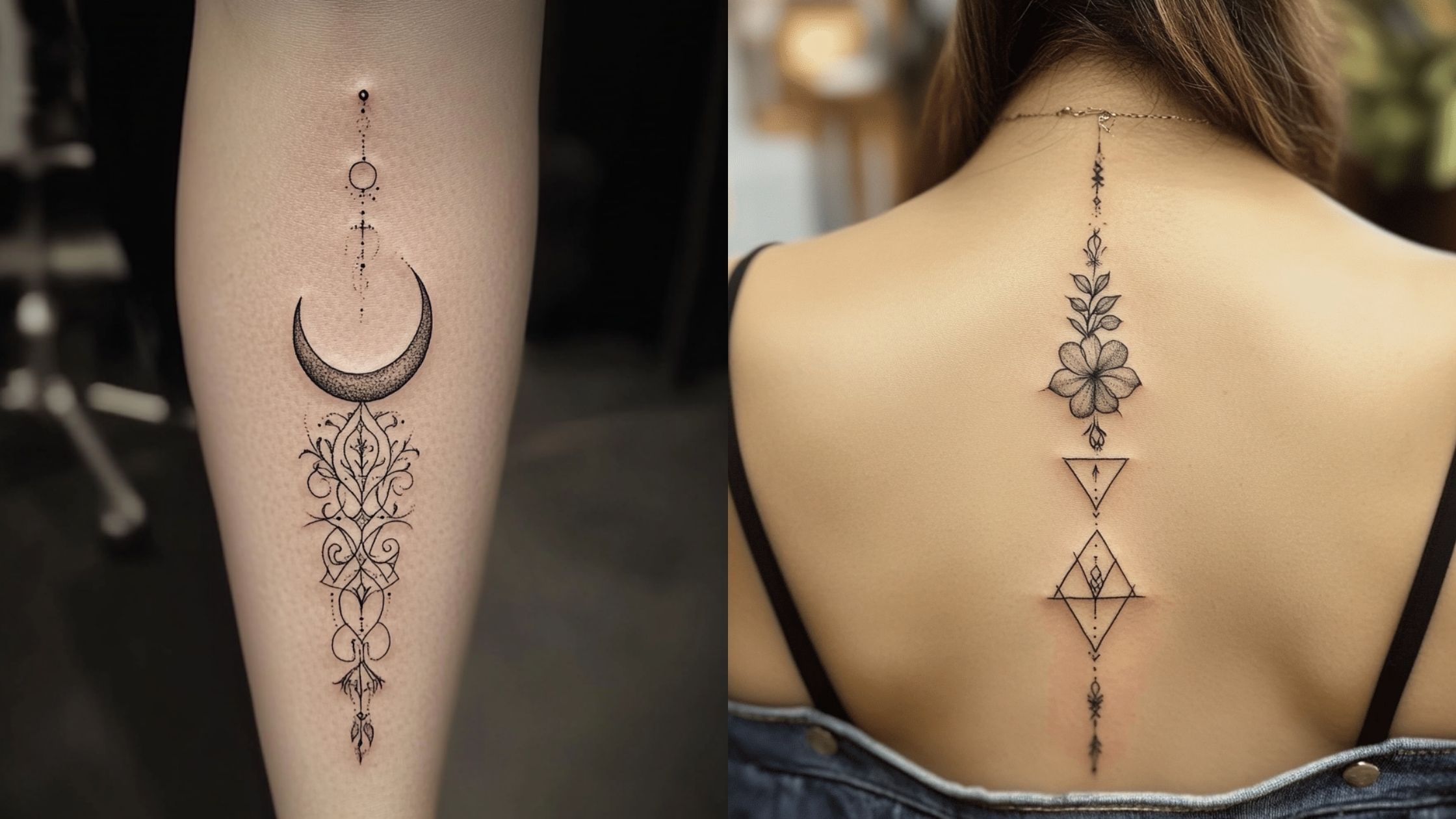
Swapping the terminating dot for a crescent moon, or running moon phases along the straight line, is one of the more elegant modifications available.
It works because it keeps the original grammar of the symbol intact. Nothing gets crowded; one element is simply substituted for another that carries the same idea of arrival.
Moon phases down the spine are a favourite of mine for exactly this reason — the phases give you stages, and the unalome already is a story about stages.
Small celestial detail needs a placement with tight skin. Forearm, spine, ankle and the back of the neck all hold small dotwork better than soft areas do. Our sun and moon spine tattoo gallery shows the vertical layouts.
Variations and Alternatives to the Classic Unalome
If the standard shape is not quite right, these are the adjacent options worth putting on the table before you book.
Reversed and paired unalomes
In traditional usage the spiral end sits at the bottom and the tattoo grows upward. Some artists reverse it, and some clients ask for two unalomes mirrored to represent a partnership or a parent and child.
Mirrored pairs look best with a shared central axis — the spine and the sternum are the natural homes for them.
Unalome with script or a date
A short word or a date set along the straight line is subtle and it dates well, provided the script is large enough. Tiny script is the single most common source of “what does that say?” a decade later.
Buddha and om pairings
For a more overtly devotional piece, the unalome sits comfortably alongside a Buddha figure or an om symbol. This is worth a conversation about intent — these are living religious symbols, not decoration, and treating them that way is simply the respectful default.
Our Buddha tattoo gallery shows how artists usually balance the two.
Simpler symbolic alternatives
If you like the meaning but not the shape, an unbroken single line, a small arrow or a semicolon all carry a comparable idea of continuing forward with far less linework to maintain.
Placement, Sizing and Aftercare That Actually Helps
Choose the placement before the design. A design drawn for a forearm and then squeezed onto a wrist is how spirals end up too tight, and that compression is not something you can fix later.
Ask for the stencil to be applied, then move — bend the arm, turn to the mirror, sit down. A unalome that is straight while you stand still can look tilted in the way you actually hold your body. Ten minutes of checking the stencil is worth more than any amount of Pinterest research.
For healing, follow the aftercare your artist gives you rather than anything you read online, including this article. Broadly, most artists advise keeping it clean, using a thin layer of a fragrance-free ointment, and leaving scabs and flakes alone.
Some redness and mild swelling in the first days is normal. Spreading redness, heat, pus, or a fever is not — that warrants a doctor rather than a forum thread. The same goes for any reaction that appears around a specific colour, which the US Food and Drug Administration notes can surface even years after the tattoo was done. General guidance on tattoo risks and safe practice is also published by the UK National Health Service.
Common Mistakes — and What to Do If You Are Still Not Sure
Going too small is mistake number one. A unalome under about four centimetres has no room for the spiral to breathe, and the spiral is the part that carries the meaning.
Mistake two is picking an artist by price rather than by portfolio. Fine-line work is a specialisation; ask to see healed photos, not fresh ones, because fresh linework flatters everybody.
Mistake three is choosing a high-friction placement for a delicate design. Fingers, palms, feet and the inner wrist all wear faster, and no aftercare routine fully compensates.
Still undecided? Narrow it by placement first. For arms, look at meaningful forearm tattoos; for something vertical, feminine spine tattoos; and for the smallest end of the scale, wrist tattoo ideas.
Frequently Asked Questions
What does a unalome tattoo actually mean?
It represents the path of a life toward clarity or enlightenment, drawn from Buddhist and Hindu iconography. The spiral stands for the wandering and mistakes of the early journey, the straight line for the clearer stretch that follows, and the dot at the tip for the point of release or realisation. Because it is directional, the orientation matters — traditionally the spiral sits at the bottom and the line grows upward. Many people also read it more personally, as a record of having come through something difficult.
Is it disrespectful to get a unalome if I am not Buddhist?
Opinions differ, and it is worth knowing that before you book. The unalome is a living religious symbol rather than a purely decorative motif, and some practitioners are uncomfortable seeing it used ornamentally. Others see thoughtful use as harmless. In my experience the people who feel best about the choice long term are the ones who read into the meaning first and can explain why they chose it.
How much does a unalome tattoo cost?
A minimalist version usually lands at or near a studio’s minimum charge, because it takes well under an hour. Floral, geometric and celestial versions typically run one to four hours of shop time. A detailed mandala piece can take three to six hours and is sometimes split over two sessions. Rates vary enormously by city and artist, so ask for a quote from your specific studio rather than working from an online figure.
Where does a unalome tattoo hurt least?
The outer forearm, outer upper arm and outer thigh are generally reported as the more comfortable placements, since there is more padding and fewer nerve endings near the surface. The spine, sternum, ribs, ankle and the area behind the ear are usually described as sharper, because the needle is working close to bone. Pain is individual, though, and a 40-minute minimalist piece is a very different experience from a four-hour mandala regardless of location.
Will a fine-line unalome blur over time?
Some softening is normal for any thin black line as ink settles into the skin over years. How much depends mostly on line weight, how tightly the spiral is drawn, the placement, and sun exposure. Keeping the spiral loops well spaced and the piece out of direct sun makes the largest practical difference. Many people book a touch-up somewhere between year three and year seven, and that is routine rather than a sign anything went wrong.
Quick Summary
- The unalome reads as a journey: spiral for the wandering, straight line for clarity, dot for arrival.
- Orientation matters — traditionally the spiral sits at the bottom and the design grows upward.
- Minimalist versions need about 4 cm of height; mandala versions need roughly 12 cm to hold detail.
- Keep the spiral loops well spaced. Tight spirals are the most common cause of blurring later.
- Add flowers, geometry, animals or celestial elements at the base or the tip, not along the whole line.
- Choose covered placements for watercolour and colour work, and expect occasional touch-ups.
- Check the stencil in a mirror while moving before anyone starts — tilt is permanent, stencils are not.
- Follow your artist’s aftercare, and see a doctor for spreading redness, heat, pus or fever.