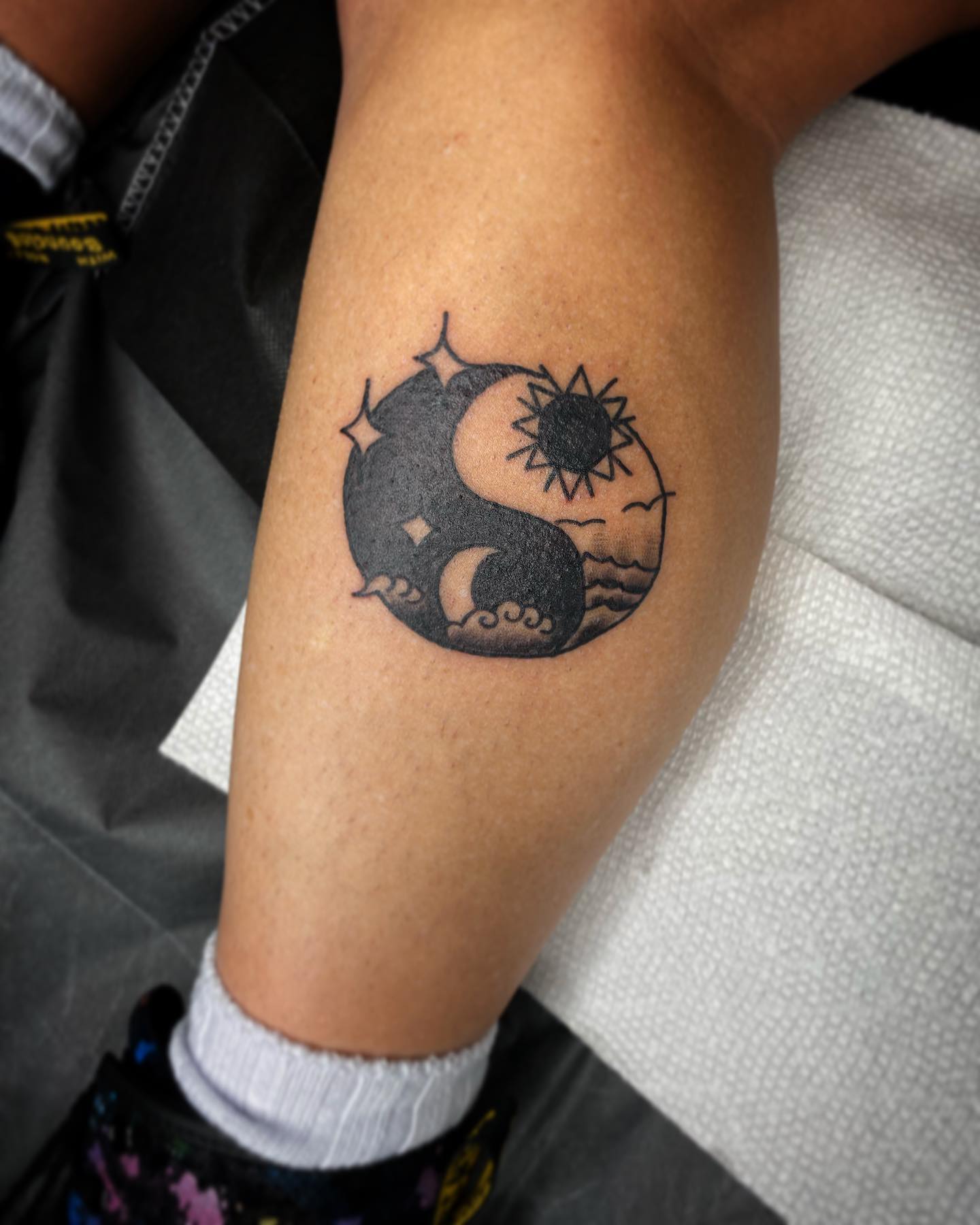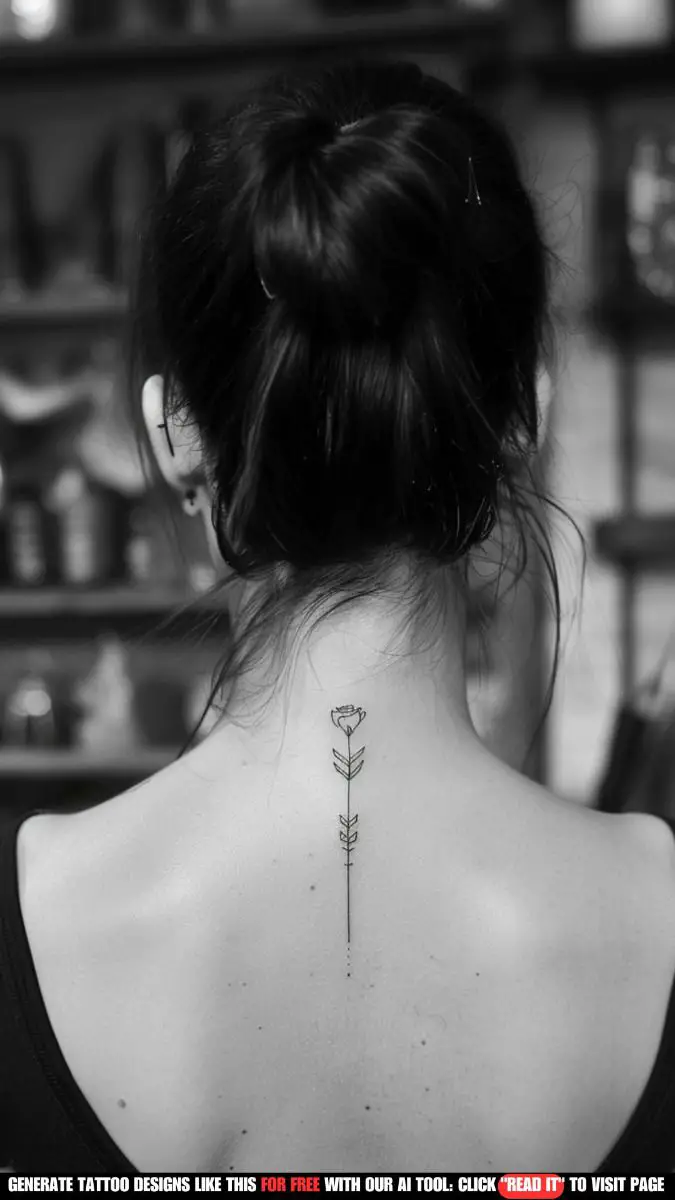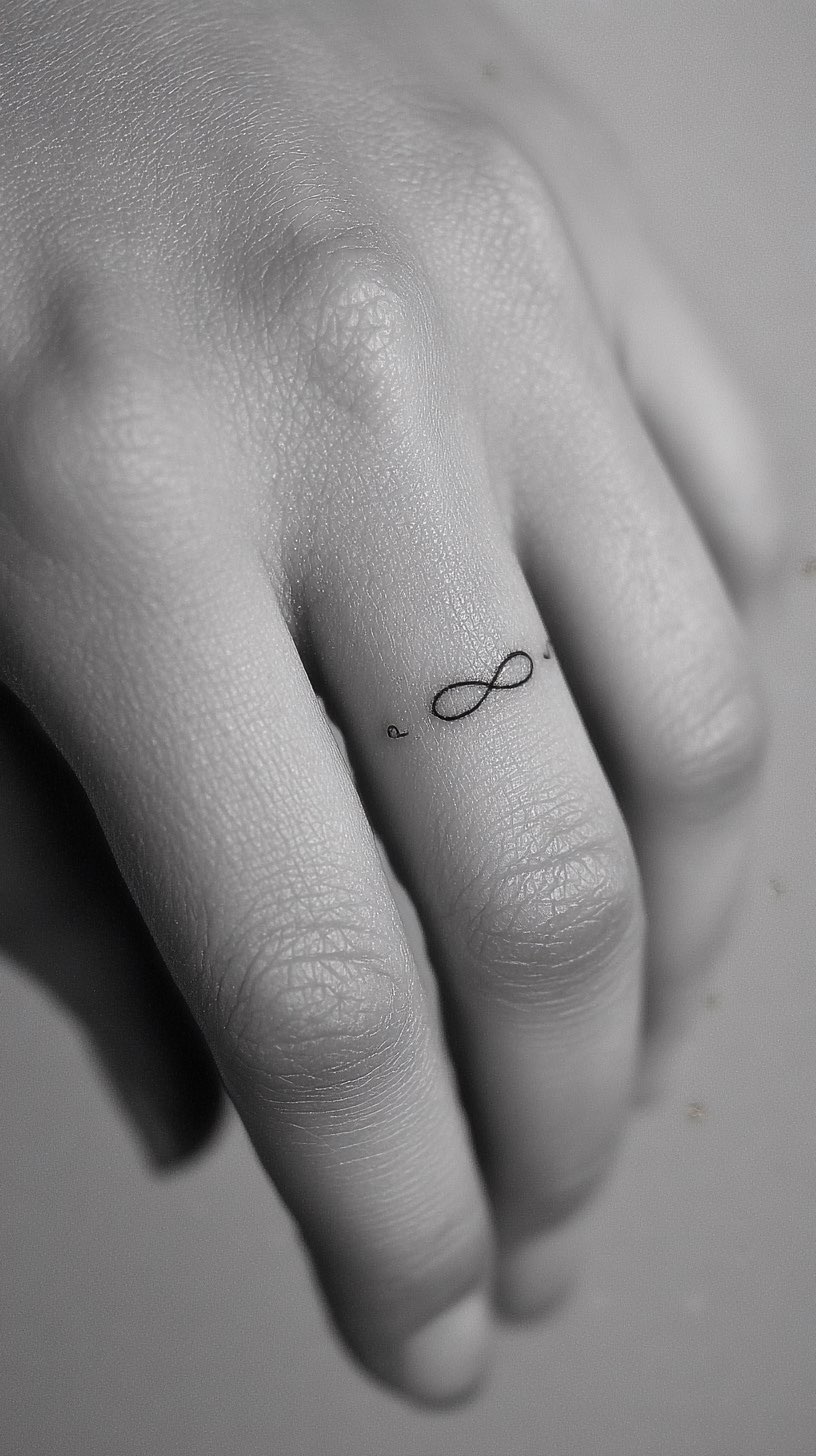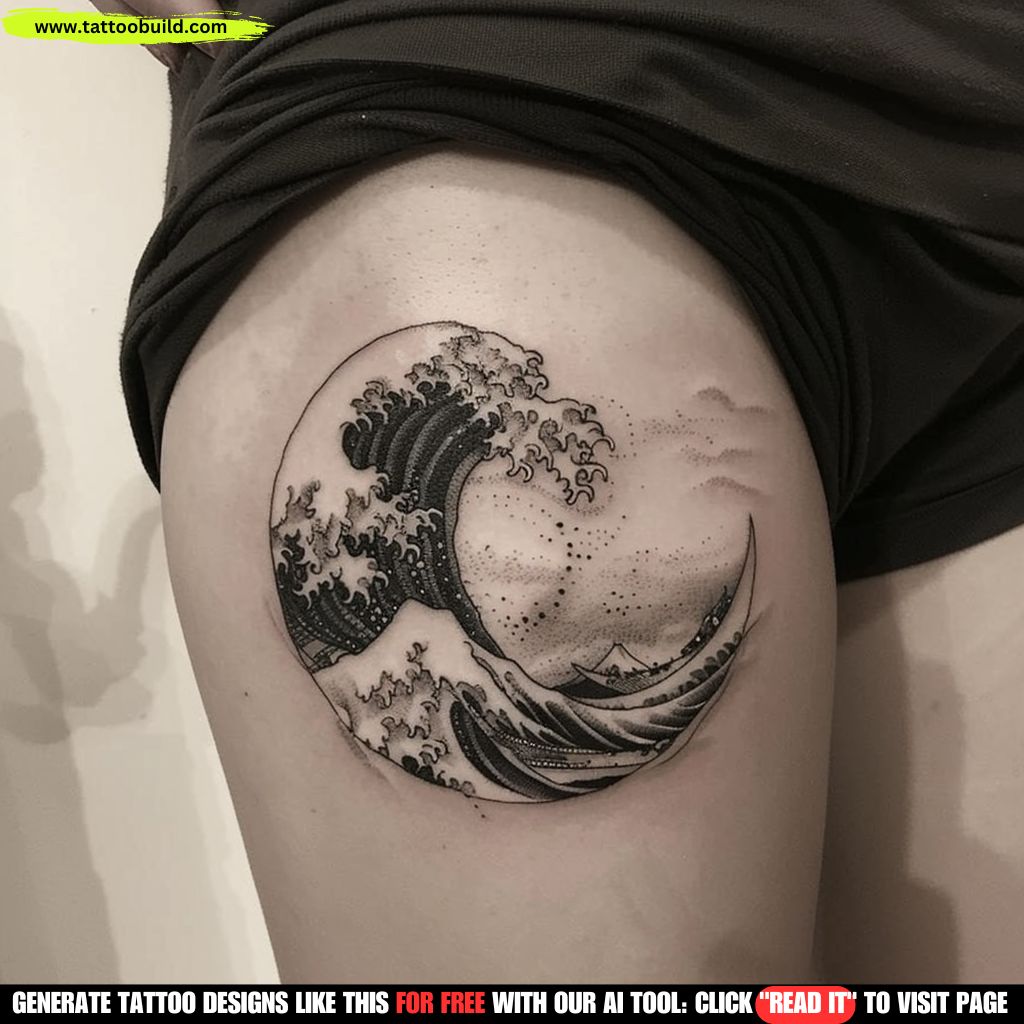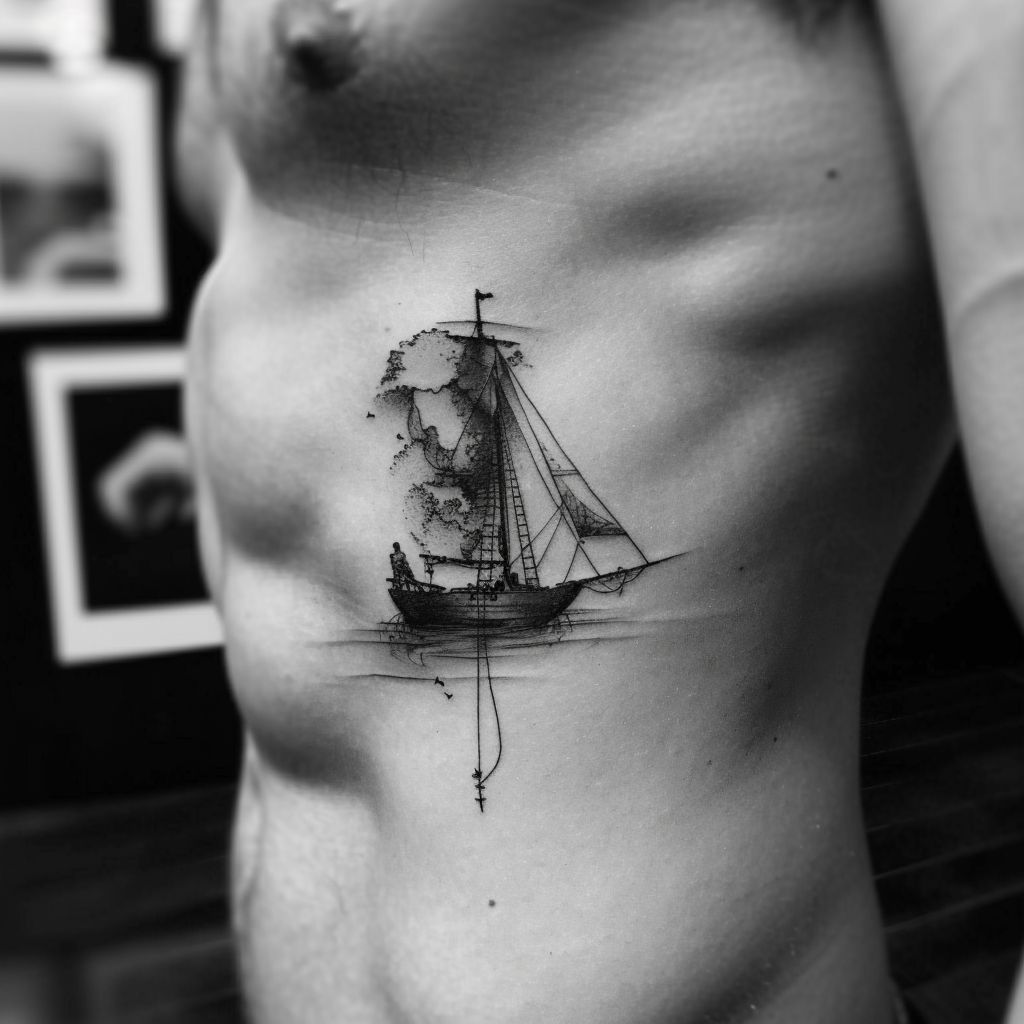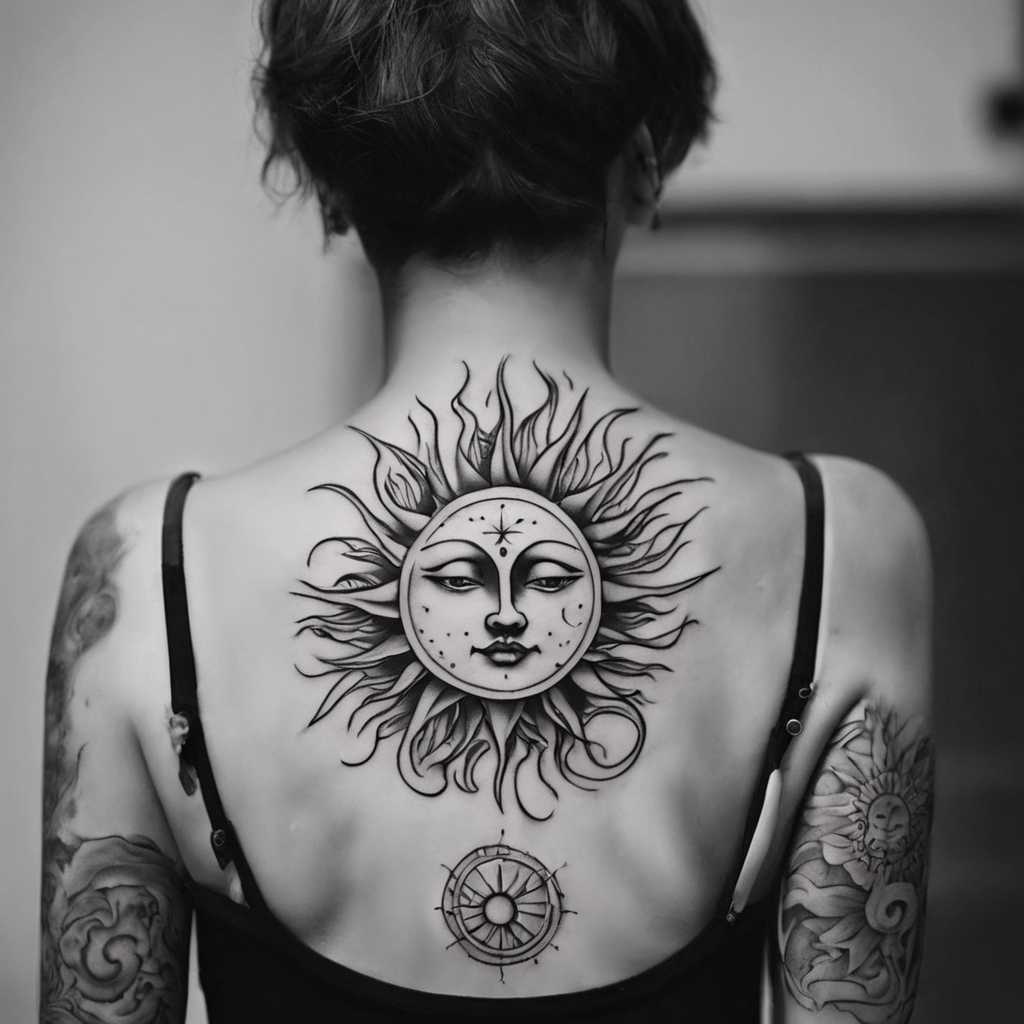
I have lost count of the number of people I have watched fall down the sun and moon rabbit hole, and almost all of them end up asking the same question: where does it go? The spine is the one placement where a sun and moon design finally gets to do what it was always meant to do — sit on a single vertical axis, one celestial body above the other, perfectly balanced.
That is not a small thing. Most placements force the sun and the moon side by side, which flattens the whole idea of day giving way to night.
Run it down the spine instead and the design reads the way the sky actually works: a descent, a cycle, something that keeps turning. Every artist I have asked about this placement says the same thing — the anatomy does half the composing for you.
Below are the styles I keep seeing work, the ones that quietly do not, and the practical things nobody mentions until you are already face-down on the table. If you are still weighing placement in general, it is worth reading through spine tattoo ideas for women before you commit to a specific design.
Which Sun and Moon Spine Style Is Right for You?
Style choice matters more on the spine than anywhere else, because the canvas is narrow and unforgiving. Here is how the main options actually compare in practice.
| Style | Best For | Typical Session Length | How It Ages |
|---|---|---|---|
| Fine-line minimalist | First tattoos, small budgets, subtle wearers | 1–2 hours | Softens fastest; may need a touch-up in a few years |
| Blackwork / tribal | High contrast, bold statement pieces | 3–5 hours | Holds the longest of any option here |
| Geometric | Symmetry lovers, sacred-geometry themes | 2–4 hours | Very well, provided the linework is even |
| Watercolour | Colour, softness, painterly effects | 3–5 hours | Fades soonest; needs sun protection and touch-ups |
| Floral fusion | Filling the full spine, feminine flow | 4–8 hours, often split | Good, if the artist leaves breathing room |
| Ornamental / mandala | Dense, symmetrical, jewellery-like pieces | 5+ hours, usually multiple sittings | Well, but fine detail can blur over decades |
Why the Spine Changes Everything About This Design
The spine is not a flat surface. It is a ridge with vertebrae you can feel through the skin, flanked by two shallow valleys of muscle.
That ridge is why alignment is so brutal here. A design that drifts even a few millimetres off centre reads as crooked forever, and no amount of shading fixes it.
Every good spine artist I have watched stencils standing up, not lying down, then re-checks the placement with the client’s shoulders relaxed. Skin shifts when you lie flat, and a stencil applied to a stretched back can settle crooked once you stand.
Pain is the other honest factor. The spine sits close to bone with very little padding, and most people I have talked to rank it among the sharper placements they have sat through.
It is not unbearable, but it is a different sensation than a thigh or an outer arm — more vibration, more of a nervy hum. If you want a realistic map of what to expect, this guide to the most painful tattoo spots is a fair starting point.
One more practical note: spine work is usually broken into shorter sittings. Sitting hunched forward for hours is uncomfortable in a way that has nothing to do with the needle.
Sun and Moon Spine Tattoo Ideas That Actually Work
These are the directions I keep coming back to, roughly in order of how often I see them succeed on this placement.
1. Minimalist Fine-Line Sun and Moon
This is the version most people start with, and there is a good reason for that. A thin crescent moon at the nape, a small radiating sun lower down, and a few millimetres of clean line in between.
Fine-line work on the spine is a genuine test of an artist’s hand, because there is nowhere for a wobble to hide on a straight vertical run.
When I have compared healed fine-line spine pieces side by side, the ones that still look crisp were done with slightly heavier lines than the client originally wanted. Hair-thin lines can soften and spread as they settle, especially on skin that stretches.
Ask your artist to size it up by ten or fifteen percent from the reference photo. It will look the same on day one and considerably better in five years. If you like this restraint, browse more minimalist tattoo ideas for shapes that translate well to a narrow canvas.
2. Celestial Harmony: Sun and Moon Interlocked
Here the two forms overlap rather than sitting apart — a crescent nested inside a sun disc, or two halves fused into one circle.
It is the most symbolically loaded version of the design, and the one people tend to choose when the tattoo marks a relationship, a loss, or a balance they are trying to hold onto.
The technical catch is that interlocked shapes need a wider footprint than a plain crescent. Squeeze one into a two-inch width and the internal detail closes up as it heals.
In my experience the sweet spot is a disc roughly the width of your hand, placed between the shoulder blades where the back is flattest. Below that point the spine curves inward and a circular motif starts to distort.
3. Floral Fusion Down the Full Spine
Adding botanicals turns a two-symbol design into a full column piece. Stems trail between the sun and moon, filling the vertical run without competing with it.
The mistake I see most often is packing the flowers too tightly. Dense foliage on a narrow strip turns into a grey smear within a few years.
Ask for at least a needle’s width of clean skin between overlapping petals — good artists build that gap in automatically, but it is worth naming out loud during the consultation.
Wildflowers, lavender and small daisies suit the scale better than roses, which need bulk to read properly. For more of this approach, vine spine tattoos show how botanical elements travel down the back.
4. Watercolour Effect Sun and Moon
Washes of colour bleeding out from a black outline give the design a painted, weightless quality that suits the celestial theme.
I will be straight about the trade-off: watercolour is the least durable option on this list. Soft, unanchored pigment fades sooner than solid black, and the spine gets sun exposure every summer.
The fix is a proper black skeleton underneath the colour. Watercolour work built on committed linework still reads clearly a decade later, even once the washes have softened.
Plan on a touch-up eventually and use sunscreen on the piece once it is fully healed. Watercolour tattoo ideas covers the palettes that hold up best.
5. Day and Night Contrast
This version splits the design down the middle: one half rendered in solid black, the other left in open line or negative space.
On the spine it is unusually effective, because the vertebral ridge already gives the eye a centre line to split along.
Solid black packing is where an artist’s experience really shows. Patchy fills on the spine are common with newer artists, and the heavier the black, the longer the healing tends to take.
When I have asked artists about this, most say they would rather do two passes across two sittings than force a saturated fill over bone in one go. That is a good sign, not a delay.
6. Tribal and Blackwork Interpretations
Heavy blackwork gives the sun and moon a graphic, almost carved quality — thick rays, a bold crescent, no gradient anywhere.
Of everything on this list, this is the style I would bet on to still look sharp in twenty years. Solid black holds its edge better than any washed or stippled technique.
One caution worth taking seriously: many tribal motifs belong to specific living cultures, particularly Polynesian and Filipino traditions, where individual patterns carry meaning that is not generic decoration.
If a pattern is drawn from a tradition that is not yours, a straightforward conversation with your artist about it is the respectful move. Plenty of artists will happily design blackwork in that visual language without borrowing sacred motifs directly.
7. Geometric and Sacred Geometry Versions
Triangles, nested circles, dotwork mandalas and precise radial rays — geometry and the spine were made for each other, because the placement is already symmetrical.
That symmetry is also the risk. A geometric design punishes any drift off the centre line, because the eye measures it against the body itself.
When I have seen geometric spine work go wrong, it is almost never the drawing — it is the stencil placement. Insist on checking the stencil in a mirror, standing straight, before a single line goes in.
Dotwork shading suits this style well and heals gently, though it takes longer to apply than solid fill. Look through geometric tattoo designs if you want to see how the maths translates onto skin.
8. The Full Vertical Column
The most ambitious version runs from the base of the neck to the lower back, with the sun at one end, the moon at the other, and a connecting motif between them.
Ornamental chains, moon phases, star maps and thin vine work all serve as that connective tissue.
This is multi-session work, and it should be. Anyone offering to complete a full spine column in a single sitting is either rushing it or underestimating it.
Every full-column piece I have seen age well was built top-down, healing each section before starting the next. It costs more in time, and it is the reason those pieces still look deliberate years later.
Variations Worth Considering Before You Book
If the standard sun-above-moon layout does not feel right, these adjacent ideas cover most of what people are actually after.
Moon Phases Only
Dropping the sun entirely and running a phase sequence down the spine is the cleanest possible use of this placement.
Each phase sits on its own vertebra, evenly spaced, and the design reads as a timeline rather than a symbol. It is also easier to extend later. Moon phase tattoo ideas shows how the spacing usually works out.
Nape-Only Placement
A compact sun and moon sitting at the top of the spine, roughly between the shoulders, gives you the composition without the commitment.
It is easier to hide, faster to sit for, and leaves the rest of the spine open if you decide to build downward later.
Ornamental Mandala Hybrid
Framing the sun as a mandala and the moon as an ornamental pendant turns the piece into something closer to jewellery than illustration.
Expect several sittings, and expect the fine detail to soften slightly over the decades. It is still one of the most striking uses of the spine I know of. More in celestial tattoo ideas.
Sitting Through It and Healing It Properly
Eat a real meal beforehand and do not drink the night before. Alcohol thins the blood, and on a placement this sharp you want every advantage you can get.
Wear something that opens at the back, or plan to sit in a bra you do not mind having pushed out of the way for a few hours. It sounds trivial until you are in the chair.
Spine tattoos are awkward to care for because you cannot reach them. Line up a partner, a friend, or at minimum a long-handled applicator before you go — the first few days matter most.
The standard routine applies: keep it clean with unscented soap, moisturise thinly rather than thickly, skip pools and long soaks, and leave the flaking alone. Surface healing usually takes around two to three weeks, with the deeper layers settling over a couple of months.
Sleeping is the genuinely annoying part. Back sleepers should plan on a few nights face-down or on their side.
Follow the aftercare instructions your artist gives you over anything you read online, including this article — they know exactly what went into your skin. The American Academy of Dermatology also publishes plain-language guidance on caring for tattooed skin, and the FDA’s tattoo safety page covers ink-related risks.
If you develop spreading redness, swelling that worsens after the first few days, heat, pus, or a fever, stop guessing and see a doctor. Allergic reactions to pigment and infections both happen, and neither is something to manage from a blog post.
Still Not Sure? Common Mistakes to Avoid
Going too small is the most common regret I hear. A design that looks delicate on a phone screen can read as an unidentifiable smudge from three feet away.
Booking with an artist who does not regularly do spine work is the second. Ask to see healed spine photos specifically — fresh photos flatter everything, and healed work tells you the truth.
Rushing the stencil is the third, and it is the one entirely within your control. Take the extra ten minutes with the mirror.
If you are still weighing the placement itself, it is worth reading whether spine tattoos are dangerous and browsing fine line spine tattoo work before you commit to a deposit.
Frequently Asked Questions
How painful is a sun and moon spine tattoo?
Most people rank the spine among the sharper placements, because there is very little fat or muscle between the needle and bone. The sensation is often described as vibrating or nervy rather than a straightforward sting. Pain tolerance varies enormously, so treat any ranking as a rough guide rather than a promise. If you are worried, book a short first session and see how you handle it before committing to a full column.
How long does a sun and moon spine tattoo take?
A small fine-line design usually takes one to two hours. A mid-sized geometric or blackwork piece typically runs three to five hours, and a full-spine column is almost always split across multiple sittings. Ask your artist for their own estimate once they have drawn the design, since it depends heavily on detail and shading. Most artists I know prefer splitting spine work rather than pushing through a single marathon session.
Do spine tattoos fade faster than other placements?
Not inherently — the bigger factors are style, ink saturation and sun exposure. Fine-line and watercolour work softens sooner than solid blackwork regardless of where it sits. The spine does catch a lot of summer sun on anyone who wears open-backed clothing, so sunscreen once healed makes a real difference. A touch-up every several years is normal for delicate work and not a sign anything went wrong.
Can I get a spine tattoo if I have had an epidural or back surgery?
Usually yes, once everything is fully healed, but this is a question for your doctor and your artist rather than the internet. Scar tissue takes ink differently and may need the design adjusted around it. Some artists prefer to avoid tattooing directly over surgical scars altogether. Bring it up at the consultation rather than on the day, so there is time to redraw if needed.
Should the sun go at the top or the bottom?
There is no rule, and both readings are common. Sun at the top with the moon below suggests day descending into night, which is the layout I see most often. Sun at the base reads as rising, which some people prefer for a design about coming through something difficult. Pick whichever story you actually want to carry — you are the one who has to explain it.
Quick Summary
- The spine suits sun and moon designs because it gives them a natural vertical axis to sit on.
- Fine-line work should be sized up slightly from your reference, since thin lines soften as they heal.
- Blackwork and geometric styles hold up longest; watercolour fades soonest and needs sun protection.
- Interlocked sun and moon shapes need width — squeeze them too narrow and the inner detail closes up.
- Check the stencil standing up, in a mirror, before any line goes in. Alignment is unforgiving here.
- Full-spine columns are multi-session work; anyone promising it in one sitting is rushing.
- Arrange help with aftercare in advance, because you cannot reach your own spine.
- See a doctor for spreading redness, worsening swelling, pus or fever — do not manage it yourself.