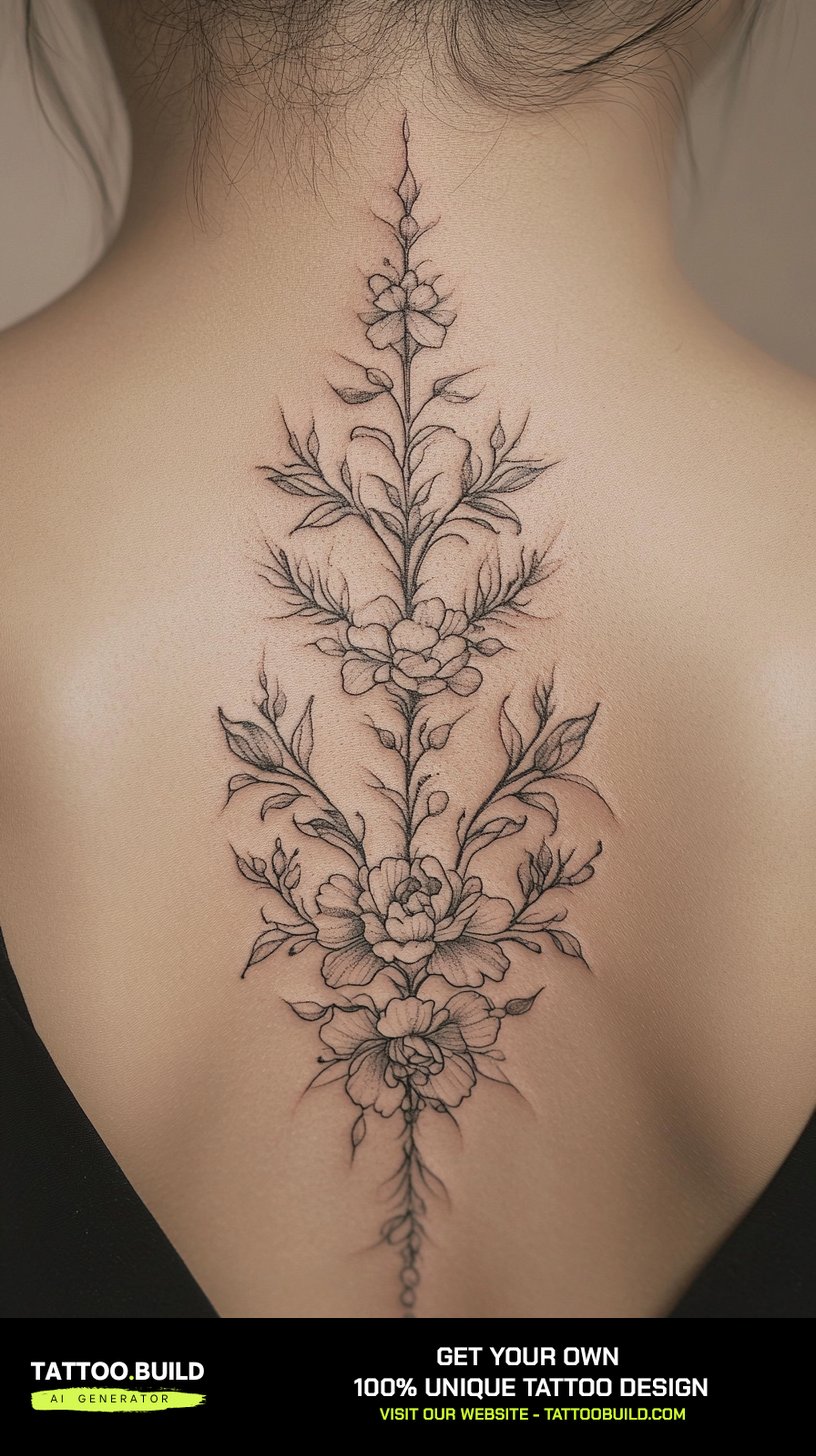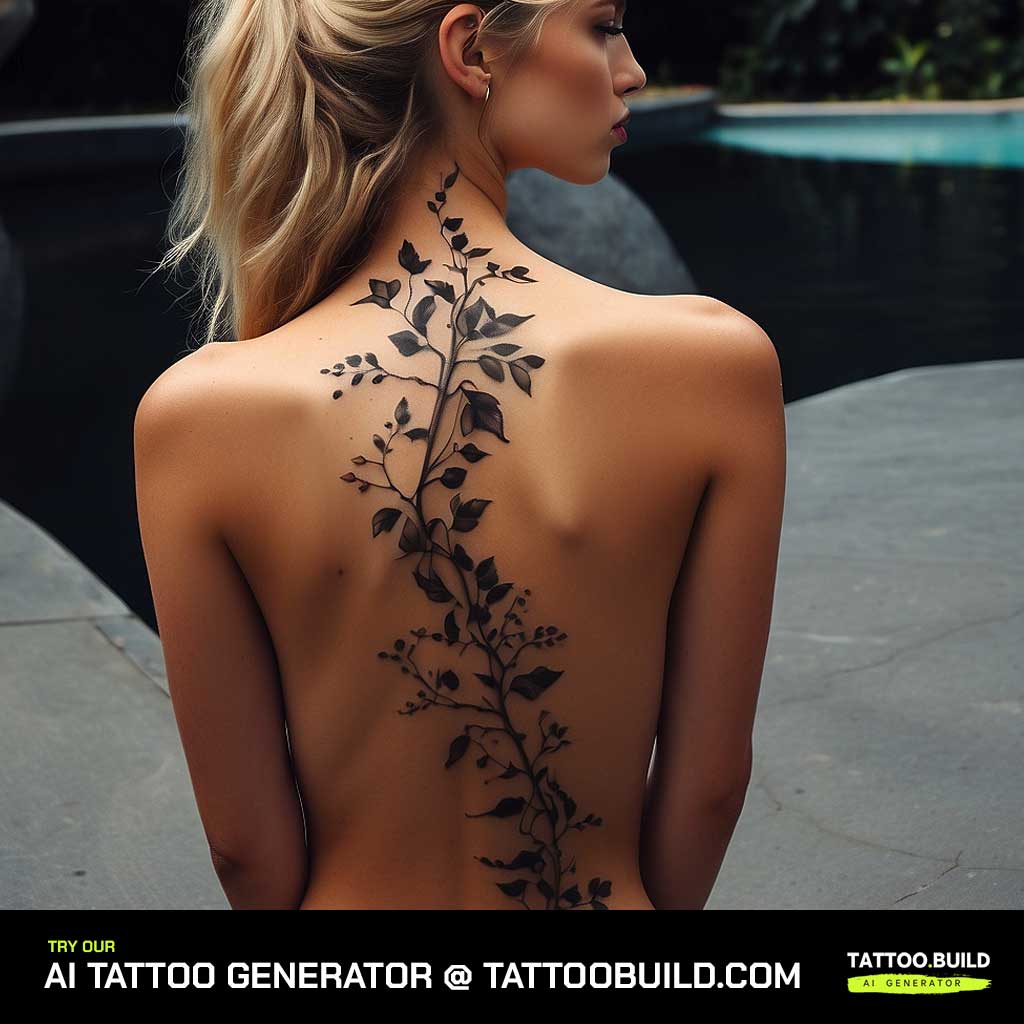
A vine spine tattoo is one of the few designs that actually gets better the longer you make it — the spine gives a stem somewhere natural to grow, and the body does the rest of the work.
I have watched a lot of people talk themselves into and out of this piece over the years. The ones who end up happiest are almost always the ones who decided on length and leaf density before they walked into the shop.
Every artist I have asked about spine work says the same two things: it hurts more than clients expect over the vertebrae, and the stencil placement matters more than the drawing. A vine that sits a few millimetres off-centre reads as a mistake even when the linework is beautiful.
This guide walks through the styles that hold up, what the placement actually feels like, and how a vine ages on the back. If you are still deciding on placement generally, the wider roundup of spine tattoo ideas for women is a useful companion read.
Which Vine Style Is Right for You?
These are the five approaches I see most often, and what each one asks of you in time, money and upkeep.
| Style | Typical Session Time | How It Ages | Best For |
|---|---|---|---|
| Fine-line vine | 2–4 hours for a full spine | Softens noticeably; may need a touch-up in 5–10 years | Delicate, barely-there looks |
| Bold blackwork vine | 4–7 hours, often split | Holds shape best of any option | People who want it readable for decades |
| Floral vine with colour | 6–10 hours across 2–3 sittings | Colour fades first, especially lighter pigments | Statement pieces with blossoms |
| Botanical / illustrative | 5–8 hours | Good, if the line foundation is solid | Realistic leaf and stem detail |
| Minimal single stem | 1–2 hours | Fine, though thin lines can blur | First tattoos and low commitment |
What Actually Affects How a Spine Vine Ages
Line weight is the single biggest factor. In my experience, anything thinner than about a millimetre on the back will soften within a few years, because skin over the spine moves constantly and the ink spreads slightly as it settles.
Placement matters almost as much. Ink sitting directly over bone with little fat underneath tends to hold crisply, while the softer areas at the lower back can blur a touch faster.
Sun exposure is the quiet killer. Backs get more incidental sun than people realise, and unprotected fine linework fades faster than almost any other placement I have watched heal.
Then there is the drawing itself. A vine with leaves spaced tightly together will eventually read as a single dark band; the same vine with breathing room between leaves still reads as a vine in twenty years.
Finally, healing. The FDA’s tattoo and permanent makeup fact sheet covers the risks worth knowing about before you sit down, and a badly healed patch will always show in the finished line.
Vine Spine Tattoo Ideas That Actually Work
These are the variations I keep seeing done well, grouped by what actually distinguishes them rather than by flower name.
1. Bold Blackwork Vine Down the Spine
A thick-stemmed vine in solid black is the most durable version of this design, and usually the one artists quietly recommend when a client asks what will still look good in fifteen years.
The trade-off is presence. This is not a subtle tattoo — it commands the whole back, and it is difficult to cover or soften later without a much larger piece.
Bold lines are also the most forgiving of imperfect healing. A little patchiness in a heavy leaf disappears after a touch-up in a way that a hairline stem never quite does.
When I have seen these done well, the artist varied leaf size deliberately — larger near the shoulder blades, tapering toward the lower back — so the eye follows the stem rather than counting leaves.
2. Fine-Line Ivy Trailing the Vertebrae
Fine-line ivy is the most requested version I come across, and the one most likely to disappoint if you pick the wrong artist for it.
This style lives or dies on needle control. A specialist will lay a consistent hairline down the full spine; a generalist will produce a line that thickens where the skin gave way.
If you are drawn to this direction, it is worth reading through dedicated guidance on the fine-line spine tattoo before booking, because artist selection matters more here than in any other style on this list.
Expect to plan for a touch-up. Most fine-line work on the back benefits from one pass of repair a year or two in, and good artists build that into the conversation upfront.
3. Simple Single-Stem Vine
A single stem with small paired leaves is the lowest-commitment entry point, and it is genuinely underrated.
It usually takes one or two hours, sits comfortably within a first-tattoo budget, and can be extended later without redrawing what already exists.
In my experience this is also the version people regret least. There is not much to dislike about a thin, well-placed stem, and it leaves the rest of the back open.
The main risk is going too thin. A stem under about a millimetre can soften into an indistinct grey line, so ask your artist for the thinnest weight they are confident will hold.
4. Floral Vine with Colour Highlights
Adding blossoms turns a vine into a floral spine piece, and colour highlights — purples, soft reds, muted greens — are the most common way to do it without committing to full colour saturation.
Colour costs time. A floral vine with colour work realistically spans two or three sittings, and each blossom adds healing surface area.
Lighter pigments fade first. Pale purples and yellows generally need refreshing sooner than the black linework underneath them, which is worth budgeting for rather than being surprised by.
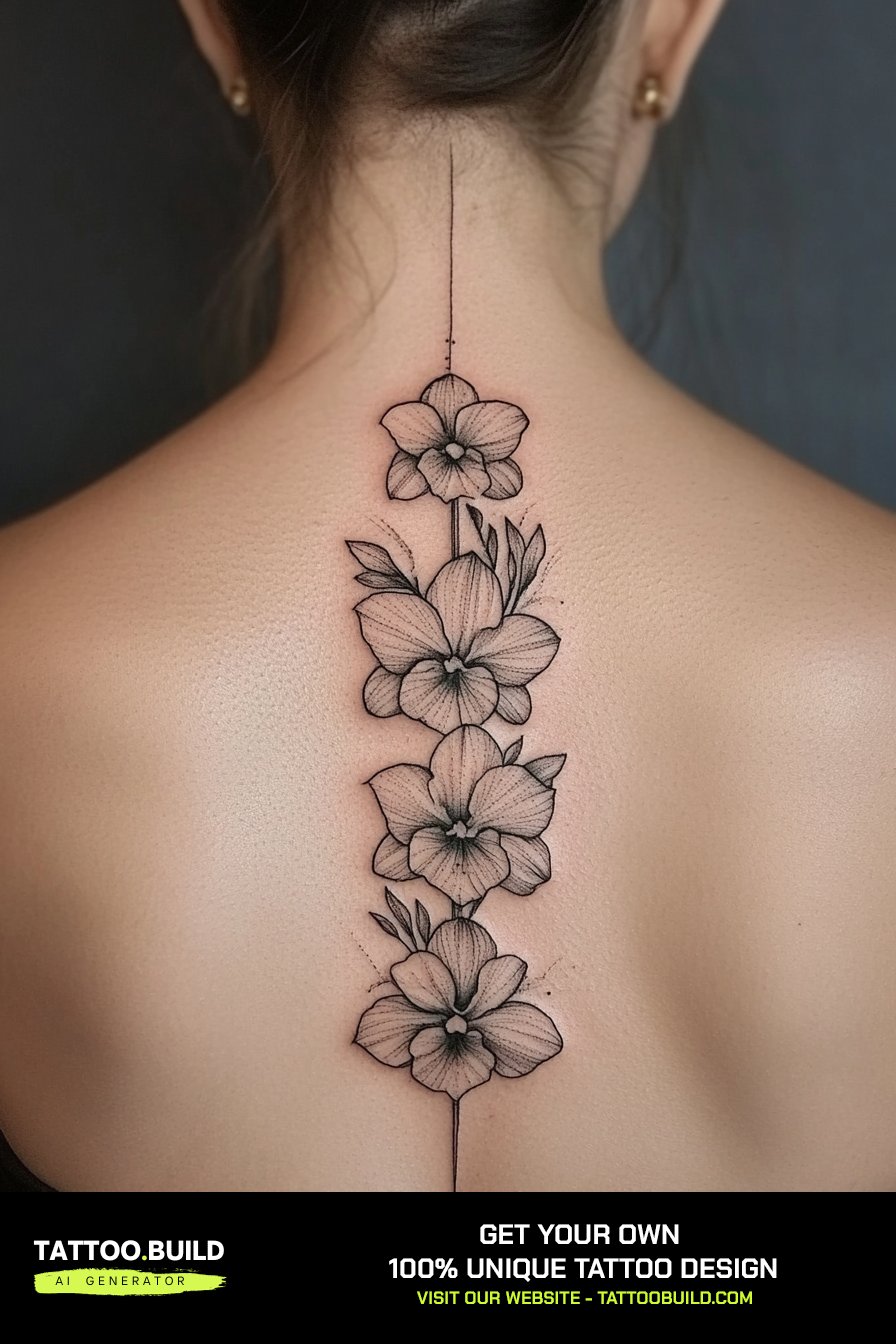
If you want a specific bloom rather than generic flowers, the orchid spine tattoo approach shows how a single well-chosen flower can anchor an entire vine.
5. Vines That Climb to the Nape
Extending the vine past the shoulder blades and up onto the neck changes the piece considerably — it stops being a back tattoo and becomes something visible with most necklines.
The neck is also one of the sharper spots to tattoo. Every artist I have asked rates the nape well above the mid back on the pain scale, and the sessions there tend to be short by necessity.
Tapering matters here. A vine that keeps the same weight all the way up looks heavy at the top; one that thins into small leaves near the hairline looks like it grew there.
Think carefully about workplace visibility before committing, because this is the part of the design you cannot hide with a t-shirt.
6. Green Leaf and Botanical Vine
Soft green shading gives a vine a botanical, almost illustrated quality that pure black linework cannot reach.
It reads gentler from a distance. Where a blackwork vine announces itself, a green botanical vine tends to be noticed up close and then admired.
The technical requirement is solid linework underneath. Green shading on top of weak lines loses definition quickly, so the foundation is where the session time goes.
In my experience these age well when the shading is kept light. Heavy colour packing over the spine takes longer to heal and can look muddier than it did on day one.
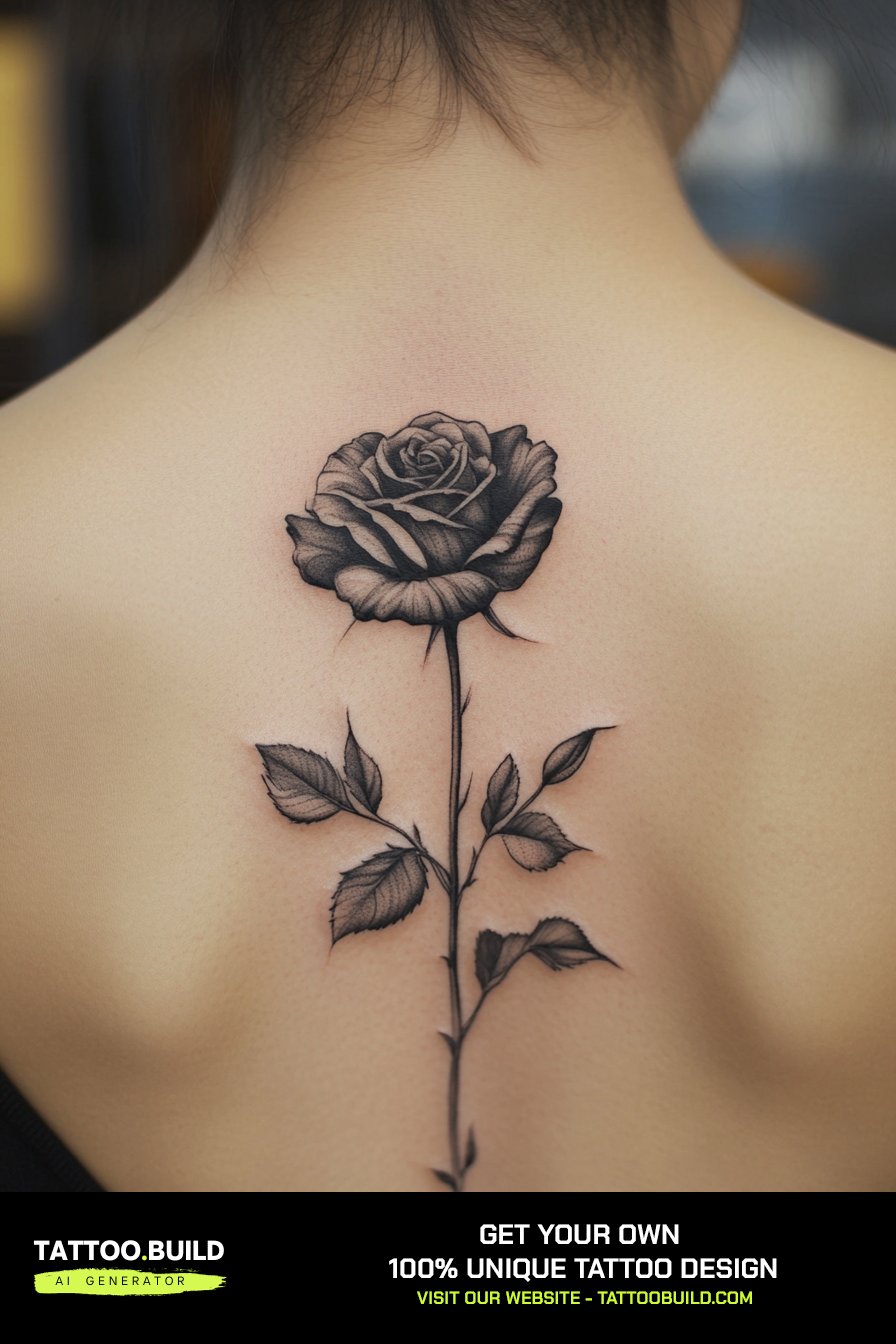
7. Rose Vine Down the Back
The climbing rose vine is a classic for a reason — the thorned stem gives the spine a natural line to follow and the blooms give the artist somewhere to put detail.
Spacing is everything. Roses carry visual weight, and three well-placed blooms almost always beat seven crowded ones.
There is real symbolism here too, and it is worth understanding what you are wearing; the piece on rose vine tattoo meaning goes into where the imagery comes from.
If you want the drama without colour, black rose spine tattoo work delivers the same shape with far better long-term stability.
8. Shaded and Dimensional Vine Work
Grey-wash shading turns a flat vine into something that appears to sit above the skin, with leaves that seem to curl toward or away from you.
This is more technically demanding than it looks. The illusion depends on consistent light direction across the whole piece, which is hard to maintain over a surface as long as a spine.
Soft grey wash is generally kinder to the skin than heavy black packing, and in most cases it heals with less irritation over the bony sections.
Ask to see healed photographs, not fresh ones. Shading looks spectacular on the day and only reveals its real quality after a few months.
Alternatives and Variations Worth Considering
A vine does not have to run the full spine, and for a lot of people a variation is the better fit.
Half-Length Vine from the Nape
Running the vine from the neck to roughly the mid back gives you most of the visual effect at about half the session time and cost.
It also leaves room to extend later, which is worth something if you are not certain how far you want to go.
I have seen more people extend a half-length vine than regret one, which tells you something about how this design tends to grow on its owner.
Off-Centre and Wrapping Vines
A vine that curves gently off the centre line often flatters the back more than a perfectly straight stem, because the human back is not symmetrical to begin with.
Wrapping tendrils that cross the spine and return break up the length and stop a long piece from reading as a stripe.
The catch is that off-centre work is harder to stencil well, and it is much more obvious when it goes wrong.
Moving the Vine Off the Spine Entirely
If the pain of spine work is the sticking point, the same botanical idea translates well to other placements.
A vine arm tattoo gives you the trailing-stem look on a far more comfortable surface, and sessions are usually shorter.
Ribs, thighs and calves all take vine designs nicely. The spine is the most striking canvas for it, but it is not the only one.
Sitting Through It and Healing It Properly
Spine sessions are long and the pain is uneven — most people find the vertebrae and the nape considerably sharper than the softer areas either side.
Eat properly beforehand and do not book a full spine as a single marathon if your artist offers to split it. Two comfortable sessions produce better linework than one exhausted one.
Follow whatever aftercare your artist gives you rather than advice from the internet, including this article. Mayo Clinic’s overview of tattoo risks and precautions is a reasonable general reference, but your artist knows what they put in your skin.
Back tattoos are awkward to care for alone — you cannot see or easily reach the area, so having someone help for the first week genuinely improves healing. If you see spreading redness, increasing pain after the first few days, or any discharge, contact your artist and see a doctor. Infection and allergic reactions are uncommon but real, and neither is something to manage from a search results page.
Common Mistakes — and Still Not Sure?
The mistake I see most is choosing length before choosing an artist. Book the person whose healed work you like, then design around what they do well.
The second is crowding. Leaves packed tightly look intricate in the stencil and turn into a solid dark band a decade later.
The third is ignoring pain honestly. If you know you struggle to sit still for two hours, a full-spine piece in one session is not the place to find out.
If you are weighing up whether the placement is right for you at all, it is worth reading about whether spine tattoos are dangerous and browsing broader feminine spine tattoo designs before you settle on a vine.
Frequently Asked Questions
How much does a vine spine tattoo hurt?
Most people rate spine work among the more painful placements, particularly directly over the vertebrae and at the nape where there is little tissue between skin and bone. The softer areas either side of the spine are noticeably easier. Pain tolerance varies a great deal between individuals, so treat other people’s ratings as a rough guide rather than a prediction. If you are unsure, ask your artist to start with a short session so you know what you are committing to.
How long does a full vine spine tattoo take?
A minimal single-stem vine can be finished in one to two hours, while a full-length bold or floral vine commonly runs four to ten hours and is usually split across two or three sittings. The variables are line weight, leaf density and whether colour or shading is involved. Your artist will give you a realistic estimate once they have drawn the design. Splitting a long piece is generally the better choice for line quality.
Will a vine spine tattoo stretch if my weight changes?
The back is one of the more stable areas for tattoo placement, and moderate weight change usually has little visible effect on a vine running down the spine. Significant weight change or pregnancy can affect the surrounding skin more than the spine itself. In most cases the design still reads correctly afterwards. If you are planning a pregnancy, it is worth mentioning to your artist so they can advise on placement.
Can I get a vine spine tattoo as my first tattoo?
You can, and plenty of people do, but a minimal or half-length version is a gentler introduction than a full-spine piece. Starting smaller lets you learn how you handle the sensation and how your skin heals before committing to a long session. A single-stem vine can also be extended later without redrawing what is already there. Most artists are happy to design with that in mind if you tell them upfront.
How do I keep a vine spine tattoo looking sharp?
Sun protection is the most effective single habit — backs pick up more incidental sun than people expect, and fine linework fades faster than heavier work. Keeping the skin moisturised helps, and most fine-line pieces benefit from a touch-up somewhere between five and ten years in. Ask your artist what they recommend for the specific style you chose. Heavier blackwork generally needs far less maintenance than delicate linework.
Quick Summary
- Decide on length and leaf density before you book — it changes cost, session count and how the piece ages.
- Bold blackwork holds its shape longest; fine-line looks the most delicate but needs a specialist and eventual touch-ups.
- Spacing beats detail. Leaves with breathing room still read as a vine decades later.
- Colour and blossoms add sittings and healing surface — budget two or three visits for a floral vine.
- The vertebrae and nape are the sharper spots; splitting a long piece across sessions improves line quality.
- Sun exposure is the main cause of fading on back pieces — protect it once healed.
- Half-length and off-centre variations give most of the effect for less time, and can be extended later.
- Choose the artist first, then design around the work they do well.