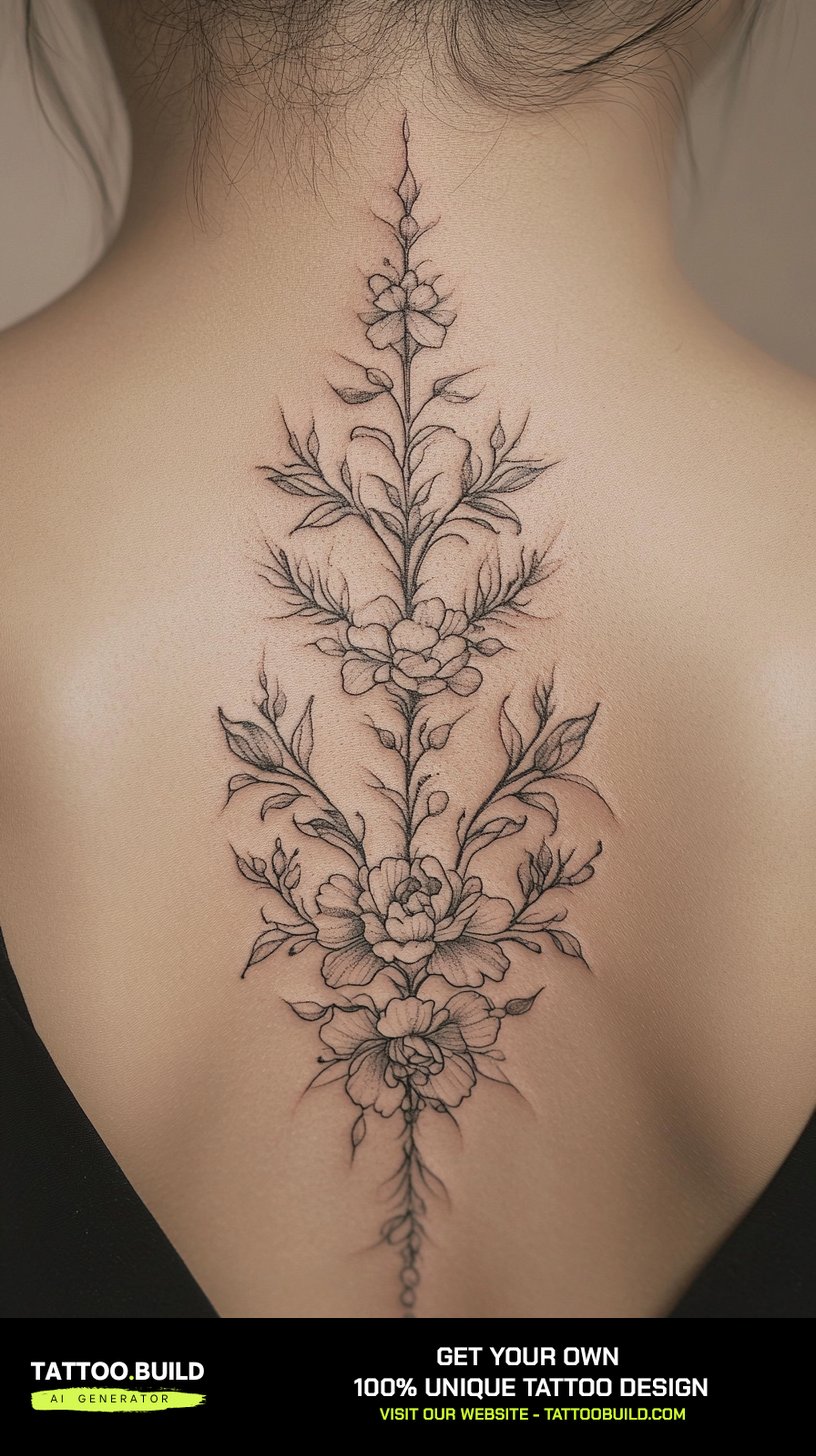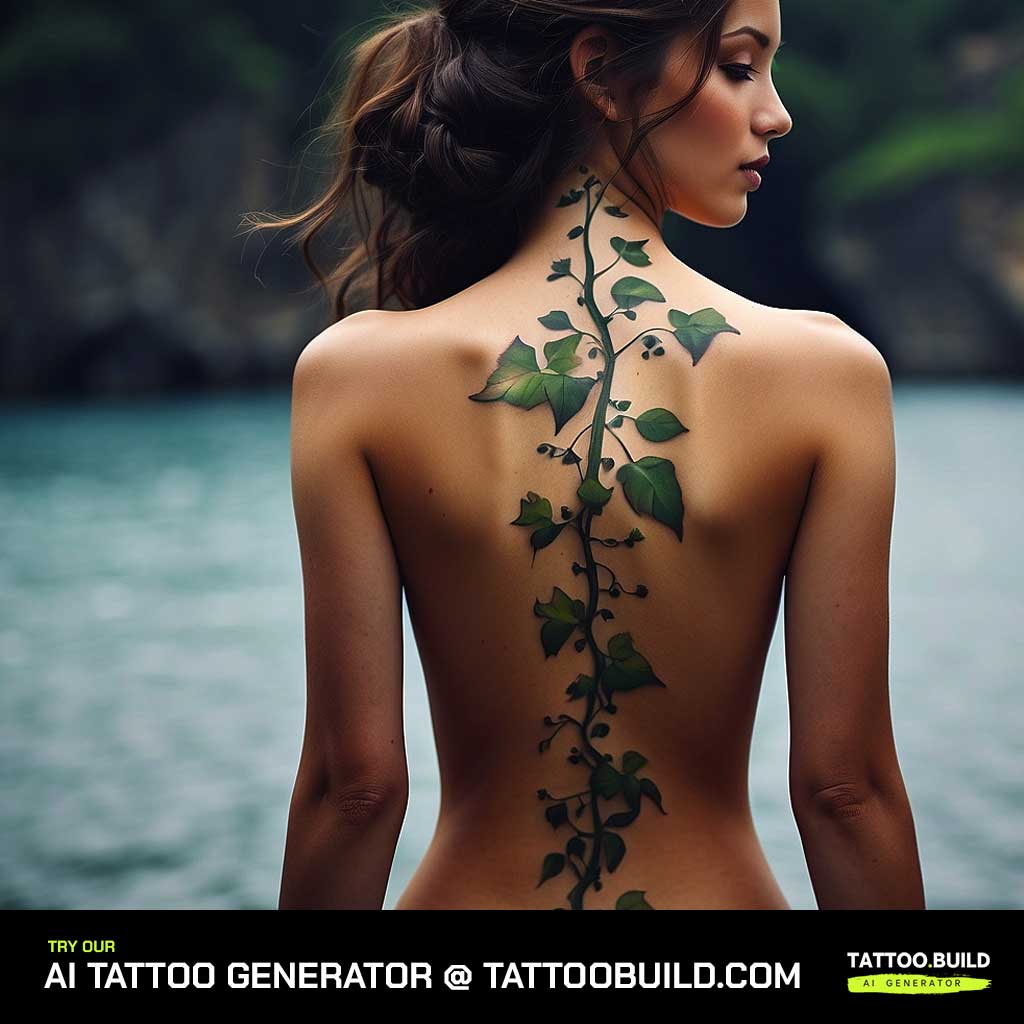
A spine tattoo is the one placement I get asked about more than any other, and the question is almost always the same: how badly does it hurt, and is it worth it? A feminine spine tattoo is worth it when the design is built around your actual spine rather than simply dropped onto it — the length of your torso, the curve of your back, and how much of it you want visible all change what works.
I have sat through a centred spine piece myself and watched a lot of friends do the same. The vertebrae section is genuinely sharp, the soft tissue either side of it is very manageable, and almost nobody regrets the placement afterwards.
What makes this placement so popular is the shape it borrows. The spine is already a long, symmetrical vertical line, so a design that follows it reads as elegant with very little effort — which is why spine tattoo ideas for women keep circling back to florals, vines and fine linework.
Below are 30+ designs I would actually recommend, grouped by style rather than numbered at random, plus the practical detail on pain, healing and stencil placement that most idea lists leave out.
Which Spine Tattoo Style Is Right for You?
Style choice drives everything downstream — session length, pain, cost and how the piece ages. This is roughly how the main options compare in my experience and from what artists have told me.
| Style | Typical Session | Pain Level | Ages Best If | Good For |
|---|---|---|---|---|
| Fine line botanical | 2–4 hours | Moderate over bone | Lines are not hair-thin | First spine tattoo |
| Trailing vine | 3–5 hours | Moderate, long sitting | Leaves stay a decent size | Full-length coverage |
| Rose or floral with shading | 4–7 hours, often split | High over vertebrae | Shading has real contrast | A statement centrepiece |
| Geometric / mandala | 3–6 hours | High, lots of linework | Dotwork is not too sparse | Symmetry lovers |
| Minimalist symbol | Under 2 hours | Low to moderate | Kept small and spaced | Low commitment |
| Script or lettering | 1–3 hours | Moderate | Letters are well spaced | Personal meaning |
Why the Spine Is Such a Demanding Placement
The spine is not a flat canvas. It is a ridge of bone with very little padding, flanked by muscle that moves every time you breathe or twist.
That matters for two reasons. Pain is concentrated directly over the vertebrae, and the skin either side stretches differently to the skin on top of the bone.
Every artist I have asked says the stencil is the hardest part of a spine piece, not the tattooing. If you are standing slightly crooked, or your shoulders are uneven, a perfectly symmetrical design will heal looking off-centre.
Expect your artist to spend a long time with the stencil, ask you to stand naturally, and check it from several angles. If you want a sense of how this placement compares to others, the tattoo pain chart is a useful reality check before you book.
The upside is that the same anatomy gives spine work its impact. A design that follows the vertebrae looks intentional in a way that the same design on a forearm never quite does.
30+ Feminine Spine Tattoo Ideas by Style
I have grouped these by style rather than numbering them one to thirty, because the style is what you actually take to an artist.
1. Fine Line Botanicals
Fine line botanical work is the most requested feminine spine tattoo I see, and for good reason — a single stem with paired leaves follows the spine without competing with it.
The version I keep coming back to is one rose or bud at the top of the spine, a long clean stem, and a dotted line trailing toward the lower back.
When I tested a fine line piece on my own upper spine, the linework itself was quick. The slow part was the artist adjusting the stencil three times to get the stem dead centre.
One honest caveat: very thin lines can soften over the years, especially on skin that flexes. Ask your artist about line weight rather than defaulting to the thinnest possible needle. There is a whole gallery of fine line spine tattoo work worth scrolling before you commit.
2. Trailing Vines and Stems
A vine is the design that uses the full length of the spine best, because it has no fixed size — the artist simply keeps going until it reaches where you want it to stop.
The good versions wrap slightly rather than running dead straight, which softens the hard vertical line of the bone underneath.
Green ink shows up occasionally in vine work and it is worth discussing with your artist. Coloured botanicals generally hold up better in larger, simpler leaf shapes than in tiny detailed ones.
In my experience vines are also the easiest style to extend later. If you stop at the mid-back this year, adding another 15 centimetres in two years reads as one piece rather than two. Vine spine tattoos for females covers the variations in more depth.
3. Roses Down the Spine
A rose spine tattoo is the statement option. Full petals with real shading turn the spine into a centrepiece rather than an accent.
It is also the longest sitting on this list. A full-length shaded rose piece is commonly split across two sessions, and I would push back on any artist who insists it can all be done in one go.
Shading is what keeps a rose readable in ten years. Very light stippling can flatten out over time, whereas solid black petals hold their contrast.
If you want the drama without the full back, a single rose at the base of the neck works beautifully. The black rose spine tattoo guide has more on that approach.
4. Arrows, Daggers and Symbolic Linework
Anything with a natural vertical axis suits the spine, which is why arrows and daggers work so well here.
An arrow with a compass or mandala detail at its midpoint gives the eye a focal point roughly level with the shoulder blades — otherwise a plain shaft can look unfinished.
Daggers read sharper and more deliberate. Every artist I have asked prefers them centred exactly, because any lean is immediately obvious on a straight-edged design.
Illustrative pieces like wolves or anchors need a bit more width than a strictly centred design allows, so they usually sit at the base of the neck where there is room. See minimalist arrow tattoos for women for smaller variations.
5. Geometric and Mandala Designs
Geometric spine work is the least forgiving style on this list, and also the most striking when it lands.
Straight lines and repeating shapes give the eye an instant reference for symmetry. If the stencil is a few millimetres off, you will see it.
When I have watched geometric spine pieces being stencilled, the artist used a plumb line or a laser level rather than eyeballing it. That is a good sign, not an overcautious one.
Dotwork shading is common in this style and it does fade faster than solid linework. Plan on a touch-up somewhere down the line and budget for it.
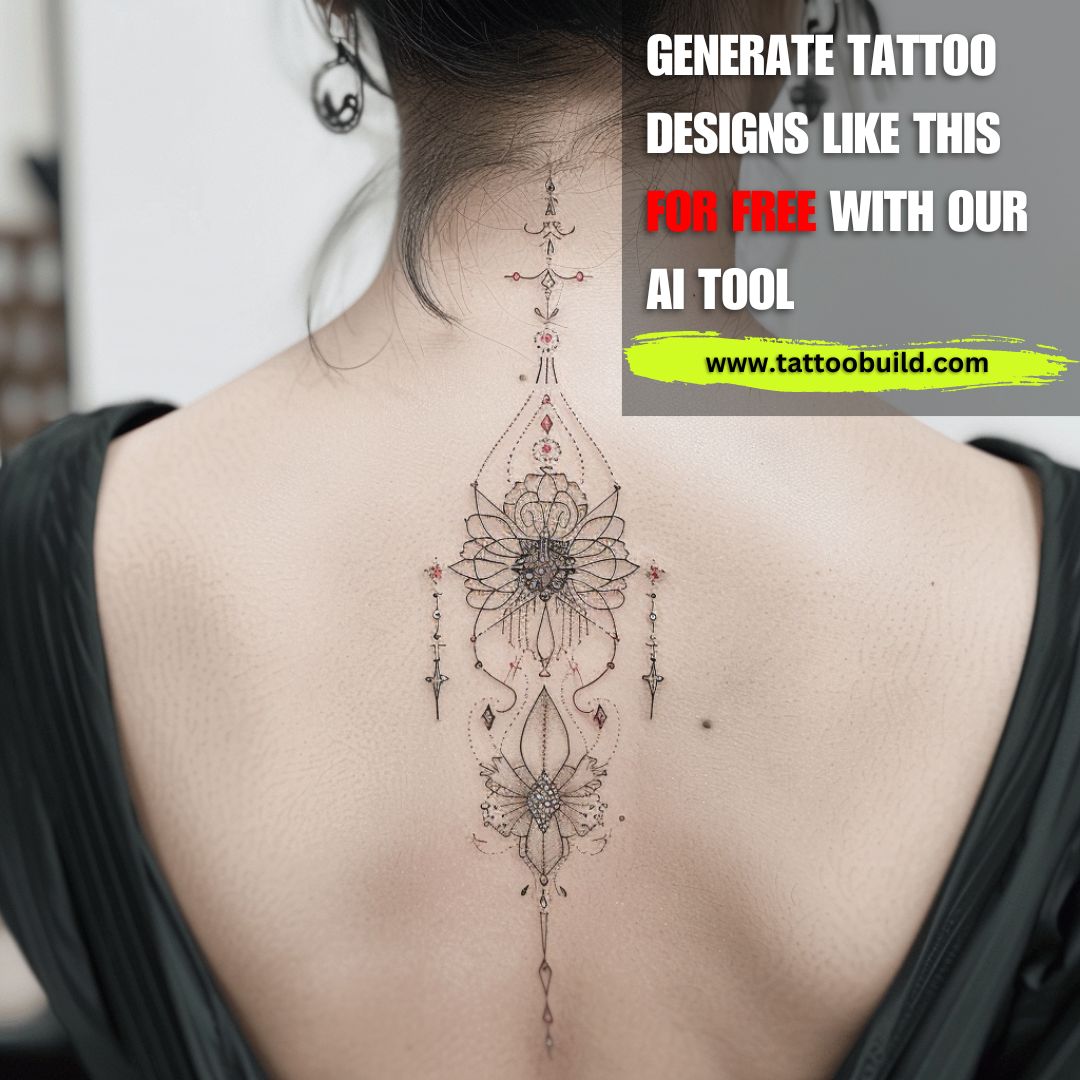
6. Ornamental Fine Line Work
Ornamental designs — flourishes, filigree, mirrored curls — are built around symmetry, which makes the spine their natural home.
The best ornamental pieces I have seen use the body’s own symmetry as the guide, mirroring each element across the centre line of the vertebrae.
These sit well on the upper back, where most necklines will still cover them if you need to. That flexibility matters more than people expect in the first year.
The trade-off is density. Ornamental work packs a lot of line into a small area, and dense linework over bone is a genuinely tough sit.
7. Delicate Script and Small Accents
Script down the spine is a classic, and it is also the design most likely to disappoint if it is done too small.
Letters that are cramped together tend to blur as the ink settles over the years. Generous spacing is the single best thing you can do for legibility.
In my experience a short word or phrase running vertically reads better than a long sentence. Long sentences force the letters smaller to fit the torso.
Small accent pieces — a few dots, a tiny symbol, a short line — are the lowest-commitment way into this placement and the fastest to heal.
8. Minimal Centred Linework
The simplest feminine spine tattoo is a single uninterrupted line or a slim repeating motif running down the centre of the back.
It sounds plain written down. In person it is the version that most consistently gets compliments, because it does exactly what the placement is good at.
Minimal work is also the easiest to build on. Leaving deliberate gaps means you can add to it in a year without redesigning anything.
If you are nervous about pain, this is where I would start. A short centred piece is often under two hours in the chair.
Alternatives and Variations Worth Considering
Not everyone wants a full centred spine piece, and there are several ways to get the same effect with less commitment.
Partial Spine Placement
Running the design from the base of the neck to the mid-back gives you most of the visual impact at roughly half the sitting time.
It also keeps the lower spine free, which some people prefer to leave open for a separate piece later.
Off-Centre and Paired Designs
Placing the design slightly to one side of the vertebrae is noticeably less painful, because you are working over muscle rather than bone.
Paired designs — mirrored elements either side of the spine — give symmetry without a single element sitting directly on the bone.
Adjacent Placements
If the spine itself feels like too much, the back of the neck carries a lot of the same elegance in a much smaller footprint, and it heals faster because you can actually reach it.
A broader back piece is the other direction to go — more room, more shading, and far less reliance on perfect symmetry. Symbolic back tattoo designs show what that looks like.
Pain, Healing and Practical Advice
The spine is a tender placement and there is no point pretending otherwise. Directly over the vertebrae is sharp; the soft tissue either side is much easier.
Eat properly before your session and bring something sugary. Lying face down for several hours with no food is how people end up lightheaded, and it is entirely avoidable.
Healing follows the same pattern as most placements — the surface usually settles within a couple of weeks, with the deeper layers taking longer. Follow whatever aftercare your artist gives you first, and use general guidance like the American Academy of Dermatology’s tattoo skin care advice as a backup, not a replacement. Our own tattoo aftercare guide walks through the day-by-day routine.
The awkward part of spine healing is reach. You cannot easily see or moisturise the middle of your own back, so line up someone who can help, or use a clean applicator.
If you notice spreading redness, increasing pain after the first few days, heat, swelling or discharge, that is a doctor’s call, not an internet call. The FDA’s tattoo safety fact sheet covers the warning signs, and this article is not medical advice. Never attempt to treat, alter or remove a tattoo yourself — see a licensed professional.
Common Mistakes and What to Do Instead
The mistake I see most often is going too small. A delicate design that looks perfect on paper can disappear on a long torso.
The second is rushing the stencil. If you feel awkward standing still for twenty minutes while your artist adjusts it, sit with the awkwardness — that is the part you live with forever.
Third is not asking about pain honestly. Some people sail through a spine piece; others need it split across sessions. Both are normal. If you are weighing up the risks of the placement itself, are spine tattoos dangerous answers the question properly.
Still not sure which direction to go? Browsing adjacent styles usually settles it — orchid spine tattoos are a good look at the softer, more botanical end of the range, and a symbolic motif is the obvious alternative if florals are not for you.
Frequently Asked Questions
How much does a feminine spine tattoo hurt?
Directly over the vertebrae it is one of the sharper placements, because there is very little padding between the needle and bone. The soft tissue either side of the spine is considerably more manageable. In my experience the pain is concentrated rather than constant — it spikes over each bony ridge and eases in between. If you are worried, start with a shorter piece on the upper spine rather than committing to a full-length design.
How long does a spine tattoo take to heal?
The surface usually settles within a couple of weeks, while the deeper layers of skin generally take longer. The awkward part is that you cannot easily reach or see the middle of your own back, so aftercare takes more planning than a forearm piece. Follow your artist’s instructions first, since they know exactly what they put into your skin. If anything looks wrong — spreading redness, heat, discharge — see a doctor rather than waiting it out.
Will a spine tattoo stop me getting an epidural?
This comes up constantly and the honest answer is that policies vary by hospital and by anaesthetist. Many will proceed normally, particularly once the tattoo is fully healed, but some are more cautious. It is not a question this article can answer for your situation. Ask your own doctor or anaesthetist well before you need to know.
Does a spine tattoo stretch if my weight changes?
The spine itself is relatively stable ground compared with places like the stomach or upper arm, so moderate weight change usually has less visible effect here. Larger changes, and pregnancy, can still shift the surrounding skin. Designs with a bit of space built into them tend to cope better than dense, tightly packed work. Your artist can advise based on the specific design you are considering.
Can I add to a spine tattoo later?
Yes, and this placement is one of the easier ones to extend — particularly vines, trailing stems and repeating motifs that have no natural endpoint. Tell your artist at the first session that you may want to extend it, so they can leave the design open at the bottom rather than closing it off. Going back to the same artist makes matching much simpler. Adding to a finished, closed design is possible but usually looks like two pieces rather than one.
Quick Summary
- Pick the style first — fine line, vine, rose, geometric, script or minimal — because it drives pain, cost and session length.
- Fine line botanicals are the safest starting point for a first spine tattoo.
- Vines and trailing stems use the full length of the spine and are the easiest style to extend later.
- Shaded rose and floral pieces make the biggest statement but often need two sessions.
- Geometric and ornamental work demands a perfect stencil — let your artist take their time with it.
- Do not go too small; delicate designs can disappear on a long torso, and cramped script blurs over time.
- Pain is concentrated over the vertebrae and much milder on the soft tissue either side.
- Arrange help with aftercare in advance, and see a doctor rather than an internet forum if healing looks wrong.