Angel tattoos are one of the few designs that work at almost any size, on almost any part of the body, and still carry the same meaning. That flexibility is why they keep showing up in artists’ books year after year.
I have sat with a lot of people choosing this design, and the conversation almost always starts the same way: someone specific is being remembered, or something specific is being asked for — protection, direction, a bit of grace.
The hard part is rarely the meaning. It is deciding whether you want a full guardian figure, a pair of angel wings, or a small cherub that reads as sweet rather than solemn.
Below are twenty designs I keep coming back to, plus the practical notes — placement, style, sizing, healing — that decide whether the piece still looks good in five years.
Which Angel Tattoo Style Is Right for You?
Style matters more than subject here. The same angel drawn in fine line and drawn in black and grey realism are two completely different commitments.
| Style | Typical Size | Sitting Time | Ages Best When | Best For |
|---|---|---|---|---|
| Black & grey realism | Forearm to full sleeve | 6–20+ hours | Kept larger than a palm | A portrait-like guardian figure |
| Fine line | 2–6 inches | 1–3 hours | Placed away from hands and feet | Delicate, discreet pieces |
| Illustrative / neo-traditional | 4–10 inches | 3–8 hours | Outlines stay bold | Colour and strong shapes |
| Geometric / linework | 3–8 inches | 2–5 hours | Lines are spaced generously | A modern, graphic look |
| Cherub / cartoon | 2–5 inches | 1–3 hours | Faces are kept simple | Warmth rather than solemnity |
| Wings only | Shoulder blade to full back | 4–15 hours | Feathers are not overcrowded | Symmetry and scale |
What Angel Tattoos Actually Mean
In Christian, Jewish and Islamic tradition angels are messengers and protectors, which is where most of the modern symbolism comes from. But plenty of people who wear them are not religious at all.
The most common reading I hear is memorial. An angel stands in for someone who has died, and the design often borrows a detail from that person — a birth flower, a date, a shape of hair.
The second most common is protection, worn as a reminder rather than a belief. A guardian figure on the shoulder or back is a quiet statement that you are being watched over, whoever you think is doing the watching.
Cherubs sit differently. They read as innocence, childhood and love, which is why they show up so often for a child, a sibling, or a relationship.
And some people simply like the shape. Wings, robes and halos give an artist a huge amount to work with, and there is no rule saying a tattoo has to mean anything at all. If you want more symbol-led options, the spiritual tattoo guide covers adjacent motifs.
20 Angel Tattoo Ideas for Women
These are grouped roughly from the boldest to the most delicate. Save two or three and bring them to your consultation — artists work far better from a direction than from a single reference they are asked to copy.
Elegant Guardian Angel Sleeve
This one covers the whole arm: golden wings, flowing robes, and enough smoky grey behind the figure to keep it from floating.
It is a serious commitment — expect multiple sessions — but sleeves like this hold up well because the artist has room to keep detail spaced out.
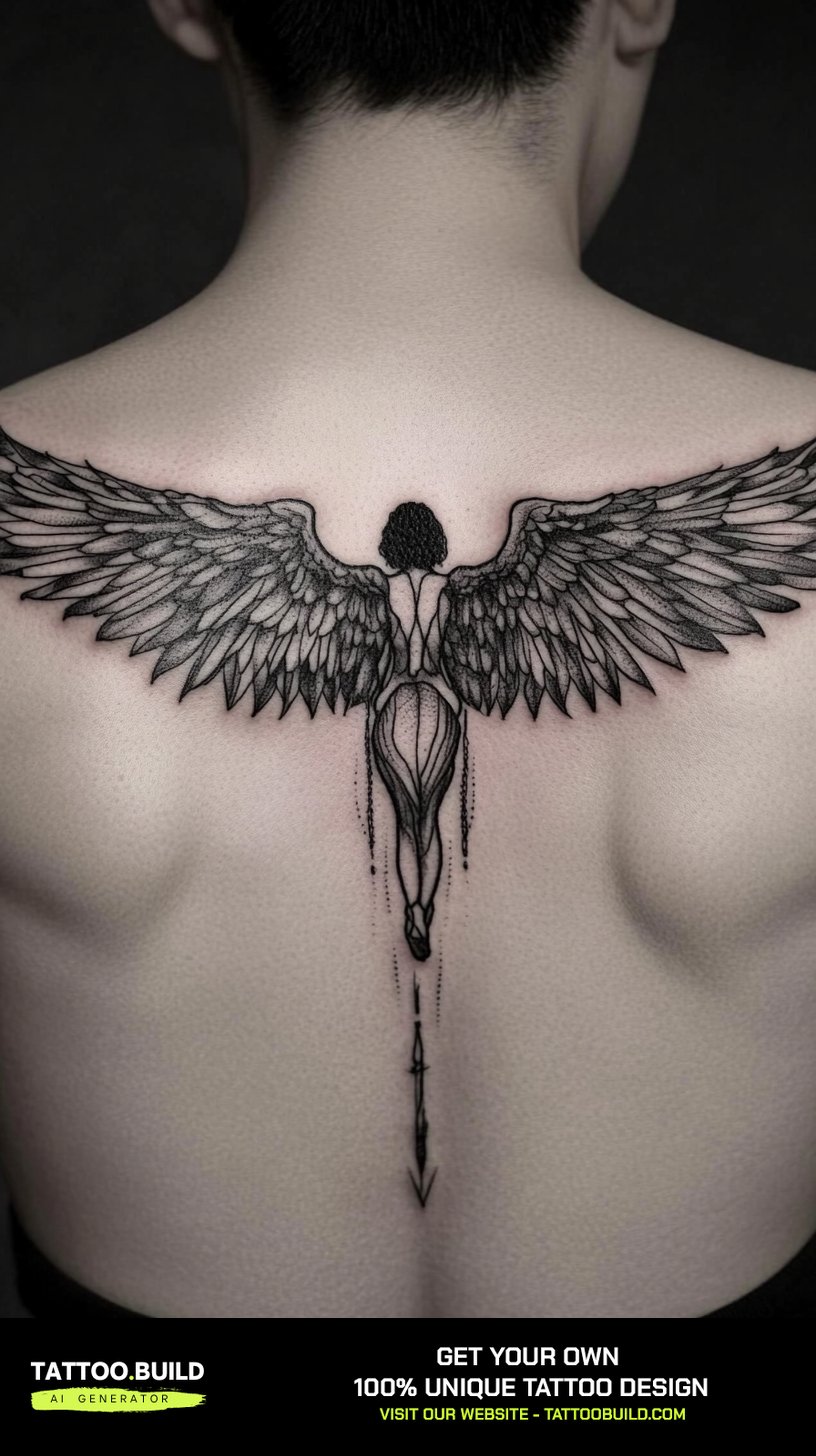
Back Angel Wings in Black Ink
A matched pair of wings across the upper back, built entirely from feather detail with no colour at all.
Symmetry is the whole job here. Ask to see the stencil on your back in a mirror before any needle touches skin, because the shoulder blades are rarely perfectly even.
Minimalist Winged Back Tattoo
The same idea stripped back to clean outlines and a suggestion of feathers.
I like this version for anyone unsure about scale. It reads clearly from a distance and takes a fraction of the sitting time of a fully rendered pair.
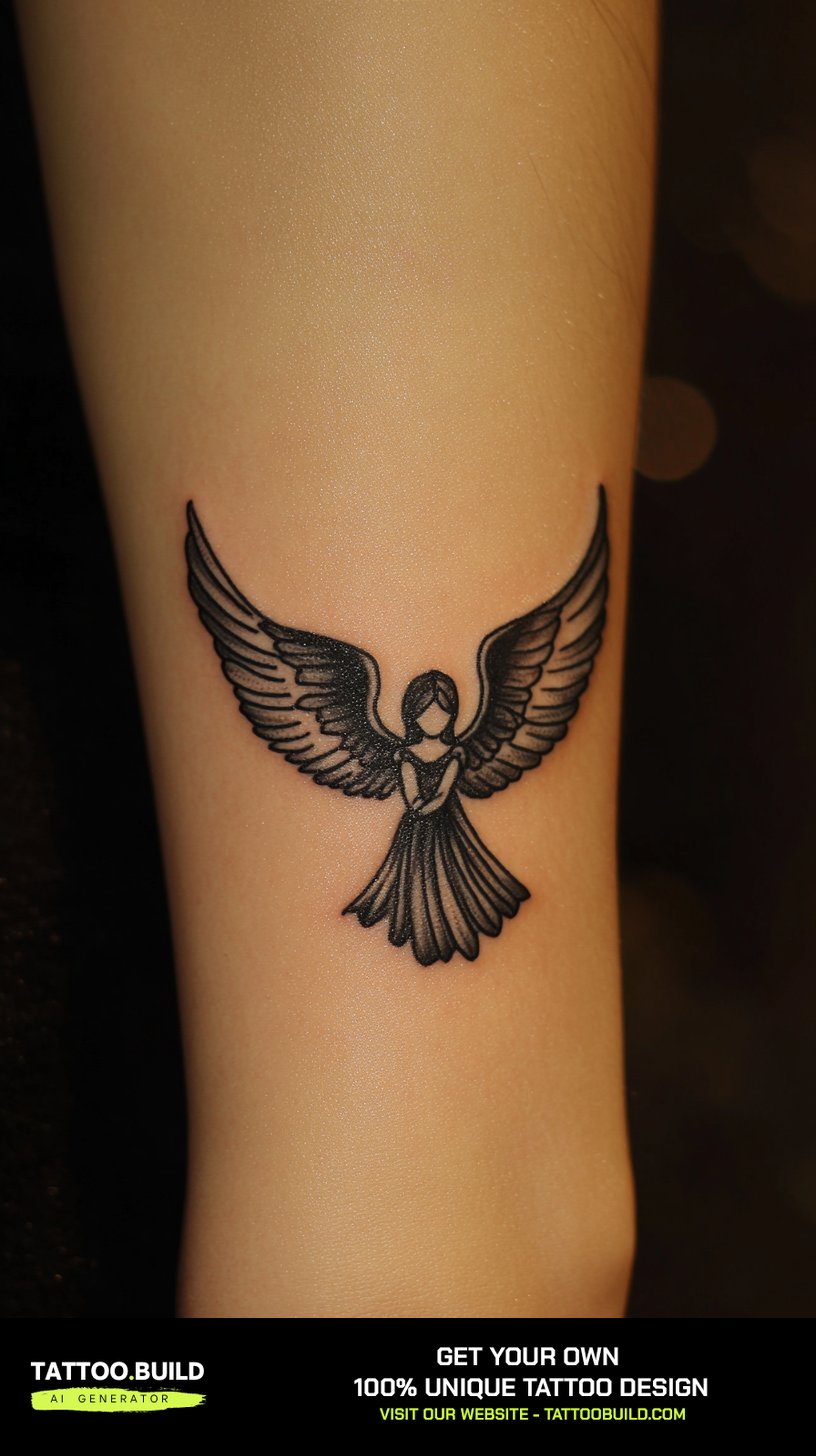
Cute Cherub Angel on Arm
A small cherub with a halo and short wings, sitting on the inner arm where the skin is smooth and easy to work.
Keep the face simple at this size. Tiny features tend to blur as a tattoo settles, so a suggested expression usually ages better than a fully rendered one.
Geometric Angel with Wings
Here the angel is built from straight lines, arcs and negative space rather than shading.
Geometric work is unforgiving — crooked lines show immediately — so this is one to book with someone whose healed linework you have actually seen.
Cherub Angel Sitting Peacefully
A seated cherub in soft black and grey, more still and thoughtful than the playful versions.
The soft shading here is what carries it. That kind of smooth grey wash needs a steady hand and holds best on the upper arm or thigh.
Graceful Angel Holding Hearts
An angel cradling hearts, which is about as direct as memorial symbolism gets.
People often add initials or a date inside one of the hearts. If you do, keep the lettering larger than you think you need — small text is the first thing to go soft.
Playful Cupid with a Bow
A cupid drawing back a bow, done in fine line so it stays light rather than cartoonish.
This is one of the few angel designs that works as a couple’s piece without feeling heavy. It also scales down well to the ankle or ribs.
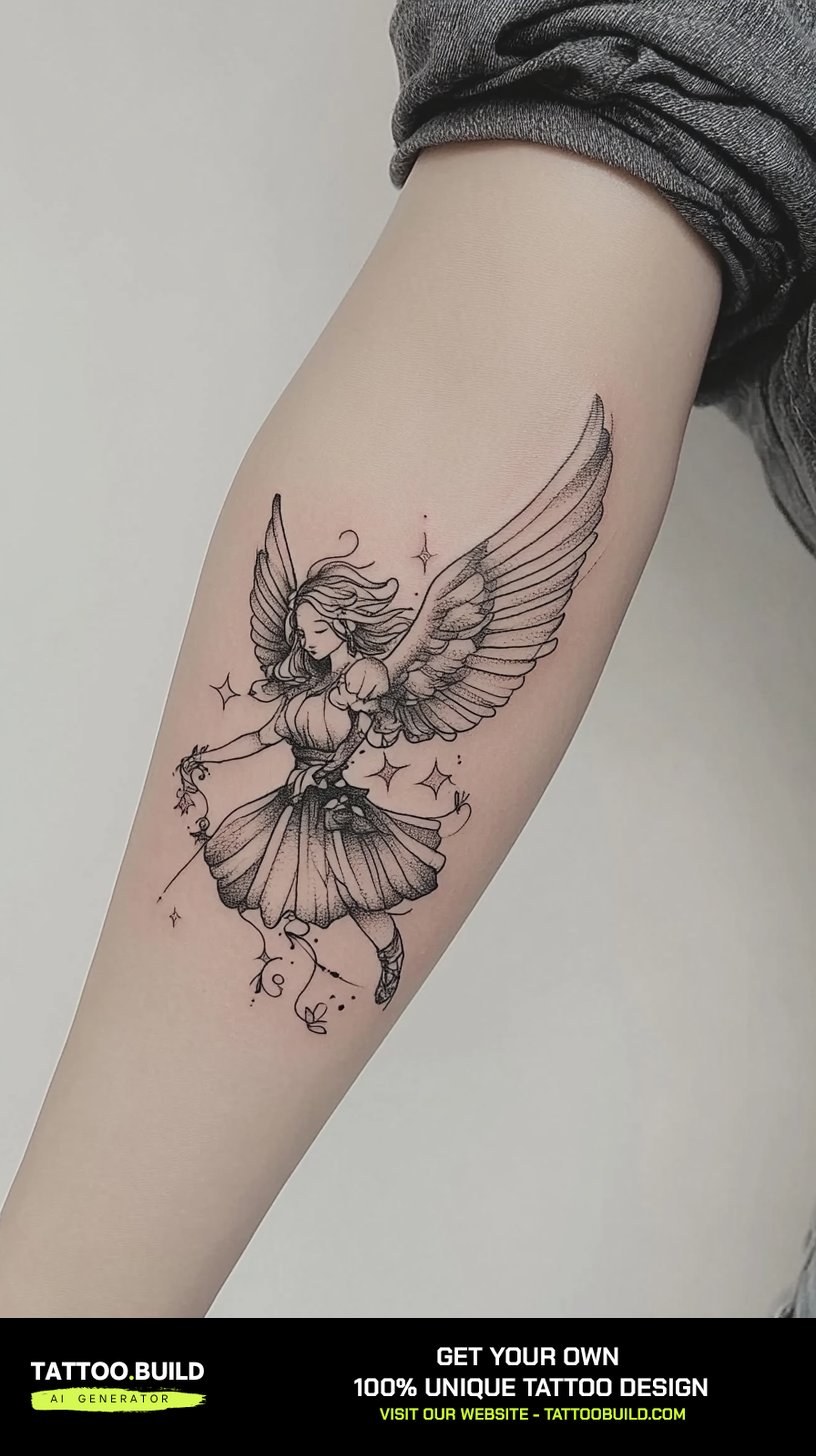
Ethereal Angel in Motion
The figure is caught mid-movement, with robes and wings trailing into soft grey.
Movement is created by leaving areas unfinished on purpose. Resist the urge to ask for more detail — the blur is the design.
Angel with a Bow on Cloud
A cherub perched on a cloud with a ribbon bow, sweeter and more decorative than most.
The cloud gives the piece a base, which stops it from looking like it is floating awkwardly on the arm. That base matters more than people expect.
Prayerful Angel with Floral Accents
A praying angel framed by loose florals, usually running down the forearm.
Adding a birth flower is the easiest way to make a standard design personal without changing the composition. Every artist I have asked prefers this to adding text.
Trio of Angels in Harmony
Three angels arranged as a single composition rather than three separate tattoos.
It is a common choice for siblings or children. Plan the spacing carefully, because adding a fourth figure later is much harder than leaving room now.
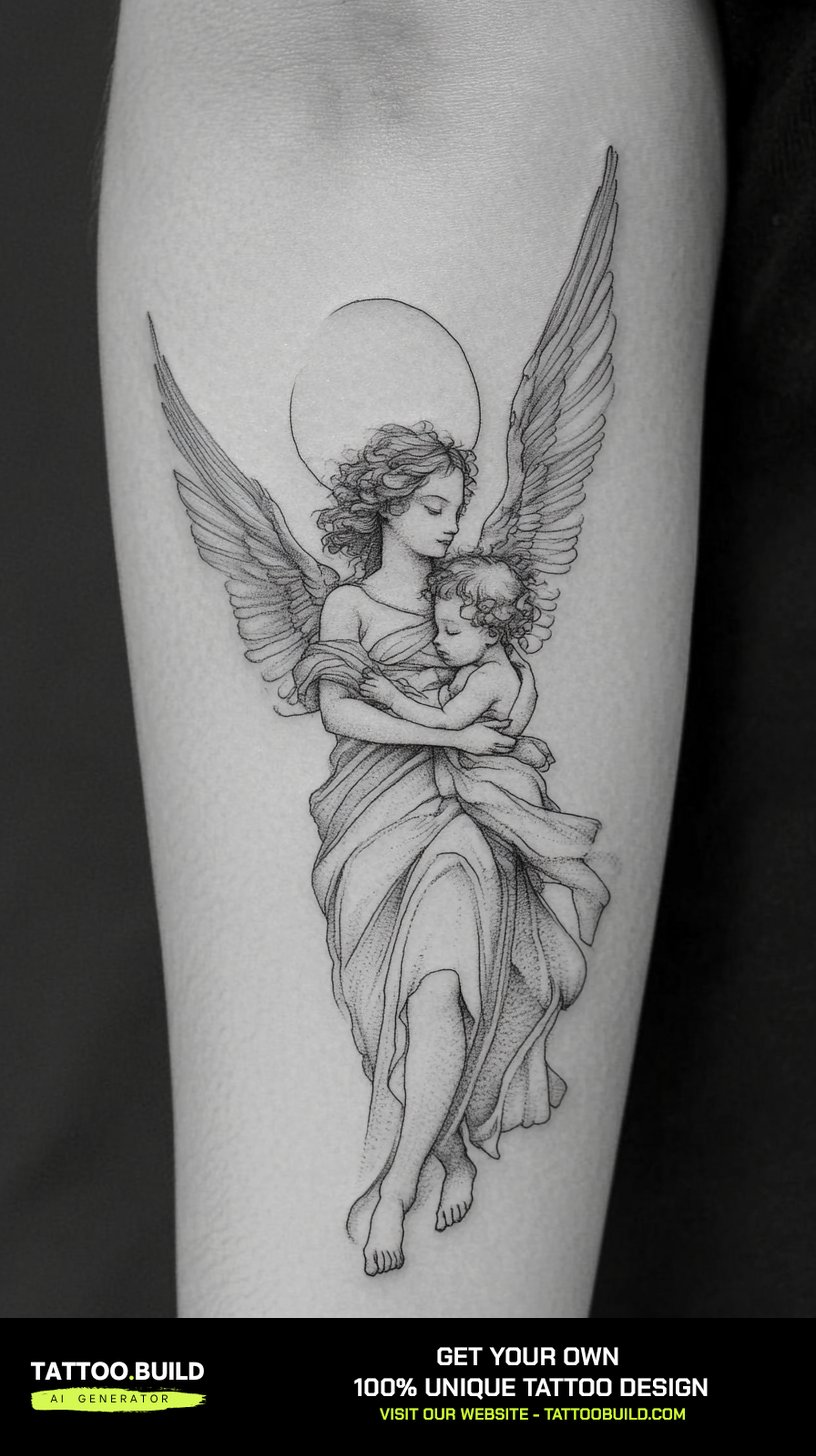
Motherly Angel Holding a Child
An angel holding a child, which is the design I see requested most often after a loss.
Faces are the hardest part of any tattoo. If you want recognisable features, go bigger — a piece like this rarely works under about six inches.
Angel with Floral Halo
A floral halo instead of the traditional ring, which softens the whole figure.
This is a good compromise if religious imagery feels too literal for you but you still want the shape and the wings.
Flowing Gown Angel on Arm
A long, draped gown wrapping around the upper arm and following its curve.
Designs that wrap need to be drawn on your arm, not on paper. Ask for a freehand stencil so the fabric folds actually follow your shape.
Haloed Angel with Bold Details
Heavier outlines and stronger contrast, closer to a traditional tattoo than a delicate one.
Bold is the safest bet for longevity. In my experience these are the pieces that still read clearly after a decade with the least touching up.
Angel Embracing a Child
A quieter version of the mother-and-child idea, rendered almost entirely in grey wash.
Grey wash needs sun protection more than most work. Once healed, sunscreen on this piece is the single best thing you can do for it.
Graceful Angel with Flowers
An angel surrounded by loose florals that break up the outline and fill the space.
Florals are also useful later — they are the natural place to extend into if you ever want to grow this into a half sleeve.
Floating Angel with Floral Accents
Lighter than the previous design, with scattered flowers and very little heavy shading.
Light pieces suit the inner forearm and calf well. Just be aware that delicate shading fades faster than solid line and may need a refresh sooner.
Angel with Floral Base
The flowers sit underneath and frame the figure rather than surrounding it.
That framing gives the tattoo a clear top and bottom, which makes placement decisions much simpler than with a free-floating figure.
Variations Worth Considering
If none of the twenty above is quite right, these are the directions people usually move in next.
Wings Without a Figure
Dropping the angel and keeping only the wings is the most popular variation by a wide margin. It is cleaner, more symmetrical, and far less likely to look dated.
It also scales in both directions — a pair of wings can sit behind the ear or cover an entire back. There are more of these in the full back tattoo guide.
Angel and Devil Pairings
Two figures, usually on opposing limbs or shoulders, representing the pull in both directions. It is a design that needs both halves committed to at once.
Half-finished pairings look unfinished rather than deliberate. There is a fuller breakdown in the angel and devil ideas guide.
Angels With Religious Symbols
A cross, rosary or scripture reference alongside the figure makes the meaning explicit rather than implied.
Lettering is the risk. Keep it larger and simpler than feels necessary, and see the cross tattoo guide for how these combine.
Fine Line and Micro Angels
At two or three inches an angel becomes a suggestion rather than a portrait, which suits the wrist, ankle and behind the ear.
These need honest expectations — fine line work generally needs refreshing sooner than bold work, as covered in the fine line tattoo guide.
Where to Place an Angel Tattoo
Placement changes the design more than most people expect, because the body’s shape decides what the composition can do.
The upper back and shoulder blade are the most forgiving spots for a full figure or a pair of wings — flat, wide, and away from the areas that stretch and crease most. The shoulder blade guide has more on sizing there.
The forearm suits vertical compositions: a standing angel, a praying figure, a wing running with the arm rather than across it.
Ribs and spine give you the most dramatic placement and the most pain. In my experience they are also the spots people most often underestimate for sitting time.
Thigh is the underrated one — plenty of flat area, easy to cover, and generally more comfortable to sit through than the ribs. If pain is a deciding factor, the tattoo pain chart is worth reading first.
Getting It Right: Practical Advice
Book a consultation before you book the tattoo. Bringing three references and a clear placement is worth more than a perfect single image, because it tells the artist what you actually like about the design.
Go bigger than your first instinct. Almost every regret I hear about detailed work — faces especially — traces back to a piece being cramped into too small a space.
Aftercare is straightforward and non-negotiable: keep it clean, keep it moisturised lightly, keep it out of the sun, and follow whatever your artist tells you over anything you read online, including this. The healing stages guide sets out what normal looks like week by week.
Watch for the things that are not normal. Spreading redness, increasing pain after day three, pus, or a fever mean you should contact a doctor rather than wait it out — the American Academy of Dermatology sets out the warning signs, and the US FDA covers ink safety and reactions. Nothing here is medical advice.
Common Mistakes and How to Avoid Them
Copying another person’s tattoo exactly. Most good artists will decline, and the ones who agree are rarely the ones you want.
Adding a face at a size that cannot hold one. This is the single most common cause of a piece needing rework.
Skipping the mirror check on back pieces. Once the stencil is on, take the time to look properly from both sides.
Choosing an artist by price rather than by healed work. Ask to see healed photos, not fresh ones — fresh tattoos all look good.
Still not sure of the direction? Browsing adjacent styles helps: the memorial tattoo guide covers remembrance pieces more broadly.
Frequently Asked Questions
Do angel tattoos have to be religious?
No. Plenty of people choose them purely for the imagery or as a memorial with no religious element at all. The symbolism comes from Abrahamic tradition, but wearing one carries no requirement to share that tradition. In my experience the split between religious and non-religious wearers is fairly even.
How much does an angel tattoo cost?
It depends almost entirely on size, detail and your artist’s hourly rate, which varies enormously by city and reputation. A small fine line cherub is usually a single short session; a detailed guardian angel sleeve can run to many sessions across months. Ask for a full estimate at consultation rather than a per-hour figure alone. Most studios also take a deposit that comes off the final total.
Which placement hurts least for an angel tattoo?
Generally the outer arm, outer thigh and calf are the more comfortable areas, because there is more muscle and fat between needle and bone. Ribs, spine, sternum and the tops of the feet are typically the hardest. Pain tolerance is very individual, so treat any chart as a rough guide rather than a promise.
Will a fine line angel tattoo fade quickly?
Fine line work generally needs refreshing sooner than bold traditional work, because thinner lines carry less ink and spread as skin ages. That does not make it a bad choice — it just means budgeting for a touch-up in a few years. Sun protection makes the biggest difference to how long it holds.
Can an angel tattoo be added to later?
Usually yes, and it is worth planning for. Designs with florals, clouds or open space around the figure extend into a half or full sleeve much more easily than a tightly framed piece. Tell your artist at the first session if you think you might expand it, so they can leave the composition open.
Quick Summary
- Angel tattoos read as protection, memorial or grace — and work for religious and non-religious wearers alike.
- Style matters more than subject: realism, fine line, illustrative, geometric and cherub are five very different commitments.
- Wings alone are the most popular variation, and the easiest to scale up or down.
- Upper back, shoulder blade, forearm and thigh are the most forgiving placements; ribs and spine hurt most.
- Go larger than your instinct, especially for anything with a face.
- Bold outlines age better than delicate shading; fine line work will likely need a touch-up sooner.
- Sun protection is the single most effective thing you can do for a healed grey-wash piece.
- Judge an artist by healed photos, not fresh ones — and see a doctor, not the internet, if healing goes wrong.