A praying hands tattoo is one of the few designs that still stops me mid-scroll, and after years of collecting reference for clients and for my own arm, I think I finally know why. Praying hands work because they carry meaning even when nobody knows your story — the gesture reads as faith, gratitude, grief or resolve without a single word of lettering.
I have watched this design outlive at least three tattoo trends. Fine line came and went, blackout sleeves came and went, and the clasped hands are still on the wall of every shop I walk into.
What has changed is how many ways there are to build it. The praying hands are now a base that artists stack with rosaries, clocks, crowns, roses and script, which is exactly why a lot of people freeze before booking.
This guide walks through the versions I keep seeing hold up over time, what each one actually costs you in skin and sitting time, and where each design belongs on the body. If you are still deciding on the wider theme, my roundup of Christian tattoo ideas is a good place to browse first.
Which Praying Hands Style Is Right for You?
The style decision matters more than the add-ons. It sets how the piece ages, how long you sit, and how much of your budget goes to one panel of skin.
| Style | Best placement | Typical sitting | How it ages |
|---|---|---|---|
| Black and grey realism | Forearm, outer bicep, chest | One to three sessions of 3–4 hours | Softens gradually; mid-greys are the first to fade |
| American traditional | Outer forearm, calf, upper arm | Usually a single 2–3 hour sitting | The most forgiving — bold lines stay legible for decades |
| Fine line | Inner forearm, ribs, ankle | 1–2 hours for a palm-sized piece | Lines thicken and can blur; expect a touch-up in a few years |
| Chicano / lettering hybrid | Chest, forearm panel, hand | Two or more sessions once script is added | Holds well when the script is kept large enough to breathe |
| Neo-traditional with colour | Thigh, upper arm, shoulder | Three-plus hours, colour packed last | Bold outlines survive; lighter colours need refreshing |
Why the Praying Hands Design Endures
The image is older than tattooing as we know it. Albrecht Dürer drew his famous study of clasped hands, Betende Hände, around 1508, and the original brush drawing is held by the Albertina in Vienna.
That drawing is still the reference sheet half the artists I know work from, whether or not they can name it. The pose already solves the hardest compositional problem: it has a natural top, a natural base, and a vertical line that fits an arm perfectly.
There is also a practical reason it survives. Hands are all mid-tone and shadow, which means a skilled artist can render them entirely in grey wash without needing colour to carry the piece.
And the meaning is flexible in a way most religious imagery is not. I have tattooed the same layout for a man marking his sobriety date and for a woman remembering her grandmother, and neither read as a statement about doctrine.
If the faith angle is the whole point for you rather than the picture, browse faith tattoo ideas alongside this page before you commit to a layout.
Praying Hands Tattoo Ideas That Hold Up Over Time
Every idea below is a variation on the same core, ordered roughly by how often I see it walk out of a shop looking good five years later.
1. Classic Black-and-Grey Praying Hands
This is the version I recommend to anyone getting their first religious piece. Two hands, realistic shading, no accessories competing for attention.
The whole design lives or dies on the knuckles and the gap between the palms. When I have seen these go wrong, it is almost always because the artist rushed the shadow under the fingers and the hands read flat.
Ask to see healed photos, not fresh ones. Fresh grey wash always looks richer than it will in six months, and healed work is the only honest preview of the contrast you are buying.
Size it at roughly palm-length or bigger. Below about four inches the fingers start merging into one shape as the ink settles, which is the single most common regret I hear about small realism.
2. Praying Hands With a Rosary
The rosary is the most requested addition, and for good reason — it gives the design a tail that can flow down the forearm and fill space the hands alone cannot.
The beads also solve a layout problem. A pair of hands on their own can float awkwardly; a draped chain anchors them and gives your eye somewhere to travel.
One thing I always flag to clients: beads need spacing. When they are crowded, they blur into a rope within a couple of years, which is a slow and unsatisfying way to lose detail.
Ask for the crucifix to sit somewhere it will not be cropped by a sleeve or a watch strap. I have seen more than one rosary tattoo where the cross lands exactly under a cuff.
3. Praying Hands With a Cross
Putting a cross behind the hands is the most direct way to make the piece unambiguously Christian. It is also the easiest variation to overload.
My honest preference is a cross that is either much larger than the hands or much smaller — never almost the same size. Two elements of equal weight fight each other and the eye does not know where to land.
A large cross behind the hands works especially well vertically on a forearm or down the centre of a chest piece, where the upright already matches the shape of the body.
Keep the crossbar clear of the fingertips so the silhouette still reads at arm’s length. If you want to look at cross layouts on their own first, there is a full set of cross tattoo drawings to work from.
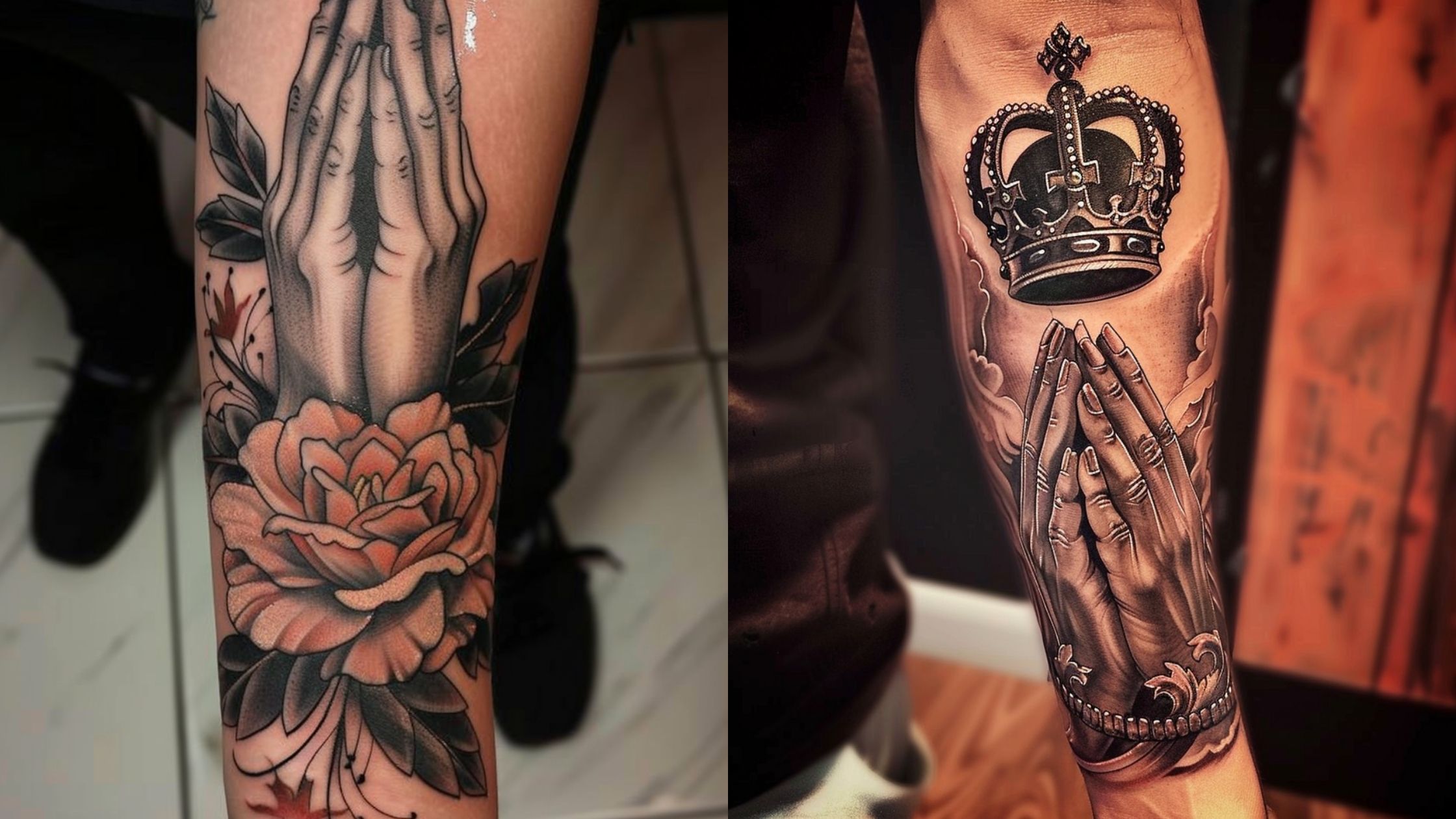
4. Praying Hands With Flowers
Flowers soften the piece without diluting the meaning, and they are the variation I most often suggest when someone wants the design to feel commemorative rather than devotional.
Roses are the default because they shade in the same greyscale language as skin and knuckles. Lilies and chrysanthemums both work too, and lilies in particular carry funeral associations that suit a memorial piece.
The trap here is density. When I have seen floral praying hands go muddy, it is because petals were wrapped tight around the fingers with no negative space left between them.
Leave a clean gap of bare skin between the flowers and the hands. If you want to compare bloom shapes before deciding, our rose tattoo ideas gallery shows how differently each style handles petals.
5. Praying Hands With a Heart
The sacred heart pairing is common in Catholic and Chicano work, and it is one of the few additions that genuinely changes what the tattoo says rather than just decorating it.
Hands plus heart reads as love and intercession — praying for someone rather than simply praying. Most of the clients I have done this for were marking a person, not a belief.
Composition-wise, the heart sits best either cradled in the palms or floating directly above the fingertips. Tucked off to one side it tends to look like an afterthought.
A small banner under the hands is the safest place for a name or a date — it keeps the lettering out of the shading and makes future additions easier.
6. Praying Hands With a Clock
Clocks and pocket watches turn the piece into something about time — a birth, a loss, a date somebody stopped drinking. It is the most personal variation on this list.
The hands of the clock are usually set to a meaningful hour, and I always ask clients to confirm that detail twice before the stencil goes on. It is the one element that cannot be quietly adjusted later.
Roman numerals hold up better than fine Arabic numbers at small sizes. Below roughly two inches of clock face, most numerals turn into marks rather than digits within a few years.
Give the clock its own visual weight below or behind the wrists rather than overlapping the fingers. If you want to see how the motif works on its own, the clock tattoo ideas collection covers face styles in detail.
7. Praying Hands With a Crown
A crown above the hands adds a note of reverence and, in a lot of the work I have seen, a note of survival — it tends to appear on people who came through something.
Crowns are deceptively hard to draw. The points have to be symmetrical from the viewing angle you will actually see the tattoo from, which is rarely straight on.
I ask artists to draw the crown on the stencil with my arm hanging naturally, not flat on a table. A crown that is level on a workbench can sit crooked once the arm is at your side.
Simple beats ornate here. A three-point crown with clean shading outlasts a jewelled one, and the minimal crown tattoo approach shows why that restraint works.
Variations Worth Considering Before You Book
If none of the standard combinations feel like yours, these are the directions I most often end up steering people toward.
The Dürer Study, Reproduced Faithfully
Some artists will reproduce the Dürer drawing almost line for line, including the sleeve cuffs at the wrists. It is a quieter, more art-historical choice and it looks excellent in fine grey wash.
Hands With Script Instead of Objects
Swapping the rosary or crown for a line of scripture keeps the composition clean. Keep the passage short — anything past about eight words needs its own panel of skin.
Hands Releasing a Dove
Open palms releasing a bird reads as letting go rather than asking for something. I have done this twice for people processing a loss, and both times it fit better than a straight prayer pose.
Minimal Outline Only
A single-weight outline with no shading is the cheapest and fastest version, and it suits an inner forearm or ankle. Be realistic that it will need a touch-up sooner than a shaded piece.
Child’s Hands or Two Sets of Hands
Smaller, softer hands change the emotional register completely. Bring a real reference photo if you want a specific person’s hands — artists cannot invent that convincingly.
Placement, Pain and Aftercare
The outer forearm is where I send most first-timers. It sits flat, it takes shading cleanly, and it is one of the more tolerable spots to sit through a long session — a fuller breakdown lives in our forearm tattoo ideas guide.
Ribs, sternum and the inside of the bicep are all noticeably harder sits. If this is your first large piece, being honest with your artist about that changes how they break the session up.
Follow the aftercare your artist gives you rather than anything you read online, including this page. They know their ink, their machine and your skin, and their instructions override generic advice.
Broadly, that means keeping the area clean, avoiding submerging it, keeping it out of direct sun while it heals, and resisting the urge to pick at flaking skin. Sun exposure is what fades grey wash fastest, so sunscreen on a healed piece is genuinely worth the habit.
If you develop spreading redness, swelling that worsens after the first few days, pus, or a fever, stop treating it yourself and see a doctor. Tattoo infections and ink allergies are real and treatable, and the American Academy of Dermatology has plain-language guidance on what warrants medical attention. Nothing in this article is medical advice.
Common Mistakes — and What to Do Instead
The first mistake is going too small. Praying hands contain a lot of internal detail, and shrinking them is the fastest way to end up with a grey blob in a decade.
The second is stacking add-ons. Rosary plus cross plus clock plus banner is four focal points, and in my experience the piece stops reading as anything at conversation distance.
The third is choosing an artist by price rather than portfolio. Realistic hands are a specialist skill, and a cheap session with someone who mostly does bold traditional will cost far more to fix than it saved.
Ask specifically for healed black-and-grey portraits or hands in the artist’s portfolio — not a general gallery. If they do not have any, they are probably not the right person for this design.
Still Not Sure?
If the religious reading feels too specific, look at broader spiritual tattoo ideas that carry a similar weight without the doctrine.
If the piece is really about a person you lost, our memorial tattoo ideas cover layouts built specifically for names, dates and portraits.
And if you want figurative religious imagery rather than a gesture, the Jesus tattoo ideas collection is the natural next stop.
Frequently Asked Questions
What does a praying hands tattoo mean?
Most commonly it represents faith, devotion and gratitude, and it has strong roots in Christian imagery. It is also used widely as a memorial symbol for a person who has died, and as a marker of surviving something difficult. The meaning is genuinely personal, and the same design can carry very different weight for two people wearing it. Adding elements like a rosary, a clock or a name usually narrows what it says.
How big should a praying hands tattoo be?
For a shaded, realistic version I would not go below roughly the length of your own palm. Smaller than that and the fingers, knuckles and the gap between the hands start merging as the ink spreads over the years. A simple outline-only design can go smaller because there is less internal detail to lose. Your artist will tell you the minimum size their linework holds at, and it is worth taking that seriously.
How long does a praying hands tattoo take?
A clean outline version can be done in an hour or two. A detailed black-and-grey forearm piece with a rosary or clock usually runs three to four hours, and larger chest or sleeve compositions are often split across two or more sessions. Time varies a lot by artist and by how much of the surrounding space you are filling. Ask for an estimate at the consultation rather than on the day.
Do praying hands tattoos have to be religious?
No. Plenty of people wear the design as a symbol of gratitude, remembrance or resilience without attaching it to a specific faith. If you want to move it further from religious reading, dropping the rosary and cross and pairing the hands with flowers, a clock or script does most of that work. Others deliberately keep the religious symbols because that is the whole point. Both are common.
Where do praying hands tattoos look best?
The outer forearm is the most popular placement because the vertical shape of the design matches the limb almost perfectly. The outer bicep, the centre of the chest and the calf all work well for the same reason. Ribs and inner arm suit the design visually but are harder sits. Curved, high-movement areas like the elbow or the side of the hand are the ones I would think hardest about.
Quick Summary
- Praying hands work because the gesture reads clearly on its own, before any add-ons.
- Pick the style first — black and grey realism, traditional, fine line or neo-traditional — then the elements.
- Go palm-length or larger for shaded realism; the fingers are the first detail to disappear.
- A rosary adds flow, a cross adds clarity, a clock makes it personal, a crown adds weight — pick one, not four.
- Leave negative space around flowers and beads so the piece does not go muddy as it ages.
- The outer forearm is the safest first placement; ribs and inner arm are considerably harder sits.
- Choose the artist on healed black-and-grey work, not on price or fresh photos.
- Follow your artist’s aftercare, keep it out of the sun, and see a doctor if healing goes wrong.